The problem usually isn't your content or your effort. It's that you don't have a system connecting all of it. A sales funnel is that system — the structured path that moves a stranger from their first interaction with your brand all the way to buying, and then buying again, without you manually chasing every lead.
This guide breaks down exactly what a high-converting sales funnel looks like in 2026, the five stages every effective funnel moves through, the most common reasons funnels stall, and how to build and optimize one for your specific business.
Key Takeaways
- A sales funnel is the automated path that moves someone from discovering your business to becoming a paying customer, no manual follow-up required at every step
- Every effective funnel has five core stages: Awareness, Interest, Decision, Action, and Retention
- Most women entrepreneurs have the effort — what's missing is a connected system that actually converts
- Generic templates rarely convert; your funnel needs to be built around your specific product/service and audience
- Optimization, not just the initial build, is what creates consistent monthly revenue
What Is a Sales Funnel (and Why It Matters for Women Entrepreneurs in 2026)
A sales funnel is a structured path that moves a stranger — someone who found you through a social post, a referral, an ad, or a search — through deliberate steps until they become a paying customer. Ideally, a repeat one.
Without a funnel, every sale depends on timing, manual effort, and luck. With one, the system works whether you're actively selling or not. Most women in social selling and coaching are working hard at awareness — but without a capture system attached to it, that effort doesn't compound.
Social Media Presence vs. A Functioning Funnel
Here's the distinction that changes everything: a website answers "who are you?" A funnel answers "what should I do next?"
Your Instagram account is rented land. The algorithm decides who sees your content, and that can shift overnight. Your email list is owned land — you control who sees what, and when. Email conversion rates run 10–40x higher than social media alone, which is why list-building isn't optional if you're serious about consistent revenue.
For women in social selling, coaching, e-commerce, and direct sales specifically, this gap is where most revenue is lost. You can have 10,000 followers and a gorgeous Instagram grid. Without a funnel converting that audience into leads and buyers, you're doing awareness work without a capture system attached to it.
Women owned 14.2 million U.S. businesses in 2023, generating $2.8 trillion in receipts — and the vast majority are still relying on manual outreach to drive revenue. A funnel replaces that manual effort with a system that qualifies, nurtures, and converts — without requiring you to be online every hour to make it happen.
The 5 Stages of a High-Converting Sales Funnel
Stage 1 — Awareness (Top of Funnel)
This is where your ideal customer first discovers you — through organic content, paid ads, referrals, or search. The goal here is simply to attract and create curiosity, not to sell.
Your messaging at this stage should speak directly to a pain point or desire your audience already has. Think: "I don't know what to post" or "I need to make more consistent income online." Meet them where they are.
Stage 2 — Interest (Middle of Funnel)
Once someone is aware of you, the funnel must give them a reason to stay engaged. This is where a lead magnet comes in: a free guide, a checklist, a webinar registration, or a content resource that positions you as the go-to solution.
This stage is where most women entrepreneurs lose leads. No clear next step means warm followers scroll on and forget.
The most effective lead magnets for social sellers and coaches are:
- Specific, actionable downloadable guides (not vague "free tips")
- Resource lists that remove a perceived barrier ("no matter how many followers you have")
- Content idea banks that solve the exact problem your audience faces daily
- Free trainings or webinars for higher-ticket offers
Automated email flows generate nearly 41% of total email revenue from just 5.3% of send volume, according to Klaviyo's 2026 benchmarks across 183,000+ brands. Capturing that email address is what makes automation possible.
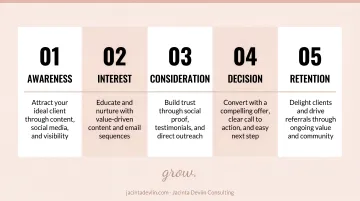
Stage 3 — Decision (Middle-to-Bottom of Funnel)
Your prospect is now actively considering whether to buy from you. The funnel must deliver:
- Social proof (testimonials, client transformations, documented results)
- Clear product/service details and outcomes
- Answers to the objections they haven't voiced yet
For coaches and consultants, a discovery call is often the decision-stage trigger. Jacinta's own Business Growth Program uses exactly this model : every prospective client books a free 15-minute growth chat before any program is recommended. By the time someone gets on that call, the nurture sequence has already done the education and trust-building work.
Stage 4 — Action (Bottom of Funnel)
The action stage is your conversion moment: the purchase, the booking, the sign-up. Friction here is one of the top reasons sales are lost.
A frictionless action stage includes:
- One clear call to action (not three)
- A simple checkout or booking process
- Immediate confirmation so the buyer feels confident in their decision
Stage 5 — Retention and Advocacy
A great funnel doesn't end at the sale. Consistent $10K+ months are built right here.
Post-purchase sequences — onboarding emails, loyalty campaigns, referral invitations, upsell and cross-sell flows — turn one-time buyers into repeat customers. Repeat buyers cost far less to convert than cold leads, and they're your highest-margin segment.
Jacinta's team builds this infrastructure into every done-for-you engagement: post-purchase sequences, abandoned cart automation (especially critical for boutique owners on Shopify), and referral program flows that turn satisfied customers into active brand advocates.
Why Most Women Entrepreneurs Struggle to Build Funnels That Actually Work
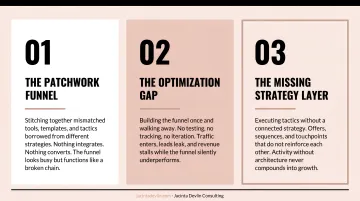
The Patchwork Problem
Many entrepreneurs piece together a landing page here, an email tool there, and a checkout link somewhere else — without a strategy connecting each piece. Leads fall through the gaps between tools, and the funnel never performs consistently.
Jacinta's coaching materials call this out directly: watching 20 YouTube clips and downloading 50 free courses isn't going to help you launch or grow your business. Without a connected strategy, tactics stay tactics — and revenue stays unpredictable.
The Template Trap
A Squarespace template that 50,000 other businesses use is not differentiating you — and the same is true for funnel templates. Generic frameworks built for someone else's audience, product/service, and business model require significant customization to convert.
Your messaging, product/service structure, and funnel steps need to match how your specific audience makes buying decisions. Without that alignment, even a well-structured funnel will stall — and you'll have no clear reason why.
The Optimization Gap
Building the funnel is only half the work.
Only 45% of small businesses actively perform A/B testing, despite 98% recognizing that landing page optimization matters. Most funnel advice stops at launch.
Without tracking where leads drop off and making targeted adjustments, even a well-built funnel plateaus. This is where many women entrepreneurs get stuck and assume funnels "just don't work for me." Typically, one stage is underperforming — and fixing it changes everything.
The three problems follow a pattern worth naming:
- Patchwork build: Tools without strategy create gaps leads fall through
- Template dependency: Generic frameworks don't convert for your specific audience
- No post-launch optimization: Without testing and adjustments, funnels plateau instead of grow
How to Build a Sales Funnel Step by Step in 2026
Clarify Your Offer and Your Ideal Customer First
No funnel performs well without a crystal-clear product/service and a specific audience. Before building any pages or automations, define:
- Exactly who you're speaking to
- What problem you solve for them
- What outcome they receive
If you can't articulate your product/service in one sentence, your prospect can't either — and they won't buy.
Map the Customer Journey Before You Build
Sketch the full path on paper first:
- Entry point: How does someone discover you?
- Lead capture: What free resource do they opt into?
- Nurture sequence: How do you build trust and address objections?
- When and how is the sale made?
- What's the one clear CTA?
- What happens immediately after they buy?
Mapping this prevents gaps and ensures each step logically leads to the next. Skip it, and you'll end up patching problems mid-build instead of launching clean.
Build Your Lead Capture Entry Point
The top of your funnel needs a mechanism to capture contact information. For social sellers and influencers, social media content feeds directly into this step — but the capture mechanism converts traffic into leads you actually own.
Effective formats for social sellers, coaches, and direct sales reps include:
- Downloadable PDF guides and checklists (fast to consume, easy to deliver)
- Free video trainings for higher-ticket offers
- Facebook Group entry for community-driven businesses
- Webinar or challenge registrations for engagement-based launches
The lead magnet must be specific enough to attract the right person, not just anyone.
Set Up Your Nurture Sequence
A nurture email sequence bridges the gap between someone opting in and being ready to buy. This sequence should:
- Build trust through your story and expertise
- Share proof (client results, transformations, documented outcomes)
- Address objections before prospects voice them
- Create desire without feeling like a pitch
Automation is what makes this scalable. Platforms like Flodesk, Klaviyo, Kit, and MailerLite handle delivery automatically — once built, your sequence runs whether you're working or not.
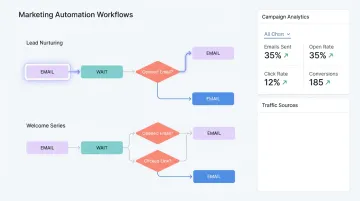
The strategic part is knowing what to write and in what order. Jacinta Devlin Consulting's done-for-you funnel builds include full email sequence architecture, built around your specific business model and audience — not copied from a framework that worked for someone else's product/service.
Create a Clear Conversion Path and Follow-Up
Structure the bottom of your funnel with:
- A sales or product/service page with a strong headline, clear benefits, social proof, and one call to action
- A simple checkout or booking process with minimal steps
- An immediate confirmation and onboarding sequence that reduces buyer's remorse and initiates retention
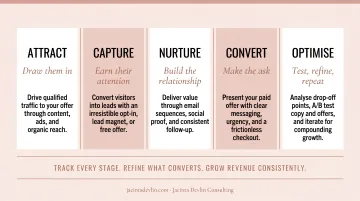
How to Optimize Your Sales Funnel for Consistent Revenue Growth
Track Where Leads Are Dropping Off
At minimum, track:
- How many people enter the funnel
- How many complete the lead capture step
- How many open and click nurture emails
- How many convert to buyers
Most entrepreneurs skip this and end up rebuilding the entire funnel repeatedly, instead of fixing the one stage that's underperforming.
Test One Thing at a Time
Change one element — headline, CTA, email subject line, product/service framing — and measure the impact before changing anything else. The most common mistake is overhauling an entire funnel when one small tweak at the decision stage often lifts conversion rates more than a full rebuild.
Strengthen the Weakest Stage First
Find the stage with the biggest drop-off and fix that before anything else. If 80% of leads open your first email but fewer than 5% click through to the product/service page, the problem is likely the product/service presentation or email copy — not the landing page. Fix that one weak link, then move on.
Use Customer Feedback to Refine Messaging
The best optimization data comes directly from your customers:
- What words did they use when they decided to buy?
- What hesitation almost stopped them?
- What finally convinced them?
Gather this through post-purchase surveys or quick conversations. Then use those exact words to strengthen your funnel copy — especially at the decision and action stages. Your buyers have already written your best copy. You just need to collect it.
What to Look for in Sales Funnel Creation Services
The difference between a high-quality funnel service and a generic template is strategy built around your specific business : your audience's buying behavior, your product/service, and your business model.
Signs of a credible funnel strategist:
- Proven results with real clients, not just theory
- Experience in your business model or industry
- A process that starts with understanding your goals and audience before recommending any tools
- Done-for-you delivery that includes both strategy and implementation
Red flags to avoid:
- One-size-fits-all course frameworks with no live strategy component
- Promises based on someone else's industry or audience
- Tools-first recommendations before understanding your business
Jacinta Devlin Consulting works exclusively with women entrepreneurs — coaches, social sellers, boutique owners, direct sales reps, and content creators — building done-for-you and done-with-you funnel systems on the platform that fits each client's business model. The platform stack spans Shopify, ClickFunnels, Kajabi, Kartra, ThriveCart, Showit + Flodesk, and more — selected based on the business, not a preference.
Jacinta's 15+ years in direct sales, e-commerce, and consulting (Top 1% Seller, National Director of Sales & Field Training at Stella & Dot, boutique owner at consistent $10K+ months) means the strategy she builds is grounded in businesses she's actually run, not theory.
Client results speak for themselves:
- Joy W. grew from $500/month to consistent $5K+ months
- Amanda O. hit $10K+ months starting from a $2,500 goal
- Lisa K. reached $100,000 in her first year
Each outcome came from individualized strategy built around that woman's specific business, not a recycled framework.
Ready to build a funnel that fits your business? Start with Jacinta's free 15-minute discovery call.
Frequently Asked Questions
What are the 5 stages of a sales funnel?
There are five stages, and each one has a specific job:
- Awareness — first discovery through content, ads, or referrals
- Interest — lead capture and nurture via a free resource or email sequence
- Decision — evaluating the product/service through social proof and details
- Action — the purchase or conversion
- Retention — post-purchase follow-up, loyalty, and repeat buying
How much do sales funnel creation services cost?
DIY funnel tools typically run $17–$300/month depending on the platform. Done-for-you funnel builds from strategists and consultants generally start at $3,500 and scale based on scope. A funnel that converts consistently will outpace its cost — focus on what the funnel will generate, not just what it costs to build.
What is the best platform for creating a sales funnel?
Popular options include ClickFunnels, Kartra, Kajabi, Systeme.io, and Shopify (for e-commerce) — the best fit depends on your business model. That said, the platform matters far less than the strategy behind it. Most entrepreneurs over-invest in tools and under-invest in the messaging and funnel architecture that actually drives conversions.
How long does it take to build a sales funnel?
A simple lead magnet funnel can be launched within a few days. A full multi-step funnel with email sequences, a sales page, and checkout typically takes 2–4 weeks — longer if you haven't nailed the product/service and messaging before building starts.
Do I need a sales funnel if I'm a social seller or direct sales rep?
Yes — social sellers especially benefit from a funnel. It turns your social media traffic into a system that captures leads, follows up automatically, and converts at higher rates than manual DM follow-up alone. You can only send so many DMs in a day — a funnel works around the clock without you.
What is the difference between a sales funnel and a website?
A website is a general destination where visitors browse on their own terms. A sales funnel is a guided path with one clear next step at each stage, designed specifically to move someone toward a purchase decision with no distractions or dead ends along the way.