

Introduction: From Overwhelmed to On-Track
You're posting consistently, trying new tactics, attending webinars — and still stuck at the same revenue month after month.
This is one of the most common patterns among women building online businesses. According to the U.S. Chamber of Commerce, 48% of small business owners experienced burnout in the past year. And SCORE reports that 33% work more than 50 hours per week — often without proportional results to show for it.
The problem usually isn't effort. It's the absence of a cohesive strategy. Posting more, downloading another course, and chasing the next trending tactic won't move the needle when the underlying business model hasn't been examined.
That's where online business strategy consulting comes in. This guide explains what it actually is, who it's built for, how to recognize when you need it, and how to find the right consultant — so you can stop spinning your wheels and start building something that actually grows.
Key Takeaways
- Strategy consulting targets the root cause of stalled growth, not just the surface symptoms
- The clearest sign you need a consultant: you're working hard but revenue isn't moving
- A good consultant delivers a customised plan, not a recycled template
- Real implementation support is what separates a useful engagement from a document you never open
- Most impactful for women already generating revenue but stuck below consistent $5k–$10k months
What an Online Business Strategy Consultant Really Does
Strategy consulting gets confused with coaching and marketing agencies all the time. They're different services solving different problems.
The Core Role
A strategy consultant acts as an objective, outside-eye diagnostic partner. Their job is to analyze your business across market positioning, offer structure, sales process, marketing effectiveness, and operational efficiency. The goal is to identify what's actually causing the gap between where you are and where you want to be.
The question a consultant answers isn't "what should I post today?" It's "where is this business going, and what's the most direct path to get there?"
According to the International Council of Management Consulting Institutes, management consulting is formally defined as providing independent and objective advice relating to strategy, structure, management, and operations in order to improve performance through analysis of existing problems and development of improvement plans.
Consultant vs. Coach vs. Agency
These three roles are easy to mix up, and the differences matter:
| Role | Primary Focus | The Question They Answer |
|---|---|---|
| Business Coach | Entrepreneur's mindset, accountability, personal growth | "What's holding you back?" |
| Marketing Agency | Execution of specific campaigns and tactics | "How do we run this campaign?" |
| Strategy Consultant | Business model, systems, and long-term growth plan | "Is this the right direction for our goals?" |
All three can be valuable. If your business fundamentals are unclear, though, no amount of ad spend or mindset work will fix what's underneath. That's where the consulting process comes in.
What the Process Looks Like
A consulting engagement typically follows this sequence:
- Business audit: Review financials, platforms, marketing performance, and operational bottlenecks
- Diagnosis: Pinpoint the specific leverage points and constraints holding growth back
- Strategic plan: Build a prioritized roadmap with clear milestones and KPIs
- Implementation support: Provide coaching, system builds, or accountability structures to see the plan through
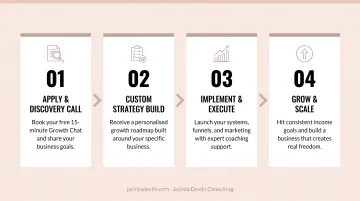
For online businesses specifically, this includes digital strategy, e-commerce optimization, content-to-conversion systems, and building a brand that stands out in a crowded marketplace.
Jacinta Devlin, who has coached thousands of women entrepreneurs across direct sales, e-commerce, and online business, puts it plainly: most women don't have a social media problem. They have a strategy problem dressed up as a social media problem. The platform isn't the issue. The absence of a coherent plan behind it is.
7 Signs Your Online Business is Ready for a Strategy Consultant
Use this as a self-assessment. The more boxes you tick, the more likely a strategic engagement will move the needle.
1. You're Making Money, But You Can't Seem to Scale
You've found product-market fit. You have real customers and consistent sales. But every attempt to grow past a certain monthly revenue — whether that's $2,500, $5k, or $10k — stalls. More work isn't producing more income.
That ceiling isn't a hustle problem. It's a structural one — and that's exactly where strategy work starts.
2. Your To-Do List is a Mile Long, But Your Priorities are Blurry
You're constantly busy but unsure if you're working on the right things. Chasing every new platform, tactic, or trend without a clear reason why is the surest way to burn out without scaling. The fix isn't doing more — it's getting clear on the few activities that actually move revenue.
3. You Feel Like You're Guessing About Your Next Move
Should you launch a new product? Invest in ads? Hire someone? Target a new audience? When major decisions feel like coin flips rather than calculated steps, it's a sign you're operating without a clear strategic framework.
4. Your Sales and Marketing Efforts Feel Disconnected
You're active on social media, you send emails, you run occasional promotions — but there's no unified system turning followers into leads and leads into loyal customers. Research from Constant Contact confirms this is widespread: small businesses consistently struggle with marketing effectiveness due to limited time, low confidence, and lack of a coherent strategy.
5. You're the Bottleneck in Your Own Business
Every decision runs through you. Nothing happens without your direct involvement. If the business stops when you stop, you haven't built a business yet — you've built a job. Breaking out of that loop requires systems and a delegation framework, not just more hours.
6. You're Facing a Major Market Shift or New Opportunity
An algorithm change, a new platform gaining traction, a sudden spike in competition — moments like these require clear thinking, not reactive scrambling. It's hard to read the label from inside the jar — outside perspective is exactly what cuts through the noise.
7. You Want to Build a Business, Not Just a Job for Yourself
This is a mindset shift as much as a strategic one. Moving from operator to CEO — from doing everything yourself to building something that runs without you — is a transition most women entrepreneurs don't make without intentional support and a real plan.
The Tangible Benefits of Strategic Consulting
Abstract promises about "clarity" and "direction" don't mean much. Here's what changes in practice:
Clarity and Focus
Clients like Carissa P. (Park Lane Jewelry) described entering coaching feeling "overwhelmed and unsure of what parts of my business needed more focus." Through Jacinta Devlin's Business Growth Program, she identified specific priorities, executed against them, and achieved 40% year-over-year business growth. Jamie R. went from being "literally all over the place" across three businesses to a focused, automated content system producing 25–30 new followers per week.
Increased Profitability
A consultant identifies where revenue is leaking and where it can grow. That means looking at pricing, offer structure, and marketing spend that isn't converting. Client results speak to what's possible:
- Amanda O. scaled from a $2,500/month starting goal to consistent $10,000+ months
- Joy W. grew from $500/month to $5,000+ every month — and surpassed her previous full annual income in just six months
Scalable Systems
Manual processes break as volume increases. The fix is building systems — email automations, sales funnels, content workflows, onboarding sequences — so the business grows without the founder working more hours for every incremental dollar.
Lisa K. of Fleur de Lis Boutique worked with Jacinta's team to build her brand identity, website, email marketing, and full launch plan. The results:
- $1,250 on launch day
- $3,300 in her launch month
- Over $100,000 in her first year
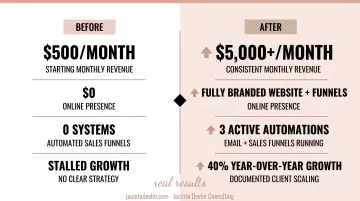
These are real client outcomes. Individual results vary based on business model, market, effort, and consistency of implementation.
How to Choose the Right Strategy Consultant for Your Business
The consulting market is crowded. Here's what actually separates a high-impact engagement from an expensive disappointment.
Look for Real-World, Relevant Experience
Theory and practice are not the same. The most valuable consultants have personally built or scaled businesses similar to yours — not just studied them.
Jacinta Devlin, for example, came to coaching after building real businesses first:
- Top 1% seller and million-dollar earner across a 12-year direct sales career
- National Director of Sales & Field Training at Stella & Dot, designing curriculum for 50,000+ women
- Six-figure Amazon storefront operator under the StyledByJacinta brand
- Consulting business grown to over $1M before taking on clients
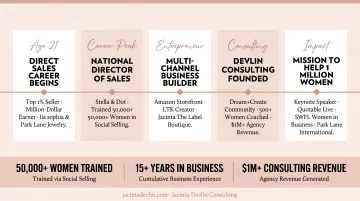
As she puts it directly: "Coaching is the fifth business, not the first."
Demand a Customized Strategy, Not a Template
Ask point-blank: will I receive a plan built around my specific business, or a program every client gets? A consultant worth hiring will spend significant time understanding your model, audience, and goals before suggesting anything. Avoid anyone selling a universal system as the answer.
Check for Implementation Support
A strategic plan that lives in a document doesn't grow a business. Ask how the consultant supports execution. Do they offer coaching through the implementation phase? Do they build systems for you, or only advise on what to build?
The best engagements include both strategic direction and hands-on support — that combination is what moves a plan off the page.
Review Specific Client Outcomes
Testimonials that say "she was amazing!" are different from testimonials that say "I scaled from $500 to $5,000 per month" or "we hit $100k in year one." Look for specificity. Ask to speak with past clients when possible.
Assess Communication and Personality Fit
This will be a close working relationship. Choose someone you trust, communicate with easily, and feel comfortable being fully honest with about where your business actually stands.
Frequently Asked Questions
What does a business strategy consultant do?
A strategy consultant analyses your business's current state — revenue, marketing, operations, positioning — identifies the key bottlenecks and growth opportunities, and develops a prioritised long-term plan to address them. Unlike coaches or agencies, the focus is on the business model and strategic direction, not mindset or campaign execution.
How much do business strategy consultants charge?
Fees vary widely. Upwork lists a median hourly rate of $55 for business consultants, with a typical range of $28–$98/hour in the freelance marketplace. For more experienced consultants working with online businesses, project-based and ongoing program fees typically range from $2,500 to $15,000+, depending on scope, depth, and the consultant's track record — with options ranging from single-session calls to ongoing monthly programs.
What's the difference between a business coach and a strategy consultant?
A coach focuses primarily on the entrepreneur — mindset, accountability, personal performance, and professional development. A consultant focuses on the business itself — its systems, model, market position, and growth plan — and delivers concrete strategic advice and an actionable roadmap. Many engagements combine elements of both.
Can a strategy consultant help a brand new business?
Yes, though the support looks different. For pre-launch businesses, a consultant helps with market research, business model validation, brand positioning, and go-to-market planning. That said, strategy engagements tend to deliver the strongest results for businesses already operating and generating revenue.
How long does a typical consulting engagement last?
It depends on scope. A one-off strategy session or focused project might span a few hours to a few weeks. A comprehensive strategic plan engagement typically runs 4–8 weeks. Ongoing advisory or coaching programs commonly run 3–12 months to cover both strategy development and implementation support.
What should I have ready before hiring a business consultant?
Come prepared with your current monthly revenue (or honest estimate), the key business metrics you track, your most pressing challenges, and a clear sense of what success looks like for you over the next 6–12 months. This preparation makes your discovery call genuinely useful — so the conversation can focus on your strategy, not catching up on basics.
Conclusion: Stop Guessing, Start Building
A revenue plateau isn't a motivation problem. Neither is the overwhelm of trying to do everything at once without a clear sense of what's actually working.
An online business strategy consultant gives you the honest outside perspective and actionable roadmap that most women building online businesses never create on their own. Jacinta's clients have used that kind of structured support to go from sub-$500 months to consistent $5k+ months, launch boutiques past $100k in year one, and finally stop spinning their wheels on tactics that weren't moving the needle.
Review the seven signs. If three or more resonate, the question isn't whether strategic support would help — it's whether you're ready to stop reacting and start building with intention.
The next step is simple: apply for a free 15-Minute Growth Chat and find out what's actually holding your business back.