

That gap — between the work you're doing and the income you expected by now — is one of the most disorienting parts of early entrepreneurship. It doesn't mean you're doing it wrong. It means you're in the part of the timeline nobody talks about honestly enough.
The "overnight success" stories you see on social media? Almost every one of them was years in the making. Understanding that reframe doesn't just make you feel better — it changes how you make decisions, how long you stay in the game, and ultimately whether you make it.
This post gives you a realistic, stage-by-stage look at how long building a successful business actually takes, what progress looks like at each phase, and what separates businesses that scale from those that stall.
Key Takeaways
- Year one is about validation, not profit — most businesses take 2–3 years to reach consistent profitability
- According to SBA data, only 49.2% of new employer establishments survive 5 years
- Stalling before scale is usually a strategy problem, not an effort problem
- Mentored businesses survive at roughly double the rate of non-mentored ones
- Patience without strategy isn't enough — consistent, intentional action is what moves the needle
What "Successful" Actually Means for Your Business
Here's a trap most new entrepreneurs fall into: measuring themselves against a vague, shifting version of success. "Doing well." "Making it." "Getting there."
Without a specific target, you can't know whether you're on track or off course — and that uncertainty is what breeds discouragement.
Success means something different at every stage:
- First paying customer — validating that someone will actually buy
- First $1,000 month, proving repeatability
- Consistent $5,000–$10,000 months, building real income
- Replacing a prior salary or hitting six figures annually
- Scaling systems so the business grows without requiring every hour you have
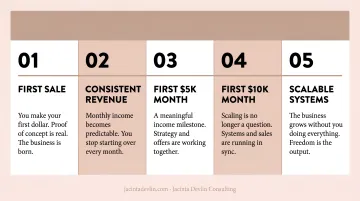
What moves women forward through these stages is knowing exactly which one they're in. The women Jacinta Devlin works with through her Business Growth Program come in with concrete definitions — a specific dollar target, a date to leave a corporate job, or a ceiling they've been stuck under for months. That clarity is what turns strategy into traction.
Write down what success looks like at your next milestone — not some distant future version, but the one directly ahead. That's the number, goal, or outcome you're actually building toward right now.
A Realistic Business Growth Timeline: Year by Year
Timelines vary by business type, industry, and how intentionally you build. But the data is clear: this is a multi-year process, not a multi-month one.
Year One: Building the Foundation
Year one is a validation phase. Your job is to find your first customers, test whether your product/service actually sells, and prove the concept works.
Most businesses don't turn a profit in year one — and that's normal. The SBA is explicit that some companies lose money for months or years before breaking even. The Federal Reserve's 2025 Nonemployer Firms report found that most early-stage businesses aged 0–2 years are not yet profitable, with 58% having applied for financing and facing a 50% denial rate on loans.
Meaningful progress in year one looks like:
- First sale made
- First repeat customer
- Audience or email list growing
- Brand identity established
- Systems starting to take shape
BLS data shows that roughly 20.4% of private-sector business establishments don't survive their first year — making it through is itself a legitimate win.
One of Jacinta's clients, Lisa K. of Fleur de Lis Boutique Florida, launched her boutique with no prior business experience and hit $1,250 on launch day, $3,300 in her launch month, and over $100,000 in year one. That kind of result is possible — but it was built on a complete strategy, not guesswork.
Years Two and Three: Finding Your Footing
This is the hardest stretch emotionally. The initial excitement is gone, savings may feel strained, and the gap between effort and income can feel discouraging. This is when most entrepreneurs quit — which is also why pushing through this phase is so significant.
What's actually happening during these years, even when it doesn't feel like it:
- Customer relationships are compounding
- Brand recognition is building steadily
- You're learning what works and what doesn't at an accelerating rate
- The habits and systems you build now become the infrastructure for later growth
Key progress markers to look for: a growing client list, repeat buyers, clearer positioning, and approaching break-even. These aren't glamorous milestones, but they signal that the roots are growing.
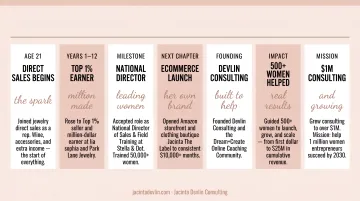
Years Four and Five: Building Real Momentum
Businesses that survive into years 4–5 are typically entering their first genuine growth phase. Offers are sharper, word-of-mouth is working, and revenue becomes more consistent. You can start building a team or refining systems rather than improvising everything manually.
What this phase tends to look like in practice:
- Revenue streams are more predictable month over month
- Referrals and repeat business reduce reliance on cold outreach
- You have enough data to double down on what's working
- Hiring or delegating becomes a real option, not a distant goal
What looks like an "overnight success" from the outside is almost always a business that's been grinding through exactly these years — testing, refining, and showing up before anyone was watching. The visibility comes late. The work started early.
Year Five and Beyond: Scale and Sustainability
By year five, the fundamentals are locked in. Profit margins are stronger, customer acquisition is more refined, and the business can run with systems rather than constant hustle. This is when the freedom that motivated you to start in the first place actually starts to show up.
According to SBA data, only 49.2% of new employer establishments survive to five years — meaning reaching this stage puts you in a meaningful minority. The businesses that reach this stage didn't shortcut the earlier years. They got here by doing the foundational work that most people abandon in years two and three.
Why Most Businesses Stall Before They Scale
Effort alone doesn't prevent stalling. Most businesses that plateau do so for specific, fixable reasons.
Why Strategy Beats Hard Work
Many entrepreneurs are working hard without a real plan built around their actual business. Generic advice, downloaded templates, and YouTube tutorials can teach concepts.
But they can't tell you what your specific product/service needs, who your specific customer is, or what sequence of actions will move your revenue forward.
Jacinta's platform puts it directly: "You almost certainly do not have a social media problem. You have a strategy problem dressed up as one. Posting more is not the answer."
The Busy-But-Not-Growing Trap
SCORE reports that 70% of small business owners prefer to handle all tasks themselves, with 33% working more than 50 hours weekly. That's a lot of activity — but activity isn't the same as revenue-generating execution.
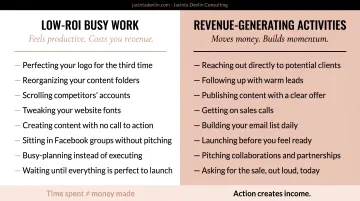
The most common low-ROI activities entrepreneurs confuse with progress:
- Tweaking the logo or website for the third time
- Consuming more courses or business content
- Posting on social media without a conversion system
- Responding to DMs without a sales process
Revenue-generating activities include: direct outreach to prospects, following up on warm leads, launching a product/service to a built audience, and improving a converting sales funnel.
The Income Ceiling Pattern
One of the most common patterns Jacinta sees: entrepreneurs stuck at $1,000–$2,000 months who can't break through to $5,000 or $10,000. They're not failing — they're plateaued.
The root causes are almost always one of three things:
- Offer clarity — no one knows exactly what they're buying or why it matters to them
- Audience targeting — posting to everyone, converting no one
- Sales process — "post and pray" marketing with no system, funnel, or follow-up
Burnout and Isolation
For women entrepreneurs especially, building alone without support accelerates burnout and decision fatigue. A 2024 University of Northern Iowa study on small business burnout found that women business owners showed higher rates of burnout and work-to-family conflict than men.
Sustained solo effort without community or accountability leads to self-doubt — and many entrepreneurs quit right before a real breakthrough. That's why Jacinta's programs are built around more than strategy:
- A private women-only community for peer support and momentum
- In-person retreats for focused, immersive growth work
- Built-in accountability between coaching calls to prevent isolation from derailing progress
What Actually Accelerates Business Growth
There are no shortcuts to building a real business. But there are proven factors that compress the timeline.
Start With a Validated Offer
Before building a website or posting daily, know that someone will actually buy what you're selling. Research your market, understand what your ideal customer wants, and build your product/service around real demand — not assumptions.
Build Repeatable Systems Early
Entrepreneurs who build systems for lead generation, follow-up, and customer onboarding grow faster than those doing everything manually. The difference is effort that compounds — not effort that multiplies.
Systems like these are what turn inconsistent months into consistent ones:
- Sales funnels that qualify and convert leads without manual follow-up
- Email automation that nurtures subscribers while you focus elsewhere
- Content workflows that keep you visible without daily scrambling
Do Fewer Things Better
Spreading effort across five platforms, three offers, and two target audiences produces worse results than focusing on one of each. The SBA's market research guidance supports this: knowing exactly who your customer is and what competitive advantage you product/service drives better outcomes than broad, unfocused execution.
Invest in Expert Guidance
Research cited by the SBA found that 70% of small businesses that received mentoring survived more than five years — double the rate of those that did not. That gap isn't a coincidence.
Working with someone who has already done what you're trying to do compresses the trial-and-error period dramatically. The key word is specific — someone who builds a strategy around your business, not someone applying a generic template.
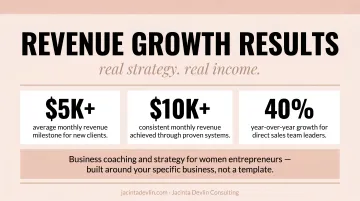
That's exactly what happened for Sharon B. She spent an entire year on Amazon alone and made $4,000 total. After working with Jacinta on a strategy built around her specific business, she reached $20,000+ per month consistently. Same hours. Completely different results.
Track Your Numbers
Entrepreneurs who watch their revenue, conversion rates, and what's driving sales make better decisions faster. If you don't know what's working, you'll waste months on strategies that aren't producing results. Start tracking from day one — even simply.
The Mindset Every Entrepreneur Needs to Last the Distance
Think of the Chinese Bamboo Tree. For the first four years after planting, almost nothing visible happens. In year five, it grows up to 90 feet in a matter of weeks. The question is: what was it doing for four years? Growing roots.
The foundational work done in years 1–3 — even when it feels invisible — is what makes explosive later growth possible. The tree doesn't grow despite those early years. It grows because of them.
The entrepreneurs who make it aren't always the ones with the best ideas. They're the ones who stay persistent when nothing seems to be working — and keep going past the point where most people quit. Many entrepreneurs walk away right before a real breakthrough, when the results are weeks away but the discouragement is loudest.
Patience in business doesn't mean passivity. It means staying in strategic motion even when results aren't visible yet — learning, adjusting, and showing up with a plan.
"This is not a get-rich-quick system. Building a profitable and sustainable business requires work, consistency, and commitment." — Jacinta Devlin
That's not a disclaimer. It's the whole truth — and knowing it changes everything.
Frequently Asked Questions
What is the 3-month rule in business?
The 3-month rule is an informal concept — not a formal business standard — that says most marketing efforts, new offers, and audience-building activities need at least 3 months of consistent execution before you can fairly evaluate results. It's a reminder not to abandon a strategy before it has a real chance to work.
How long does it take to start making money in a new business?
First sales can happen within weeks, but consistent, reliable income typically takes 1–2 years to establish. The timeline depends heavily on product/service clarity, how built your audience is, and how consistently you prioritize revenue-generating activities over everything else.
Is it normal to not make a profit in your first year of business?
Completely normal. The SBA is clear that businesses often lose money for months or years before breaking even. Year one is about validating your product/service, landing early customers, and building the foundation — profit typically comes later.
What percentage of small businesses fail in the first few years?
According to recent SBA data, approximately 20% of establishments don't survive year one, and only 49.2% reach the five-year mark. These numbers aren't meant to discourage — they're motivation to build intentionally rather than reactively.
How do I know if my business is growing too slowly?
Slow growth is relative, but a real warning sign is when 3–6 months of consistent effort produce no movement in new customers, revenue, or audience growth. If that's happening, it's usually a strategy problem — not a patience problem.
Can working with a business coach speed up my growth?
Yes — the right coach helps you stop guessing, avoid costly mistakes, and build a strategy that fits your actual business. The difference between fast and slow growth often comes down to whether you're working from a plan built for you, or borrowing a template that was built for someone else.