
Thousands of women launch boutiques every year — beautiful brands, carefully curated inventory, genuine love for fashion. And then the sales plateau. The cash gets tight. The social media posts go quiet. What felt like momentum stalls into inconsistency.
The gap between "open for business" and "actually growing" is real, and it's not closed by working harder. It's closed by working with a real strategy. According to IBISWorld, there are over 235,000 clothing boutique businesses in the U.S. in 2025 — meaning competition is fierce and differentiation is everything.
This guide covers exactly what it takes to build a boutique that generates consistent, profitable revenue: defining a niche that attracts loyal buyers, sourcing and pricing inventory for real margins, building a marketing engine that actually converts, retaining customers, managing your finances, and scaling toward consistent monthly income.
Key Takeaways
- Boutique profitability comes from aligning niche, pricing, marketing, and operations together
- Social media drives sales when backed by a clear content strategy — not just frequent posting
- Profitability requires both revenue growth and cost discipline — margin matters as much as volume
- Repeat customers are more valuable than a constant chase for new ones
- Scaling requires systems, not just hustle
Define Your Niche and Build a Brand Identity That Attracts Buyers
A boutique without a defined niche competes with everyone and wins with no one. "Women's fashion" isn't a niche. Elevated casual wear for women over 40 or sustainable fashion for eco-conscious millennials — those are niches. Each one defines a specific customer, an aesthetic, and a lifestyle intersection that attracts the right buyers and filters out everyone else.
How to Validate Your Niche
Start where your competition is weakest:
- Find the gap your target customer hasn't had filled — read reviews, scroll comments, and note what shoppers say they wish boutiques actually carried
- Audit your closest competitors to see where their customers are frustrated or underserved
- Build from genuine expertise, not just trending aesthetics — buyers can tell the difference, and that trust compounds over time
Faire's 2024 Main Street survey found that nearly 90% of independent retailers focus on personalized service and curated product selections — and over 80% said customers visit specifically to get recommendations from staff. That kind of loyalty doesn't happen by accident — it's what a well-defined niche makes possible.
What Brand Identity Actually Means
Brand identity isn't just a logo. It's the complete feeling your customer gets every time she encounters your boutique — from your Instagram grid to how you respond to DMs to the tissue paper inside your packages.
A strong boutique brand includes:
- A consistent visual identity — logo, color palette, and typography that carry through every platform
- A distinct voice — how you write captions, respond to comments, and tell your story
- Clear positioning — the specific woman you serve and why your boutique exists for her
- Intentional touchpoints — packaging, shipping inserts, email subject lines, and story replies that reinforce the brand experience every time
This is exactly what Jacinta Devlin builds with boutique clients before a single product posts — brand identity, website, social media presence, and a strategic launch plan, all built together before anything goes live.
When Lisa K. of Fleur de Lis Boutique Florida came to Jacinta with her dream of launching a boutique, Jacinta's team built the entire foundation from scratch. The results: $1,250 on launch day, $3,300 in her launch month, $20,000 in her first four months, and over $100,000 in year one.
Define Your Ideal Customer — Beyond Demographics
Knowing your customer's age and zip code isn't enough. Go deeper:
- What does she value most when she gets dressed?
- What problems does she want solved by her wardrobe?
- Where does she currently shop, and what frustrates her about it?
- What does she aspire to feel when she wears your pieces?
These psychographic details drive every product selection, every caption, and every email subject line you write. Generic boutiques compete on price. Boutiques with a real brand identity compete on connection — and repeat buyers built through connection are what turn a launch into a lasting business.
Source Your Inventory Smartly and Price for Real Profit
Where Boutiques Source Inventory
The right sourcing channel depends on your boutique's niche, budget, and stage:
| Source | Best For |
|---|---|
| MAGIC Las Vegas (August 2026: 16,900+ attendees, 800+ brands) | Boutiques ready to buy volume and discover trends in person |
| Dallas Market Center (multiple market dates throughout 2026) | Regional boutiques, especially in the South and Midwest |
| Faire (100,000+ brands, 60-day payment terms) | Online boutiques and new owners who need low MOQs and flexible terms |
| FashionGo (1M+ registered buyers, net 30/45/60 terms) | Mid-size boutiques sourcing contemporary and trend-forward apparel |
| Tundra | Boutiques seeking unique, independent brands with free shipping |
| Independent designers | Boutiques building an exclusive, curated aesthetic |
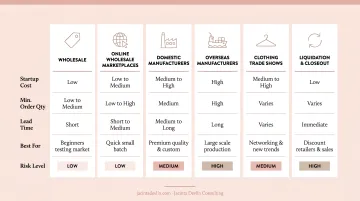
One common early mistake: buying from too many vendors too quickly. Spreading across 10+ vendors fragments your aesthetic and strains cash flow. Build depth with a few core vendors first.
Open-to-Buy Budgeting
Open-to-buy (OTB) is the single most important inventory discipline boutique owners overlook. Rather than buying what excites you in the moment, OTB planning ties every purchase to projected revenue.
The basic formula: OTB = Planned sales + planned markdowns + planned end-of-month inventory − beginning-of-month inventory
This turns inventory buying from an emotional decision into a financial one. Boutiques that skip OTB planning tend to either overstock slow sellers or run out of their best performers at the wrong moment — both drain cash.
Once your buying is disciplined, pricing is where the real margin lives.
Pricing for Real Margin
The standard starting point is keystone pricing: wholesale cost × 2 to 2.5. But that's a floor, not a ceiling.
For exclusive, limited-edition, or high-demand pieces, go higher. Customers shopping boutiques are not looking for the cheapest option — they're paying for curation, experience, and aesthetic. Underpricing signals low quality and kills the trust you've worked hard to build.
The most common pricing mistake: trying to compete on price with big-box retailers. You can't, and you shouldn't try. A boutique that races Target or Amazon to the bottom has already lost.
Compete on what they genuinely can't offer:
- A personal relationship with the buyer
- Curated selection built around a specific aesthetic
- Real styling expertise and recommendations
- A brand your customer actually wants to be part of
Build a Marketing Strategy That Consistently Brings In Sales
Posting pretty pictures is not a marketing strategy. A real marketing strategy moves a specific customer through awareness, interest, desire, and action — on purpose, not by chance.
The key distinction: content that builds brand (lifestyle shots, behind-the-scenes, styling tips) versus content that converts (product launches, limited drops, direct calls to action). You need both, in a deliberate ratio.
Sell on Social Media Like a Pro
Platform selection matters:
- Instagram — brand presence, Reels for discovery, Stories for daily engagement and sales sequences
- TikTok — 83% of TikTok Shop users discovered a new product on the platform, and 76% purchased via livestream in the past year
- Facebook Groups — community building, VIP customer engagement, live selling
- Pinterest — long-tail discovery; 631 million monthly active users, audience 70% women, and 80% of weekly Pinners feel inspired by their shopping experience
Jacinta Devlin has used this exact platform combination — Instagram, Facebook, TikTok, and Pinterest — both in scaling her own clothing boutique, Jacinta The Label, to consistent $10,000+ months, and in coaching boutique clients like Lisa K. and Amanda O. to their revenue milestones. Live selling takes that platform reach and turns it into real-time revenue — and it's still one of the most underused tools boutique owners have.
Live Selling as a Revenue Driver
Live selling builds urgency, recreates the in-person shopping experience, and forms direct customer relationships in a single broadcast. The data shows how significant the upside is: CommentSold powers over 10,000 retailers and $5.3B+ in transacted GMV, Mason Jar Boutique hit $2.6M in yearly sales, and Willow Boutique generated $100K in a single livestream.
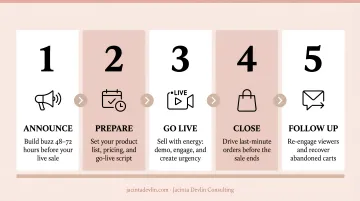
Practical tips for a successful live sale:
- Announce in advance — promote on Stories and email 48-72 hours before
- Have your inventory prepped — know your prices, sizes, and talking points before you go live
- Create urgency — limited quantities, live-only pricing, or bundle deals
- Engage actively — call out names, answer questions in real time, make it a conversation
- Follow up after — email your list the replay and a "last chance" offer within 24 hours
Email Marketing: The Channel You Actually Own
Social media is rented land. Your email list is owned land. One algorithm change can halve your organic reach overnight. Your email list stays yours regardless.
Effective boutique email types:
- New arrivals — direct links to products, ideally styled in a flat lay or on a model
- VIP early access — let subscribers shop new drops 24 hours before everyone else
- Styling guides — outfit ideas built around what you have in stock right now
- Abandoned cart sequences — automated reminders that recover sales you'd otherwise lose
- Post-purchase follow-up — a timely check-in that turns one-time buyers into regulars
Aim for at least one email per week. Klaviyo data shows automated flows generate 41% of total email revenue from just 5.3% of sends — a setup-once system that generates revenue without ongoing effort on your part.
Turn Shoppers Into Loyal Repeat Customers
Customer retention is the most cost-effective growth strategy available to any boutique owner. According to Harvard Business Review, acquiring a new customer is 5-25x more expensive than retaining an existing one — and a 5% increase in retention can boost profits by 25%-95%.
Apparel brands using loyalty programs in Yotpo's 2023 benchmark saw a 50.2% average increase in revenue per redeeming customer within 90 days. For a boutique operating on tight margins, that kind of lift changes your trajectory.
Practical Loyalty-Building Tactics
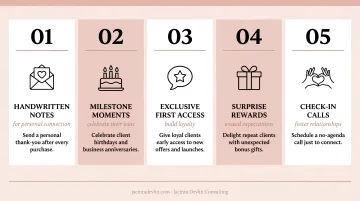
These tactics work because they're personal — and personal is exactly what big-box retailers can't offer:
- Reward every purchase and referral with a points-based loyalty program — give customers a reason to return before they've even left
- Give top buyers early access to new arrivals 24-48 hours before anyone else
- Reach out with personalized styling notes that reference past purchases ("You loved that wrap dress — we just got it in two new colors")
- Send handwritten thank-you notes — 90 seconds of your time creates the kind of impression no Amazon delivery ever will
- Create a private Facebook Group for VIP customers to build community investment, not just transactional loyalty
Build a Community, Not Just a Customer Base
The tactics above drive repeat purchases. What drives long-term growth is when customers stop thinking of themselves as shoppers and start thinking of themselves as part of something.
That shift happens through consistent, two-way engagement — VIP email lists, in-store or virtual styling events, and community spaces where customers connect with each other, not just with you. When it works, occasional buyers become brand advocates who refer friends, tag you in posts, and defend your pricing without being asked.
Jacinta Devlin has coached clients to grow Facebook Groups from zero to 36,000+ members — and those communities became primary revenue engines, not just support forums. Build it intentionally, and it compounds in ways that paid ads never will.
Manage Your Boutique Finances Like a CEO
Key Financial Metrics to Track Monthly
Boutique owners who review financials quarterly instead of monthly are flying blind. Track these every single month:
- Gross profit margin — revenue minus cost of goods, divided by revenue
- Net profit margin — what's left after all operating expenses
- Cost of goods sold (COGS) — your true cost of inventory sold
- Inventory turnover rate — how quickly you're selling through stock
- Revenue per customer — tracks whether you're increasing value from each buyer
The U.S. Chamber of Commerce identifies cash flow issues — often stemming from poor budgeting or inventory mismanagement — as one of the primary failure drivers for small businesses.
The Most Common Financial Mistakes
These patterns show up repeatedly in boutique owners who plateau:
- Over-investing in inventory before establishing a sales track record
- Mixing personal and business finances — it creates accounting chaos and hides your boutique's true financial health
- Under-calculating true operating costs when setting prices — rent, packaging, shipping, platform fees, and your own time all count
- Not setting aside money for taxes — quarterly estimated taxes catch too many boutique owners off guard
- Making inventory decisions based on taste alone — data should inform every reorder decision
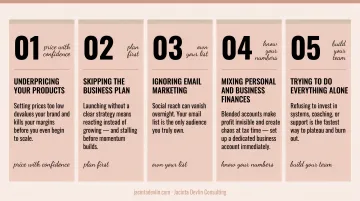
The Dual Role: Creative Director and CEO
Running a boutique means holding two jobs at once. The creative director curates inventory, builds the brand, and crafts the content. The CEO reads the financial reports, manages cash flow cycles, and makes decisions based on numbers.
Most boutiques that stall are nailing the creative director role and ignoring the CEO side entirely. Monthly financial reviews, understanding seasonal cash flow dips, and tracking key metrics are not optional extras — they're what separate boutiques that grow from boutiques that scrape by.
Scale Your Boutique to Consistent Monthly Revenue
Scaling isn't just selling more. It's building repeatable systems so the business can grow without you manually doing every single task.
The most common stall point: boutique owners plateau when they're still the only person doing everything, with no documented processes, no automation, and no strategy — just hustle. Hustle gets you started. Systems get you to consistent revenue.
Revenue Streams That Allow Real Scaling
A single-channel boutique is fragile. Boutiques that scale to consistent $10K+ months typically operate across multiple revenue streams:
- Online store (Shopify) as the primary sales channel
- Social commerce — TikTok Shop, Instagram Shopping, Facebook Shop
- LTK or Amazon storefront for affiliate-adjacent revenue
- Subscription box or styling service for predictable recurring revenue
- Brand partnerships for additional income alongside product sales
- Live selling as a standalone revenue event and a community-building tool
This is the multi-channel approach Jacinta Devlin used to scale her own boutique to consistent $10,000+ months, and it's the framework she builds with boutique clients. Amanda O. entered her Business Growth Program with a $2,500/month goal and reached consistent $10,000+ months within months — directly attributing the shift to learning how to streamline and systematize her operations.
From Operator to CEO
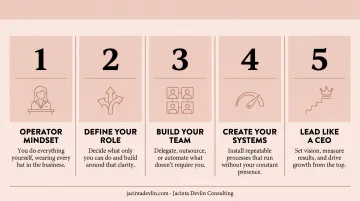
Scaling requires a fundamental shift in how you operate. The boutique owner who handles everything manually, makes decisions by gut, and has no documented process will eventually hit a ceiling — no matter how hard she works.
The shift looks like this:
- Moving from reactive posting to a documented content calendar
- Building automation sequences so email and follow-up run without you
- Reviewing weekly analytics and making decisions based on data
- Delegating execution so strategic thinking gets protected time
- Investing in expert support rather than consuming more free content
That last point — investing in expert support — is often the deciding factor. Boutique owners ready to stop guessing and build a real growth strategy can work directly with Jacinta Devlin Consulting, a women-only business coaching firm.
Clients like Lisa K. of Fleur de Lis Boutique Florida have achieved $100K+ in first-year revenue through this work. The Business Launch Program and Business Growth Program are built specifically for women at every stage — from launching from zero to breaking through revenue plateaus.
Frequently Asked Questions
How profitable is owning a boutique?
Profitability varies significantly based on business model, operating costs, and how well pricing and inventory are managed. Online boutiques carry lower overhead than brick-and-mortar locations, giving them stronger net margin potential when run efficiently.
How do I attract customers to my boutique?
Consistent social media presence, live selling, email marketing, and local or community partnerships are the most effective customer attraction strategies. Attraction is a result of targeted messaging aimed at a specific customer — not random promotion across every platform.
What are the top selling boutique items?
Women's tops, dresses, denim, accessories, and jewelry consistently perform well across boutiques. The best-selling items for any specific boutique depend on how closely the inventory matches the defined niche and the preferences of the target customer.
How do boutiques get their inventory?
Most boutique owners source through a mix of wholesale trade shows like MAGIC Las Vegas or Dallas Market Center, online wholesale platforms like Faire or FashionGo, and direct relationships with independent designers or smaller manufacturers. The right mix depends on niche, budget, and how much exclusivity the boutique wants in its product selection.
How much money do I need to start a boutique?
An online boutique can launch for as little as $2,000–$15,000 according to Shopify, while a physical storefront requires significantly more when accounting for rent, fixtures, and inventory. Starting lean online first is a smart way to validate your concept and build a customer base before committing to overhead.
Can I run a profitable boutique entirely online?
Online boutiques can be highly profitable, particularly when paired with strong social media and email marketing. Many boutique owners scale to consistent five-figure months without ever opening a physical storefront — the key is disciplined inventory management and a clear pricing strategy from day one.