This guide is different. Jacinta Devlin has spent 15+ years in the social selling space, trained 50,000+ women, and built her own consulting business to over $1M — coaching clients from first-dollar launches to consistent $20k+ months. What you'll find here reflects what actually works: brand foundation, the right channel mix, social selling, email systems, and how to measure results.
Key Takeaways
Here's what this guide comes down to:
- Authentic brand positioning drives results; copying someone else's strategy rarely does
- Social media is one channel in a larger strategy, not the whole plan
- Email, SEO, and community-building consistently outperform social-only approaches for long-term revenue
- Systems and automation turn hustle into scalable, repeatable income
Why Women-Owned Businesses Need a Different Digital Marketing Approach
There are now 14 million women-owned businesses in the U.S., representing 39.1% of all U.S. businesses — up 13.6% from 2019 to 2023. That growth means the competition for attention has intensified, and generic marketing advice is no longer enough.
Women consumers drive purchasing decisions. NielsenIQ reports women have 70–80% influence on all consumer spending globally. This audience prioritizes trust, peer recommendations, and authentic connection over hard-sell tactics. Most generic marketing frameworks were built for a different buyer entirely.
The Specific Challenges Women Business Owners Face
Constant Contact research found that only 16% of small business owners felt confident they were using the right marketing channels — and 56% spent one hour or less per day on marketing. The pressure to be everywhere at once is real, and it leads to scattered effort with limited return. Those numbers track with what Jacinta sees repeatedly in her coaching practice. The most common traps:
- Treating social media posting as a complete marketing strategy
- Soft-launching without a sequenced campaign behind it
- Building a brand without clearly defining the audience first
- Neglecting email list building in favor of platform-dependent follower counts
The Genuine Advantage
Women entrepreneurs naturally build relationships, create community, and tell compelling stories — skills that form the backbone of effective digital marketing. The work is channeling those instincts into systems that generate consistent revenue, not just engagement.
Build Your Digital Brand Foundation First
No marketing tactic works without a brand foundation underneath it. The clearest social strategy and most sophisticated email funnel will underperform if the brand story, audience, and voice aren't defined first. Brand clarity is a revenue decision — not a creative one.
Clarify Your Unique Story and Value Proposition
The question isn't just what you sell. It's why you do it and who you specifically serve. Your origin story is one of the most powerful differentiators in a crowded market, because no one else has yours.
Jacinta's Done-For-You brand development process builds this from the ground up — brand vision, mission, positioning, messaging architecture, and a complete style guide. Clients like Christina R. (My Balanced Style) grew her Instagram from 13k to 95k+ followers after a full rebrand; Jamie R. consolidated three separate businesses into one cohesive personal brand.
A clear story, consistently expressed, is what makes a brand feel real rather than assembled.
That story needs to show up the same way across your website, social profiles, email, and content. When those elements align, trust builds faster — and so does revenue.
Know Exactly Who You're Selling To
Vague targeting produces vague results. Before creating any content or choosing any platform, define your ideal client with specificity:
- Demographics — age, location, income range, life stage
- Pain points — what problem are they trying to solve right now?
- Online behavior — where do they spend time, who do they follow?
- Purchase triggers — how do they decide to buy, and what slows them down?
Women consumers in particular conduct more research and seek peer validation before purchasing. Designing marketing touchpoints that answer their questions and reflect real social proof isn't optional — it's the job.
Choose Your Platforms with Purpose, Not Pressure
The "be everywhere" approach is one of the fastest ways to burn out and generate little revenue. The better approach: identify one or two platforms where your ideal client is most active, and show up there consistently before expanding.
Jacinta's platform selection is always business-category-specific:
- Boutique and product brands → Instagram, Pinterest, TikTok Shop
- Amazon/LTK affiliates → Instagram, TikTok, Facebook Groups
- Coaches and service providers → Instagram, LinkedIn
- Direct sales leaders → Facebook Groups, Instagram
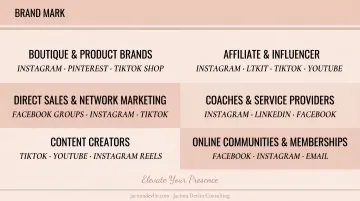
That specificity is what separates a focused platform strategy from a template copied from someone else's business. Jacinta Devlin Consulting builds platform plans around your exact business model and client — not a generic framework.
The Core Digital Marketing Channels That Drive Real Revenue
These channels consistently generate results for women-owned businesses — because they match how buyers actually research and make purchasing decisions.
Search Engine Optimization (SEO)
SEO creates compounding visibility. Once content ranks, it drives traffic without ongoing ad spend. Ahrefs found that 72.9% of Google top-10 pages are more than three years old — which means SEO rewards patience, but the payoff is durable.
For women entrepreneurs, the most effective SEO approach focuses on:
- Buyer-intent keywords — the questions your ideal client is already Googling ("best online boutique for petite women," "how to start Amazon affiliate income")
- Blogging as a trust-building tool — HubSpot reports businesses that blog average 55% more website visitors than those that don't
- Local SEO — for service-based businesses, a complete Google Business Profile and location-specific keywords drive high-intent local traffic
Google itself notes that SEO changes can take several months to reflect — but rankings, once earned, keep working without additional spend.
Content Marketing
One long-form piece of content — a blog post, video, or podcast episode — can become email content, social posts, and short-form clips. That single piece of content can realistically reach five or six different audiences across platforms without creating anything new.
Consistent content also builds authority over time. By the time a prospect reaches out, they've already watched, read, or listened to enough of your work to trust you — which means the sales conversation starts much further along.
Content that works hardest tends to do three things:
- Answers a specific question your ideal client is already asking
- Demonstrates your expertise through real examples or results
- Ends with a clear next step (book a call, join your list, follow for more)
Paid Advertising: When and How to Use It
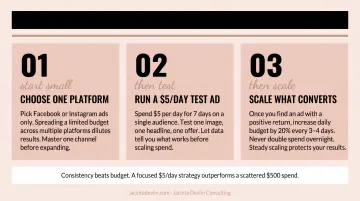
Paid ads amplify what's already working. They are not a substitute for strategy. For women-owned businesses with limited budgets:
- Start with retargeting — reaching people who've already visited your website or engaged with your content typically delivers better ROI than cold audience ads
- Set a specific goal before spending — brand awareness requires different campaign structure than direct conversion
- Scale spend only after proof — find one ad set that works, then increase budget rather than testing many simultaneously
The average cross-industry PPC conversion rate runs around 5.63%, with a cost per lead near $51.50. Those numbers vary widely by industry, which is why testing small before scaling matters.
Social Selling and Community Building: The Women Entrepreneurs' Edge
Social selling is distinct from social media posting. It's the intentional use of platforms to build relationships, establish credibility, and guide people toward a purchase — the approach Jacinta Devlin has used across direct sales, ecommerce, and consulting to generate millions in revenue.
Use Social Media to Build Trust, Not Just Visibility
The difference between broadcast posting and social selling:
| Broadcast Posting | Social Selling |
|---|---|
| Pushing content out | Starting and sustaining conversations |
| Optimizing for reach | Optimizing for conversion |
| Counting impressions | Counting conversations and sales |
| Sporadic presence | Consistent, platform-specific strategy |
DMs, Stories sales sequences, live shopping sessions, and community groups drive sales in ways that static posts don't. The goal isn't a large audience — it's the right audience, engaged consistently. Jacinta's speaking topic "How I Made Multiple 6-Figures Online With Less Than 10K Followers" makes this point directly.
Build and Leverage a Community
Women entrepreneurs have a genuine edge in community-building. Two of Jacinta's clients demonstrate what structured community growth actually produces:
- Christina R. built a Facebook group from 0 to 36,000+ members. She reached a six-figure income and quit her corporate job within six months.
- Sharon B. launched two Facebook groups to 30,000+ and 37,000+ members in four months — and her Amazon sales went from $4,000 in year one to $20,000+ per month.
Behind both results: a deliberate growth strategy, not passive posting. Practical community formats that work:
- A private Facebook Group around a specific topic your audience cares about
- A free challenge with a clear outcome (30-day, 5-day)
- A regular live series with consistent scheduling
Referral Programs and Strategic Partnerships
Referrals work because they transfer trust. A buyer who comes through a peer recommendation is already partially sold. Natural referral partners for women entrepreneurs include:
- Wellness and fitness coaches
- Fashion stylists and personal shoppers
- Business coaches and bookkeepers
- Photographers and brand designers
Brand partnerships extend that trust to a larger stage. Jacinta's clients have negotiated five-figure deals with companies like Walmart and QVC after learning to pitch and negotiate through the Business Growth Program.
Build Systems That Scale: Email, Automation, and Consistency
Many women entrepreneurs are doing all the right marketing activities but haven't built systems to capture and convert the interest they generate. Systems — not more hustle — create consistent monthly revenue.
Email Marketing as Your Most Valuable Asset
Social media is rented land. The platform decides who sees your content. Email is owned land — you control who receives what message and when, with no algorithmic gatekeeping.
Email marketing returns an average of $36 for every $1 spent. For ecommerce businesses specifically, automated email flows generate nearly 41% of email revenue from just 5.3% of total sends.
Every effective email system runs on three components:
- A lead magnet — a valuable freebie (checklist, guide, or mini training) that grows your list. Jacinta's own freebies include "10 Affiliate Link Programs to Apply For" and "5 Ways to Make Sales Online" — both designed to attract subscribers already interested in what she sells.
- A welcome sequence — 5–7 automated emails that introduce the brand, build trust, and move new subscribers toward a first purchase without any manual effort.
- A regular newsletter — consistent communication that mixes valuable content with offers. Consistency matters more than volume.
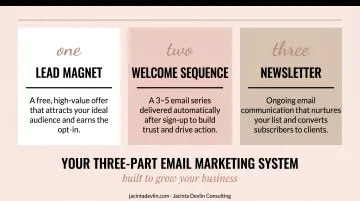
Once built, this system works even when you're not actively marketing. Jacinta Devlin Consulting builds these done-for-you email systems — lead magnets, welcome sequences, automations, and segmentation — tailored to each client's specific business and audience.
Automation That Works While You're Not
Marketing automation drives a 14.5% increase in sales productivity and a 12.2% reduction in marketing overhead, according to Nucleus Research. The automations that deliver the most immediate impact for women-owned businesses:
- Welcome email sequence — triggered the moment someone joins your list
- Abandoned cart emails — critical for boutique and ecommerce owners; recovers revenue that would otherwise be lost
- Instagram DM automation — tools like LinkDM respond to post comments automatically, turning engagement into subscribers and sales
- Post-purchase sequence — turns one-time buyers into repeat customers without manual follow-up
Even a basic automation setup improves conversion rates and keeps revenue moving between active selling pushes. That's the difference between a business that grows and one that stalls every time life gets busy.
How to Measure What's Actually Working
Without tracking, marketing decisions are guesses. The key metrics to watch:
- Website traffic and source — are visitors coming from search, social, email, or referrals?
- Email open and click rates — a healthy range is 17–28%, depending on industry
- Conversion rate — what percentage of visitors or subscribers are taking the desired action?
- Revenue attributed to each channel — which marketing activity is actually driving sales?
A simple monthly marketing review:
- Identify which channels drove the most traffic
- Check which channels converted that traffic into actual sales or sign-ups
- Note which content performed best
- Decide where to double down and where to pull back
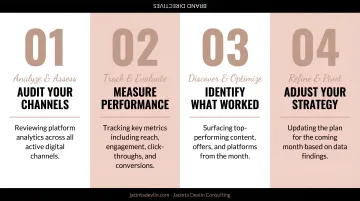
Free tools like Google Analytics and your email platform's built-in dashboard give you everything you need to run this review in under 30 minutes a month.
Frequently Asked Questions
What are the five main strategies of digital marketing?
The five core strategies are SEO, content marketing, social media marketing, email marketing, and paid advertising. The right mix depends on your specific business, audience, and goals — most women entrepreneurs see the strongest results from combining SEO, email, and social selling before adding paid ads.
What is the 3-3-3 rule in marketing?
The 3-3-3 rule refers to reaching the right audience, with the right message, at the right time. Some versions describe this as addressing three distinct audiences, using three content types, and distributing across three channels — a framework for keeping strategy focused rather than scattered.
What is the 70-20-10 rule in digital marketing?
The 70-20-10 rule, as described by Smart Insights, suggests 70% of content should be proven, value-driven material; 20% should be curated or shared content; and 10% can be promotional. For women entrepreneurs, this balance builds trust without turning every post into a sales pitch.
What digital marketing platforms work best for women entrepreneurs?
It depends on your business type and audience. Instagram, Facebook Groups, Pinterest, and email consistently perform well for women-owned businesses — particularly in fashion, lifestyle, coaching, and wellness. Pinterest alone has 631 million monthly active users with strong shopping intent.
How do I build an email list as a woman-owned small business?
Offer a valuable freebie — a checklist, guide, or mini training — in exchange for an email address. Promote it on social media and your website, then use a platform like Flodesk or Klaviyo to manage and nurture your growing list.
How long does it take to see results from digital marketing?
Paid ads can show results within days. SEO and content marketing typically take 3–6 months to gain traction — Google notes that ranking changes can take several months to fully reflect. Email results depend on list size and consistency; the channels that compound over time, like SEO and email, deliver the strongest long-term returns.