
The stakes are real. The right coach can be the difference between spinning your wheels for another year and building a business that generates consistent, predictable income. The wrong one can set you back months or more.
This guide covers what a business coach should actually do for you, the six qualities that separate coaches who deliver real results from those who sell inspiration without substance, the red flags to watch for, and the questions to ask before you invest.
Key Takeaways
- A business coach builds a real strategy around your specific business — not a generic template someone else used.
- The most important quality is real-world business results: look for a coach who has built what they're teaching.
- Experience with your specific business model matters more than credentials alone.
- Red flags: income guarantees, high-pressure sales tactics, and programs that are just pre-packaged courses.
- Matching your goals to your coach's expertise is the fastest route to real results.
What Does a Business Coach Actually Do?
A business coach works alongside you to identify where your business is stalling, build a real strategy to move forward, and hold you accountable to executing it. According to the International Coaching Federation, coaching is "partnering with clients in a thought-provoking and creative process that inspires them to maximize personal and professional potential."
That's the official definition. In practice, it means weekly strategy conversations, honest feedback, concrete action plans, and accountability between sessions.
Before you invest, understand what a coach is not:
- A therapist processing your relationship with money
- A course creator handing you 40 pre-recorded videos
- A consultant who delivers a finished plan and disappears
- A cheerleader validating every idea you have
That distinction is worth real money. Many programs sold as "coaching" are pre-built digital courses with a group call tacked on — and you won't know the difference until you've already paid. Real coaching is live, responsive, and built around your specific situation.
When Do You Actually Need a Coach?
Coaching is valuable at multiple stages — not just when you're struggling. Common signs it's time:
- You're making money but have hit a revenue ceiling you can't seem to break through
- You're constantly busy but not actually growing
- You're starting out and want to avoid costly guesswork
- You've tried to figure it out alone and keep circling the same problems
The 2018 American Express State of Women-Owned Businesses report found that 88% of women-owned businesses generated under $100K annually. Only 1.7% reached $1M or more. That ceiling is real — and the right coaching gives you the strategy to break through it.
What to Look for in a Business Coach
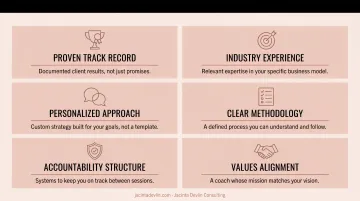
With so many coaches marketing themselves online, you need a clear framework for evaluation. These six qualities separate coaches who deliver real results from those who sell inspiration without substance.
Proven, Real-World Business Results
Start here. A coach should have actually built what they're teaching — if they're coaching on scaling revenue, growing a sales team, or building an online business, they should have done it themselves, with verifiable results to back it up.
Credentials and certifications matter far less than track record. The question is whether the coach has sold products, grown a team, managed real business challenges, and created the kind of income they're promising to help you build. The FTC notes there is no licensing requirement to become a business coach — meaning anyone can hang a shingle.
Ask directly: What businesses have you built? What are your own revenue milestones? Can I verify them?
Relevant Experience in Your Type of Business
Not all business experience is equal. A coach who spent 20 years in corporate consulting is not automatically the right fit for a woman building an e-commerce brand, a social selling business, or an online coaching practice.
This is especially important for women in:
- Direct sales and network marketing
- Boutique retail and e-commerce
- Amazon, LTK, and affiliate marketing
- Digital coaching and service businesses
The strategies, platforms, and sales dynamics in these models are unique. A coach who has never run a Shopify store, grown an affiliate income stream, or built a direct sales team will struggle to give you relevant guidance — regardless of their general business background.
Individualized Strategy, Not a One-Size-Fits-All Template
Many programs sold as "coaching" are actually pre-built courses or group templates created for someone else's business. Strong coaches build strategy around your specific situation, revenue goals, and constraints.
Ask any prospective coach directly: Is your approach customized to my business, or does every client go through the same framework?
The answer will tell you everything. If they can't describe how your strategy would differ from another client's, you're looking at a template with a coach's name on it.
A Track Record Working with Women Entrepreneurs
Women-owned businesses face specific dynamics — from navigating self-doubt to managing businesses around family responsibilities to building income streams that create real flexibility. A coach who has worked extensively with women in business will understand these without you having to explain them.
NWBC reports that women-owned businesses account for 39.2% of U.S. enterprises but only 6.2% of total firm revenue. There are structural and strategic reasons for that gap.
A coach who has directly helped women scale from early revenue to six and seven figures knows exactly where most women's businesses stall — and what it takes to push past those ceilings.
Communication Style and Personal Fit
The coaching relationship only works if you trust the person you're working with. Look for a coach who is:
- Direct and honest, not just validating
- Willing to ask hard questions
- Focused on what you need to hear, not what you want to hear
- Respectful of your time
A discovery call is not just a sales conversation. It's your opportunity to evaluate whether this person actually understands your business and will push you to do the work. Pay attention to how they show up in that first conversation.
Clear Accountability and Measurable Progress
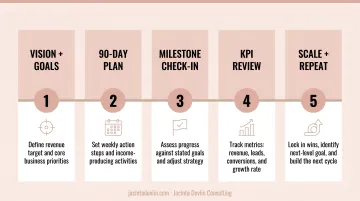
A strong business coach will help you set concrete, trackable goals from day one — not vague outcomes like "build confidence" or "grow your brand," but specific revenue targets, sales milestones, and business KPIs you can measure over time.
Ask any prospective coach: How do you define success, and how will we track progress throughout our work together?
A coach who can't answer this clearly is selling you motivation. Strategy looks different — it has numbers, timelines, and checkpoints attached to it.
Red Flags to Watch Out For
The FTC has been explicit about warning signs in the business coaching industry — and has taken enforcement action against multiple coaching schemes, including returning over $4.7 million to victims of one scheme and halting another that took over $14 million from consumers.
Watch for these warning signs:
- Guaranteed income promises — Any program promising guaranteed earnings, a "proven system," or 50–100% ROI is a red flag. No legitimate coach can guarantee your results.
- High-pressure sales tactics — If you're being pushed to sign up before you've had time to evaluate the fit, that pressure is intentional. Walk away.
- Repackaged courses sold as personalized coaching — If the "coaching" is really a video library and a monthly group call, that's a course, not a coach.
- Mindset work with no business strategy — Inspiration without a concrete sales plan or growth framework leaves you exactly where you started.
- No verifiable client results — Vague testimonials, success stories from unrelated industries, or a refusal to provide references are all red flags.
Before you invest, search for reviews, ask for references from clients with businesses like yours, and confirm that any success stories are real, specific, and relevant to what you're building.
Questions to Ask Before You Hire
Go into any discovery call with a prepared list. The questions below are worth asking every time:
- What results have your clients achieved? Ask for specifics — revenue milestones, timelines, business types. Then ask if you can speak with a reference.
- How is your coaching structured? One-on-one or group? How often do you meet? Who do I actually work with — you, or a junior associate?
- Is the strategy customized to my business? Or do all clients go through the same framework?
- How will we define and measure success? What does progress look like at 30, 60, and 90 days?
- What income claims are you making? Any guaranteed earnings promises should end the conversation immediately.
- Are there upsells, required add-ons, or refund limitations? Know what you're buying before you commit.
The answers matter — but so does how a coach responds. Do they ask thoughtful questions about your business before pitching their program? A coach who leads with curiosity about your situation before selling their solution is a strong signal you're talking to someone who will actually customize their work to you.
How Jacinta Devlin Consulting Can Help
Jacinta Devlin is a business growth consultant who has built exactly what her clients are working toward. Her background includes:
- 12-year direct sales career — Top 1% seller and million-dollar earner at lia sophia and Park Lane Jewelry
- National Director of Sales & Field Training at Stella & Dot — trained 50,000+ women
- Six-figure Amazon affiliate storefront and a clothing boutique scaled to consistent $10,000+ months
- Consulting business grown to over $1M
Coaching is her fifth business — not her first.
That matters. Every client at Jacinta Devlin Consulting receives an individualized strategy built around their specific business, goals, and stage of growth. There are no generic templates, no DIY course dumps, and no cookie-cutter advice.
Her client outcomes reflect it:
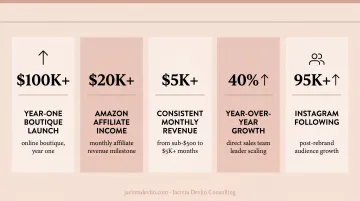
- Lisa K. (boutique owner) — $100,000+ in sales in her first year, starting from zero
- Sharon B. (Amazon affiliate) — grew from $4,000 total in her first year to $20,000+ per month
- Joy W. (direct sales and boutique) — went from $500/month to consistent $5,000+ months
- Carissa P. (Park Lane Jewelry) — 40% year-over-year business growth through 1:1 coaching
Jacinta has coached and trained thousands of women entrepreneurs across social selling, boutique retail, affiliate marketing, e-commerce, and online coaching. If you're ready to find out whether her programs are the right fit for your business, you can book a free 15-minute Growth Chat at jacintadevlin.com — a no-pressure call where Jacinta assesses your specific situation and either recommends the right program or tells you honestly that a different path makes more sense.
Frequently Asked Questions
What qualities should I look for in a business coach?
Prioritize real-world business experience over credentials — look for a coach who has built what they teach. The most important qualities are a relevant track record with clients in similar businesses, the ability to build a personalized strategy, and a communication style that challenges you while building your confidence.
How do I know if a business coach is the right fit for me?
Fit comes down to trust, communication style, and relevance of experience. A good coach will ask as many questions about your business as you ask about them. You should leave a discovery call feeling clearer and more energized, not pressured into a decision.
What is the difference between a business coach and a business consultant?
A consultant typically delivers a finished plan or solution, while a coach works alongside you to build your own strategy and skills over time. Many strong coaches blend both approaches — combining strategic guidance with ongoing accountability and, in some cases, done-for-you execution.
What are red flags to watch out for when hiring a business coach?
The main warning signs: guaranteed income promises, high-pressure sales tactics, no verifiable client results, and programs that are really just pre-built courses sold as personalized coaching. The FTC has taken action against multiple coaching schemes making false earnings claims — treat those red flags seriously.
Do I need a business coach who has experience working specifically with women?
Not strictly, but it matters more than most people expect. A coach who has worked extensively with women entrepreneurs will recognize the specific growth patterns, confidence barriers, and business challenges that come up — and won't waste your time figuring out context that a specialist already knows.
How much should I expect to invest in a business coach?
Coaching rates vary widely based on experience, format, and depth of support. The ICF reports an average of $234 for a one-hour session, but comprehensive 1:1 programs typically run higher. Evaluate the coach's documented client results first — price is secondary to whether the work will actually move your business forward.