
The missing piece is almost always the same: no intentional sales funnel. Not a prettier theme, not more Instagram followers. A deliberate, connected sequence that moves visitors from first discovery to purchase to repeat buyer.
According to Littledata's benchmark of 2,800 Shopify stores, the average Shopify conversion rate is just 1.4%. The top 20% of stores convert at 3.2% or higher. That gap isn't luck — it's the result of a funnel that's intentionally built instead of accidentally assembled.
This article walks through exactly how to build that funnel: what to do first, what the steps look like in sequence, and what actually determines whether it converts.
Key Takeaways
- A Shopify sales funnel is a deliberate sequence — from awareness to purchase to repeat buying — not a collection of disconnected pages
- Most stores underperform because funnel stages are missing or unconnected, not because the products are wrong
- A high-converting funnel gets four things right in sequence: audience, traffic, conversion experience, and follow-up
- Your product page copy, email sequences, and post-purchase experience matter more than traffic volume
- Sending traffic to your homepage and skipping email capture are common, fixable mistakes
What Is a Sales Funnel on Shopify and Why It Matters
A sales funnel is the specific sequence of steps a visitor moves through — from first hearing about your brand to making a purchase to becoming someone who buys again. On Shopify, that means your traffic sources, landing pages, product pages, checkout, and post-purchase emails working as one connected system rather than isolated pieces.
Many store owners focus on marketing (building awareness and interest) but ignore the sales side (converting that interest into purchases). A complete funnel handles both.
What Are the Stages of a Sales Funnel on Shopify?
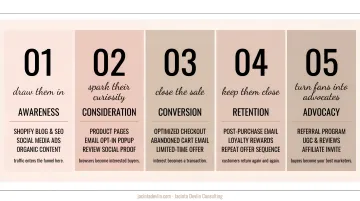
The four core stages map directly onto your Shopify store:
- Awareness — A potential customer discovers your brand via social media, search, or a referral
- Interest — She browses your content, explores your products, or joins your email list
- Desire — She reads your product page or email sequence and decides she wants what you're offering
- Action — She completes the purchase
There's also a fifth stage most stores skip entirely: Retention. This is where sustainable revenue actually compounds. A customer who buys twice is far more likely to buy a third time — and she cost you nothing extra to acquire. Stores that ignore retention are essentially pouring money into acquiring customers they never fully monetize.
What You Need in Place Before You Start Building
The most common mistake is going straight to apps and tools before answering basic strategic questions. Tools built on a vague strategy produce vague results — something Jacinta Devlin sees consistently when she starts working with a new ecommerce client. Her Business Launch Program begins with market research, competitive audits, brand positioning, and messaging clarity before a single Shopify page is built.
Three questions to answer before touching any tool:
- Who exactly is your customer? Not "women aged 25-45" — but her specific problem, what she's searching for, and what objection is stopping her from hitting "buy now"
- What is your core product/service or flagship product?
- What action do you want visitors to take at each stage of the funnel?
Baseline technical requirements that must be working:
- A professional Shopify theme that loads quickly on mobile
- Product pages that communicate benefits, not just features
- A functioning checkout with multiple payment options (including guest checkout)
- Shopify Analytics set up so you can see where visitors are dropping off
Start with a single product — your best-selling or most natural entry point. Lisa K. of Fleur de Lis Boutique Florida used this approach — a focused launch built around one boutique concept — and hit $100,000 in her first year.
How to Build a High-Converting Sales Funnel on Shopify
Step 1: Define Your Audience and Funnel Goal
Before writing a single word of copy or installing any app, get clear on two things: who this funnel is for, and what one measurable outcome you want it to produce.
Build a simple customer avatar:
- What problem is she trying to solve?
- What's her hesitation before buying?
- Where does she spend time online?
- What does she need to see before she trusts you enough to buy?
Every funnel decision — your headline, your imagery, your email subject lines — flows from this. Get it right here and the rest becomes cleaner. Skip it and you'll spend months optimizing the wrong things.
Then pick one funnel goal: capturing email leads, driving first purchases, or increasing average order value. Trying to optimize for all three simultaneously is why most funnels stall.
Step 2: Drive Awareness-Stage Traffic to Your Store
Once your goal is locked in, every traffic decision gets easier. Traffic must be intentional and matched to your audience. The three most effective awareness channels for Shopify sellers targeting women buyers:
- Paid and organic social — Instagram and Facebook remain the highest-leverage platforms for women-owned product brands. Reels, Stories, and Facebook Groups drive qualified discovery traffic when the content speaks directly to your buyer's world
- Influencer and affiliate partnerships — Creators who already speak to your exact customer are a faster path to qualified traffic than building an audience from scratch
- SEO-optimized content — Blog posts and product descriptions optimized for organic search capture buyers who are already actively looking — and already warm
One rule that matters more than any of these: send awareness traffic to a specific product page or landing page, never your homepage. Your homepage is a "choose your own adventure" — visitors can go anywhere and most will go nowhere. A focused page gives you control over what happens next.
Step 3: Capture Interest with Lead Magnets and Email Opt-Ins
Research from Episerver found that 92% of first-time website visitors aren't there to buy. That means if you're not capturing their contact information before they leave, you have no way to follow up. Every traffic campaign starts from zero.
Four lead magnet formats that work reliably for Shopify stores:
- A discount code popup — still the most common, and still effective. Popups average a 3.77% signup rate according to Omnisend
- A style quiz or product recommendation tool that delivers a personalized result
- Early access to a new product drop
- A free guide relevant to your niche
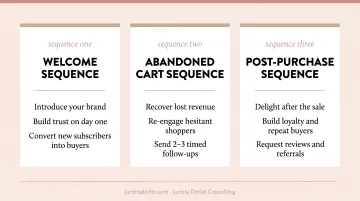
Once you capture the email, you need a welcome sequence that does more than confirm a signup. Jacinta's team builds 5–7 email welcome sequences for clients — enough to introduce the brand, build trust, demonstrate value, and bring subscribers back to the product before they forget you exist.
Flodesk is Jacinta's recommended platform for most Shopify boutique clients. Klaviyo is a strong alternative for stores that need more advanced segmentation as they scale.
Step 4: Convert Browsers into Buyers
Your product page is the highest-leverage page in your entire funnel. This is where desire is either created or lost.
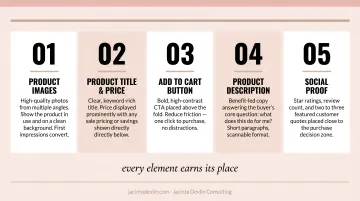
A high-converting Shopify product page needs all five of these:
- A benefit-driven headline (not just the product name)
- Lifestyle imagery that helps your customer picture herself using the product
- A featured customer testimonial near the buy button
- A clear, simple CTA — "Add to Cart" or "Buy Now," not both
- Visible trust signals: return policy, guarantees, payment options
Reducing abandonment at checkout matters just as much. Baymard's analysis of 50 ecommerce studies found an average cart abandonment rate of 70.22%. The top reasons: unexpected extra costs (39%), slow delivery (21%), and required account creation (19%).
Fix these by offering guest checkout, showing shipping costs early, and adding a progress indicator to the checkout flow. Then set up an abandoned cart email sequence — minimum 2–3 emails, with a time-limited incentive in the final one. Klaviyo's benchmark data shows abandoned cart flows average a 50.5% open rate and $3.65 revenue per recipient — one of the highest-ROI automations available to any Shopify store.
Three ways to increase average order value at the purchase moment:
- Order bumps — a relevant add-on offered directly at checkout
- Product bundles with a slight discount baked in
- Post-purchase upsell pages that appear immediately after the sale
Step 5: Build Post-Purchase Retention
The sale is the beginning of the relationship, not the end. Most stores treat the purchase as a finish line — which means they're working twice as hard as they need to.
A basic post-purchase email sequence:
- Order confirmation — confirms the purchase, sets delivery expectations, and reinforces that she made a good decision
- Day 3–5 follow-up — share usage tips, ask for a review, or invite her to your social community
- Day 14–28 replenishment email — product/service the logical next purchase based on what she already bought
Retention tactics that work well for boutique and lifestyle brands:
- Loyalty rewards programs tied to purchase frequency
- Referral incentives for customers who bring in friends
- VIP customer segments with early access to new drops
- Post-purchase + loyalty email sequences (Jacinta's team builds these as a standard deliverable for boutique clients)
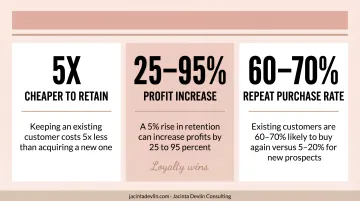
The economics are clear: according to Harvard Business Review, acquiring a new customer costs 5 to 25 times more than retaining an existing one. A 5% increase in retention can lift profits by 25–95%. If your average order is $60 and a loyal customer buys four times a year, her lifetime value is $240 annually — and you only paid to acquire her once.
Key Variables That Determine If Your Funnel Converts
Two store owners can follow the same funnel steps and get completely different results. Four variables control whether a funnel compounds or stalls. Here's what actually separates the ones that do.
1. Your Product Page Copy and Visual Experience
Copy that lists features without describing outcomes kills conversion — even with strong traffic. High-converting product pages lead with the customer's problem, describe the transformation your product creates, and close with urgency or social proof. What your buyer is thinking when she lands on your page is more important than what you want to say about the product.
2. Your Traffic Source and Audience Match
Traffic quality matters more than volume. Driving the wrong audience to your funnel means no amount of product page optimization will save your conversion rate.
Watch for these warning signs of a traffic mismatch:
- High session counts with low add-to-cart rates
- High bounce rates on product pages
- Email open rates below your industry average
The Shopify average conversion rate is 1.4%. If you're well below that, start by examining whether your traffic matches your actual buyer — not just your target demographic.
3. Your Email Follow-Up Sequence
Litmus reports email marketing generates an average return of $36 for every $1 spent — the highest ROI of any channel in ecommerce. One welcome email is not a sequence. A real sequence moves a cold subscriber through multiple touchpoints before asking for a purchase. At minimum, you need three automations running: a welcome series, an abandoned cart series, and a post-purchase series.
4. Your Post-Purchase Experience
Customer lifetime value — not first-purchase revenue — is the real measure of funnel success. Shipping speed, packaging quality, and the emails your customer receives after buying directly determine whether she comes back. Design the post-purchase experience before you need it. The second sale is where funnels start paying for themselves.
Common Mistakes That Kill Shopify Sales Funnels
Most funnel problems come down to a short list of fixable decisions:
- Sending traffic to the homepage — every paid ad and social link should point to a specific product page or landing page. Homepages bleed conversions.
- Skipping email capture — without a list, you can't follow up with the ~92% of visitors who don't buy on their first visit. Every new traffic campaign starts from zero.
- Treating the funnel as "set it and forget it" — copy that worked six months ago may not be resonating now. Around 77% of firms run A/B tests, with 71% running two or more per month — regular testing is what keeps a funnel growing instead of stalling
- Focusing entirely on acquisition while ignoring retention — new customers cost 5–25x more to win than to keep. If your funnel is all acquisition and no retention, you're on a treadmill.
Avoiding these mistakes is straightforward once you know what to look for — the harder part is building the right system around your specific store from the start. Jacinta Devlin's Done-For-You Marketing Systems are built for women with existing Shopify stores who want the funnel structured correctly, without the expensive trial-and-error. Her Business Growth Program pairs ongoing 1:1 coaching with the initial build for women ready to scale past it.
Frequently Asked Questions
What are the stages of a sales funnel on Shopify?
The four core stages are Awareness (discovery), Interest (engagement and consideration), Desire (wanting the product), and Action (purchase). A fifth stage, Retention, is where sustainable revenue compounds — turning one-time buyers into repeat customers and stretching the return on every dollar you spent acquiring them.
How much does Shopify take from a $20 sale?
If you're using Shopify Payments, there's no additional transaction fee — only standard credit card processing rates. If you use a third-party payment provider, Shopify charges a transaction fee of 2% on the Basic plan, 1% on the Shopify/Grow plan, and 0.6% on the Advanced plan. Factor these into your pricing and margin calculations when building your funnel.
How long does it take to build a sales funnel on Shopify?
A minimum viable funnel — product page, email opt-in, welcome sequence, and abandoned cart emails — can typically be set up in one to two weeks. A complete funnel with post-purchase retention automation takes 30–60 days to build and begin optimizing. Timelines vary based on your starting point and whether you're building it yourself or working with a done-for-you team.
Do I need a funnel builder app for Shopify?
Shopify's native tools can handle the basics: product pages, Shopify Email, and Shopify Analytics cover the core funnel elements. As your store grows, Klaviyo adds meaningful email segmentation and automation capabilities, and a landing page builder becomes useful when you need more design control beyond standard Shopify templates.
What is a good conversion rate for a Shopify sales funnel?
The average Shopify store converts at 1.4%. The top 20% convert at 3.2% or higher, and the top 10% exceed 4.7%. In fashion specifically, top-performing stores hit 6.1%. A well-built funnel with strong email follow-up and accurate audience targeting can push well past the average — but that starts with pinpointing exactly where in the funnel visitors are dropping off.
How do I drive traffic to my Shopify sales funnel?
The three primary traffic sources for Shopify sellers are paid social ads (Meta/Instagram), organic social content and influencer partnerships, and SEO. Channel choice matters less than audience fit. Traffic from the wrong people won't convert regardless of volume. Start with the channel where your actual buyer is most active, and send all traffic to a specific product page, not your homepage.