

Here's the reality: 84.2% of the U.S. interior design workforce is women, according to Data USA's 2024 workforce data. Yet the average female interior designer earns $69,482 annually compared to $83,008 for her male counterparts — a gap that doesn't come from a talent deficit. It comes from undercharging, underselling, and running a business without the right strategy in place.
Being an extraordinary designer and running a profitable design business are two completely different skill sets. The gap between them is exactly where most women get stuck.
This post covers five practical business coaching tips for women interior designers — from defining your niche to pricing confidently, building systems, marketing consistently, and knowing when outside support becomes the smartest move you can make.
Key Takeaways
- Niching down attracts better clients and makes pricing easier — not harder
- Undercharging is a positioning problem, not a math problem
- A chaotic business means the business is running you — systems fix that
- Consistent marketing beats perfect marketing every single time
- A business coach is not a marketing consultant or bookkeeper — the problems they solve are different
Why Women Interior Designers Struggle to Grow
Design school teaches you to design. It does not teach you to run a business.
CIDA's 2024 accreditation standards include broad topics like financial management and client relations — but pricing strategy and sales psychology are not required curriculum. That gap sends most designers into the market to figure it out through expensive trial and error.
Once a design practice picks up momentum, a familiar pattern emerges:
- Too many projects at different stages with no centralized workflow
- Endless back-and-forth emails with clients and contractors
- No time to think strategically about where the business is heading
- Revenue that fluctuates wildly month to month
This "firefighting" mode feels productive. It isn't — it's a sign the business lacks the infrastructure to grow sustainably.
The operational chaos also masks a deeper problem: confidence. A 2013 Forbes report on women entrepreneurs found that fewer than half of women felt confident they could successfully start a business, compared to nearly two-thirds of men. For women in creative fields specifically, this translates into chronic undercharging, over-delivering, difficulty holding boundaries, and saying yes to clients who drain every last resource.
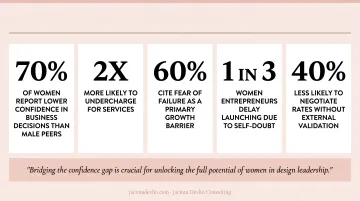
These aren't personal failings. They're systemic patterns — and recognizing them is the first step toward building a business that actually works.
Tip 1: Define Your Niche and Get Clear on Your Ideal Client
Niching down feels terrifying when you're trying to fill your calendar. The fear is logical: narrowing your focus seems like turning away work. Research consistently shows the opposite is true.
A clear niche sharpens every other area of your business:
- Pricing becomes easier — specialists command higher fees than generalists
- Referrals become more targeted — happy clients send more clients just like themselves
- Marketing becomes more effective — specific messaging attracts the right audience
- Onboarding becomes streamlined — you know exactly what to expect from each project
Staying broad doesn't protect your calendar — it fills it with the wrong clients. The ones who question every line item, demand more than they're paying for, and drain your energy before the project wraps.
Find Your Niche With These Questions
Start here. Take 20 minutes with a notebook and answer honestly:
- Which past project energized me most — and what made it different from the rest?
- What type of client made the work feel easy and collaborative?
- What aesthetic, lifestyle, or design category do I naturally gravitate toward?
- What budget range do I need clients to have for a project to actually be profitable?
- If I could only take one type of project for the next two years, what would it be?
Your answers won't hand you a perfectly packaged niche statement. They'll do something more useful: show you where your best work, best clients, and best margins already overlap. That overlap is your positioning.
When your portfolio, website copy, and social media all speak to one specific client with one specific problem, the right inquiries start coming in. The wrong ones stop.
Tip 2: Price Your Services With Confidence
Undercharging in interior design is almost never a math problem. It's a confidence and positioning problem.
Most designers set rates based on fear — fear of losing the client, fear of seeming too expensive, fear that the market won't support a higher number. So prices get set just low enough to feel "safe" — and those low rates attract clients whose budgets and expectations match exactly.
Know Your Billing Model Options
According to Architectural Digest, most designers use one of four models:
| Model | How It Works | Best For |
|---|---|---|
| Flat/Fixed Fee | One price for the full scope | Well-defined project scopes |
| Hourly | Billed by time spent | Consultations, small projects |
| Cost-Plus | Design fee + product markup | Procurement-heavy projects |
| Hybrid | Combination of above | Complex, multi-phase projects |
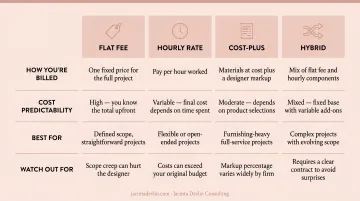
Flat fee and hybrid models tend to support stronger profit margins because they're not capped by billable hours. If your income has plateaued, the billing model is worth examining.
Run a Pricing Audit
Before changing anything, get clear on what's actually happening:
- Pull your last 3–5 completed projects
- Add up every hour you actually worked — design, client calls, contractor coordination, revisions, admin
- Divide your fee by those hours
- Look at your effective hourly rate
For most designers who do this honestly, the number is uncomfortable. That discomfort is useful — it's what finally moves you to change.
That number tells you exactly where to start. Raise your rate, refine your positioning, and your client profile shifts — higher-budget clients bring cleaner projects, clearer communication, and referrals that match their level.
Tip 3: Build Business Systems That Eliminate the Chaos
A chaotic business isn't a sign you're thriving — it's a sign the business is running you.
ASID data from 2022 found that 58% of interior design projects experienced delays that same year, with 65% of designers citing product availability as their top concern. Behind every delayed project is a workflow gap — and those gaps are fixable with the right systems.
The Four Core Systems Every Design Business Needs
- Client onboarding process — a documented, repeatable intake sequence from first inquiry to signed contract
- Project management workflow — one place where every project lives, with clear milestones and communication threads
- Contract and scope-of-work process — a clear standard for what's included and what triggers a change order
- Financial tracking routine — weekly or monthly review of revenue, outstanding invoices, and project profitability
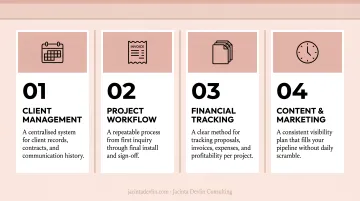
None of these require expensive software. They require consistency.
Stop Running on Reactive Mode
Most designers think they have a marketing problem. Often the real issue is that the delivery experience is disorganized — and disorganized delivery creates clients who refer others expecting low-boundary, chaotic service.
Fix the foundation first. Marketing a broken system doesn't bring in better clients — it brings in more of the same clients, faster.
Block one hour per month — at minimum — to step out of active project work and look at your business from the outside. Where is it heading? What's not working? What are the next 90 days actually for? That one hour of strategic thinking is worth more than ten hours of reactive execution.
Tip 4: Market Yourself Consistently and Strategically
Most women interior designers fall into one of two marketing traps: doing nothing for months and then posting in a panic, or trying to be everywhere at once and burning out by week three.
Neither works. Consistency matters far more than perfection or volume.
Interior design is a visually driven business — and that's an advantage for social media marketing. Content formats that build trust with prospective clients include:
- Before-and-after project reveals
- Behind-the-scenes process shots and videos
- Client testimonials (video especially)
- Material sourcing and design decision breakdowns
- Day-in-the-life studio content
You don't need to post daily. You need a rhythm you can maintain — even when a project is in full swing.
Sequence Matters: Foundation Before Volume
That content strategy only works when the foundation underneath it is solid. Marketing should come after pricing is set, your niche is defined, and the client experience is one you're proud of. When those pieces are in place, visibility accelerates growth instead of exposing cracks.
Marketing a broken backend only brings in more of the wrong clients faster. Get the systems, pricing, and positioning dialed in first: then turn up the volume.
Tip 5: Know When to Bring In a Business Coach
There's a specific ceiling that many interior designers hit, and pushing through it alone is genuinely difficult.
Signs You've Hit That Ceiling
- Income has plateaued even though your calendar is full
- You're exhausted and can't see how to grow without adding more hours
- The same client or pricing problems keep repeating despite your best efforts
- You've tried online courses or group programs and gotten limited traction
- You know something needs to change but can't see clearly enough to know what
These are not signs of failure. They're signs you need a personalized strategy — not more information.
What a Business Coach Actually Does
Each of these roles serves a different function:
- A marketing consultant addresses visibility and lead generation
- A bookkeeper handles financial records
- A brand designer builds visual identity
- A business coach identifies what's actually holding the business back, builds a custom strategy around your specific situation, and provides accountability to implement it
YouTube videos, free webinars, and DIY courses are everywhere. What's missing for most business owners is a personalized strategy and someone in their corner helping them execute it.
That's exactly what the 1:1 Business Growth Program with Jacinta Devlin Consulting is built around. Jacinta has helped women entrepreneurs move from inconsistent months to consistent $10K+ revenue — working directly with each client on strategy built around their specific business model, offer, pricing, and audience.
The program includes weekly Zoom strategy calls with Jacinta herself, a personalized growth plan, and accountability between sessions.
This isn't a group program where you share 60 minutes with 15 other people. It's custom, individual work — which is what most service-based business owners actually need.
If you're ready to stop guessing and start building something that actually grows, book your free 15-minute growth chat here.
Frequently Asked Questions
What is the average cost of a business coach for interior designers?
According to the ICF's 2025 Global Coaching Study, the average hourly coaching fee globally is $234, with North American coaches averaging higher. Group programs range from a few hundred to a few thousand dollars; 1:1 retainers typically start around $3,500 and scale with the coach's experience and results track record.
How do I grow my interior design business?
The core levers are: define a clear niche, charge rates that reflect your actual value, build repeatable systems, market with consistency rather than bursts, and get strategic support when you hit a ceiling you can't break through on your own. These five areas compound — fixing one makes the others easier.
Do I need a business coach or a marketing consultant?
A marketing consultant addresses visibility and lead generation. A business coach addresses the broader strategy, operations, pricing, and confidence issues affecting the whole business. Most interior designers need the latter before the former — marketing a business that has unclear positioning or a chaotic backend just brings in more of the wrong clients faster.
How do I stop undercharging as an interior designer?
Start by treating it as a positioning and confidence problem, not a math problem. Know your true cost of doing business (including your time), understand the specific value you deliver to clients, and align your pricing with the clients you actually want. Raising your rates without refining your positioning rarely sticks — both have to move together.
When is the right time to hire a business coach for my design business?
There's no single right moment, but the clearest signals are: income has plateaued despite being fully booked, the same problems keep repeating despite effort, or you're ready to grow but aren't sure which moves to make next. Any one of those is enough reason to start the conversation.