
Introduction
You're posting consistently. You're showing up. And you're still hearing crickets.
This is the frustration Jacinta Devlin hears from nearly every female entrepreneur who walks into her coaching practice. They're not lazy — they're active. The problem, as Jacinta puts it directly, is that "you don't have a social media problem. You have a strategy problem dressed up as a social media problem."
The opportunity is real. Global social media users reached 5.79 billion as of April 2026, with people spending an average of 141 minutes per day on social platforms. Small businesses that approach this strategically can compete with brands 10 times their size at a fraction of the cost.
That opportunity only materializes with a plan behind it.
This guide breaks down what that plan actually looks like — from picking the right platform for your business to building content that drives sales, growing an audience that buys, and tracking what moves the needle. Whether you're launching, scaling, or stuck in a plateau, the goal is the same: turn your social presence into a real revenue channel.
Key Takeaways
- Choose 1-2 platforms where your ideal customer already spends time — not every platform at once
- Lead with value: 80% of posts should educate, inspire, or entertain before you sell
- Engagement beats follower count — a smaller, active audience converts far better than a large, passive one
- Review your metrics monthly at minimum; analytics tell you what's actually working
Why Social Media Marketing Still Matters for Small Businesses in 2026
It's Now a Primary Discovery Channel
Social media has shifted from a marketing add-on to the place people actually go to find and evaluate businesses. Research from Sprout Social found that 41% of Gen Z turns to social platforms first for information, surpassing traditional search engines — and 90% of Gen Z users say social content influenced a purchase in the last six months.
For product-based businesses in particular, social platforms have become direct sales channels. TikTok Shop held 18.2% of US social commerce in 2025, with US social commerce forecast to exceed $100 billion in 2026. According to Modern Retail, TikTok Shop reported US small-business seller sales rose 66% in 2025, with 215,000 active small sellers on the platform.
That commerce opportunity comes with a catch, though — and it's one small businesses are actually positioned to win.
The Authenticity Advantage
AI-generated content is flooding every feed, and consumers are noticing. SurveyMonkey found that 46% of consumers have a negative perception of companies using AI to generate content, and 43% are less likely to purchase from them.
This is a direct advantage for small businesses. The personality, the behind-the-scenes moments, the founder story — these aren't just nice-to-have content ideas. They're what stands out when polished, AI-assisted brand content blends into the background.
Four 2026 trends worth knowing:
- Social commerce features (TikTok Shop, Instagram Shopping) are removing friction between discovery and purchase
- Algorithm updates on TikTok and Facebook increasingly reward two-way engagement over broadcast-style posting
- Authentic, human-centered content consistently earns more organic reach than trend-chasing
- Roughly one-third of consumers think brands jumping on viral trends is "embarrassing," per Sprout Social — real resonates more than reactive
How to Choose the Right Social Media Platform for Your Business
The foundational rule: go where your ideal customer already spends time — not where your competitors are, and not where you feel most comfortable. A focused presence on one or two platforms consistently outperforms a thin presence across six.
Platform-by-Platform Breakdown
Instagram and TikTok are strongest for visual products, lifestyle brands, boutiques, fashion, beauty, and direct-to-consumer businesses. Instagram reaches 182 million US users, with a female-skewing audience (54.5% female) — making it the default starting point for most women-owned product brands.
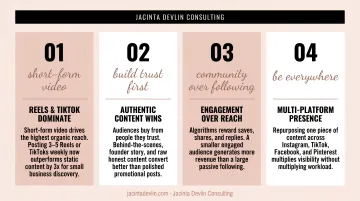
TikTok's 153 million US users skew younger, and its social commerce momentum is unmatched right now. Short-form video — Reels, TikToks, and Stories — drives the highest organic reach for product-based brands in 2026.
Facebook remains the largest platform by adult US reach (197 million US ad audience) and the strongest tool for community building through Groups, local business visibility, and reaching audiences 35 and older. It pairs particularly well with a small paid budget to extend organic reach.
Pinterest is chronically underused by small businesses. It's a high-intent discovery platform — users are actively searching for ideas, products, and solutions. 85% of weekly US Pinterest users have made a purchase from Pins. For boutique owners, LTK creators, and home goods brands, this platform deserves serious attention.
LinkedIn is the right platform for service-based businesses, coaches, consultants, and anyone targeting professional or B2B audiences. It's the strongest channel for thought leadership content and establishing credibility with decision-makers.
Three Questions to Narrow Your Platform Choice
Before committing to any platform, answer these honestly:
- Who is my ideal customer, specifically? Age, interests, shopping habits, and where they spend time online
- What type of content can I realistically create and sustain? Video requires different capacity than static images or written posts
- Where are my competitors finding customers? Not to copy them — but to confirm there's an active audience there
Those answers point to 1-2 clear choices. Start there, go deep, and don't expand to additional platforms until you have real traction on the first.
How to Build a Content Strategy That Actually Converts
Strategy vs. Posting
There's a meaningful difference between posting and having a strategy. Posting is putting content out. Strategy means every piece of content serves a defined purpose — building trust, driving traffic, or prompting a purchase — and follows a plan.
Most small businesses stall not from lack of effort, but because they're posting without a framework built around their specific business and customer. Jacinta Devlin sees this constantly: women spending hours on content every week, but with no clear line between what they're posting and how they're making money.
Building Your Content Pillars
Content pillars are 3-5 recurring themes that anchor all your posts and ensure variety without randomness. They eliminate the "what do I post today?" spiral that leads to inconsistent content.
Examples relevant to women entrepreneurs and small business owners:
- Educational tips — teach your audience something valuable related to your niche
- Behind-the-scenes — show your process, your workspace, your day
- Customer stories and testimonials — let results speak for you
- Product or service features — show what you product/service in context, not just as a catalog image
- Founder story — your journey, your "why," what makes you different
The goal is that every post fits one of these pillars. This creates a recognizable, intentional presence instead of a random stream of content.
The 80/20 Content Mix
Apply this ratio to your content calendar:
- 80% value-driven — educate, entertain, inspire, or relate to your audience
- 20% promotional — direct pitches, offers, sales announcements
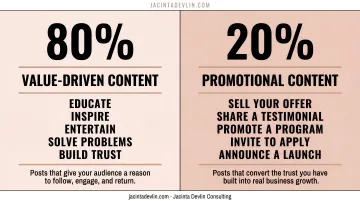
This ratio builds the trust that makes your promotional content feel natural rather than pushy. Audiences follow accounts that give them something. When you lead with value consistently, the 20% that asks for a sale lands very differently than it would from an account that opens with "buy this."
Format and Cadence
A practical starting point for most small businesses: 3-4 posts per week on your primary platform, with Stories or short-form video filling in the gaps. This is sustainable and consistent — two things that matter more than posting daily for two weeks and burning out.
A few format guidelines worth following:
- Reels and TikTok videos drive higher organic reach than static posts on most platforms
- Carousels perform well for educational content and multi-step tips
- Stories work best for time-sensitive offers, polls, and behind-the-scenes content
- Batching content — recording or writing a week's worth in one sitting — reduces the daily friction that leads to inconsistency
Tools like Later, Buffer, or Meta Business Suite let you schedule in advance, so you're not scrambling to post in real time.
The Authenticity Edge
Scheduling the work is only half the equation. What you show up as matters just as much as how often you show up.
Polished corporate content is losing ground to authentic, human-first content. Founder stories, real customer transformations, unscripted behind-the-scenes moments — these consistently earn more organic reach than brand campaigns. For women entrepreneurs especially, this is a real advantage: your story, your face, and your specific experience are things a brand campaign can never replicate.
What authentic content looks like in practice:
- Sharing the "why" behind your business, not just what you sell
- Showing a customer result in her own words, not your pitch
- Posting an honest behind-the-scenes moment — even an imperfect one
How to Grow Your Audience and Turn Followers Into Paying Customers
Community Building Over Broadcasting
Growing a following requires active participation, not just publishing. That means:
- Responding to every comment, especially early — platforms reward early engagement signals
- Initiating conversations through polls, question stickers, and "reply to this" prompts
- Engaging with your followers' content, not just waiting for them to engage with yours
- Showing up as a real person, not a logo
Both TikTok's and Facebook's content distribution systems reward accounts where users actually interact — not just view.
Audience Growth Tactics That Work
Hashtags: Use targeted, relevant hashtags rather than generic high-volume ones. Quality matters more than quantity — a focused set of 5-10 hashtags that reach your specific audience outperforms 30 generic tags.
Collaborations: Partner with complementary brands or micro-influencers who serve the same audience. A boutique owner and a jewelry designer serving the same customer type can cross-promote with genuine mutual benefit. Micro-influencers consistently deliver higher engagement rates and lower cost per engagement than macro-influencer campaigns — making them a smarter starting point for most small businesses.
Social commerce features: Use TikTok Shop, Instagram Shopping, and LTK storefronts to shorten the path from discovery to purchase. Every extra step between seeing your product and buying it is a drop-off opportunity — these tools eliminate most of them.
The Follower-to-Buyer Conversion Path
Followers don't automatically become customers. Converting them requires several things working together:
- Consistent, trust-building content that establishes your credibility before you ask for anything
- A clear call to action — not vague "link in bio" mentions, but direct, specific instructions
- Lead capture — move followers off rented social media land and onto your email list, which you own and control. Conversion rates from email are typically far higher than from social posts
- A follow-up system — welcome sequences, nurture emails, and sales content that builds toward a purchase decision over time
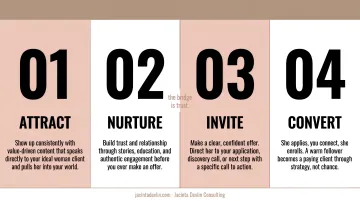
Getting that conversion path right is what determines whether your social strategy actually generates revenue — or just generates likes. That's also where the organic vs. paid decision starts to matter.
Organic vs. Paid: Finding the Balance
Start with organic content. It teaches you what resonates with your audience before you spend money amplifying anything.
Once you have posts that are genuinely performing — strong engagement, saves, shares — those are your candidates for paid boosting. Putting a small budget behind a proven organic post extends its reach to new audiences without the risk of running a cold ad with untested creative. It's a lower-pressure entry point into paid social than building a full ad campaign from scratch.
Measure What Matters: Tracking Social Media Success
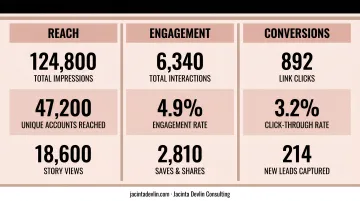
Measurement starts with tying your metrics back to your original goal — because the number you should care about depends entirely on what you're trying to achieve.
| Goal | Metrics to Track |
|---|---|
| Brand awareness | Reach, impressions, follower growth |
| Engagement | Likes, comments, shares, saves |
| Traffic | Click-through rate, website sessions from social |
| Revenue | Conversions, sales from social, revenue per post |
Every major platform — Instagram Insights, Facebook Insights, TikTok Analytics, Pinterest Analytics — provides this data natively. Most small businesses have access to all of it. The gap is in actually reviewing it and making decisions based on what it shows.
Constant Contact found that the top frustration among small businesses is not knowing what's working in their marketing — and only 18% feel "very confident" in their marketing impact. Monthly analytics review is one of the most practical ways to close that gap.
What to do with the data:
- Expand on content themes and formats that consistently drive results
- Let underperforming content run for at least 30-60 days before pulling the plug — one bad week isn't a pattern
- Look for what drives saves and shares, not just likes — these are stronger indicators of content value
- Track which posts lead to profile visits or link clicks — those are the ones moving people closer to buying
Common Social Media Mistakes Small Businesses Make
Mistake 1: Too Many Platforms Spreading effort across 5+ platforms leads to inconsistent posting, lower-quality content, and burnout. The Constant Contact 2025 report found 42% of small businesses have less than one hour per day for marketing. That hour cannot cover six platforms effectively. Master 1-2 before expanding.
Mistake 2: Posting Without Engaging Treating social media as a broadcast channel — post and disappear — actively works against you. Algorithms favor accounts with two-way interaction. Block dedicated time to respond to comments and engage with others every time you post.
Signs you're falling into this pattern:
- You post consistently but get little to no reach growth
- Comments go unanswered for 24+ hours
- You never proactively engage with accounts in your niche
Mistake 3 — Over-Promoting Before You've Earned It Accounts that lead with sales pitches train their audience to scroll past. Every promotional post needs to be earned by the value-driven content that surrounds it. The 80/20 rule works in practice: 80% of your content builds trust, teaches, or entertains — and that foundation is what makes the other 20% convert.
Conclusion
Social media success for small businesses isn't about going viral. It's about showing up consistently for the right audience, with the right message, on the right platform — and connecting that content to real business outcomes.
The strategies in this guide give you a strong starting point. The businesses that grow fastest, though, work from a plan built specifically around their business — not a template borrowed from someone in a different industry with a different customer.
If you're ready to stop guessing and start building a strategy that actually generates revenue, Jacinta Devlin Consulting works with female entrepreneurs to do exactly that. Every client receives a customized growth strategy — not one-size-fits-all advice — built around their specific offers, audience, and revenue goals. Start with a free 15-minute growth chat to see if it's a fit.
Frequently Asked Questions
Which social media platform is best for small businesses in 2026?
There's no universal answer — the best platform depends on your audience, industry, and what content you can realistically create. Product-based businesses typically see strong results on Instagram and TikTok. Service-based businesses, coaches, and consultants often get better traction on LinkedIn or Facebook. Start where your ideal customer already spends time.
How often should a small business post on social media?
A realistic and sustainable starting point is 3-4 times per week on your primary platform. Consistency over time matters more than daily volume — an account that posts four times a week for six months outperforms one that posts daily for two weeks and burns out. Quality and response time to comments matter equally.
How do I turn social media followers into paying customers?
Build trust through consistent value-driven content first, then direct followers to a specific next step — a link in bio, a DM, or an email opt-in. Nurture those leads through a follow-up sequence before making a product/service. Most small businesses stall by expecting a direct purchase from a single post.
What type of content gets the most engagement for small businesses?
Authentic, relatable content consistently outperforms polished promotional posts. Behind-the-scenes footage, founder stories, customer testimonials, and educational short-form video tend to generate the strongest engagement. Polls and question stickers also perform well — they prompt a response rather than passive scrolling.
Should small businesses use paid ads or focus on organic content first?
Start with organic content to learn what resonates before spending money on amplification. Once you have posts genuinely performing, boosting them with a small budget extends reach to new audiences without the risk of running untested creative as a cold ad.
How long does it take to see results from social media marketing?
Most businesses start seeing meaningful traction — follower growth, engagement, inbound inquiries — within three to six months of consistent, strategic posting. The timeline varies by industry and sales cycle, but early engagement is a reliable signal that revenue will follow.