Introduction
Millions of small businesses have a Facebook presence. Most of them are posting into the void — collecting likes from friends and family, watching follower counts creep up, and wondering why none of it is translating into actual sales.
If that sounds familiar, you're not alone. The problem usually isn't effort. It's strategy.
Jacinta Devlin has spent 15+ years in social selling — long before "social selling" was a recognized term. As a Top 1% seller, million-dollar earner in direct sales, and former National Director of Sales & Field Training at Stella & Dot, she's trained 50,000+ women to build real businesses.
She's watched women generate consistent revenue from Facebook — and watched just as many spin their wheels. The difference almost never comes down to how often someone posts.
This guide covers the five things that actually move the needle: setting up a page that converts, building content that earns trust, growing community through Groups, using ads on a budget, and measuring what matters to your bottom line — not just your ego.
Key Takeaways
- A fully optimized Facebook Business Page builds credibility and makes it easy for customers to take action.
- The 80/20 rule — 80% value, 20% promotion — earns more organic reach and more trust than constant selling.
- Facebook Groups drive higher engagement than Pages and remain one of the most overlooked tools for small businesses.
- Even $5–$10/day in ads can drive real results when your targeting and objectives are dialed in.
- Track reach, engagement rate, and link clicks — not page likes — to know if your strategy is working.
Why Facebook Still Works for Small Business Growth
The Scale Is Hard to Ignore
According to Statista's 2025 global social network data, Facebook has 3.07 billion monthly active users — making it the largest social platform in the world. For small businesses that can't afford billboard campaigns or TV spots, that reach represents something traditional advertising never could: the ability to get in front of highly specific audiences without a massive budget.
Facebook's targeting goes well beyond basic demographics. You can reach people by:
- Location, age, and household income
- Interests, hobbies, and lifestyle behaviors
- Past purchasing behavior and brand affinity
- Niche communities — boutique shoppers, women in direct sales, community-driven buyers
That level of specificity is a genuine competitive advantage for small businesses competing against bigger budgets.
The Real Reason Many Businesses Struggle
Organic reach on Facebook isn't dead — it just works differently now.
The algorithm has changed. Posts don't automatically reach every follower. But businesses that treat Facebook as a community platform — not a broadcasting channel — are still seeing meaningful organic results.
Meta's own Feed ranking documentation confirms that posts are ranked on signals like genuine conversation and meaningful engagement. The businesses winning on Facebook today are the ones building relationships, not just pushing content out.
Set Up Your Facebook Business Page the Right Way
The Non-Negotiables
An incomplete Facebook Business Page silently turns customers away. Before you post a single piece of content, make sure these elements are in place:
- Profile photo — Use a professional logo or branded headshot, not a phone selfie
- About section — Write a clear, keyword-rich description; Meta's Graph API documents the
aboutfield at 100 characters, so lead with your most important information - Contact details and hours — Fill everything in completely; missing information creates doubt
- CTA button — Select the action that matches your goal: Shop Now, Book Now, or Contact Us. Meta Help Center confirms Page managers can add, edit, or delete this button at any time
Page vs. Personal Profile — Why It Matters
Meta's Terms of Service and Commercial Terms are clear: Pages are designed for businesses, brands, and organizations. Personal profiles are for personal use. Beyond the policy issue, Business Pages are the only way to access Ads Manager, Page Insights, a CTA button, and the Shop feature — tools you'll need as your business grows.
Keywords and Searchability
Most business owners skip this step entirely: adding searchable keywords to your Page name and About section. If someone searches "women's boutique Boston" or "business coach for women," your page needs to surface.
Think about what your ideal customer actually types into Facebook's search bar, then work those phrases in naturally. A few places to focus:
- Page name — Include your business category if it fits naturally (e.g., "Jacinta Devlin | Women's Business Coach")
- About section — Describe what you do and who you serve using the words your audience uses, not industry jargon
- Services tab — List specific offerings with descriptive titles; these are indexed in Facebook search
Build a Content Strategy That Actually Drives Sales
The 80/20 Rule in Practice
Post constant sales pitches and your audience learns to scroll past you. The algorithm notices too — posts that feel promotional tend to generate fewer interactions, which means less reach.
The 80/20 rule fixes this: 80% of your content should educate, entertain, inspire, or add value. Only 20% should be promotional. That ratio keeps your audience engaged and trains the algorithm to show your content to more people.
Which Formats to Use
Not every format performs equally, and mixing them matters. Here's what works well on Facebook right now:
- Short-form video and Reels — Best for discovery; new audiences find you through these
- Photo carousels — Strong for product showcases and storytelling
- Text posts with questions — Drive comments, which signal engagement to the algorithm
- Stories — Time-sensitive updates, behind-the-scenes moments, limited-time offers
- Live video — Real-time connection that builds trust faster than polished production
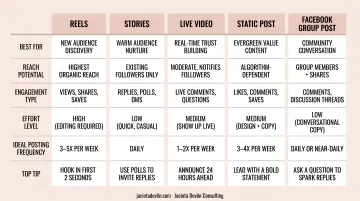
Rotate formats. An account that only posts static images (or only Reels) tends to plateau.
A Simple Weekly Content Rhythm
You don't need a full creative team to stay consistent. A 3-2-1 framework works well for most small businesses:
- 3 value-based posts — tips, education, inspiration, behind-the-scenes
- 2 engagement posts — questions, polls, conversation starters
- 1 promotional post — a product/service, product feature, or call to action
That's six posts per week if you push daily, or you can spread them across fewer days. The key is having a plan before you open Facebook, not improvising in the moment.
Captions That Stop the Scroll
Your first line determines whether anyone reads the rest. The strongest openers use one of three approaches:
- A direct question that calls out a pain point your reader already feels
- A bold statement that challenges a common assumption
- A behind-the-scenes detail that creates immediate curiosity
Close every post with a clear call to action — tell people exactly what to do next: comment below, click the link, send a DM. Personal storytelling (your journey, a customer win, a real moment) consistently outperforms scripted promotional copy for driving genuine engagement.
Pair strong captions with a content calendar. Meta Business Suite's free built-in scheduler or a tool like Buffer keeps you consistent without manually posting every day.
Grow Your Audience with Facebook Groups and Community
Pages vs. Groups: Know the Difference
Your Business Page is your brand's broadcast hub: the official face of your business. Your Group is where relationships actually form.
Meta reported that more than 1.8 billion people use Facebook Groups every month. Groups generate more organic engagement than Pages because the algorithm prioritizes meaningful interactions in group settings. Most small businesses set up a Page and stop there — leaving the higher-engagement channel completely untouched.
Two Approaches to Groups
You have two options — and both work:
- Join existing groups. Find niche or local groups where your ideal customers already spend time. Answer questions, share expertise, celebrate other members. Pitch nothing until people know and trust you. You become the go-to authority before anyone is ready to buy.
- Start your own branded group. Name it around what people actually search, not just your business name. "Women Growing Boutique Businesses Online" attracts new members organically. "Lisa's Corner" doesn't.
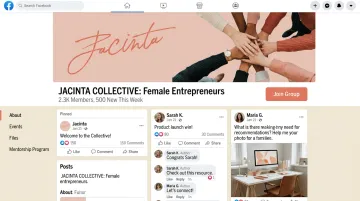
Jacinta Devlin built her own free Facebook community, Business Growth for Female Entrepreneurs, Social Sellers, Influencers, Direct Sellers & Business Owners, using exactly this approach. Two of her clients, Sharon B. and Christina R., each grew their Facebook Groups to 30,000+ members using the same group-first strategy under her coaching.
Messenger: Your Competitive Advantage
Big brands respond to customer messages with bots. You can respond like a human, and that distinction builds trust faster than any ad campaign.
Meta reports that 7 out of 10 consumers feel closer to businesses they can message. Facebook also publicly displays your Page's response time. Set up an automated instant reply so customers get immediate acknowledgment, then follow up personally as soon as you're available.
An engaged community of 500 loyal followers will consistently generate more actual sales than a page with 5,000 passive likes.
When and How to Use Facebook Ads on a Small Budget
Boosted Posts vs. Ads Manager
These are not the same thing. Meta defines a Boosted Post as an ad created from an existing organic post — quick to set up, limited in customization. Ads Manager gives you full control over campaign objectives, audience targeting, placements, and creative testing.
The smart approach: boost high-performing organic posts first to test messaging at low cost. Once you know what resonates, move into Ads Manager for campaigns with specific goals — website traffic, lead form submissions, or purchases.
Targeting the Right Audience
Broad targeting wastes budget. Start narrow:
- Use location, age, and interests to reach your ideal customer
- Custom Audiences — re-engage people who already visited your site or interacted with your content
- Lookalike Audiences — expand reach by targeting people who mirror your best existing customers
Meta's Help Center documents both Custom and Lookalike Audiences as available tools even at modest budget levels.
Practical Budget Guidance
Starting at $5–$20 per day is enough to test messaging before scaling. WordStream's 2025 Facebook Ads data puts the average traffic campaign CPC at $0.70 — a useful benchmark, though costs vary by industry, audience, and creative.
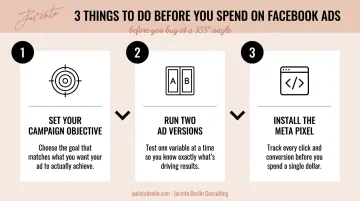
Three things to do before you spend a dollar:
- Set your campaign objective first. Awareness, engagement, and conversion campaigns work very differently. Matching the objective to your actual goal is what separates profitable ads from wasted budget.
- Run two ad versions. Test different creative or copy on the same audience to see what performs before committing larger spend.
- Install the Meta Pixel. It tracks what happens after someone clicks your ad, enabling smarter retargeting and more efficient spend over time.
Track What Matters: Facebook Metrics for Small Business Growth
Vanity Metrics vs. Business Metrics
Page likes feel good. They don't pay bills — here's the distinction that matters:
| Vanity Metrics | Business Metrics |
|---|---|
| Total page likes | Reach (unique viewers) |
| Total followers | Engagement rate |
| Impressions | Link clicks |
| Post views | DMs / leads received |
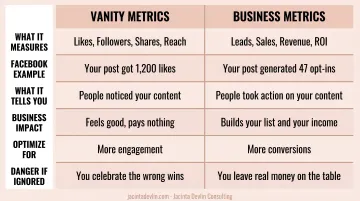
Focus on the numbers that connect to revenue, not the ones that feel impressive.
Three Metrics to Review Weekly
1. Reach — Meta defines reach as the number of unique accounts that saw your content at least once. Declining reach signals the algorithm isn't favoring your content; rising reach means it is.
2. Engagement Rate — Interactions (reactions, comments, shares, saves) divided by reach. Rival IQ's 2024 benchmark report puts the median Facebook engagement rate at 0.063% across industries — useful as a comparator, not a universal target.
3. Link Clicks and DMs — These signal purchase intent. Someone clicking your Shop link or sending a DM is closer to buying than someone who liked a photo.
Find all of this inside Meta Business Suite Insights — it's free and built into your Business Page.
Adjust Every 30 Days
Look at what generated the most comments and shares, then do more of that. Cut or revise what consistently underperforms. Small, consistent adjustments based on real data compound into measurable growth month over month.
Data tells you what happened. Strategy tells you what to do next. If you're tracking the numbers but aren't sure how to build a plan around them, Jacinta Devlin Consulting offers a free 15-minute growth chat for women entrepreneurs who are ready to turn their metrics into a business strategy built around their specific goals.
Frequently Asked Questions
How do I promote my small business on Facebook?
Start with a fully optimized Business Page, then post consistent value-driven content at least 3–4 times per week. Engage with comments and DMs, participate in or build Facebook Groups to grow community, and use boosted posts or targeted ads to expand your reach beyond current followers.
What is the 20 rule on Facebook?
The 80/20 rule means only 20% of your content should be promotional — selling, announcing offers, or pitching your products. The remaining 80% should provide real value through education, entertainment, inspiration, or behind-the-scenes content. That balance keeps your audience engaged and signals to the algorithm that your posts are worth showing.
How often should a small business post on Facebook?
Three to four times per week is a sustainable and effective starting point for most small businesses. Consistency and content quality matter far more than daily posting volume. A smaller number of intentional, engaging posts will consistently outperform daily filler content in reach, engagement, and audience growth.
Do I need a Facebook Business Page, or can I use my personal profile?
A Business Page is required for marketing a business. Personal profiles are governed by Meta's Terms of Service for personal use, and Business Pages unlock the tools you actually need: Ads Manager, Page Insights, a CTA button, and the Shop feature. None of those are available on a personal profile.
Should I use Facebook ads if I have a small budget?
Yes. Even $5–$10 per day can generate meaningful results when your audience targeting and campaign objective are set correctly. Starting small lets you test creative and messaging before scaling spend — which prevents wasting money on untested ads.
What types of Facebook content get the most engagement for small businesses?
Short-form video and Reels currently get the highest organic reach for discovery. Posts that ask questions or invite opinions drive the most comments. Personal stories, customer wins, and behind-the-scenes content consistently outperform polished promotional posts when it comes to genuine audience engagement and trust-building.