

Here's the thing most online business owners miss: there's a real difference between growing and scaling. Growing means more revenue requires more of you — more hours, more effort, more output. Scaling means revenue grows faster than your costs because systems, automation, and strategy are doing the heavy lifting.
That distinction matters everything when you're a woman building an online business and burnout is already knocking.
This guide walks through 6 concrete steps to scale an online business — what to put in place, the traps to avoid, and how to move from inconsistent income to consistent $10K+ months.
Key Takeaways
- Scaling is about building systems that work without you, not doing more
- Validate your product/service before investing in growth — or you'll scale the wrong thing
- Email automation and diversified revenue streams are your two highest-impact growth levers
- Delegation isn't optional — every woman running her business alone eventually hits a ceiling she can't hustle through
- Tracking profit margin, customer acquisition cost, and retention turns effort into real strategy
How to Scale an Online Business in 6 Steps
Step 1: Validate Your Offer and Nail Product-Market Fit
Scaling amplifies what already exists. If your product/service isn't resonating, scaling will only accelerate the problem, not solve it.
Stripe defines product-market fit as how well a product meets the needs of a specific market and solves at least one significant customer problem. Before investing in growth, you need to confirm yours.
Signs your product/service is validated:
- Repeat buyers coming back without heavy discounting
- Organic referrals — people recommending you unprompted
- Consistent demand across multiple months, not just one good week
- Customers who can clearly articulate why they chose you
To stress-test fit, look at which products or services drive the most revenue with the least friction. Who are your most loyal buyers? What brought them back? If you can't answer those questions, you're not ready to scale yet.
For social sellers and ecommerce brands specifically, brand story matters here. Online buyers don't just purchase products — they buy from people they trust. A clear, authentic brand narrative converts far better than a polished product page alone.
This is why Jacinta Devlin's clients go through brand identity development before any growth investment is made. A DIY-looking brand cuts willingness-to-pay and closes doors with brand partners before a single ad dollar is spent.
Step 2: Build Systems and Automate Your Operations
Most online businesses stall because the founder is the system. Remove yourself, and everything stops.
The fix isn't working harder. It's replacing yourself with documented processes and automation tools that run whether you're working or not. According to research from Time Etc, entrepreneurs spend an average of 36% of their workweek on administrative tasks. That's time that could be running automated flows instead.
The highest-impact areas to automate first:
- Email welcome and nurture sequences — generates 41% of total email revenue from just 5.3% of sends, at nearly 18x higher revenue per recipient than manual campaigns
- Abandoned cart recovery — non-negotiable for any product-based business
- Customer onboarding — a structured sequence eliminates manual back-and-forth
- Social media scheduling — batch content so visibility doesn't depend on your daily availability
- Lead magnet and opt-in funnels — the mechanism that captures email addresses automatically
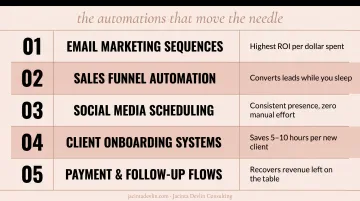
The right automation stack depends entirely on your business model. A social seller's priority sequence looks different from a boutique owner's, which looks different from a coach's.
This is exactly where individualized strategy pays off more than a generic course or template. Jacinta Devlin's team builds these systems for clients through her Done-For-You Marketing Systems service, covering everything from Flodesk and Klaviyo email flows to Shopify integrations, ClickFunnels, and Instagram DM automation. The goal: a business that converts audience into customers while you're not working.
Step 3: Grow Your Audience and Master Social Selling
Visibility is the fuel for scaling. You cannot reach $10K+ months on a small, stagnant audience; the math simply doesn't work.
US social commerce sales are projected to surpass $100 billion in 2026, which means the opportunity is real. But being on every platform isn't the answer.
What actually builds an audience that converts:
- Email list over social followers — Your list is owned real estate. Social platforms decide who sees your content; your email list doesn't have that problem
- Consistent presence on 1–2 platforms rather than scattered efforts across five
- Storytelling and personal brand content — authenticity builds the trust that converts
- Facebook group building as a long-term community asset — client Sharon B. grew two Facebook groups, one to 30,000+ members and one to 37,000+ members in four months, and scaled Amazon affiliate income from $4K in year one to $20,000+ per month consistently
On micro-influencers: Nano influencers now reach up to 11.9% engagement on TikTok, compared to far lower rates for macro accounts. Nearly half of consumers report making a purchase monthly because of influencer posts. Genuine community-driven endorsements convert at a rate that paid reach alone can't match.
The platform you prioritize matters. Boutique owners tend to see the most traction on Instagram and Pinterest. Social sellers and affiliates often get the best conversion through Facebook groups, Amazon, and LTK. Coaches need LinkedIn and YouTube alongside Instagram. Strategy should follow the business model, not the other way around.
Step 4: Add Scalable Revenue Streams
Trading time for money has a ceiling. There are only so many hours in a day, and at some point, adding more clients or orders doesn't produce more income. It just produces more exhaustion.
The shift from time-based to scalable revenue:
| Time-for-money model | Scalable alternative |
|---|---|
| 1:1 coaching sessions | Group program or membership |
| Custom service work | Digital product or course |
| One-time product sales | Subscription box or loyalty program |
| Social posting alone | Affiliate partnerships (Amazon, LTK) |
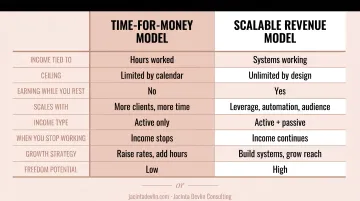
Scalable revenue streams compound. Annual subscription billing drives 50–60% more revenue per user than shorter billing cycles, according to Recurly's benchmark data on 76 million subscribers. One digital product or membership continues generating income without proportional effort added.
Matching the stream to your existing audience:
- Coaches can move into group programs or digital courses
- Boutique owners can add subscription boxes or loyalty memberships
- Social sellers can layer in Amazon storefronts, LTK, and brand partnerships
- Direct sales leaders can build team income as a leveraged revenue layer
Jacinta Devlin's clients have built multiple income streams within a single coaching year. Christina R. now earns "hundreds of thousands each month" across Amazon and LTK, starting from a rebrand and a Facebook group at zero. The key is matching the new stream to the audience already built, not starting from scratch.
Step 5: Delegate Strategically and Build a Team You Trust
Every solo founder eventually runs out of hours. The inability to let go isn't a personality trait. It's a business problem that stops growth regardless of how strong demand is.
Entrepreneurs who delegate effectively report 143% mean revenue growth compared to 80% for those who don't, according to a Time Etc survey of 251 US entrepreneurs. That gap is significant enough to take seriously.
How to start delegating without losing control:
- Document your own processes first — you can't hand off what isn't written down
- Identify low-value, time-consuming tasks: customer service, inbox management, content scheduling, order tracking
- Hire for those tasks before scaling up to higher-level roles
- Use contractors and VAs before full-time hires to keep fixed costs low while expanding capacity
Building a team doesn't require a payroll from day one. Virtual assistants and specialized contractors can cover the time-draining work that's pulling you away from the activities that actually grow revenue.
Jamie R. — influencer, DJ, and store owner — came to Jacinta managing three separate businesses with no documented systems. After consolidating her brand and automating her social media, she grew by 25–30 new followers per week. Not by adding hours, but by removing the manual dependency.
Step 6: Track Your Numbers and Optimize for Profitability
You can't optimize what you're not measuring. Yet 50% of US small business owners encounter fiscal challenges due to gaps in financial literacy, including interpreting financial metrics and managing cash flow.
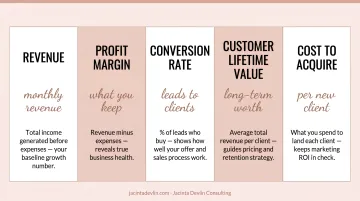
The metrics every online business owner must monitor:
- Monthly revenue — the baseline; track trends, not just totals
- Profit margin — revenue is vanity, profit is reality
- Customer acquisition cost (CAC) — what it costs to bring in each new buyer
- Customer lifetime value (CLV) — calculated as average purchase value × purchases per year × years retained
- Email list growth and conversion rate — owned audience is your most reliable revenue signal
Apply the 80/20 principle. Roughly 80% of your revenue comes from 20% of your products, customers, or channels. Shopify's ABC inventory analysis frames it the same way: A-grade products account for approximately 80% of revenue. Identify that 20% and double down there rather than spreading effort across everything equally.
Profitability, not just revenue, is the real measure of a scalable business. Scaling costs money. Reinvesting wisely requires knowing your numbers in real time, not at the end of the quarter.
Signs Your Online Business Is Ready to Scale
Scaling too early is as damaging as scaling too late. The foundation has to be solid first.
Signals that you're ready:
- Consistent monthly revenue for at least 3–6 months
- Strong repeat purchase or rebooking rates
- Organic referrals coming in without you asking
- Current capacity beginning to strain under demand
- At least one documented operational process
- Growing email list or engaged audience
- Positive profit margins — not just revenue
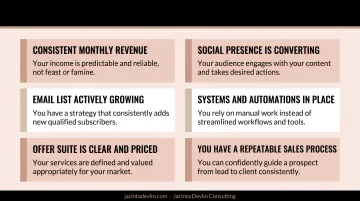
Signs you're not ready yet:
- Inconsistent monthly income with no clear pattern
- No defined niche or validated product/service
- Founder handling every task manually with nothing documented
- No clear picture of which activities are actually driving revenue
Knowing where you stand on these signals is exactly what shapes the right next step. In Jacinta's application-based intake process, women who come in pre-launch are directed toward the 12-Week Business Launch Program, while those who've launched but plateaued move into the Business Growth Program. Your current stage determines your strategy — and that's where real growth starts.
Common Mistakes That Stall Business Growth
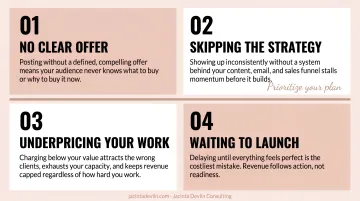
Most growth stalls aren't about effort — they're about avoidable mistakes. Here are four that come up again and again:
Scaling before the product/service is validated. Investing in ads, new hires, or new platforms before confirming consistent demand doesn't solve an unclear product/service — it amplifies the problem.
Building on hustle instead of infrastructure. If your business depends entirely on your daily presence, you don't have a business — you have a job. Growth requires systems that work without you.
Spreading across every platform instead of going deeper on one. Research from Constant Contact found that 56% of small businesses had one hour or less per day for marketing. Splitting that time across six platforms produces thin results everywhere instead of real traction anywhere.
Chasing new customers while ignoring the ones you already have. Acquiring a new customer costs 5 to 25 times more than retaining an existing one, according to Harvard Business Review. A 5% lift in retention can boost profits by 25–95%. Repeat buyers cost less and convert faster than cold leads.
Conclusion
The six steps work together as a foundation — validate the product/service, build systems, grow the audience, add scalable revenue streams, delegate, and track the numbers. Treating them as a checklist to race through is where most businesses stall.
The businesses that scale — with or without massive followings or big ad budgets — share one thing: a clear strategy and the systems to execute it without the owner trapped inside every moving part.
If you're ready to stop guessing and start building with a real plan, Jacinta Devlin works 1:1 with women entrepreneurs ready to scale — and she's built multiple six and seven-figure businesses across direct sales, ecommerce, affiliate marketing, and consulting herself. Start with a free 15-minute Growth Chat to see if it's the right fit.
Frequently Asked Questions
What is the difference between growing and scaling an online business?
Growth typically means revenue increases alongside proportional cost increases — more sales require more hours or headcount. Scaling means revenue grows faster than costs, achieved through systems, automation, and smarter operations rather than additional effort.
How do I know when my online business is ready to scale?
The clearest signals are consistent revenue across several months, repeat buyers, a validated product/service, and current capacity starting to feel strained. Readiness means you have a foundation worth building on — not just a desire to do more.
What are the 4 pillars of scaling up an online business?
Verne Harnish's Scaling Up framework identifies four core decisions: People, Strategy, Execution, and Cash. All four must work together — a strong strategy with poor execution, or growth without cash visibility, leads to the same outcome: stalled momentum and a business that can't sustain itself.
What is the 80/20 rule in e-commerce?
The Pareto Principle holds that roughly 80% of revenue comes from 20% of products, customers, or channels. Smart scaling means identifying that 20% and concentrating resources there rather than distributing effort evenly across everything.
What are the 5 C's of e-commerce?
The 5 C's marketing framework applied to e-commerce covers Company, Collaborators, Customers, Competitors, and Context — a simple framework for mapping where your business stands before making growth decisions.
How much is an online business worth with $500,000 in sales?
Valuation depends on profit margins, growth trajectory, and business model. According to Flippa's 2025 marketplace data, ecommerce multiples stabilized around 3.98x annual profit. A $500K revenue business could range widely in actual value — what matters is net profit, not top-line sales.