

Introduction
Most women entrepreneurs aren't struggling because they lack drive. They're struggling because they're running their business without a map.
You post consistently, show up for your audience, take on clients — and still can't predict what next month's revenue will look like. Sound familiar? Clients who come to Jacinta Devlin Consulting describe exactly this: being "all over the place," stuck at the same income ceiling month after month, unsure which actions are actually moving the needle.
The problem isn't effort. It's the absence of a revenue growth strategy framework — a structured plan that tells you which levers to pull, in what order, for your specific business right now.
This post breaks down a practical framework built for women-owned businesses:
- The 4 pillars every revenue strategy needs
- The 4 revenue levers you can pull right now
- A step-by-step process to build your strategy
- The most common ceilings that keep women entrepreneurs stuck, and how to break through them
Key Takeaways
- A revenue growth strategy framework maps where your income comes from, where it can grow, and what actions get you there
- Four pillars drive the framework: Revenue Clarity, Offer Strategy, Sales and Visibility, and Systems and Retention
- Every dollar you earn traces back to four levers — price, volume, frequency, and expansion — and most businesses are underusing at least two
- Breaking through $5K, $10K, and $25K+ monthly ceilings each requires a different diagnosis and a different fix
What Is a Revenue Growth Strategy Framework — and Why You Need One
A revenue growth strategy framework is a structured approach that identifies exactly where your revenue comes from, where it can grow, and what actions will get you there.
Generic business advice tells you what to do — but not in what order, at what stage, or why it applies to your situation. When you're a solo operator or running a lean team, that distinction matters enormously. You don't have bandwidth to try everything, so a framework focuses your effort on the highest-return moves for your specific business, product/service, and audience right now.
What a revenue growth framework is NOT:
- A one-size-fits-all course or 17-step checklist
- A social media content calendar
- Someone else's playbook handed to you as a template
It's a personalized map of the right levers for your business. Jacinta Devlin puts it plainly: every strategy she builds with clients is "custom-built around your business, your offers, your audience, your platform mix, and your specific revenue goals" — not a generic module delivered to a group.
Women who come to Jacinta after years of downloading courses and watching YouTube tutorials often arrive with the same problem: plenty of information, inconsistent revenue. The content wasn't wrong. What was missing was sequencing — knowing which move to make first, at which stage, for their business. Without that, information is just noise.
The 4 Pillars of a Revenue Growth Framework
These four pillars are the structural foundation your business needs before any tactic can work reliably. Skipping any one of them is typically why businesses plateau.
Pillar 1: Revenue Clarity
Revenue Clarity means knowing your exact income goal, your current revenue baseline, and which products or services are driving or draining that revenue. Without this, every strategy is a guess.
Start simple: pull the last 3–6 months of income and identify your average monthly revenue. Then break it down by product/service. Which product or service generated the most income? Which required the most effort for the least return?
From there, reverse-engineer your target. If your goal is $10,000/month and your core product/service is priced at $500, you need 20 sales per month. That specific number changes how you think about visibility, sales conversations, and content. Everything becomes measurable instead of directional.
Pillar 2: Offer Strategy
Your product/service portfolio — the suite of products, services, or programs you sell — must be designed intentionally. A business with one product/service at one price point caps its own growth.
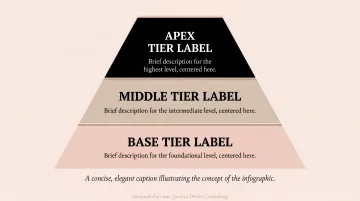
A healthy product/service ecosystem has three tiers:
- Entry point — a free resource, low-ticket product, or discovery call that builds trust without a high financial commitment
- Core product/service — your primary revenue-generating program or service
- Premium or recurring option — a high-touch, high-ticket, or membership-based product/service that maximizes revenue per customer over time
Jacinta's own business models this architecture exactly: free lead magnets and a 15-minute Growth Chat at the entry level, flagship 1:1 coaching and done-for-you systems as core offers, and the Dream+Create membership and in-person retreats at the premium tier. Each layer serves a different buyer stage and creates natural progression through the ecosystem.
Pillar 3: Sales and Visibility
This pillar is the engine that drives new revenue in. It covers how you get in front of ideal buyers and convert them — and it's where most women-owned businesses operate reactively instead of systematically.
Social selling, content marketing, and community building are particularly effective channels for women entrepreneurs. Jacinta's clients have built Facebook Groups to 30,000–36,000+ members that serve as both primary audience and sales engine. Visibility without a repeatable sales process, though, is just noise.
A consistent sales process includes:
- Defined content pillars and a weekly posting cadence
- A lead-to-customer email sequence
- A DM or funnel path that converts engagement into revenue
That's the difference between a strategy and posting and hoping.
Pillar 4: Systems and Retention
Growth without systems creates burnout. This pillar covers the automation, follow-up sequences, repeat purchase strategies, and referral systems that make revenue predictable.
The financial case for retention is clear: research shows acquiring a new customer costs anywhere from five to 25 times more than retaining an existing one. Yet most women entrepreneurs spend almost all of their energy on acquisition and almost none on keeping the customers they already have.
Retention systems don't have to be complex. A post-purchase email sequence, a loyalty product/service, and an abandoned cart automation can meaningfully shift repeat purchase behavior — and they run without you manually following up every time.
The 4 Revenue Levers: Where Growth Actually Comes From
Revenue is a formula, not a mystery. Every dollar your business earns comes from some combination of four levers. Pull the right one — or the right combination — and growth follows. Here's where to look.
Lever 1 — Price
Many women entrepreneurs chronically underprice. Analysis of freelancer billing data shows female freelancers charge materially less than male peers — in one dataset of 9,000+ U.S.-based Upwork freelancers, women's average rates ran roughly 26% lower. The gap exists across service categories, and it represents real revenue left on the table.
Consider what a pricing shift actually produces: if you currently charge $200 per session and raise your rate to $250, you generate the same monthly income with 20% fewer clients. That's more revenue, same (or less) work.
Raising rates, introducing a premium product/service, or repackaging an existing product/service can increase income without a single new customer. This lever is often the fastest and most underused.
Lever 2 — Volume
Volume is the number of new customers coming in. Most women focus exclusively on this lever — more followers, more visibility, more reach. It's also the most expensive lever to pull.
Customer acquisition through visibility, referrals, and partnerships is important, but it shouldn't be your only strategy. Jacinta's team is direct on this point: "You do not have a social media problem. You have a strategy problem dressed up as a social media problem. Posting more is not the answer."
Volume matters — but it works best when paired with the other three levers.
Lever 3 — Purchase Frequency
Getting existing customers to buy more often is one of the highest-ROI strategies available. The systems that drive repeat purchases don't require a large marketing budget — they require setup.
Tactics that move the needle:
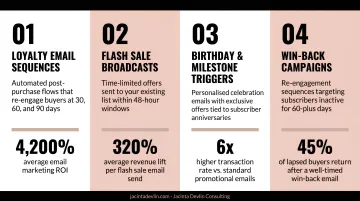
- Recover lost sales with abandoned cart email sequences — automated, set-once flows that convert customers who didn't complete checkout
- Follow up after the first purchase with complementary product/service emails that bring buyers back
- Run structured launch campaigns — seasonal sales events that give existing customers a reason to return
- Reward repeat buyers with early access, exclusive pricing, or bundle deals that deepen loyalty
Email is the most effective channel for purchase frequency. Klaviyo data shows abandoned cart email flows generate an average of $3.07 revenue per recipient — roughly 30 times higher than a standard campaign — illustrating how much revenue automated retention systems can generate from an existing audience.
Lever 4 — Expansion
Expansion means growing average order value or adding adjacent income streams. This lever is especially relevant for multi-stream entrepreneurs.
Common expansion strategies:
- Present related offers at or after the point of purchase to increase the value of every transaction
- Layer a digital product onto an existing service business — a template, guide, or workshop that earns without adding hours
- Monetize an existing audience through Amazon storefronts, LTK, or TikTok Shop affiliate programs
- Negotiate paid brand partnerships as a standalone income stream alongside your owned offers
Clients working with Jacinta have scaled affiliate income from sub-$5K months to $20,000+ per month on Amazon alone by applying this lever with a clear plan — no larger audience required, just a smarter monetization approach.
How to Build Your Revenue Growth Strategy Step by Step
Step 1 — Audit Your Current Revenue
Pull the last 3–6 months of income data. Identify which offers or products drove the most revenue. Calculate your average monthly income.
The goal is honest clarity about where you actually are before deciding where you're going. Many women entrepreneurs skip this step and build strategy on assumptions rather than data.
Step 2 — Set a Specific Revenue Goal with a Deadline
"I want to make more money" produces vague results. "I want to reach $10,000/month in revenue by [specific date]" is a strategy you can reverse-engineer.
Take your goal and work backward:
- What is your average order value or product/service price?
- How many sales does that require per month?
- How many conversations or leads do you need to generate those sales?
Every number in your visibility and content strategy should connect back to this math.
Step 3 — Choose the Right Levers for Your Stage
The right levers depend on where you are right now:
| Stage | Revenue Range | Primary Levers |
|---|---|---|
| Early | ~$2K/month | Price clarity, brand foundation, email list setup, social media strategy |
| Growth | $5K–$8K/month | Purchase frequency systems, product/service suite refinement, platform expansion |
| Scaling | $10K+/month | Expansion (affiliate, brand deals, income stacking), DFY systems, team leverage |
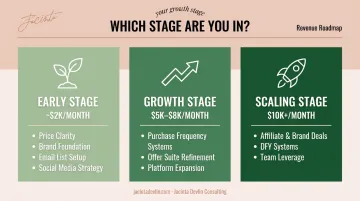
A woman just hitting $2K/month who tries to scale via brand partnerships is pulling the wrong lever at the wrong time. At $8K/month, chasing new followers instead of building retention systems is what keeps predictable income just out of reach.
Step 4 — Build a 90-Day Action Plan
Ninety days is the sweet spot. Short enough to maintain focus, long enough to see real results from consistent execution.
Take the levers you've identified and translate them into specific weekly actions. Build in checkpoints at weeks 4 and 8 to assess progress and course-correct before the full 90 days are up.
If you want support building yours, the Business Growth Program structures exactly this — a 90-day strategy built around your specific model, offers, and goals, with weekly 1:1 Zoom calls to keep you accountable week to week.
Step 5 — Track, Adjust, and Repeat
A revenue growth framework is not set once and forgotten. Track these four core metrics monthly:
- Monthly revenue — is it trending in the right direction?
- Conversion rate — what percentage of leads or traffic is becoming customers?
- Customer retention rate — are buyers coming back?
- Average order value — is each transaction getting larger over time?
Use these numbers to make deliberate adjustments — not reactive pivots. If your conversion rate drops, look at your product/service and sales process before overhauling your content strategy. The metrics show you exactly where the gap is — so you fix the right thing instead of starting over.
The Revenue Ceilings Women Entrepreneurs Hit Most Often
Most women-owned businesses hit predictable growth plateaus. Each ceiling has a specific cause — and a specific fix.
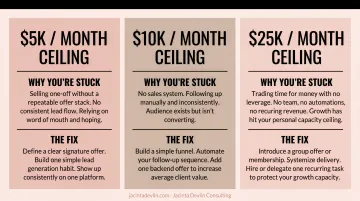
The $5K/Month Ceiling
The $5K/month ceiling is almost always caused by an unclear product/service or inconsistent visibility. Women at this stage are typically relying on manual, reactive selling without foundational systems in place. The fix: build the foundation first — brand identity, content strategy with defined pillars, email list with a basic welcome sequence, and a simple funnel.
Joy W. broke through this ceiling, growing from $500/month to consistently $5K+ across multiple businesses after building these foundations.
The $10K/Month Ceiling
The $10K/month ceiling is usually a capacity and conversion problem. The entrepreneur has some momentum but no automated revenue engine — good months followed by flat months because income depends on manual effort. The fix: build email marketing automations, a sales funnel that converts between launches, and a platform-specific content strategy that moves followers toward purchase.
Amanda O. scaled from a $2,500/month goal to consistent $10K+ months by addressing exactly these gaps.
The $25K+/Month Ceiling
The $25K+/month ceiling typically comes down to distribution and diversification. The business has systems, but it's maximizing conversion from a limited audience. The fix: expand distribution through platform growth (Facebook Groups, Amazon, LTK), add brand partnerships as a high-margin income layer, and stack income streams so no single platform disruption collapses revenue.
Christina R. is a clear example: she grew a Facebook Group from zero to 36,000+ members, scaled Instagram to 95K+, and reached hundreds of thousands in monthly affiliate revenue.
Knowing which ceiling you've hit is step one. Getting the right strategic support is step two. Jacinta Devlin Consulting works specifically with women at each of these stages — from first dollar to scaling — to diagnose the actual bottleneck and build a strategy that addresses it directly. If you're ready to stop hitting the same wall, a free 15-minute Growth Chat is where that conversation starts.
Frequently Asked Questions
What are revenue growth strategies?
Revenue growth strategies are the specific methods a business uses to intentionally increase income over time — raising prices, acquiring new customers, improving retention, or expanding offers. The most effective strategies are chosen based on your business's current stage and goals, not applied randomly.
What are the pillars of revenue growth management?
The four core pillars are Revenue Clarity, Offer Strategy, Sales and Visibility, and Systems and Retention. Together, they create a complete framework for consistent growth — not a collection of random tactics.
What are the 4 growth frameworks?
For women entrepreneurs running small or growing businesses, the most actionable framework centers on four levers: price, volume, frequency, and expansion. Pull the right lever at the right stage, and growth becomes intentional rather than accidental.
How do I know if my business is ready to scale?
You're ready to scale when you have a proven product/service that sells consistently, a repeatable sales process, and systems in place to handle increased volume. Scaling before these foundations exist typically produces burnout rather than growth.
What is the difference between a revenue growth strategy and just making more sales?
Making more sales is one tactic. A revenue growth strategy is the overarching plan that determines which levers to pull, in what order, at what price point, and through which channels — making growth intentional and repeatable rather than sporadic.
How long does it take to see results from a revenue growth strategy?
Most businesses see measurable momentum within 30–60 days of implementing a clear, focused strategy. Sustainable, consistent income growth typically takes 3–6 months of committed execution — especially when you're building new systems and sales habits for the first time.