
Building a funnel isn't just about setting up tech. Results vary dramatically based on how well each stage is designed, who it's built for, and how consistently it gets executed. A store built on unclear positioning will leak at every stage, no matter how sophisticated the tools are.
This article covers what an ecommerce sales funnel actually is, the five stages, how to build one step by step, what variables make or break performance, and the mistakes that quietly kill conversions before they ever reach checkout.
Key Takeaways
- An ecommerce sales funnel maps the complete journey from stranger to loyal repeat buyer
- Women-owned stores hold a natural edge: community trust, authentic storytelling, and social-first audiences are conversion drivers when used with intention
- Each funnel stage needs different content and a different call to action; the same message at every stage is one of the most common mistakes
- Most revenue leaks happen at the bottom of the funnel — purchase and retention — where the biggest wins are often hiding
- Track 2–3 key metrics per funnel stage so you know exactly where to optimize
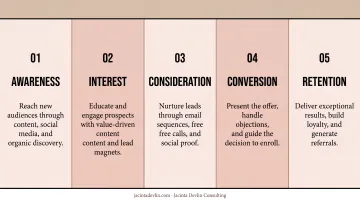
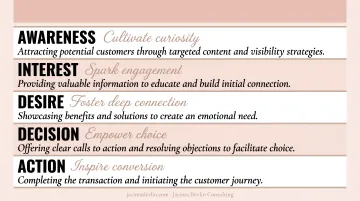
Understanding the Ecommerce Sales Funnel and Its 5 Stages
An ecommerce sales funnel is the structured path that moves a potential customer from first discovering your brand through to making a purchase — and coming back again. The funnel shape reflects natural drop-off at each stage. That's normal. Your job is to reduce unnecessary drop-off at every step.
A marketing funnel generates awareness and engagement. A sales funnel converts that attention into revenue. Both work together, but they serve different goals — and confusing them leads to strategies that feel busy but don't produce sales.
Awareness
At this stage, potential customers don't know your store exists. Your job is to show up where your ideal buyer already spends time — Instagram, Pinterest, TikTok, Google — with content that reflects your brand's personality and solves a problem she actually cares about. This is top-of-funnel, and it's where everything else begins.
Interest and Evaluation
Once someone lands on your site or follows your account, she enters the consideration phase. This is where product pages, reviews, testimonials, user-generated content, and email opt-in offers do the heavy lifting. The goal isn't to sell yet — it's to keep her engaged long enough to build trust.
Desire
She wants what you're selling — she just hasn't committed yet. Limited-time offers, abandoned cart sequences, and personalized email follow-ups create the urgency and trust needed to tip her toward purchase. Timing matters here. The goal is catching her before she moves on.
Action
This is the purchase moment — but the experience doesn't stop here. A smooth checkout, clear order confirmation, and immediate post-purchase communication (thank-you email, shipping update) set the tone for the entire relationship. A clunky checkout can undo everything that came before it.
Retention
Retention is the most underused stage in women-owned stores, and it's where the real money is.
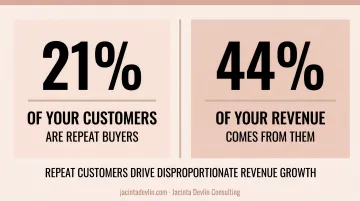
According to Gorgias ecommerce merchant data, repeat customers represent just 21% of customers but generate 44% of revenue and 46% of orders. That means almost half your revenue potential is sitting in the customers you already have.
The primary tools for this stage include:
- Loyalty programs that reward repeat purchases and referrals
- VIP offers exclusive to past buyers
- Post-purchase email sequences that stay in touch after the sale
- Community-building — a Facebook group or VIP customer list — where the founder's relationship with her audience becomes a retention asset no competitor can replicate
How to Build Your Ecommerce Sales Funnel Step by Step
Building a funnel is less about finding the perfect tool and more about creating a clear, intentional path — one that matches how your specific customer discovers, evaluates, and buys from stores like yours.
Step 1: Define Your Ideal Customer and Her Buying Journey
Before building anything, you need a precise picture of who your buyer is. Not just demographics — what triggers her to search, what objections she has before buying, and what platforms she uses daily.
Map her buying journey by asking: What does my buyer do from the moment she has the problem I solve to the moment she hits "place order"? Walk through every step. Where does she discover stores like yours? What does she look at before buying? What makes her hesitate?
This shapes every decision in the funnel — the platforms you target, the content you create, the offers you make.
Step 2: Build Your Top-of-Funnel Traffic Strategy
For most women-owned ecommerce stores, top-of-funnel traffic comes from a combination of:
- Organic social content — Instagram Reels, Pinterest boards, TikTok videos
- SEO-driven blog content — long-term traffic that compounds over time
- Paid social ads — when you're ready to amplify what's already working
Pick 1–2 channels and go deep. Spreading thin across every platform produces mediocre results everywhere.
One genuine advantage for women entrepreneurs: personal branding. Showing the face and story behind the store builds organic trust faster than any ad budget can buy. Jacinta Devlin built her initial reach through personal brand positioning as a fashion influencer, which directly funded the launch of Jacinta The Label and her path to consistent $10,000+ months.
Founders who show up on camera and share their story see stronger organic reach and faster audience trust.
Social commerce is a growing direct sales channel worth tracking: US social commerce sales grew 26% in 2024 to $71.62 billion, with TikTok driving the largest share of buyer activity. These platforms aren't just for awareness anymore — they're becoming direct sales channels.
Step 3: Create a Middle-of-Funnel Lead Capture System
The goal here is to get a visitor's email address before she leaves. Without it, every visitor who doesn't buy immediately is gone forever.
Opt-in incentives that work for product-based stores:
- Welcome discount (10–15% off first order)
- Style guide or lookbook
- Product quiz with personalized recommendations
- Exclusive early access to new arrivals
Simpler offers typically convert better. Ecommerce popups convert at an average of 6.88% based on over 1 billion displays — with Shopify-specific popups converting at 6.97%.
Once someone opts in, set up a welcome email sequence of 5–7 emails that:\
- Introduces the brand and your story\
- Shows bestsellers or what you're known for\
- Addresses common buying objections (sizing, shipping, returns)\
- Shares social proof (reviews, real customer photos)\
- Delivers a first-purchase product/service with a clear deadline
Welcome emails average a 51% open rate and $2.35 revenue per recipient according to Klaviyo's 2025 email benchmarks — among the highest-performing email sequences available.
For platform selection: Jacinta recommends Flodesk for women-owned stores building this system from scratch, and Klaviyo for Shopify-integrated builds.
Step 4: Optimize the Bottom-of-Funnel Purchase Experience
The bottom of the funnel is where friction costs you money. Key elements that directly affect conversion:
- Product page clarity — clear photos, sizing information, and specific product descriptions
- Trust signals — customer reviews, a clear return policy, and secure payment badges
- Checkout simplicity — fewer steps, guest checkout available, multiple payment options
- Mobile optimization — a Deloitte/Google study found a 0.1-second improvement in mobile site speed increased retail conversions by 8.4% and average order value by 9.2%
Abandoned cart emails are one of the highest-ROI tactics available. According to Baymard Institute, the average cart abandonment rate is 70.22% — roughly 7 out of 10 shoppers who add items to their cart leave without buying.
Klaviyo's 2024 benchmark data reports abandoned cart flows average a 3.33% placed-order rate and $3.65 revenue per recipient, based on analysis of 143,000 flows.
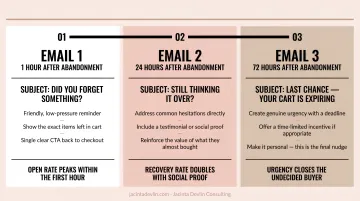
Those numbers add up quickly with the right timing. Send the first reminder 2–4 hours after abandonment, a second at 24 hours, and a third at 3–5 days. Keep the tone warm and practical — remind her what she left behind, address any hesitations, and consider a small incentive in the final email.
Step 5: Build a Retention Loop After the Sale
The sale is the beginning of the customer relationship, not the end.
A basic post-purchase retention system:
- Thank-you email within 24 hours — personal, warm, with order confirmation details
- Follow-up 7–10 days after delivery — check in and request a review
- Re-engagement product/service 30–45 days later — new arrivals, a loyalty reward, or an exclusive discount
For women-owned stores where the founder's relationship with her audience is central to the brand, community-building adds another layer. A VIP Facebook group, a loyalty rewards program, or a close-friends Instagram list creates ongoing touchpoints that drive repeat purchases without a paid ad each time.
Clients who work with Jacinta Devlin on building these retention systems consistently report this as the stage that converts most reliably once it's in place — covering post-purchase sequences, loyalty automations, and community infrastructure.
What You Need Before Building Your Funnel
Preparation directly shapes how effective the funnel will be. A funnel built on unclear brand positioning or an unvalidated product will leak at every stage regardless of the tools used.
Platform and Tech Requirements
The minimum viable tech stack:
| Tool Type | Options |
|---|---|
| Ecommerce platform | Shopify (recommended for product-based stores) |
| Email marketing | Flodesk (Jacinta's primary recommendation), Klaviyo, Kit, MailerLite |
| Analytics | Google Analytics or platform-native reporting |
You don't need expensive software to start. Most store owners already have what they need — the gap is usually in how those tools are connected and used.
A Clear Offer and Validated Product
The funnel amplifies what's already there. If the product/service isn't clear or the product hasn't been validated with at least some real buyers, building a funnel prematurely wastes time and budget. Start with a small proof-of-concept before scaling funnel spend.
A Strategy Built Around Your Specific Business
Copying another store's funnel rarely works — customer behavior, price point, product category, and brand positioning all differ. A boutique selling clothing needs a fundamentally different funnel architecture than a candle brand or a jewelry store.
This is the custom funnel strategy Jacinta Devlin builds with women store owners before they start executing. Her Business Growth Program and Done-For-You Marketing Systems are built around each client's specific business model, not a generic template. That distinction shows up in results: boutique clients like Lisa K. of Fleur de Lis Boutique generated $100,000+ in year one, and Amanda O. scaled from a $2,500/month goal to consistent $10,000+ months.
Key Variables That Affect Funnel Performance
Two stores can follow the same funnel framework and get completely different results. These four variables separate a funnel that converts from one that stalls.
Traffic Quality
Sending the wrong audience into the funnel creates poor conversion rates at every stage and skews your data. High volume from mismatched sources is worse than low volume from the right people.
Assess traffic quality using:
- Bounce rate (are visitors leaving immediately?)
- Time on site (are they actually looking around?)
- Email opt-in rate (are they interested enough to give you their email?)
Email List Engagement
Your email list is the middle and bottom of the funnel. A disengaged list means your nurture sequences are going unread — which stalls conversions at the desire and action stages.
Healthy benchmarks to track (Mailchimp ecommerce data):
- Open rate: ~29.81% average
- Click rate: ~1.74% average
If your numbers are below these, the problem is likely audience fit, subject line quality, or send frequency — all fixable before you touch anything else in the funnel.
Checkout and Site Experience
A strong top and middle of funnel can be completely undone by a slow, confusing, or mobile-unfriendly checkout. Mobile commerce is forecast to represent nearly 70% of total retail ecommerce sales globally — if your checkout isn't built for mobile, you're losing sales every day.
Switching to a streamlined, one-page mobile checkout is often the fastest single fix in the entire funnel.
Post-Purchase Follow-Up Consistency
Retention rates are directly tied to how deliberately a store nurtures buyers after the first purchase. Most stores send one confirmation email and go silent — and that's where revenue gets left behind.
Repeat customers make up only 21% of customers but drive 44% of revenue. A post-purchase sequence — even a simple 3-email series covering a thank-you, a usage or styling tip, and a replenishment nudge — closes that gap directly.
Common Mistakes Women Store Owners Make When Building a Funnel
Skipping the nurture layer entirely. Most store owners focus on getting traffic (top) and running promotions (bottom) but skip email capture and lead nurturing in between. Without a middle-of-funnel system, every visitor who doesn't buy immediately is gone for good. There's nothing in place to bring her back.
Treating the funnel as a one-time setup. A funnel is a living system that requires regular review. Failing to monitor cart abandonment rate, email open rates, and conversion rate means problems compound quietly without ever getting caught or fixed.
Writing for everyone instead of one specific buyer. Copy that could belong to any store — "Shop our new arrivals!" with no context about who she is or why she should care — fails to create the connection that moves a buyer forward. The more specific your message is to the right person's situation, the higher every stage converts.
Frequently Asked Questions
What is an ecommerce sales funnel?
An ecommerce sales funnel is a framework representing the stages a potential customer moves through — from first discovering a brand to making a purchase and becoming a repeat buyer. Understanding it helps store owners create the right content and offers at each stage rather than using one message for everyone.
What are the 5 stages of an ecommerce sales funnel?
The five stages are Awareness, Interest/Evaluation, Desire, Action (Purchase), and Retention. Most stores put all their energy into Awareness and ignore Retention — which is usually where the most revenue is left on the table.
How long does it take to build an ecommerce sales funnel?
A basic functional funnel — traffic strategy, email opt-in, welcome sequence, and post-purchase follow-up — can be set up in 2–4 weeks. Optimizing it for strong conversion is an ongoing process, not something you set once and walk away from.
What tools do I need to build an ecommerce sales funnel?
The minimum viable stack is an ecommerce platform (Shopify works well for most product-based stores), an email marketing tool (Flodesk, Klaviyo, or equivalent), and basic analytics. Most store owners already have these — the gap is in how they're connected.
How do I know if my ecommerce sales funnel is working?
Watch three signals: email opt-in conversion rate (top/middle funnel health), cart abandonment rate and email open rates (middle/bottom funnel health), and repeat purchase rate (retention health). These three metrics reveal exactly where the funnel is leaking.
What is the most important stage of an ecommerce sales funnel?
All stages work together, but most small stores lose the most revenue in two places: the middle of the funnel (no email capture system) and the retention stage (no post-purchase follow-up). Start there. Small fixes in either area typically produce faster results than rebuilding your traffic strategy from scratch.