Introduction
You built your travel agency on passion and expertise. You know destinations, you know what travelers need, and you know how to craft an itinerary that creates memories. But passion doesn't fill your booking calendar. A clear marketing strategy does.
The challenge most women-owned travel agencies face isn't a lack of talent. It's competing against massive booking platforms with unlimited ad budgets while trying to figure out Instagram, email lists, SEO, and referral programs all at once, without a structured plan connecting any of it.
Generic travel agency marketing advice makes this worse. It ignores the genuine competitive advantages a women-owned agency holds and treats every agency owner as interchangeable.
This guide covers what actually works: defining a niche that sharpens every marketing channel, building a social presence that converts followers into bookings, and creating owned assets like email lists and blog content that work for you over time.
Each section is actionable and sequenced so you can build a strategy that compounds, not just tactics you try once and abandon.
Key Takeaways
- Women drive travel decisions — 82% of all travel decisions are made by women, giving women-owned agencies natural audience alignment
- Picking a niche makes every marketing dollar more effective; specialized agencies are easier to refer and consistently command premium pricing
- Relationships and community convert followers into clients — pretty photos alone don't close bookings
- Your email list is your most valuable marketing asset — algorithms can't touch it
- Most agencies underuse their three highest-ROI channels: reviews, referrals, and post-trip follow-up
Why Being a Woman-Owned Travel Agency Is a Marketing Advantage
The Numbers Back You Up
According to Skift Research, women make 82% of all travel decisions — including destination selection, booking, and activity planning — and are projected to control 75% of discretionary spending by 2028. Women-only travel is growing fast too: Intrepid Travel's Women's Expeditions grew 37% globally in 2024, with roughly 82% of participants booking solo.
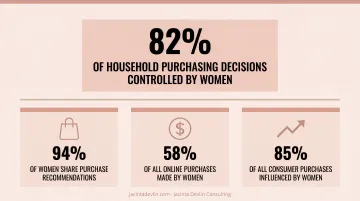
Your ideal client is a woman. As a women-owned agency, you understand her priorities firsthand.
The Trust Advantage
Women travelers increasingly think about safety, comfort, and whether an agency truly understands their preferences — not just logistics. A women-owned agency can speak to solo female travel concerns, girls' trip dynamics, or the specific anxiety of planning a honeymoon with genuine credibility that an algorithm-driven booking platform can't offer — no intake call, no nuanced questions, no lived experience behind the recommendation.
That lived understanding is what turns a browser into a booked client.
How to Activate It in Your Marketing
The trust advantage only works if you make it visible. Don't add "women-owned" to your bio as a badge — make it a value statement across every touchpoint:
- Website copy: "As a women-owned agency, we specialize in travel experiences designed with women's priorities in mind — from safety and comfort to the details that make a trip feel personal"
- Social bios: Lead with your perspective, not just your credentials
- Google Business Profile: Include "women-owned" as a business attribute — it appears in local search results
- Email signature and proposals: Normalize it as part of who you are, not a footnote
Your Personal Story Is a Marketing Asset
Your "why" — the reason you built this business — is something no competitor can copy. Sharing your founding story creates emotional connection before a client ever submits a booking inquiry, and authenticity is what turns that connection into a conversion.
Women's communities — Facebook groups, workplace networks, local organizations — actively seek out and refer women-owned businesses. That organic referral network is something larger agencies can't buy their way into, regardless of budget.
Start With Strategy: Define Your Niche and Ideal Client
Why "Everyone Who Travels" Converts No One
Marketing to every traveler sounds like maximizing opportunity. In practice, it produces messaging so generic it resonates with no one. Before spending a dollar on ads or hours on content, choosing your niche is the most important decision you'll make.
Profitable niches particularly well-suited for women-owned agencies:
- Solo female travel and women-only group tours
- Honeymoon and romance packages
- Luxury girls' getaways
- Family travel with young children
- Destination weddings
- Wellness retreats and spa travel
- Adventure travel for women
The right niche sits at the intersection of market demand and your personal passion and experience. If you've never planned a destination wedding, don't build your agency around them. If you've taken 15 solo trips and know every safety consideration cold, that's your niche.
Build Your Ideal Client Avatar
Spend 30 minutes answering these questions about your one specific ideal client:
- Demographics — Age range, household income, where she lives
- Travel motivations — What is she seeking? Adventure, relaxation, connection, status?
- Budget range — What does she consider "affordable" vs. "splurge"?
- Booking trigger — What pushes her to hire a travel agent instead of booking herself? (Time pressure? A complex itinerary? A once-in-a-lifetime trip she doesn't want to risk?)
- Objections — What makes her hesitate to hire you?
Every piece of content you create, every social post, every email subject line — all of it should speak directly to her.
Niche Clarity Pays Off Downstream
Once you know exactly who she is, that clarity sharpens every channel — here's how it plays out in practice:
- Social content becomes more focused and attracts the right followers
- SEO keywords become specific and achievable (ranking for "travel agent for solo women in Boston" is realistic; ranking for "travel agent" is not)
- Past clients know exactly who to refer you to — "You need to talk to her, she specializes in girls' trips to Europe"
- Premium pricing becomes justifiable because you're the specialist, not the generalist
Social Selling and Social Media: Your Most Powerful Growth Channel
Choose Your Platforms Strategically
Phocuswright's 2024 research found that 57% of travelers use social media for trip planning, and 62% of those users made a specific trip decision after viewing social content. Social media isn't optional for travel agencies — but spreading thin across every platform is worse than mastering two or three.
Platform breakdown for travel agencies:
| Platform | Best Use |
|---|---|
| Visual destination content, Stories selling, DM inquiries | |
| Evergreen trip inspiration; 1B+ travel searches annually | |
| Community building, targeted advertising, Groups | |
| TikTok | Reach and discovery with younger travelers; travel content views up 410% since 2021 |
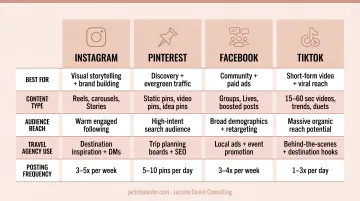
Pick two or three and master them before expanding to others.
Social Selling vs. Posting
Posting content and social selling are not the same thing. Social selling means:
- Showing up in conversations where your ideal clients already are
- Answering travel questions in Facebook Groups and comment sections
- Engaging with followers' content, not just waiting for them to engage with yours
- Building relationships before pitching — so when someone is ready to book, you're already the person they trust
Women entrepreneurs often do this naturally. The strategic layer is making it intentional and consistent — and that starts with knowing what content actually drives those conversations.
Content That Works for Travel Agencies
High-performing content types:
- Destination short-form videos and photo walkthroughs
- Client transformation stories ("She almost didn't book — here's what happened")
- Behind-the-scenes booking process content (demystify what a travel agent actually does)
- Niche-specific travel tips (packing lists for solo women, honeymoon planning timelines)
- Dream destination engagement posts that invite comments and saves
Build Community, Not Just a Following
A posting calendar keeps you consistent. A community strategy keeps clients returning between bookings and referring others before they ever book their next trip. The tactics that close that loop fastest:
- Facebook Groups where past and prospective clients can engage with your expertise
- Instagram Stories that invite replies, not just views
- A private client community that gives past bookers a reason to stay connected
This is where most travel agency owners stall — not from lack of content, but from lack of strategy connecting content to community to conversion.
Jacinta Devlin has spent 15+ years helping women entrepreneurs build exactly that infrastructure. Her clients include travel planners like Holly & Chris Moore, who credited her team with transforming how they manage client volume and sustain growth. Her Business Growth Program builds the systems that turn social media activity into consistent booking revenue. If that gap sounds familiar, a free 15-minute discovery call is where the conversation starts.
A Practical Consistency Framework
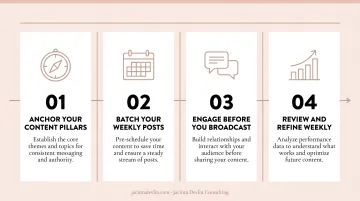
You don't need to post daily. You need a system:
- Batch content once per week — film, photograph, or write in one focused session
- Use a simple content calendar — even a spreadsheet with platform, date, and content type
- Repurpose across platforms — one destination Reel becomes a Pinterest pin, a Story, and a Facebook post
- Schedule in advance — remove the daily decision of "what do I post today"
Build Your Content Engine: Email, SEO, and Blogging
Your Email List Is the Most Valuable Asset You'll Build
Social media followers are rented. An algorithm change, a platform shift, or an account flag can cut your reach overnight. An email list is yours.
Start building one from day one:
- Offer a free PDF ("Top 10 Honeymoon Destinations" or "Solo Female Travel Safety Guide") in exchange for an email address
- Place a sign-up prompt on every page of your site — especially your booking inquiry form
- Bring a simple sign-up sheet to bridal expos and women's networking events
For platform, Flodesk is a strong starting point for travel agencies — clean templates, flat monthly pricing, and straightforward automation setup.
SEO Basics That Move the Needle
You don't need to become an SEO expert. Three priorities make the biggest difference for a small travel agency:
Claim and complete your Google Business Profile. Verify it, fill out every field — hours, photos, description, and the "women-owned" attribute. Google ranks local results on relevance, distance, and prominence; a complete profile improves all three.
Create destination-specific content. A post titled "Best Travel Agent for Solo Women in Boston" or "How to Plan a Girls' Trip to Italy" answers exactly what your ideal client searches for. You don't need to rank for "travel agent" — you need to rank for what your niche client actually types into Google.
Make your website fast and mobile-friendly. Most travel research happens on phones. A site that loads slowly or displays poorly on mobile loses clients before they ever read your copy.
Blogging as a Long-Term Authority Builder
Publishing destination guides, niche-specific travel tips, and "how to plan X" posts builds organic search traffic and positions you as the go-to expert in your niche.
A prospective client who finds your blog post about planning a solo trip to Japan — before she ever finds your agency — already trusts you before the first conversation.
SEO typically takes 3 to 6 months to show meaningful results. The best time to start is now.
Turn Clients Into Repeat Bookings and Referrals
A Proactive Review Strategy
BrightLocal's 2026 survey found that 97% of consumers read reviews for local businesses, and 85% are more likely to use a business after positive reviews. Reviews aren't optional — they're the first thing a prospective client checks.
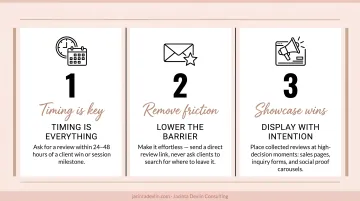
Here's a simple system that takes the friction out of getting them:
- Ask at the right moment — right after a client returns from a successful trip, while the experience is fresh
- Remove barriers — send a direct link to your Google or Facebook review page; fewer clicks means higher completion
- Display them where they count — homepage and booking inquiry page, not buried in a testimonials tab
A Simple Referral Program
Happy clients are your best sales channel. Most of them just need a nudge and a clear reason to refer.
A simple structure:
- Incentive: Travel credit (e.g., $100 toward their next booking), a gift card, or an exclusive upgrade for referred clients
- Communication: Tell every satisfied client about the program after their trip, in your post-trip follow-up email
- Tracking: Ask new inquiries "how did you hear about us?" and keep a simple record
Referred clients typically book higher-value trips and stay longer than cold leads — meaning one good referral program can quietly outperform any paid ad campaign you run.
Post-Trip Follow-Up Touchpoints
Most agencies go silent after a trip ends. That silence costs repeat bookings. A simple follow-up sequence:
- Post-trip check-in — A quick message 1-2 days after return: "How was the trip? We'd love to hear!"
- Birthday or anniversary reminder — If you know a client's anniversary, a "Have you thought about celebrating in [destination]?" email in the weeks before is perfectly timed
- Seasonal touchpoint — "Where are you dreaming of next summer?" sent in January catches clients before they book independently
None of this requires a paid advertising budget. What it does require is a CRM — even a basic spreadsheet — and the discipline to work it consistently.
Round Out Your Marketing Mix: Paid Ads, Partnerships, and Local Tactics
Facebook and Instagram Advertising
Paid social advertising earns its place once you have a proven niche, a clear offer, and a landing page that converts. Facebook and Instagram ads let you target by age, interest, location, and behavior. A modest budget spent on "women 30-50 interested in travel, located within 50 miles of [your city]" can reach the exact right audience for a specific package or seasonal promotion.
Start small (even $10-$20/day) to test what resonates before scaling spend.
Supplier and Influencer Partnerships
Once you know what's converting, partnerships extend your reach without adding to your ad spend. Co-marketing with hotels, cruise lines, or destination tourism boards can provide free content, promotional materials, and audience access at little or no cost — and many suppliers actively seek agency partners to feature their properties to qualified buyers.
Micro-influencers in the travel or women's lifestyle space can expand your reach to new audiences. Most nano- and micro-influencer partnerships are negotiated for under $500, making this accessible for small agencies without a large ad budget.
In-Person and Community Tactics
Digital marketing alone has a ceiling for local trust-building. High-ROI in-person options for women-owned agencies:
- Bridal expos and wedding fairs — Direct access to honeymoon and destination wedding clients
- Women's networking events and women-in-business organizations — Natural referral communities
- Short talks and workshops — "How to Plan Your Dream Girls' Trip" at a local women's group positions you as the expert and generates warm leads in a single hour
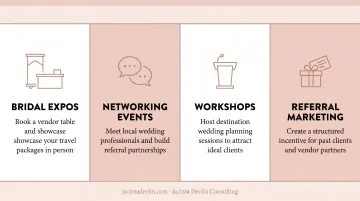
No online booking platform can replicate a handshake, a referral from a trusted peer, or the moment someone in the room decides they want you planning their next trip.
Frequently Asked Questions
What is the best marketing strategy for a travel agency?
The most effective approach combines a clear niche, consistent social media presence, a growing email list, and a structured referral strategy. Trying to activate every channel at once produces mediocre results across all of them — sequencing matters more than volume.
What are the 5 P's of tourism marketing?
The 5 P's are Product, Price, Place, Promotion, and People. For a travel agency, People carries the most weight — the relationship between the agent and the client is the product differentiator, especially for women-owned agencies where that personal connection is the core value proposition.
How do I attract clients to my travel agency when I'm just starting out?
Start with your personal network — let everyone know what you do and what niche you serve. Set up two or three social media profiles focused on that niche, and actively seek reviews from your first clients. Early social proof accelerates trust-building faster than any paid channel.
How can social media help grow a women-owned travel agency?
Social media lets you showcase destination expertise, build community with ideal clients, and demonstrate your personal perspective in ways that large platforms cannot. Targeted advertising on Facebook and Instagram makes even a small budget effective for reaching specific traveler demographics.
How important is picking a niche for a travel agency's marketing?
Very. A specialized agency is easier to refer, ranks faster in search for specific terms, and commands premium pricing compared to a generalist. Narrowing your focus is what makes the rest of your marketing actually stick.
How long does it take for a travel agency marketing strategy to show results?
Paid ads can drive results within days. Social media typically builds over 3-6 months; SEO and referral programs take 6-12 months to take hold. The timeline accelerates as channels stack — email amplifies social, referrals strengthen SEO, and the system compounds over time.