That's what a sales funnel does. It takes someone from "never heard of you" to "just bought and texting my friend about it." Without one, every sale feels like luck — because it is.
This guide walks through exactly how to build an ecommerce sales funnel for a clothing brand, stage by stage. You'll learn what makes clothing funnels uniquely different from other product categories, the five steps to build yours, and the mistakes that quietly kill conversions for boutique owners who are otherwise doing everything right.
Key Takeaways
- Fashion shoppers browse, save, and return before buying — your funnel must account for that non-linear path
- A clothing sales funnel has four stages: Awareness, Lead Capture, Conversion, and Retention
- Cart abandonment in fashion runs as high as 76.94%, making automated recovery sequences non-negotiable
- Fit-specific social proof converts clothing shoppers more effectively than generic star ratings
- Most revenue is lost in the middle and bottom of the funnel, not at the top
What Is an Ecommerce Sales Funnel for Clothing — and Why It's Different?
An ecommerce sales funnel is the structured path a potential customer follows — from discovering your brand to making a purchase and coming back to buy again. It covers the entire customer journey: every touchpoint, every decision point, every moment where a shopper either moves forward or disappears.
Clothing funnels behave differently than almost every other product category. Here's why:
- Fashion is emotional. Shoppers aren't buying a shirt — they're buying how they'll feel wearing it. That emotional trigger makes the path to purchase unpredictable.
- Browsing is the norm. Most visitors are saving, screenshotting, and returning days later — not buying on first contact.
- Cart abandonment is exceptionally high. Fashion, accessories, and apparel sees a cart abandonment rate of 76.94% — meaning roughly three out of four shoppers who add something to their cart leave without buying.
- Impulse buys are real but unreliable. The "see it, love it, buy it" moment happens — but you can't build a business on it.
The Four Stages of a Clothing Sales Funnel
Every clothing funnel moves through four stages:
- Awareness — Getting in front of the right people before they're actively shopping
- Lead Capture and Nurturing — Collecting contact information and building the relationship
- Conversion — Turning interest into a completed purchase
- Retention — Turning one-time buyers into repeat customers and brand advocates
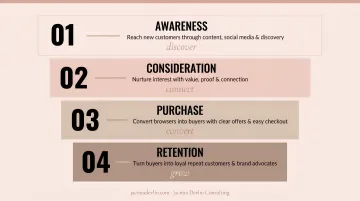
Each stage demands a completely different approach — and the rest of this guide breaks down exactly what to do at each one.
How to Build Your Ecommerce Clothing Sales Funnel Step by Step
Step 1: Define Your Customer and Your Offer
Before any funnel can work, you need clarity on two things: who you're selling to, and exactly what you're selling them.
On the customer side, go beyond demographics. Ask:
- What triggers her to shop? (An event, a mood, a season change?)
- What occasions drive clothing purchases for her specifically?
- What objections might stop her from buying? (Fit uncertainty, return policy, price?)
A working woman shopping for elevated basics has a completely different trigger — and different objection — than a trend-follower buying for a Saturday night out. Build the funnel for one, and the other won't convert.
On the product/service side, define:
- Which core product or collection the funnel promotes
- The price point and what justifies it
- Upsell and bundling opportunities ("complete the look" add-ons, accessories, layering pieces)
Skip this step, and everything downstream is a guess.
Step 2: Build Your Awareness Strategy
The goal at the top of the funnel is simple: get in front of the right people before they're actively shopping, so your brand is already familiar when the purchase trigger hits.
The most effective awareness channels for clothing brands:
- Instagram and TikTok organic content — Reels and short-form video for reach; lifestyle posts for brand identity
- Meta paid ads — Highly targeted reach to lookalike and interest-based audiences
- TikTok paid ads — One global fashion brand generated 6.4x ROAS and over 154,000 completed orders in 1.5 months through TikTok Video Shopping Ads
- Pinterest — Aspirational discovery, particularly strong for Gen Z shoppers (men's fashion searches up 35%, women's up 30% year-over-year among that demographic)
One thing that separates clothing awareness content from other categories: quality of visuals is the strategy. Lifestyle imagery, styling content, and aesthetic alignment with your target customer's identity are what drive follows and clicks. A blurry product-on-white-background photo will not move the needle.
Step 3: Capture Leads and Nurture Interest
Most clothing shoppers will not buy on the first visit. This is why capturing an email address or phone number is essential — it gives you a way to continue the conversation after they leave.
Lead magnets that work for clothing brands:
- A first-order discount code (10–15% off)
- A style quiz that delivers personalized outfit recommendations
- Early access to new arrivals or exclusive drops
- A "how to style" guide tied to a specific collection
Once you've captured the contact, a welcome email sequence does the nurturing work. A solid clothing welcome sequence (typically 5–7 emails) should:
- Introduce your brand story and what makes it different
- Showcase bestsellers with real customer photos and reviews
- Address sizing and fit concerns proactively
- Deliver a soft call to purchase with a low-pressure product/service
- Build social proof through customer testimonials
The welcome sequence is where most boutique owners lose new subscribers. They don't email too much — they don't email at all.
Step 4: Convert Browsers into Buyers
By the time a shopper reaches the conversion stage, they've seen the product — maybe more than once. They need one final reason to complete the purchase.
A high-converting clothing product page includes:
- Multiple lifestyle photos (not just product shots)
- At least one photo showing movement, texture, or fit
- A clear, detailed size guide
- Customer reviews that mention height, weight, and body shape
- A visible, easy-to-understand return policy
- Mobile-optimized design with streamlined checkout
Then there's cart abandonment. According to Klaviyo's analysis of over 143,000 abandoned cart flows, apparel and accessories abandoned cart emails achieve a 51.43% open rate and a 3.42% placed order rate. That's meaningful revenue recovered automatically.
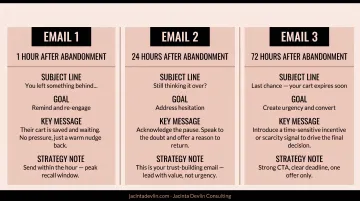
An abandoned cart sequence should include at minimum:
- Email 1: Within 1 hour of abandonment — gentle reminder, no discount yet
- Email 2: 24 hours later — add social proof, address fit or return concerns
- Email 3: 48–72 hours later — introduce a time-sensitive incentive if needed
Step 5: Turn One-Time Buyers into Loyal Customers
The sale is not the finish line. For clothing brands, the post-purchase period is where the most profitable part of the funnel begins.
A post-purchase email sequence should include:
- Order confirmation with a "you might also love" product recommendation
- A follow-up 7–14 days later asking for a review (with a small incentive)
- A reengagement email 30–60 days post-purchase featuring new arrivals or an exclusive returning-customer product/service
Loyalty mechanics that work for clothing brands:
- VIP early access to new drops before they go live
- Referral incentives ("give $10, get $10")
- Seasonal reactivation campaigns tied to wardrobe refreshes (spring, back-to-school, holiday)
Jacinta Devlin built her clothing boutique, Jacinta The Label, to consistent $10,000+ months using this exact framework: owned-audience awareness, automated nurture sequences, and structured retention. Her clients at Devlin Consulting follow the same system. Lisa K. of Fleur de Lis Boutique generated over $100,000 in her first year with a full funnel build that included email sequences, abandoned cart automation, and a structured launch plan.
What Makes a Clothing Sales Funnel Actually Convert
Two brands can follow the same funnel blueprint and get completely different results. The gap usually comes down to four variables.
Visual Presentation Quality
Clothing is bought by sight. How a product looks in photos and video determines whether a shopper trusts it enough to buy without trying it on first.
High-converting clothing visuals include:
- Multiple angles, including back and side shots
- Models that reflect your target customer's body type
- Lifestyle context shots (not just product on a hanger)
- Video showing movement, drape, and texture
This is exactly what Jacinta Devlin focused on when scaling Jacinta The Label to consistent $10K+ months — investing in content that worked across awareness posts, product pages, and email sequences at once, rather than shooting each piece in isolation.
Social Proof with Fit Specificity
Clothing shoppers want to know how a product fits on a real body, not just whether it's good. Research by PowerReviews found that 92% of clothing shoppers pay attention to sizing and fit information in reviews, and 94% find reviewer measurement details like height and weight helpful.
That means a generic five-star review ("Love it!") is significantly less persuasive than: "I'm 5'4", 145 lbs, ordered a medium — fits true to size with room through the hips."
Build a review request process that prompts customers to include those details. That one prompt change can meaningfully lift your conversion rate on high-traffic product pages.
Mobile-First Experience
Fashion ecommerce skews heavily mobile — in the Fashion Clothing & Accessories category, 65.5% of sales come from mobile devices. But mobile converts at a lower rate than desktop, which means friction on mobile directly translates to lost revenue.
A mobile-first clothing funnel requires:
- Pages that load in under 3 seconds
- Thumb-friendly navigation and buttons
- One-tap checkout options (Shop Pay, Apple Pay)
- Product photos that display clearly on a small screen
Strategic Audience Segmentation
Sending the same email to every subscriber is one of the fastest ways to kill engagement. A shopper who just discovered the brand needs a different message than someone who bought twice six months ago.
Segment your list by:
- Browse behavior — visited product pages but didn't add to cart
- Cart behavior — added to cart but didn't purchase
- Purchase history — first-time buyer vs. repeat buyer
- Engagement level — active openers vs. inactive subscribers
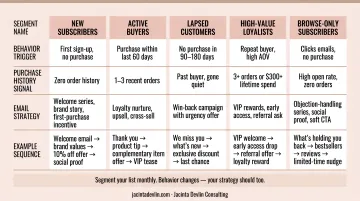
When your messaging matches where someone is in the buying journey, every send works harder — and your list stops feeling like a broadcast channel and starts functioning like a revenue system.
Common Mistakes to Avoid When Building Your Clothing Sales Funnel
Most clothing boutiques don't fail because of bad products. They fail because of avoidable funnel mistakes that quietly drain revenue at every stage.
- Skipping lead capture — Sending cold traffic directly to a product page means losing most visitors permanently. Email is what makes the rest of the funnel work. Without it, every sale requires starting from zero.
- Treating all traffic the same — A shopper who just found you through a TikTok video needs a completely different message than a customer who bought three months ago. Generic messaging produces generic results, and a lot of unsubscribes.
- Ignoring cart abandonment — Fashion and apparel see a 76.94% abandonment rate. Without an automated recovery sequence, that's real revenue walking out the door. It's consistently one of the first gaps Devlin Consulting addresses when working with new boutique clients.
- Treating the first sale as the finish line — In clothing ecommerce, a repeat customer's lifetime value far exceeds a single transaction. Brands without a post-purchase sequence, loyalty mechanism, or reengagement strategy cycle through expensive customer acquisition with nothing compounding over time.
Conclusion
Building an ecommerce sales funnel for a clothing brand comes down to one thing: a clear strategy for every stage of the customer journey. The technology is secondary. The intentionality is everything.
For women building clothing businesses who are ready to stop guessing and start growing, working with someone who has actually done it changes the outcome. Jacinta Devlin built her own ecommerce brand to consistent $10K+ months — and now helps other women build the same systems through her coaching and consulting programs at Devlin Consulting.
If you're ready to build a funnel that actually works, start with a free 15-minute consultation.
Frequently Asked Questions
What is the ecommerce sales funnel for clothing brands?
An ecommerce sales funnel for clothing brands is the structured path that guides a potential customer from first discovering the brand through making a purchase and returning to buy again. It covers four stages: awareness, lead capture and nurturing, conversion, and retention — each requiring a distinct strategy.
What are the 4 P's of fashion?
The 4 P's are Product, Price, Place, and Promotion. For clothing brands, these marketing principles shape how you build a compelling product/service — what you sell, how you price it, where you sell it, and how you communicate its value throughout the funnel.
How long does it take to build a sales funnel for a clothing brand?
The core infrastructure — lead capture, product page, and a basic email sequence — can be set up in a few days to two weeks. Optimizing for consistent conversions is an ongoing process that typically takes 60–90 days of testing and refining.
What is the best traffic source for a clothing brand sales funnel?
Instagram and TikTok are the strongest starting points for fashion brands — both platforms are built around visual content, which makes them a natural fit for clothing. Meta paid ads and Google Shopping capture higher-intent buyers. The strongest strategies combine organic and paid across platforms rather than relying on a single channel.
How do I reduce cart abandonment in my clothing store?
Start with an automated 3-part abandoned cart email sequence — the first email should go out within 1 hour of abandonment. Pair that with SMS reminders, display shipping costs before checkout, and make sure your mobile checkout experience is frictionless.
What email sequences should a clothing brand use in their sales funnel?
Three sequences are essential:
- Welcome series (3–5 emails): introduces the brand and drives the first purchase
- Abandoned cart sequence (2–3 emails): recovers lost sales
- Post-purchase sequence: requests reviews, recommends products, and surfaces new arrivals to drive repeat orders