This is one of the most common frustrations women jewelry founders describe when they first seek coaching: they're working hard but not seeing growth. The gap isn't passion or product quality. It's strategy.
The global jewelry market is projected to reach $518.90 billion by 2030, and consumers are actively seeking independent, unique brands over mass-produced alternatives. Meanwhile, jewelry and personal accessories ranks among Etsy's top six categories, which together generated $9 billion in 2024 alone. The opportunity is real.
What separates the women capturing it from those spinning their wheels is having a real growth plan.
This guide covers the five pillars of growing a jewelry business — niche, brand, pricing, marketing, and systems — with the kind of practical, founder-tested advice that actually moves the needle.
Key Takeaways
- Narrow your niche before trying to scale — clarity is what makes marketing and selling easier
- Your brand is a sales tool, not just an aesthetic — brand inconsistency costs you sales
- Pricing too low keeps you busy without making you profitable — a real formula matters
- Consistent sales require a multi-channel presence, not just Instagram posts
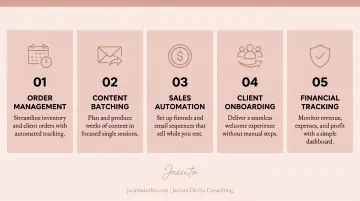
- Systems and automation are what turn a reactive hustle into a business that actually grows
Start With a Clear Niche and Ideal Customer
Trying to sell jewelry to everyone is the fastest route to selling to no one. When your brand speaks to a specific woman — her style, her occasions, her price point — your marketing becomes sharper, your content resonates, and your conversions improve.
Know Your Business Model First
Not all jewelry businesses grow the same way. Each model requires a different strategy:
- Handmade/artisan — Built on craft and story; Etsy is your natural discovery channel, and custom orders drove approximately 30% of Etsy's 2024 marketplace sales
- Fashion/costume jewelry — A $31 billion global market growing at 7.4% annually — volume and visual branding are the levers
- Fine jewelry — Higher margins, longer sales cycles; brand trust is essential before scaling
- Direct sales — Relationship-driven and community-focused; social selling is your primary growth engine
- Curated resale — Requires strong sourcing instincts and a distinct editorial point of view
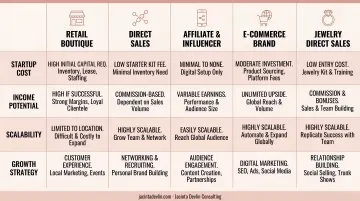
Jacinta Devlin started as a direct sales jewelry rep at 21 — not knowing it would become a 12-year, Top 1% career at lia sophia and Park Lane Jewelry. Understanding her model deeply before trying to scale was the foundation for everything that followed — and it's the same place every jewelry business needs to start.
Build a Basic Customer Profile
Once you know your model, your next job is knowing your buyer. Every brand, pricing, and channel decision flows from that clarity. When building your customer profile, define:
- Demographics — age range, lifestyle, income bracket
- Shopping behavior — impulse buyer vs. considered purchase, gift buyer vs. self-purchase
- Emotional driver — what occasion or feeling prompts the purchase
- Where she spends time — Instagram, Pinterest, TikTok, Facebook groups, Etsy
Once you can answer these clearly, your content, pricing, and channel choices become obvious rather than guesswork.
Build a Brand That Attracts and Converts
A pretty feed is not a brand. A real brand has a consistent visual identity and a story that makes buyers feel something — and that combination is what converts browsers into customers.
The Elements That Actually Drive Sales
Strong jewelry brands share a few non-negotiable components:
- Visual identity — logo, color palette, typography, packaging, and photography that all feel like the same brand
- Founder story — the "why" behind the business, told honestly and specifically
- Consistent voice — how you write product descriptions, respond to DMs, and show up on every platform
According to a 2023 Edelman Trust Barometer report, 59% of consumers are more likely to buy new products from a brand they trust, and 79% of Gen Z say trust in the brands they buy matters more than ever. A fractured brand identity erodes that trust silently — even when the product is genuinely good.
Product Photography Is a Conversion Decision
Low-quality images are one of the most common conversion killers for jewelry businesses. Etsy data shows that 90% of shoppers say photo quality is extremely or very important to their purchase decision. A Baymard Institute study found that 42% of users try to judge product size from images alone — and 23% of ecommerce sites still don't include model images for wearable products.
For jewelry, strong photography requires:
- Detail shots that show texture, finish, and scale
- On-model or on-body shots showing how pieces wear
- Lifestyle images that place the jewelry in a real context
- Consistent backgrounds and lighting that signal brand quality
Storytelling as a Differentiator
In a crowded market, your story is often the only truly unique thing you have. The sourcing process, the inspiration behind a collection, the reason you started — these create emotional connection that product listings alone cannot.
Weave your story into product descriptions, email content, and social posts. Your brand should have a clear narrative thread that buyers can follow — not just on the "About" page, but woven into every touchpoint.
Where to embed your story:
- Product descriptions that reference the inspiration behind a piece
- Email sequences that introduce your founding moment early
- Social captions that connect collection launches to your personal "why"
Jacinta's client Carissa P., a Park Lane Jewelry direct sales leader, chose to work with Jacinta specifically because "she's walked in my shoes." That shared story built enough trust for Carissa to commit — and she achieved 40% year-over-year business growth through the Business Growth Program.
Price Your Work to Make Real Money
The most common pricing mistake women jewelry founders make is pricing based on what competitors charge — or worse, what "feels right." Neither approach accounts for your actual costs, and both lead to a business that generates revenue without generating real profit.
A Basic Pricing Formula
Start here:
(Cost of materials + Cost of labor + Overhead allocation) × Markup = Retail price
A few notes:
- Count your time as labor at a real hourly rate — not zero
- Include packaging, platform fees, shipping supplies, and a proportional share of tools and workspace in overhead
- Apply a retail markup of 2x to 4x your total cost, depending on your market and brand positioning
- Plan wholesale pricing at 50% of retail from the start, so that margin still leaves you profitable
The Psychology of Underpricing
Here's what most jewelry founders don't realize: pricing too low signals low value to buyers, not accessibility. Research published in PMC confirms that consumers consistently use price as a shortcut for quality when other signals are absent. When your earrings are $8, the buyer questions the materials — not the price.
Raising prices, when done with the right brand positioning, often increases conversions rather than reducing them. That's where a tiered product structure comes in — it gives every price point a purpose.
Product Tiering for Consistent Revenue
Having only one price point limits your revenue ceiling. A tiered structure lets you capture different buyers and increase average order value:
| Tier | Role | Example |
|---|---|---|
| Entry-level | Accessibility piece, impulse buy | Everyday stud or simple chain |
| Mid-range | Core revenue driver | Signature collections, layered sets |
| Premium | High-margin, brand-elevating | Custom, fine, or limited-edition pieces |
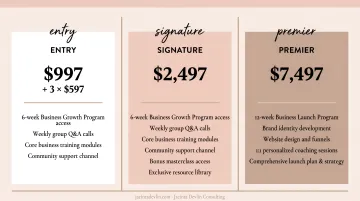
Ally G. at Dune Jewelry hit consistent $10,000+ sales months working with Jacinta — same hours, smarter offer structure across all three tiers.
Grow Your Sales With a Multi-Channel Marketing Strategy
Posting on Instagram and hoping is not a marketing strategy. Consistent sales come from consistent visibility across multiple channels — and that requires a real plan, not sporadic product drops.
Social Selling and Direct Sales Channels
Social selling — selling through relationships and conversation rather than just product listings — is one of the most effective channels for jewelry founders, especially early-stage.
What actually works:
- Facebook groups — Build a community around your brand, not just a feed. Jacinta's client Sharon B. grew two Facebook groups to 30,000+ and 37,000+ members in four months, which drove consistent daily Amazon sales
- Instagram Stories sequences — A structured Stories arc (not random daily posts) moves viewers from awareness to purchase; Jacinta builds Story sales sequences as a core deliverable for her clients
- TikTok Live — Show-and-tell format is high-converting for jewelry because buyers see pieces styled in real time; a scripted live framework converts far better than going in without a script
- Limited drops — Create urgency through scarcity; coordinating your content, email, and Stories around a drop generates far more revenue than passive listing
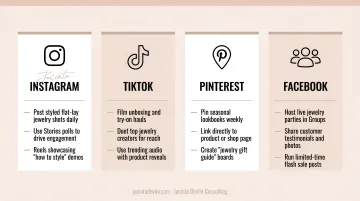
TikTok's official data shows 81% of female entrepreneurs under 30 agree their business needs TikTok marketing to stay competitive.
Build a Multi-Platform Presence
Relying on one platform is fragile. A diversified presence protects your revenue when algorithms shift and expands your discovery surface.
Core platforms for jewelry businesses:
- Etsy — Strong organic discovery; jewelry is a top category with surging search trends (custom charm necklace searches rose 227% year-over-year in late 2023)
- Shopify — Gives you brand ownership, customer data, and full control over the buying experience
- Amazon Storefront — Effective for accessories-adjacent products and affiliate-style curations; Jacinta's client Sharon B. scaled from $4,000 in her first year to $20,000+ per month consistently
- TikTok Shop — U.S. GMV surpassed $9 billion in 2024 and is growing fast for independent sellers
Email is your most reliable revenue channel. An email list is the one asset an algorithm cannot take from you. According to Litmus, email delivers an average $36 return for every $1 spent — and Mailchimp's ecommerce benchmarks show a 29.81% average open rate versus single-digit organic social reach.
A simple email strategy:
- Lead magnet — a discount, styling guide, or exclusive content to grow your list
- Welcome sequence — 5–7 emails introducing your brand, story, and first purchase incentive
- Consistent ongoing sends — a mix of product stories, new arrivals, and promotions on a regular schedule
The most effective email setups run largely on autopilot — welcome sequences, abandoned cart recovery, post-purchase flows, and launch campaigns all triggered without manual effort. Platforms like Flodesk make this straightforward to build even if you're starting from zero.
Influencer and Affiliate Partnerships
Once your email foundation is in place, influencer and affiliate partnerships are the next lever for reaching new buyers without a large ad budget. Engagement rate matters more than follower count when identifying micro-influencers. A simple gifting arrangement with a creator whose audience matches your ideal customer can introduce your brand to thousands of aligned buyers. Use affiliate codes or tracking links to measure what's actually working.
Build Systems That Let Your Business Scale Without Burning Out
When a jewelry business starts to grow without systems in place, the symptoms are predictable: missed orders, inconsistent content, no time to think strategically, and a founder who is working more hours for the same revenue.
According to a 2024 Intuit survey, businesses spend 25 hours per week on manual data entry and reconciliation, and 91% say manual processes undermine their productivity. Those are hours that could be spent building the business instead of just running it.
The Systems Every Growing Jewelry Business Needs
- Content batching calendar: Plan and produce content in bulk sessions rather than scrambling daily; hook templates and a defined calendar cut production time dramatically
- Order management workflow: A clear fulfillment process, confirmation emails, and shipping timelines prevent customer service fires before they start
- Abandoned cart email automations alone can recapture 10–15% of lost sales; post-purchase sequences turn one-time buyers into repeat customers
- Customer follow-up sequences for review requests, loyalty offers, and re-engagement run automatically once built
- Multi-platform inventory tracking: If you sell on Etsy, Shopify, and at markets, your stock levels need to sync across all channels
Multiple Income Streams as a Scaling Model
Jacinta herself built five distinct revenue streams before launching her consulting business: direct sales jewelry, influencer and brand partnerships, her Amazon storefront (StyledByJacinta), her clothing boutique (Jacinta The Label), and ultimately coaching. That layered model is what she teaches clients — a single revenue channel is fragile.
For jewelry founders, diversified income might look like:
- Direct product sales paired with a wholesale account
- A teaching workshop or beginner jewelry class
- Affiliate income through Amazon or LTK
- Selling simultaneously on Etsy and Shopify
Each stream feeds the others when they're rooted in a consistent brand identity.
When You're Ready to Stop Guessing and Start Building
There's a specific moment many women jewelry founders hit: they're already making money, they have a following, their product is proven — but growth has stalled. Generic advice isn't moving the needle, and another DIY course isn't the answer.
As Jacinta puts it: "You don't have a social media problem. You have a strategy problem dressed up as a social media problem."
That's exactly what Jacinta Devlin's coaching is built to fix — for women in direct sales jewelry brands like Park Lane, Dune Jewelry, or Stella & Dot, and for founders running independent labels and boutiques who've hit a ceiling they can't coach their way past alone.
Recent client results:
- Ally G. (Dune Jewelry) — hit $10,000+ sales months for the first time
- Carissa P. (Park Lane Jewelry) — grew her business 40% year-over-year
- Joy W. (Park Lane Jewelry) — scaled from $500/month to $5,000+ every month
If you've seen other women grow and you're thinking "why not me?" — that's the signal to stop guessing and start building with a real plan.
Book a free 15-minute Growth Chat with Jacinta to find out exactly which program fits your business stage and revenue goals.
Client results are real but not typical. Results depend on your own consistency, effort, and implementation.
Frequently Asked Questions
What is the 2:1:1 rule for a jewelry business?
The 2:1:1 rule is a content strategy guideline used in social selling: for every 2 value-based or lifestyle posts, share 1 promotional piece and 1 engagement-focused piece. The ratio varies by platform and audience, so treat it as a starting framework rather than a fixed rule.
What types of jewelry sell best online?
Fashion and personalized jewelry consistently drive strong online sales volume. Etsy search data shows custom charm necklace searches rose 227% year-over-year in late 2023. Fine and handmade jewelry can command higher margins. The best-selling category for your business depends on your niche, platform, and customer.
How profitable is a jewelry business?
Jewelry businesses can carry strong margins when priced correctly. A 2021 disclosure from Paparazzi showed consultants earning 35%–45% gross profit per item. Net profitability varies widely by model — direct sales, handmade, and fine jewelry all operate differently — shaped by your pricing strategy, channel mix, and cost of goods.
Where do jewelry businesses source their inventory?
Main sourcing channels include wholesale suppliers and trade shows (JCK Las Vegas, Tucson Gem & Mineral Show), wholesale marketplaces like Faire (which connects retailers with 100,000+ brands), overseas suppliers on Alibaba, and raw materials suppliers like Rio Grande for handmade creators.
How do I get consistent sales for my jewelry business?
Consistent sales come from consistent visibility — a multi-channel presence across social, email, and marketplace platforms, a regular posting and promotional cadence, and a structured sales process. Sporadic product drops rarely build the momentum that predictable income requires.