
Introduction
You're posting on Instagram, sending emails, following up in DMs — and still watching potential customers disappear without ever buying. That's not a work ethic problem. It's a funnel problem.
According to a 2025 Constant Contact report, only 18% of small businesses feel confident their marketing is actually working — down from 27% the year before. Another 23% say their biggest frustration is not knowing which efforts drive results. A sales funnel is what closes that gap.
A sales funnel gives structure to the customer journey. Instead of posting and hoping something lands, each piece of content, each email, and each follow-up has a defined purpose: move the right person one step closer to buying.
This guide covers:
- What a sales funnel is and why small businesses need one
- The four stages (plus the critical fifth one most owners skip)
- Proven strategies for each stage
- A five-step process to build your own funnel
- The mistakes that are quietly costing you customers
What Is a Sales Funnel and Why Every Small Business Needs One
Salesforce defines a sales funnel as "the journey a prospect takes from awareness of a product or service to purchase." The definition is straightforward. The real value is what the funnel lets you actually see about your business.
Without a defined funnel, marketing feels random. You post, you hope, you wonder why some weeks bring sales and others bring silence. With a funnel, you know exactly where leads enter, where they're dropping off, and what to fix.
This matters especially for small businesses operating with limited time and budget. Every hour you spend creating content should have a clear role in moving someone toward a purchase — not just filling a feed.
Sales Funnel vs. Marketing Funnel
These terms often get used interchangeably, but they serve different functions:
- Marketing funnel — creates awareness and attracts potential customers to your business
- Sales funnel — takes over from there, guiding those prospects through a decision and into a purchase
Think of the marketing funnel as getting people in the door. The sales funnel is everything that happens once they're inside.
For social sellers, boutique owners, coaches, and affiliate marketers, the two funnels work as a system. One brings people in; the other converts them. When both are running, you stop relying on luck and start building a business that grows predictably.
The 4 Stages of a Small Business Sales Funnel
Most small business funnels are built on the AIDA framework — a model traced back to 1898 and still the most practical structure for mapping the customer journey.
Here's how each stage works:
| Stage | What's Happening | Your Job |
|---|---|---|
| Awareness | They discover you exist | Get found consistently |
| Interest | They want to learn more | Give them a reason to stay |
| Decision | They're comparing options | Build trust and remove doubt |
| Action | They buy | Make it easy to say yes |
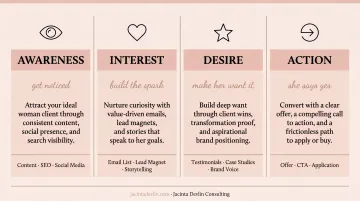
Each stage requires different messaging. What works at Awareness (broad, relatable, discoverable content) will feel pushy at Interest, and what works at Decision (social proof, urgency, direct offers) will feel premature at Awareness.
The Critical Fifth Stage: Retention
Most small business funnels treat the purchase as the finish line. That's a costly mistake.
Harvard Business Review, citing Bain & Company research, found that a 5% increase in customer retention can raise profits by 25% to 95% — and that acquiring a new customer can cost 5x to 25x more than keeping an existing one. The businesses that grow consistently are the ones building post-purchase relationships, not just chasing new leads.
That retention data points to a broader principle: every stage of your funnel matters. Most small businesses leak revenue in the middle — and they don't catch it because they're too focused on driving more traffic instead of fixing what's already broken.
Proven Sales Funnel Strategies for Small Businesses
These strategies are built for small businesses — not enterprise brands with six-figure ad budgets. Each section maps to a specific funnel stage.
Top-of-Funnel: Get Found and Build Awareness
The awareness stage is about getting in front of cold audiences who don't know you yet.
Organic social media remains the most accessible awareness tool for small businesses. Constant Contact found that social media is the most-used channel among small businesses at 60%, and Keap's 2024 research found 54% of businesses use it specifically for lead generation. The key isn't volume — it's consistency on the right platforms.
For the clients Jacinta Devlin works with — boutique owners, direct sellers, coaches, and affiliate marketers — Instagram and TikTok are typically the highest-leverage platforms for social discovery. Pinterest is a standout for boutiques, bloggers, and LTK creators, functioning more like a search engine than a social feed.
What works at the top of funnel:
- Short-form video (Reels, TikToks) that speaks directly to your audience's pain points
- Pinterest boards and Idea Pins built around buyer-intent search terms
- SEO-optimized blog content that surfaces your business to people already searching for solutions
- Showing up consistently on 1-2 platforms rather than posting sporadically across five
Searchable content compounds. A well-optimized blog post or Pinterest board keeps working months after you publish it — which is exactly the kind of leverage a time-strapped business owner needs.
Middle-of-Funnel: Capture and Nurture Leads
Getting attention is step one. Converting that attention into a contact you can follow up with is step two — and where most small business funnels have a hole.
Offer something genuinely valuable in exchange for an email address. That lead magnet is the bridge between a stranger's first impression and an ongoing relationship.
Strong lead magnet examples by business type:
- Service-based (coaches, consultants): "5 Ways to Make Sales Online," a free audit checklist, or a short video training on a common pain point
- Product-based (boutiques, direct sellers): A first-purchase discount code, a style guide, or a "how to shop the collection" resource
- Affiliate/content creators: A curated resource list (like "10 Affiliate Programs to Apply For No Matter How Many Followers You Have")
Once someone opts in, the lead magnet alone won't close a sale. That's what a nurture email sequence is for.
A simple 3-5 email sequence over one to two weeks should:
- Welcome and deliver the lead magnet immediately
- Share your story — who you are and why you do what you do
- Provide pure value — a tip, resource, or insight with no ask attached
- Build social proof — a client win, a transformation, a real result
- Make the offer — now that trust is established, introduce what you sell
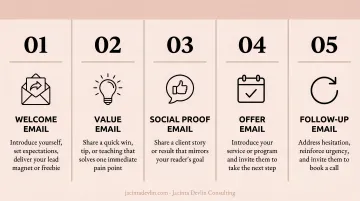
Automated email flows generate nearly 41% of email revenue from just 5.3% of sends, according to Klaviyo's benchmark data. The nurture sequence is not optional — it's where the relationship (and the sale) actually forms.
Pushing an offer too fast is one of the top reasons email lists go cold. Educate first, build trust second, sell third.
Bottom-of-Funnel: Convert and Close
At this stage, the lead knows who you are and what you offer. Your job is to make saying yes feel easy and obvious.
Effective conversion strategies:
- Social proof — testimonials, before-and-afters, client results, and reviews. Interacting with reviews leads to a 128% average conversion lift, according to PowerReviews.
- Limited-time offers — a clear deadline gives a reason to act now rather than later
- Direct, specific calls to action — "Book your free call" beats "Learn more" every time
- Friction removal — simplified checkout, fast response times, easy booking links
Baymard Institute reports a 70.19% average cart abandonment rate, with 18% of shoppers abandoning specifically because checkout was too long or complicated. For boutique owners and product sellers, fixing checkout friction alone can meaningfully move conversion numbers.
For Instagram sellers, Story sales sequences, live shopping scripts, and DM-to-sales automation tools (like LinkDM) act as bottom-of-funnel conversion tools. They route engaged followers directly toward a purchase — no app-switching required, which means less drop-off at the final step.
Post-Purchase: Retain, Upsell, and Get Referrals
This is the most underutilized stage in most small business funnels — and often the highest-return one, because the work of earning trust is already done.
A customer who just bought from you is at peak trust. They chose you over alternatives, they got what they came for, and if you deliver well, they're primed to buy again and tell others about it.
Post-purchase strategies that work:
- A thank-you email sequence (separate from the receipt) that makes them feel seen and valued
- A loyalty incentive for their next purchase
- A direct ask for a testimonial or review — 48-72 hours post-purchase is the sweet spot
- A referral prompt: "Know someone who'd love this? Here's a link to share."
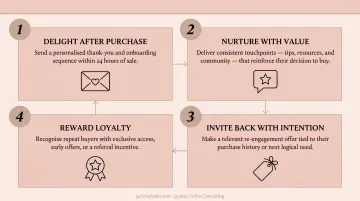
Devlin Consulting builds post-purchase loyalty sequences, upsell automations, and referral program flows into every Done-For-You marketing system — because for the women in these programs, this is the stage that turns a good month into a repeatable one.
How to Build a Sales Funnel for Your Small Business
Step 1 — Know Your Customer
An effective funnel starts with clarity on who you're building it for. What are their pain points? What do they search for? What makes them hesitate at the moment of purchase?
Without this, every other step is guesswork. Customer clarity informs your lead magnet topic, your nurture email content, your conversion offer, and even the platform you show up on.
Step 2 — Create a Lead Capture Mechanism
You need a defined way to move someone from "follower" or "visitor" to a contact you can follow up with. This might be:
- A landing page with a free offer (built on Flodesk, Showit, or your email platform)
- A "link in bio" tool like Stan Store or Beacons with a freebie
- A website pop-up triggered by time-on-page or exit intent
The specific tool matters less than having something in place. No lead capture = no list = no follow-up = no funnel.
Step 3 — Set Up an Email Sequence
Build a nurture sequence that moves a new lead from curious to confident. A standard welcome and nurture sequence runs 5-7 emails, delivering value before making a sales ask. Flodesk is a strong starting point for small businesses — it supports opt-in pages, automations, and sequences without requiring advanced technical skills.
Send consistently, but don't overcommunicate. Two to three emails per week during an active launch is reasonable; one to two per week for ongoing nurture is the norm.
Step 4 — Create a Conversion Offer
Match your offer to where the lead is in their decision process. The first offer in a funnel is rarely your highest-ticket product — it's typically:
- A lower-commitment entry point that delivers real value
- Priced to feel like an obvious yes given what they now know about you
- Packaged with a clear, specific reason to act now
Step 5 — Track, Test, and Optimize
A funnel is never finished. The key metrics to watch:
- Email open rates — Mailchimp's 2023 benchmark sits at 35.63% average open rate; below this signals subject line or list health issues
- Landing page conversion rate — the median across 41,000 pages is 6.6%; anything above 11% is strong
- Click-through rates — low CTR on nurture emails often means the offer isn't landing yet
- Sales rate — tracking how many leads convert at each stage reveals where the leak is
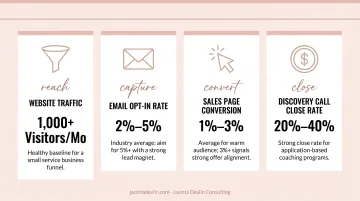
Even small adjustments — a clearer subject line, a more direct CTA, a different offer structure — compound over time.
Sometimes the leak isn't obvious until someone outside your business looks at the numbers. Jacinta Devlin works with women entrepreneurs to audit their funnel stage by stage — pinpointing exactly where leads drop off and rebuilding those steps with a strategy built around their specific business.
Sales Funnel Mistakes That Are Costing You Customers
Most funnel problems aren't technical — they're strategic. Here are three mistakes that consistently kill conversions for small business owners.
Mistake 1 — Skipping the Nurture Phase
Going straight from "hi, nice to meet you" to "here's my offer" is the fastest way to lose a warm lead.
The nurture stage builds the trust that makes a sale feel natural rather than pushy.
This is what the "post and pray" pattern looks like in real life: posting sporadically, sending one email a month, and hearing crickets. Not because the audience isn't interested, but because the relationship wasn't there yet when the ask arrived.
Mistake 2 — Building a Funnel Around the Wrong Offer or Audience
Many small business owners build a funnel for the product they want to sell, not the problem their customer is actively trying to solve. This misalignment is why funnels get traffic but no conversions.
Watch for these warning signs:
- The symptom: People opt in, engage with your emails, and still don't buy
- The diagnosis: The lead magnet attracted the wrong audience, or the offer doesn't connect to the problem that brought them in
- The fix: Deep customer clarity before you build anything else
Mistake 3 — No Follow-Up After the Sale
Treating a purchase as the finish line means leaving repeat business and referrals on the table. Acquiring a new customer costs significantly more than keeping one, yet most small business funnels end the moment someone buys.
A simple post-purchase email sequence, a loyalty incentive, and a direct referral ask deliver some of the highest ROI in your entire funnel. Build them once, and they keep working every time a new customer comes through.
Frequently Asked Questions
What are the best sales funnel strategies for small businesses?
The highest-impact combination: organic social content for awareness, a lead magnet to capture emails, a nurture sequence to build trust, and a clear conversion offer with a compelling reason to act now. The specific platforms and offer types depend heavily on your business model and audience.
What is the 10-3-1 rule in sales?
The 10-3-1 rule is a prospecting ratio: for every 10 prospects you connect with, roughly 3 will show genuine interest, and 1 will convert into a customer. It's a rule of thumb, not a universal law — but it sets realistic expectations and reinforces why consistent top-of-funnel activity drives bottom-of-funnel results.
What are the 5 C's of sales?
One widely used framework lists the 5 C's as: Contact, Connect, Cultivate, Convert, and Continue (or Close). Each maps to a funnel stage — from initial outreach through relationship-building to conversion and retention. The core principle: a sale is a process, not a single moment.
What's the difference between a sales funnel and a marketing funnel?
A marketing funnel focuses on creating awareness and attracting potential customers to your business. A sales funnel picks up from there, guiding those prospects through a purchase decision. In practice, the two overlap — but they serve distinct purposes and require different content and strategies at each stage.
How long does it take to build a sales funnel for a small business?
A basic funnel — landing page, lead magnet, email sequence, and conversion offer — can be built in one to two weeks. Optimizing it for consistent conversions is an ongoing process that improves over time as you gather data on what's working and what isn't.
Do I need expensive software to run a sales funnel?
No. Many effective funnels run on free or low-cost tools — Flodesk starts at $25/month and a free Stan Store can handle lead capture. Strategy matters far more than software; a clear customer journey on simple tools will outperform an expensive tech stack with no plan behind it.
Conclusion
A sales funnel is not a complicated tech project. It's a clear, intentional path that guides the right people from discovering your business to becoming loyal, paying customers.
The businesses that grow consistently aren't the ones with the most content or the biggest following. They're the ones with a system — one that turns steady effort into steady revenue.
For women entrepreneurs ready to stop guessing and start building a funnel that actually converts, Jacinta Devlin builds the strategy around your specific business. She has helped thousands of women move from unpredictable sales to consistent $10k+ months, with individualized plans, not recycled frameworks.
Ready to build a business that creates real income and real freedom? Book your free 15-minute growth chat and start with a conversation that's actually about your business.