Introduction
You've got the product. You're showing up on social media. Maybe you're even getting some traffic. But sales? Inconsistent at best.
Here's the truth most women entrepreneurs don't hear early enough: the product isn't usually the problem. The missing piece is a structured system that moves people from "I just found this brand" to "I'm buying — and telling my friends."
That system is a sales funnel. And according to a 2025 Constant Contact report, only 18% of small business owners feel confident their marketing is actually working. The other 82% are largely guessing.
This guide walks you through a practical 6-step framework for building a high-converting sales funnel — built specifically for female entrepreneurs who are ready to turn attention into consistent, predictable revenue.
Key Takeaways
- A sales funnel is a deliberate system — skipping steps creates gaps where leads fall through
- Traffic quality beats volume — 100 ideal customers outperform 10,000 wrong ones
- Most leads need multiple touchpoints before buying — a nurture sequence closes that gap
- The funnel doesn't end at purchase — retention costs far less than acquisition
- Simple, well-executed funnels consistently outperform elaborate ones built on assumptions
What Is a High-Converting Sales Funnel?
A sales funnel is a mapped-out series of steps that intentionally moves a potential customer from first discovering your business all the way through to purchase — and beyond.
The core stages look like this:
- Awareness — They discover you exist (social content, search, referral)
- Interest — They engage with your brand and want to learn more
- Decision — They're evaluating whether your product/service is right for them
- Action — They purchase
- Retention — They buy again and refer others
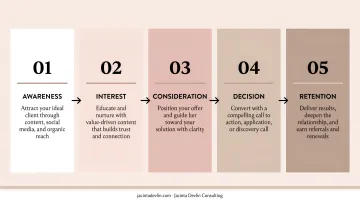
Most female entrepreneurs have the Awareness stage covered. The gap is almost always at Interest and Decision — no structured way to move someone from "I like what I see" to "I'm ready to buy."
What Makes a Funnel "High-Converting"
A high-converting funnel is built around how your buyer actually thinks at each stage — what question is she asking, and are you answering it at the right moment?
That means addressing the right questions at the right moments:
- At awareness: "Is this for me?"
- At decision: "Can I trust this? Is it worth it?"
- At action: "Is this easy to buy?"
When each stage answers its question clearly, more people move forward — and that's where the six steps below come in.
Why Small Businesses Need a Sales Funnel
Without a funnel, revenue depends on timing and luck. Someone sees your post on the right day, in the right mood, and happens to buy. That's not a business — it's a lottery.
Research from PYMNTS shows 63% of small businesses rely on word of mouth as a primary customer acquisition channel. Word of mouth is valuable, but it's neither predictable nor scalable — especially for solo founders and small teams.
The alternative is a funnel-based strategy: a repeatable, scalable path that works whether you're actively selling or not. It captures leads when you're unavailable and presents your product/service when they're ready to buy.
This is exactly the gap Jacinta Devlin sees most often with new clients. The pattern is consistent: a growing social audience, an engaged community, but no infrastructure converting that attention into revenue. The missing pieces typically look the same:
- No lead magnet to capture interest
- No email sequence to build trust over time
- No sales page to close the sale
Just posting and hoping someone buys.
A funnel fixes the structural problem. Word of mouth becomes one traffic source feeding into a system that nurtures, converts, and scales — with or without you in the room.
The 6-Step Framework for Building Your High-Converting Sales Funnel
These steps work together as a system. Skipping any one of them creates a gap where leads fall through — and most of the time, those leads are gone for good.
Step 1: Generate the Right Traffic
Traffic quality matters far more than volume. A hundred people who are genuinely interested in what you sell will always outperform ten thousand unqualified visitors.
Before worrying about how much traffic you're getting, ask: does this audience actually want what I'm selling?
Practical traffic sources for small businesses:
- Organic Instagram and TikTok content (highest emphasis for most business types)
- Email list building (consistently the highest-converting channel — 44% of SMBs cite email as their most effective marketing channel)
- SEO-driven blog content (strong ROI, especially for boutique and service businesses)
- Pinterest (particularly effective for boutique, blogger, and LTK creator audiences)
- Facebook Groups (powerful for influencers and affiliate sellers)
- Referral partnerships
The most common mistake? Spreading thin across every platform at once. With limited time — and most small business owners have less than one hour per day for marketing — mastering one primary channel first is the only approach that works. Pick the channel where your specific audience already spends time and build real presence there before expanding.
Step 2: Create a Lead Magnet That Delivers Real Value
A lead magnet is a free, specific resource that solves one painful problem for your ideal customer — in exchange for their contact information. It pulls someone from casual visitor into your funnel.
Effective lead magnet formats for small businesses:
- PDF checklist or guide (fast to create, immediately actionable)
- Short email course (positions you as an expert over 3-5 days)
- Quiz or scorecard (high engagement, especially for coaches and service businesses)
- Free webinar or workshop (strong conversion — webinar landing pages convert at 22.3%)
- Template or swipe file (high-value and easy to act on immediately)
The Specificity Rule
The difference between a lead magnet that converts and one that doesn't usually comes down to specificity.
"The 3-Day Instagram Content Plan for Boutique Owners" outperforms a generic "Social Media Guide" every time — because it speaks directly to one person's exact problem. The reader immediately thinks: that's for me.
Jacinta Devlin's own lead magnets illustrate this perfectly. Rather than a broad marketing guide, she offers things like "10 Affiliate Link Programs to Apply For No Matter How Many Followers You Have" and "5 Ways to Make Sales Online." Immediately actionable. Unmistakably targeted.
Solve one specific problem completely. That's the whole job.
Step 3: Build a Simple Landing Page That Converts
The landing page has one job: give visitors a single clear decision to make. Opt in — or leave.
Every converting landing page needs:
- A benefit-focused headline that answers "what do I get and why does it matter?" in one sentence
- 2-3 bullet points summarizing what they'll receive
- Social proof (a testimonial, a credential, or a credibility statement)
- One call-to-action button
The Homepage Mistake
Sending traffic to your homepage instead of a dedicated landing page is the most common small business conversion killer. Homepages have navigation menus, multiple links, and competing messages — all of which pull visitors away before they opt in.
A dedicated landing page removes every distraction and keeps attention on one decision. According to Unbounce, median landing page conversion rates sit at 6.6% across industries, with top performers reaching 40.8% — the difference often comes down to clarity and focus.
One writing principle worth keeping: clear beats clever. The headline should use the exact language your ideal customer uses to describe their own problem. Not how you describe your product — how they describe their pain.
Step 4: Nurture Leads with Strategic Content
Most people who enter your funnel are not ready to buy. They need time, information, and trust. This is where most small business funnels fall apart — the lead magnet gets delivered, and then nothing.
A simple email nurture sequence fixes this:
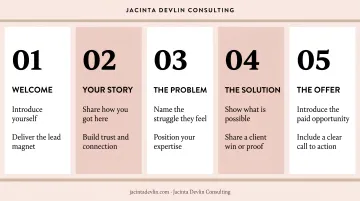
- Welcome email — Delivers the lead magnet, introduces you, and sets the tone for the sequence
- Emails 2-3 — Educate on the problem your product/service solves; share a relevant story or lesson
- Email 4 — Address the most common objection your audience has before buying
- Email 5 — Introduce your paid product/service naturally, with context that makes it feel like a logical next step
Write these in a conversational, human tone — not corporate copy. GetResponse reports welcome emails average an 83.63% open rate, so that first message is your highest-impact touchpoint. Use it well.
Social media runs alongside your email sequence as a second nurture channel. Between emails, people see your posts, your stories, your Reels — all reinforcing the same message and keeping your brand present. Consistency across both channels is what moves someone from "interested" to ready to buy.
Step 5: Close the Sale with Confidence
When someone doesn't buy, they're rarely saying "no forever." They're saying "I'm not sure yet." The closing stage is about removing that uncertainty — not applying pressure.
The main barriers to purchase:
- Lack of trust in you or the product/service
- Unclear value — they don't understand exactly what they're getting
- Friction in the buying process
- Timing — they want it, but something else is competing for their attention right now
Practical closing tools:
- Clear product/service page — answers "what do I get, how much does it cost, and what happens next" without ambiguity
- Testimonials with specific results — 99.9% of consumers read reviews before purchasing, and interaction with reviews lifts conversion by 120.3%
- Simple guarantee or risk-reversal statement — reduces the perceived downside of buying
- Low-friction checkout — Baymard reports 70.22% average cart abandonment, with 17% abandoning because checkout is too complicated. Every unnecessary step costs you sales.
On urgency: use it, but only when it's real. Time-sensitive bonuses, limited spots, or genuine enrollment windows create honest urgency. Manufactured scarcity — fake countdown timers, artificial "only 3 left" copy — erodes the trust you spent your entire funnel building.
Step 6: Retain Customers and Build Brand Advocates
The funnel doesn't end at purchase. It's actually just getting started.
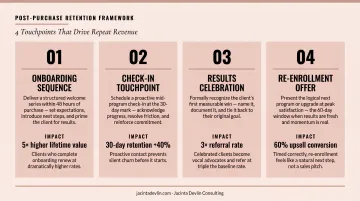
Harvard Business Review found that acquiring a new customer costs 5 to 25 times more than retaining an existing one. And Bain & Company research shows that increasing retention by just 5% can increase profits by 25% to 95%.
Retention strategies that work:
- Onboarding sequence — A 3-5 email series after purchase that sets expectations, celebrates their decision, and delivers an early win
- Milestone check-ins — Acknowledge progress and make customers feel seen
- Upsell and next-step offers — Presented when the customer is already experiencing results, not immediately after purchase
- Post-purchase email series — Klaviyo data shows these average $0.41 revenue per recipient, with top performers reaching $5.14
Turning Customers Into Referral Sources
Happy customers are the most cost-effective marketing channel you have. Ask for referrals and testimonials at the right moment — after a win, after a milestone, after they express satisfaction rather than out of nowhere.
Make it easy. Give them a template, a direct link, or a specific prompt. And recognize their advocacy, whether that's public acknowledgment, exclusive access, or a meaningful thank-you.
Referred customers cost less to acquire, stay longer, and spend more.
Key Factors That Affect Sales Funnel Performance
Even a well-built funnel can underperform if these fundamentals are off:
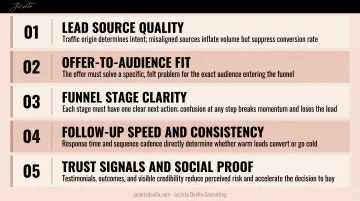
- Traffic quality — Mismatched audience is the most common reason funnels fail, regardless of how well everything else is built
- Offer-message fit — The language throughout your funnel must mirror the exact words your ideal customer uses to describe their problem, not how you'd describe your own product
- Friction and unnecessary steps — Every extra click or confusing process between interest and purchase chips away at your conversion rate
- Follow-up consistency — Businesses that stay in touch convert far more leads than those who send one email and go quiet
- Data tracking — Without knowing where leads drop off, there's no way to improve. Tracking opt-in rates, email opens, and conversions shows you exactly where to focus
Common Mistakes Small Business Owners Make with Sales Funnels
Mistake 1: Building the Funnel Before Knowing the Customer
Launching a funnel without deep clarity on who your ideal customer is, what they want, and what language they use to describe their problem results in a funnel that speaks to no one. Every technical element can be perfect. If it's aimed at the wrong person or using the wrong words, it still won't convert.
Mistake 2: Making It Too Complicated Too Soon
Many small business owners try to replicate complex, multi-step funnels designed for large marketing teams and big ad budgets. A simple three-stage funnel — lead magnet, nurture sequence, clear product/service — built on real customer understanding will outperform an elaborate funnel built on assumptions. Start simple. Complexity earns its place only after the basics are converting.
Mistake 3: Setting and Forgetting
A funnel is not a one-time build. It requires regular review of key metrics, then ongoing testing based on what the data shows. At minimum, track:
- Opt-in rate
- Email open rates
- Conversion rate at each stage
Test headlines, subject lines, calls to action, and offers. High-converting funnels are built through multiple iterations — not a first draft that got lucky.
Frequently Asked Questions
What is a sales funnel and why does my small business need one?
A sales funnel is a structured system that guides potential customers from first discovering your business through to purchase and repeat buying. Without one, small businesses rely on inconsistent tactics — word of mouth, sporadic posts — with no repeatable path to revenue.
How long does it take to build a sales funnel?
A basic funnel — lead magnet, landing page, 3-5 email sequence, product/service page — can be built in one to two weeks. High-converting funnels take longer because they're refined over time using real performance data. The first version is a starting point, not a finished product.
What is a lead magnet and which type works best for small businesses?
A lead magnet is a free resource that solves a specific problem in exchange for contact information. Checklists and guides work well for information-seekers; quizzes and mini-courses perform well for coaches and service businesses. The right format depends on your audience.
How do I get traffic to my funnel without a big advertising budget?
Start with organic strategies: consistent content on one social platform, SEO-driven blog content, email list building, and referral partnerships. Master one channel before putting money into paid ads — it's a faster path to traction and wastes far less of your budget.
How do I know if my sales funnel is working?
Track the key metrics at each stage: opt-in rate on the landing page (a healthy benchmark is above 6%), email open and click-through rates, and conversion rate from lead to paying customer. A significant drop-off at any stage tells you exactly where to improve.
Do I need expensive software to build a sales funnel?
No. Many small businesses start with free or low-cost tools — an email platform like Flodesk or MailerLite, a simple landing page builder, and a payment processor. Simplicity in tech leads to faster execution. Add complexity only once your core funnel is proven to convert.