

This is one of the most common patterns Jacinta Devlin sees when women first come to her for coaching. They have an audience. They have a product people want. But revenue stays inconsistent month to month, and no one can quite explain why. The culprit is almost never the product. It's the funnel — or more accurately, the absence of one.
This guide breaks down the four stages of a high-converting ecommerce sales funnel in plain terms, shows you where most small businesses silently leak revenue, and gives you a clear optimization roadmap built for the way shoppers actually behave in 2026.
Key Takeaways
- A sales funnel is a repeatable system — without one, revenue stays unpredictable no matter how good your product is
- All four stages (Awareness → Consideration → Conversion → Post-Purchase) require different tactics, and a leak at any stage costs you money
- Over-investing in awareness while ignoring conversion and retention is the most common and expensive mistake
- Short-form video and social commerce drive 2026 awareness, but the real revenue comes from the middle and bottom of the funnel
- Your biggest drop-off point is your highest-leverage fix — identify it first, measure results, then move on
What Is an Ecommerce Sales Funnel (and Why You're Losing Sales Without One)?
Think of it like a boutique. A stranger walks past, sees something in the window, and steps inside. A good salesperson doesn't immediately shove a product in their face — they let the person browse, answer questions, build some trust, and eventually guide them toward a purchase. Done right, that stranger becomes a regular.
An ecommerce sales funnel works the same way. It's the structured path someone takes from first discovering your brand to completing a purchase — and ideally coming back to buy again. The funnel gives you a repeatable system instead of relying on chance.
Without one, you're essentially hoping the right person shows up at the right moment with their credit card ready. That's not a strategy. That's luck.
The funnel matters especially for small ecommerce businesses and social sellers because it's what separates sporadic sales from consistent $10K+ months. Jacinta Devlin built her own clothing boutique, Jacinta The Label, to that milestone using exactly this kind of system.
It's the same infrastructure her team now builds for boutique clients like Lisa K. of Fleur de Lis Boutique Florida, who hit $100K+ in her first year.
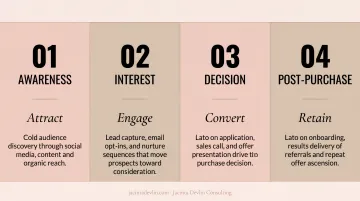
A well-built funnel moves shoppers through four core stages:
- Awareness — they discover your brand through social, search, or a referral
- Interest — they engage with your content, browse your products, or join your list
- Decision — they weigh options, read reviews, and consider buying
- Purchase (and beyond) — they convert, and your retention system kicks in
In 2026, shoppers no longer follow a straight line. TikTok Shop data shows 70% of shoppers have discovered a new brand on TikTok, while BCG's 2025 consumer research confirms that purchase decisions now span multiple touchpoints — social platforms, video, and search — before anyone clicks "buy." Your funnel needs to show up across all of them.
The 4 Stages of a High-Converting Ecommerce Sales Funnel
Think of these as a connected journey, not isolated steps. A leak at any stage costs you money — and most small business owners are bleeding from more than one place without realizing it.
Awareness: Getting the Right Eyes on Your Brand
The goal here isn't to sell. It's to get discovered by the right people.
Primary awareness channels for boutique owners and social sellers in 2026:
- Short-form video — TikTok and Instagram Reels remain the highest-reach organic formats
- Social commerce — TikTok Shop, Instagram Shopping, and live selling shorten the path from discovery to purchase
- Influencer collaborations — micro-influencers with engaged audiences often outperform polished paid ads
- SEO-driven blog content — builds long-term organic traffic that compounds over time
What's working right now: authenticity dramatically outperforms production value. Shoppers want to see real people, real products, and real results. According to Bazaarvoice's 2024 Shopper Experience Index, 86% of consumers engage with creator content before buying — not brand ads.
TikTok Shop is worth singling out. eMarketer projects it will reach $23.41 billion in US ecommerce sales in 2026 — up 48% year over year. More than one-third of all TikTok Shop US purchases in 2024 went to small businesses.
Consideration: Turning Curious Browsers Into Interested Buyers
At this stage, the shopper is evaluating whether your brand is worth trusting. They've found you — now you need to give them reasons to stay.
Tools that build confidence here:
- Real customer reviews and testimonials (not stock photos, not generic praise)
- Before/after results or product-in-use photos
- Detailed product descriptions that answer the unspoken questions
- FAQ content that addresses objections before they become reasons not to buy
Reviews matter more than most sellers realize. PowerReviews surveyed more than 8,000 US shoppers and found that 93% said ratings and reviews directly impact their purchase decision. A product page with no reviews is a conversion killer.
For people who visited but didn't buy, retargeting through email and SMS is where you recapture them. Abandoned cart emails average a 50.5% open rate and 3.33% placed-order rate according to Klaviyo's 2024 benchmarks.
Conversion: Turning Interest Into a Sale
This is the moment of decision. What makes someone click "buy now" versus abandoning their cart?
Key conversion drivers:
- Frictionless checkout with as few steps as possible
- Guest checkout option — removing forced account creation
- Multiple payment options (Shop Pay, Afterpay, Klarna matter to today's buyer)
- Clear, prominent return policy before the buy button
- Limited-time offers or low-stock indicators that create genuine urgency
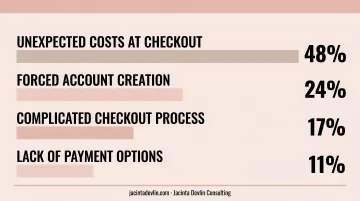
Cart abandonment is the biggest revenue leak at this stage. Baymard Institute reports an average cart abandonment rate of 70.22% across ecommerce — roughly 7 out of 10 shoppers who add something to their cart leave without buying.
The top reasons shoppers abandon:
- Unexpected extra costs (39%)
- Delivery too slow (21%)
- Didn't trust the site with their credit card (19%)
- Required account creation (19%)
An abandoned cart email sequence — minimum 2–3 emails — is one of the highest-ROI fixes available for any small ecommerce business.
Post-Purchase: Turning One-Time Buyers Into Loyal Customers
The sale is just the start of the relationship. Most small businesses invest heavily in getting the first purchase and almost nothing in keeping it — which is exactly where the margin lives.
What a strong post-purchase sequence includes:
- Order confirmation + onboarding — sets expectations and starts the relationship right
- Value-add follow-up — usage tips, styling ideas, care instructions — something genuinely useful
- Review request — sent at the right time, this feeds your consideration stage for future buyers
- Loyalty incentive or referral product/service — a reason to come back or bring a friend
Encouraging user-generated content (UGC) from existing customers — photos, reviews, social shares — feeds directly back into the top of your funnel. Your best buyers become your best marketing. That's a self-reinforcing cycle that compounds over time and doesn't require ad spend.
Post-purchase emails consistently outperform other automation types. Omnisend's 2025 data shows order follow-up emails achieve a 22.64% click-to-conversion rate — among the highest of any email type.
Where Most Ecommerce Funnels Break Down (and How to Spot It)
Most small business owners can identify where they're spending their time. What they can't see is where their funnel is quietly hemorrhaging revenue.
The Awareness Trap
The most common failure: pouring energy into content and ads while the middle and bottom of the funnel are broken. Traffic without conversion infrastructure isn't growth — it's expensive visibility.
Jacinta calls this the "post and pray" strategy — posting sporadically and hoping for sales. It's a pattern she sees consistently among women who reach out before building proper funnel systems. The problem isn't the content — it's that there's nothing designed to catch the people who actually show up.
Product Pages That Don't Convert
Weak product pages cause drop-off even when a shopper is ready to buy. Common culprits:
- Poor or generic product photos
- Vague descriptions that don't answer real questions
- No customer reviews or social proof
- Unclear shipping timelines and return policies
- No indication of who this product is for or why it matters
A shopper arriving on a page like this doesn't think "I need more information." They think "I don't trust this" — and they leave.
The Checkout Experience as a Silent Killer
Three checkout friction points kill sales more consistently than almost anything else:
- Forced account creation before purchase
- Shipping costs hidden until the final step
- A mobile experience that wasn't built for a phone
That last one matters more every year. With 70%+ of ecommerce traffic now happening on mobile, a checkout that doesn't work on a small screen is a direct revenue leak — and most owners don't realize it's happening.
The Blind Spot Problem
Most women entrepreneurs don't realize where their funnel is leaking because they're measuring the wrong things. They're tracking followers and likes — not conversion rates and cart abandonment numbers.
Getting a second set of eyes from someone who has personally built and scaled an ecommerce funnel often reveals gaps invisible from the inside. That's the foundation of how Jacinta structures her Business Growth Program: individualized strategic review, not generic advice.
How to Optimize Your Ecommerce Funnel for 2026
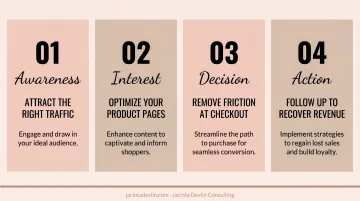
Don't overhaul everything at once. Find the stage leaking the most potential revenue and fix that first. That's the core of a funnel audit — reviewing each stage's performance data to find the biggest drop-off point, then working from there.
The stage-by-stage breakdown below is where that audit becomes action.
Awareness Stage
- Prioritize short-form video on TikTok and Instagram Reels — batch-create content that speaks to your ideal buyer's specific problem
- Use TikTok Shop and Instagram Shopping to shorten the path from discovery to purchase
- Focus on relatability over production value — authentic content drives more trust than polished ads
Consideration Stage
- Every product page needs real customer reviews, real photos, and clear answers to common objections
- Your value proposition should be immediately obvious — don't make shoppers work to understand why they should buy from you
- A/B test headlines, product photos, and CTAs to find what actually converts for your audience
- Build a welcome email sequence (5–7 emails) that introduces your brand and builds trust before asking for a sale
Conversion Stage
- Implement an abandoned cart email sequence of at least 2–3 emails — every cart that goes unanswered is revenue you've already lost for any Shopify boutique
- Simplify checkout to as few steps as possible; remove forced account creation
- Offer multiple payment options including BNPL (Afterpay, Klarna, Shop Pay)
- Make your return policy prominent and reassuring — it should appear before the buy button, not buried in the footer
Jacinta's team builds these abandoned cart sequences as a core Shopify automation for boutique clients, typically integrated with Klaviyo or Flodesk depending on the client's existing stack.
Post-Purchase Stage
Once the conversion is secured, the post-purchase stage is where loyalty — and repeat revenue — gets built. An automated post-purchase flow should:
- Delivers immediate value (usage tips, care instructions, styling ideas)
- Requests a review at the right moment
- Introduces a reason to return (loyalty discount, referral incentive)
- Cross-sells complementary products while purchase intent is still high
According to Omnisend's 2025 data, automated messages generate 2,361% higher conversion rates than manually sent email campaigns. For small ecommerce businesses, that gap shows up directly in monthly revenue.
How to Measure Whether Your Funnel Is Actually Working
You can't fix what you can't see. Here are the core KPIs to track at each stage:
| Funnel Stage | Key Metrics |
|---|---|
| Awareness | Website traffic, new follower growth, reach |
| Consideration | Email open rates, time on page, product page views |
| Conversion | Conversion rate, cart abandonment rate, add-to-cart rate |
| Loyalty | Repeat purchase rate, average order value, email click-through rate |
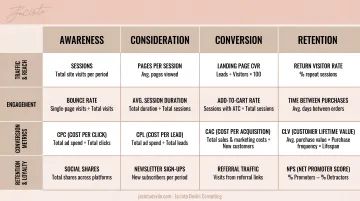
All of these can be tracked in free or low-cost tools — Shopify analytics, Google Analytics, and your email platform dashboard (Klaviyo, Flodesk, Mailchimp) cover everything you need to start. Once you have those tools set up, start with the number that tells you the most: your conversion rate.
Calculate Your Conversion Rate
Shopify defines ecommerce conversion rate simply: conversions divided by total visitors, multiplied by 100. If 1,000 people visit your site and 15 buy, your conversion rate is 1.5%.
According to Shopify's ecommerce benchmarks, average conversion rates range from 2% to 3% for most online stores, with a reported global average of 1.6% as of Q3 2025. If you're below 1%, your funnel has a problem worth diagnosing before spending more on traffic.
Build a Monthly Review Habit
Once a month, check 3–4 key numbers:
- Traffic vs. conversions — is the gap getting smaller?
- Cart abandonment rate — is it improving after email automation?
- Email open rates — are nurture sequences engaging your list?
- Repeat purchase rate — are buyers coming back?
Thirty minutes a month is enough. When a number looks off, that's your signal — go fix that stage before adding more traffic or budget to the mix.
Frequently Asked Questions
What is an ecommerce sales funnel in simple terms?
It's the journey a stranger takes from first discovering your brand to becoming a paying customer — and ideally a repeat one. It's designed to make sales predictable and repeatable rather than dependent on luck or perfect timing.
How many stages should my ecommerce funnel have?
The standard model uses four stages: Awareness, Consideration, Conversion, and Post-Purchase. Some businesses simplify to three. What matters is having intentional strategy at every step. A gap at any stage costs you revenue.
What is the biggest mistake small ecommerce businesses make with their funnel?
Focusing all energy on attracting traffic while neglecting to build trust and reduce friction at the purchase stage. Visibility without conversion infrastructure is wasted spend. You need both working together.
How do I know which stage of my funnel needs the most work?
Look at where the biggest drop-off occurs in your data. Between traffic and product page views? Between page views and add-to-cart? Or between cart and completed checkout? The biggest gap tells you where to start.
How long does it take to see results from funnel optimization?
Some fixes show results quickly — an abandoned cart email sequence can recover sales within days of going live. Bigger changes like building social proof or improving SEO-driven awareness typically take 60–90 days to pay off.
Do I need expensive tools to optimize my ecommerce funnel?
No. Free and low-cost tools — Shopify analytics, Google Analytics, and entry-level email platforms like Klaviyo or Flodesk — are sufficient to get started. Strategy matters far more than software.