
Introduction
Most small businesses don't stall because the owner isn't working hard enough. They stall because effort is being poured into tactics without a real strategy underneath them.
Jacinta Devlin has seen this pattern thousands of times. As a business coach who has helped women scale from their first dollar to consistent $10K+ months — and beyond — she knows exactly where businesses get stuck. And it's almost never where the owner thinks it is.
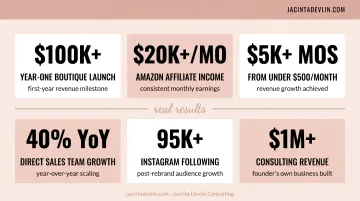
The 9 tips below are the same strategic pillars Jacinta uses with her clients — covering everything from nailing your product/service and building an audience to creating systems that generate revenue consistently. These aren't generic business advice. They're the exact moves that have taken women from $500/month to $5K+, from zero to $100K in year one, and from a single income stream to consistent six-figure months.
Key Takeaways
- Strategy before tactics — without a clear plan, effort leads to burnout, not results
- A strong online presence and social selling system are your most accessible revenue tools
- A repeatable sales funnel separates businesses that survive from those that scale
- Retaining existing customers is faster and cheaper than constantly chasing new ones
- Systems, automation, and the right coaching accelerate growth — guesswork doesn't
Tips 1 & 2: Start With Strategy — Not Tactics
Tip 1: Define Your Revenue Target and Build From There
One of the most common reasons small businesses plateau? Starting without a clear revenue goal.
If you don't know what you're building toward, every tactic feels equally valid, and you end up doing everything but growing nothing. Start by naming a specific monthly income target. The $10K/month milestone is a common anchor Jacinta uses with clients — it's concrete, achievable across multiple business models, and forces you to reverse-engineer an actual strategy.
That reverse-engineering is where real growth begins.
A real growth strategy asks:
- What product/service generates your revenue?
- How many customers do you need at what price point?
- What channels reach those buyers?
- What does your sales process look like from first touch to purchase?
Copying what worked for someone else's business skips all of this thinking. Research from Harvard Business Review shows entrepreneurs who write formal plans are 16% more likely to achieve viability — not because the document is magic, but because the process forces clarity.
That's the same principle behind Jacinta's 1:1 Business Growth Program: every client gets a personalized growth plan built around their specific revenue goal, business model, and product/service.
Tip 2: Know Your Numbers
Financial clarity is the foundation of growth. According to Intuit QuickBooks, 61% of small businesses globally struggle with cash flow, and 32% can't pay vendors, employees, or themselves because of it. U.S. owners alone lose an average of $43,394 annually by passing on projects due to insufficient funds.
You don't need to be an accountant. You need to track four things consistently:
- Revenue — what's actually coming in
- Expenses — what's going out and where
- Profit margins — what you keep after costs
- Cash flow — when money moves in and out
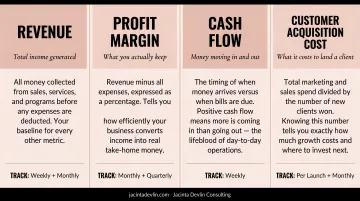
These numbers tell you where to invest next, what to cut, and whether your pricing is actually working. Without them, you can't tell if your pricing is working or where your next dollar should go.
Tips 3 & 4: Master Your Online Presence and Social Selling
Tip 3: Build an Online Presence That Attracts Buyers
Your online presence isn't just a digital business card. It's the first thing a potential customer uses to decide whether to trust you enough to spend money.
A growth-ready online presence includes:
- A website or landing page that clearly communicates what you do, who you help, and how to buy
- Consistent branding across platforms (colors, voice, imagery)
- Content that positions you as a trusted authority — not just a product pusher
Content types that actually move buyers:
- Educational posts — teach something your ideal customer is actively searching for
- Testimonials and results — proof that your product/service delivers
- Behind-the-scenes — humanizes your brand and builds connection
- Storytelling — your journey and your clients' transformations
Jacinta personally grew her Amazon storefront (StyledByJacinta), LTK platform, and boutique (Jacinta The Label) to consistent $10K+ months through this exact content-driven approach — combining authentic lifestyle content with shoppable platforms and email list building.
Tip 4: Use Social Selling to Drive Consistent Revenue
Social selling and social media posting are not the same thing.
Posting is activity. Social selling is a strategy designed to move someone from follower to buyer through a deliberate sequence. Most small business owners lose revenue here: they create content without a conversion path attached to it.
Social selling done right includes:
- Platform-specific content built around your buyer's behavior
- Calls to action that direct people toward a purchase, opt-in, or conversation
- DM sequences and automated responses that capture warm leads
- A funnel that takes someone off social media and into an owned channel (your email list)
eMarketer projects U.S. social commerce sales will surpass $100 billion in 2026, and female-led businesses are well-positioned to capture a significant share. Jacinta has spent 15+ years in the social selling space, training 50,000+ women across direct sales and e-commerce. The strategies she teaches are drawn from real sales floors, not content marketing theory.
Tip 5: Build a Sales System That Consistently Converts
Posting content and hoping buyers show up is not a sales strategy. A sales funnel is.
A funnel is the path a potential customer travels from first hearing about you to actually purchasing. Without a structured path, you're losing buyers at every stage — often without realizing it.
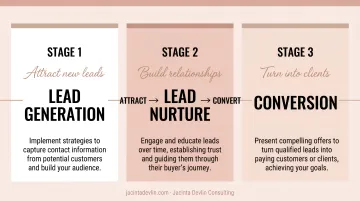
Every small business needs three stages working:
- Lead generation — getting the right people into your world (opt-ins, lead magnets, social content that drives to a landing page)
- Lead nurturing — staying top of mind and building trust before the ask (email sequences, value-driven content, community)
- Conversion — making the product/service and closing the sale (sales emails, direct follow-up, a clear purchase path)
Email is the most underused tool in this funnel. Email marketing delivers an average ROI of $36 for every $1 spent, and automated email flows can generate up to 4x more orders than one-off broadcasts. Social media reaches people when the algorithm decides to. Email reaches them when you decide to.
If buyers are falling off before purchasing, the fix is usually one of four things: pricing, messaging, product/service clarity, or trust signals. Audit your funnel before you spend money on more traffic.
When Jacinta builds funnel systems for clients, the tools are matched to the business model — not forced into a one-size-fits-all stack. Depending on what you're selling, that might include:
- Flodesk — email marketing and automations (Jacinta's go-to platform)
- ClickFunnels or Kajabi — sales pages, courses, and membership funnels
- Shopify — product and boutique storefronts with integrated checkout
Tips 6 & 7: Retain Customers and Diversify Your Revenue
Tip 6: Prioritize Customer Retention
Chasing new customers while ignoring existing ones is one of the most expensive mistakes in small business.
According to research from Harvard Business Review, acquiring a new customer can cost 5 to 25 times more than retaining one. Bain & Company found that a 5% increase in retention can raise profits by 25% to 95%.
The customers you already have are your fastest path to growth. Three retention strategies to start now:
- Personalized follow-up — a simple post-purchase check-in email, a loyalty reward, or a direct message goes further than any ad
- Exceptional customer experience — make buying from you easier, faster, and more enjoyable than the alternative
- Loyalty incentives — repeat-buyer discounts, early access to new products, or exclusive bundles reward people for staying
Client Lisa K. (Fleur de Lis Boutique) re-booked Jacinta's programs repeatedly as her boutique grew — scaling from her launch year to continued expansion. When the experience consistently delivers, clients don't leave. That's not luck — that's a retention strategy working exactly as it should.
Tip 7: Diversify Your Revenue Streams
Retention keeps your current revenue stable. Diversification is how you grow beyond it.
Relying on one product, one platform, or one income stream isn't just a growth ceiling — it's a vulnerability. When that stream dries up (and eventually, every single one does), there's nothing to catch you.
Jacinta models this personally: consulting, her Amazon storefront, LTK affiliate income, Jacinta The Label boutique, and speaking engagements all run simultaneously. When one slows seasonally, another picks up — that's the actual value of a diversified model.
For her clients, the most practical expansion paths include:
- Adding affiliate income to an existing social or content presence (Amazon, LTK, TikTok Shop)
- Bundling existing offers into packages or memberships rather than one-off purchases
- Opening a marketplace channel alongside an existing store — client Sharon B. went from $4,000 in her first year on Amazon to $20,000+ per month after building a focused strategy around it
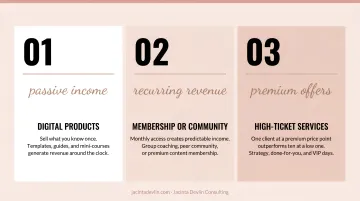
The key isn't adding everything at once. It's identifying the next stream that aligns with your existing audience and product/service, then building the infrastructure to run it consistently.
Tips 8 & 9: Automate, Delegate, and Get Expert Support
Tip 8: Invest in Systems and Automation
Doing everything manually is the single biggest bottleneck for growing businesses. There's a ceiling to what you can handle alone — and most owners hit it faster than they expect.
Research from Zapier found 66% of SMBs say automation is essential, and 34% say it lets them spend less time on administrative tasks. That time goes back into strategy, sales, and the work that actually grows revenue.
Start by auditing your weekly workflow. Ask: what am I doing manually that a system could handle?
Common high-priority automation targets:
- Follow-up emails after a purchase, inquiry, or abandoned cart
- Appointment scheduling via Calendly or Acuity (no more back-and-forth)
- Social media DM responses using tools like LinkDM for Instagram
- Email sequences triggered by opt-ins, purchases, or inactivity
You don't need to automate everything at once. Identify the 3-5 tasks that drain the most time and start there. One well-built email sequence can generate consistent revenue while you're focused elsewhere.
Tip 9: Invest in Expert Guidance and Accountability
Guessing at your own strategy is slow, expensive, and exhausting. Personalized guidance shortens the path — because the gap between general advice and a plan built for your specific business is where most entrepreneurs lose time and money.
SCORE data shows mentored businesses are 12% more likely to remain in business after one year than the national average.
That's the foundation of Jacinta Devlin Consulting. Whether you're launching from scratch or hitting a revenue ceiling, the work starts with a strategy designed specifically for your business — 1:1 coaching, not a DIY course you navigate alone.
Client results include:
- Joy W. grew from $500/month to consistent $5K+ months in six months
- Amanda O. scaled from a $2,500 goal to $10,000+ months within her first months of coaching
- Christina R. hit six figures and left her corporate job in six months
The starting point is Jacinta's Free 15-Minute Growth Chat — a no-pressure call where she personally reviews your business and goals, then recommends the right next step for where you are right now.
Frequently Asked Questions
How can I make my business grow?
Growth comes from pairing a clear strategy with consistent execution across the right channels. Define a revenue target, build a repeatable sales system, protect your existing customers, and invest in guidance specific to your business — not generic advice designed for someone else's situation.
What is the 3-month rule in business?
The 3-month rule means any new strategy, product/service, or marketing effort needs at least 90 days of consistent action before results are meaningfully measurable. Most people quit before they hit that window. Stay the course, track your numbers, and let the data tell you what to adjust.
What business can make $10,000 a month?
$10K/month is achievable across many business types — e-commerce boutiques, Amazon affiliate storefronts, direct sales, coaching, and content creator businesses have all hit this milestone through Jacinta's coaching. The business type matters less than having the right strategy, pricing, and systems in place.
What are the biggest mistakes small business owners make when trying to grow?
The most common pitfalls: growing without a clear strategy, skipping customer retention in favor of only chasing new buyers, doing everything manually instead of building systems, and treating tactics as a substitute for a real business foundation.
How long does it take to grow a small business?
Businesses with a clear plan and the right support often see meaningful momentum within 30 to 90 days and hit significant milestones within 6 to 12 months. The compounding effect — where growth builds on itself — typically becomes visible in the 12 to 24 month window.