This is one of the most common situations Jacinta Devlin sees when a new client walks in: a woman doing everything she's been told to do, with nothing to show for it. Not because she lacks talent or work ethic, but because activity without strategy is just expensive noise.
Digital marketing genuinely levels the playing field for women entrepreneurs. Over 14 million women-owned businesses now operate across the US, generating $2.7 trillion in revenue — yet women still face disproportionate barriers to traditional financing. The ability to build a global audience with a $0 ad budget changes that equation. But only when you approach it with intention.
This guide covers the channels that actually move the needle, how to build a brand that converts, and how to create a strategy that grows with you — without burning out.
Key Takeaways
- Strategy, not volume, drives digital marketing results — more content is rarely the answer
- Social media, email, and content/SEO are the three channels worth mastering first — everything else builds from there
- Authenticity and storytelling are real competitive advantages — use them intentionally
- Building an owned email list is non-negotiable — social media is rented land
- Matching channels to your business stage prevents overwhelm and wasted resources
Why Digital Marketing Works Differently for Women Entrepreneurs
The Economics Make It Necessary
Women-owned businesses represent 39.1% of all US businesses — yet they account for only 5.8% of total revenue. That gap isn't about effort. It reflects real structural barriers: limited access to capital, fewer investor networks, and the compounding demands of running a business while managing everything else.
Digital marketing directly addresses this. Organic social media, email marketing, and content SEO require time and strategy more than money. A woman launching a boutique or coaching business doesn't need a six-figure ad budget to build a six-figure income — several of Jacinta's clients have proven exactly that.
Your Natural Strengths Are Already Algorithmic Advantages
Community building, relationship-nurturing, and storytelling are exactly what digital platforms reward. According to Edelman's 2025 Trust Barometer, 73% of consumers say their trust in a brand increases when it authentically reflects today's culture. Algorithms, engagement metrics, and buyer behavior all favor trust-first communication — the kind many women entrepreneurs do naturally.
The challenge isn't learning to be more authentic. It's learning to be strategic about it.
How Women Consumers Buy
That trust-first instinct also shapes how your customers buy. Research from PowerReviews shows 99.5% of US shoppers research purchases online before buying, and 93% say ratings and reviews directly affect their purchase decisions. Women consumers, in particular, research thoroughly, seek peer validation, and prioritize trust before committing.
This is a built-in advantage for women entrepreneurs marketing to women. A sale rarely happens from a single post — it happens after someone has seen your content, read your reviews, and decided they trust you enough to buy.
The Core Digital Marketing Channels That Drive Real Results
The biggest mistake is trying to be everywhere at once. The goal is two to three channels matched to your business stage, executed consistently — not six channels done poorly.
Social Media: Show Up Where Your Buyers Already Are
Pew Research's 2024 data confirms women's platform usage is concentrated: 76% use Facebook, 54% use Instagram, and 50% use Pinterest — compared to only 19% of men on Pinterest. Platform choice should follow your audience, not trends.
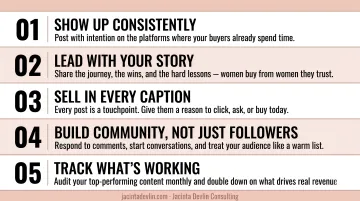
The difference between social media that builds a business and social media that wastes your time comes down to one word: engagement. Broadcasting (posting and hoping) doesn't convert. Building conversations does.
What works on social media:
- Share behind-the-scenes content and personal stories before making offers
- Lead with value — educate, inspire, or solve a problem before you sell
- Use calls to action that invite replies and DMs, not just clicks
- Prioritize video: short-form video is the top ROI-driving content format according to HubSpot's 2026 marketing data, cited by 49% of marketers
- Consistency beats frequency. Showing up three times a week reliably outperforms daily posting that fades after two weeks
Sharon B., an Amazon affiliate seller, grew two Facebook Groups — one to 37,000+ members in just four months — and scaled from $4,000 in her first year on Amazon to $20,000+ per month consistently after implementing a community-driven social strategy through Jacinta's coaching.
Social media builds the audience. Email is where that audience becomes revenue.
Email Marketing: Your Most Reliable Revenue Channel
Email delivers an average ROI of $36 for every $1 spent, according to Litmus — and in 2025, 44% of small businesses cited email as their most effective marketing channel, up from 23% the previous year.
Why? Because you own your list. No algorithm decides who sees your emails. No platform change erases your audience overnight.
The basic architecture of an effective email strategy:
- Lead magnet — A free resource that solves a specific problem for your ideal client, in exchange for their email address
- Welcome sequence — 5–7 automated emails that build trust before making a product/service
- Ongoing broadcasts — Regular value-driven emails that keep subscribers engaged between purchases
For women entrepreneurs, email is where relationships deepen. The emails that convert don't read like promotional blasts — they're personal, specific, and arrive at the right moment in the buyer's journey.
Jacinta's clients build their email systems primarily on Flodesk (her recommendation for personal brands, coaches, and boutique owners), with Klaviyo for Shopify-heavy e-commerce businesses that need advanced behavioral automation.
Content Marketing and SEO: Visibility That Compounds Over Time
Content marketing — blogs, YouTube, podcasts — paired with SEO creates discoverability that works even when you're not actively marketing. Unlike social media posts, well-optimized content continues driving traffic long after it's published.
The trade-off: It takes time. Ahrefs data shows 72.9% of pages in Google's top 10 are more than three years old. This is a long-game channel, not a quick win.
How to approach it at the right stage:
- Think in terms of your client's problems, not your services (they search "how to grow Instagram sales," not "business coaching for women")
- For service-based businesses, local SEO matters — Google Business Profile, location-based keywords, and client reviews all contribute to appearing in local search
- For product businesses, optimizing product titles and descriptions is the equivalent priority
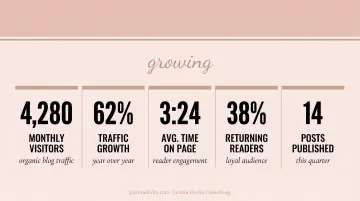
Jennie S., a boutique owner and direct seller coached by Jacinta, grew her blog to 3,000+ monthly visitors within one year — a traffic asset that fed her broader sales funnel alongside Instagram and email.
Building Your Personal Brand and Authentic Online Presence
Personal branding is the consistent communication of your values, your story, your expertise, and the specific transformation you create for your clients — it's what makes someone choose you over a competitor with nearly identical offerings.
The Core Elements of an Authentic Online Presence
- Clear brand message — Who you help, how you help them, and what makes you different. If a stranger lands on your website and can't answer those three questions in ten seconds, you have a clarity problem.
- A professional, fast, mobile-first website — Your website is your 24/7 sales rep. A DIY-looking site signals amateur at every price point above $50.
- Consistent visual and voice identity — Across your website, social media, and emails. Consistency builds recognition; recognition builds trust.
Being authentic means being intentional — not unpolished. These elements work together, but only when the story behind them is clear.
Storytelling as a Marketing Strategy
Buyers don't just buy products or services — they buy the person behind them. Christina R. (My Balanced Style) rebranded her Instagram under Jacinta's coaching, grew from 13,000 to 95,000+ followers, quit her corporate job in six months, and negotiated five-figure brand deals with Walmart and QVC. The strategy wasn't better content in a vacuum — it was a clearer story told to the right audience consistently.
Lisa K. (Fleur de Lis Boutique Florida) wove her personal story — launching her dream boutique after her husband's cancer diagnosis — into her brand narrative. The result: $1,250 on launch day, $100,000+ in her first year, starting from zero with no prior boutique experience.
On Self-Promotion and Visibility
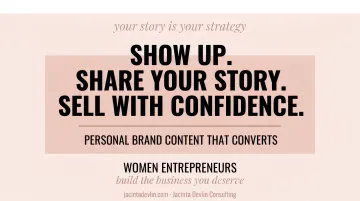
Many women entrepreneurs struggle with the reluctance to show up publicly. The reframe that matters: visibility is service. When you share your expertise consistently, you're helping real people find a real solution. The women who stay quiet are the ones whose ideal clients never find them.
Two things worth remembering here:
- You don't need a massive following — you need the right audience and a clear path to conversion
- Consistent visibility compounds: showing up 3–4 times a week outperforms a viral post with no follow-through
One of Jacinta's most requested speaking topics — "How I Made Multiple 6-Figures Online with Less Than 10K Followers" — directly addresses this. A smaller, engaged audience built around a clear story will outperform a large, passive one every time.
How to Build a Digital Marketing Strategy That Actually Scales
A strategy is different from a to-do list. A real marketing strategy starts with three things: who you're targeting (not "women" — the specific woman with a specific problem), what you want her to do, and what you're offering at each stage of her journey from stranger to loyal buyer.
The Simple Funnel Most Women Entrepreneurs Are Missing
| Stage | Channel | Goal |
|---|---|---|
| Top of funnel | Social media, blog, SEO | Get in front of new eyes |
| Middle of funnel | Email list, lead magnets, nurture content | Build trust with warm prospects |
| Bottom of funnel | Offers, sales sequences, consultations | Convert to paying customers |
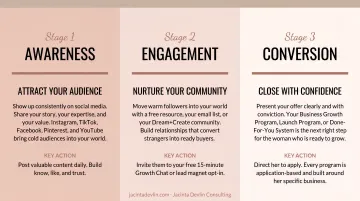
Most small businesses focus exclusively on the top — posting, posting, posting — and wonder why they're not converting. The answer isn't more content at the top. It's building the middle and bottom.
Matching Channels to Business Stage
- Just starting out: One social platform where your ideal clients already spend time, plus email from day one
- Scaling past $5K/month: Layer in SEO, partnerships, or paid ads — but only once you have a proven product/service and a functioning funnel to send traffic into
- Hitting a plateau: The issue is almost never the channel — it's the strategy connecting the channel to revenue
This is the core of what Jacinta helps her clients work through at Devlin Consulting: moving from guessing to building a real, customized growth strategy built around their specific business, audience, and bandwidth. Joy W. grew from $500/month to consistently $5,000+ per month, surpassing her previous full annual income in just six months.
The Role of Automation in Making Strategy Sustainable
Marketing automation is what separates a business from a job. Set these up once and your marketing works even when you're serving clients:
- A strategic email welcome sequence that nurtures new subscribers automatically
- A pinned lead magnet that captures interest around the clock
- A social media content calendar that keeps you visible without daily scrambling
Research from Constant Contact found 33% of small businesses saved over 40 minutes per week using AI and automation — and 48% of SMBs now use AI in their marketing, primarily for writing copy and content drafting.
That adoption isn't equal, though. Among Gen Z business owners, 20% of male-owned firms vs. 13.9% of female-owned firms had adopted AI by 2025, according to JPMorgan Chase Institute data.
That gap is an opportunity. Tools like ChatGPT for content drafting and Canva's AI features for design are accessible, low-cost entry points that cut the time burden of marketing significantly — without requiring a big budget or a tech background.
Common Digital Marketing Mistakes Women Entrepreneurs Make
73% of small businesses lack confidence that their current marketing strategy is working, and 56% have one hour or less per day for marketing, according to Constant Contact research. These are structural problems — not personal failures.
The most common mistakes:
- Chasing followers instead of buyers — Vanity metrics (likes, follower count) don't pay bills. Track email subscribers, DM inquiries, and actual sales.
- Showing up inconsistently — Algorithms and audiences both reward consistency. Sporadic posting makes it impossible to build momentum regardless of content quality.
- Skipping the email list — Relying entirely on platforms you don't own is a business vulnerability. One algorithm change can cut your reach overnight.
- No funnel connecting activity to revenue — Posting and showing up without a defined product/service, a lead capture mechanism, or a follow-up system means energy spent without results.
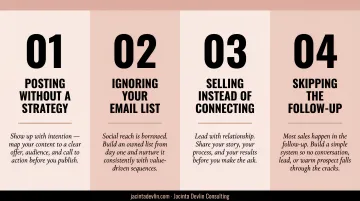
As Jacinta puts it directly: "You almost certainly do not have a social media problem. You have a strategy problem dressed up as a social media problem."
Frequently Asked Questions
What is the best digital marketing strategy for women entrepreneurs just starting out?
Start with one social platform where your ideal clients already spend time — Instagram and Facebook are the strongest documented performers for most women-owned businesses. Build an email list from day one using a simple lead magnet, and prioritize showing up consistently over showing up perfectly.
How can women entrepreneurs use social media without spending hours online every day?
Batch your content in advance and schedule it using tools like Later or Buffer. Then limit your active time to specific blocks — 20–30 minutes for responding to comments and DMs — rather than being always-on. Presence and responsiveness matter more than volume.
What digital marketing channels have the best ROI for women-owned businesses?
Email marketing and content/SEO deliver the highest long-term ROI. Social media delivers the fastest initial visibility. The right mix depends on your business type and stage — boutiques and affiliate sellers lean heavily on Instagram and Facebook Groups, while coaches and service providers often see faster returns from email and SEO.
How much should a woman entrepreneur budget for digital marketing?
Most early-stage entrepreneurs can start with free or low-cost tools — organic social and a basic email platform like Flodesk run under $40/month. Paid advertising becomes worthwhile once you have a proven product/service and a clear funnel to send traffic into. Running ads to a broken funnel just accelerates the leak.
Can a woman entrepreneur do digital marketing herself, or does she need to hire help?
DIY works early on, but a coach or strategist compresses the learning curve fast — especially when you're hitting a revenue ceiling. One client, Carissa P., credited 1:1 coaching as the single biggest change she made, driving 40% year-over-year growth.
How long does it take to see results from digital marketing as a woman entrepreneur?
Social media shows engagement within weeks; email builds momentum over one to three months; SEO and content take three to six months for measurable traffic. The slower channels are also the most durable — they keep paying off long after the work is done.