
Revenue plateaued. Energy ran low. And the business that was supposed to create freedom started feeling like a trap you built yourself.
This is one of the most common places women entrepreneurs get stuck — and it's not a motivation problem. It's a strategy problem.
Growing a one-person business requires a fundamentally different approach than starting one. The tactics that got you your first dollars won't get you to consistent $5K, $10K, or $20K months. That requires systems, intentional pricing, and a marketing engine that doesn't depend on you showing up every single day.
This guide covers exactly that: why growth stalls, how to build a marketing engine, how to price for real profit, the systems that create scale, and the mindset work that makes all of it stick.
Key Takeaways
- Most growth stalls come down to strategy gaps, not a lack of effort
- Fixing your pricing, showing up consistently in marketing, and tracking your numbers are where real growth happens
- Automation and selective outsourcing let you scale without adding payroll
- Your email list is the one asset you own outright — build it from day one
- The right community and accountability structure keep you moving even on the hard days
Why Most One-Person Businesses Stop Growing
The "Busy But Not Breaking Through" Trap
Filling your days with tasks isn't the same as building a business. Most solo entrepreneurs who plateau aren't lazy — they're doing a lot. The problem is that most of what they're doing doesn't move revenue.
Answering DMs, redesigning their logo for the fourth time, posting sporadically and hoping for traction — this is what Jacinta Devlin, business coach and founder of Jacinta Devlin Consulting, describes as "post and pray" marketing. Her clients have described their pre-coaching state in exactly these terms: overwhelmed, scattered, unsure which parts of the business deserve focus.
The fix isn't working harder. It's identifying which actions actually drive revenue and protecting your time for those first.
The Three Most Common Stall Points
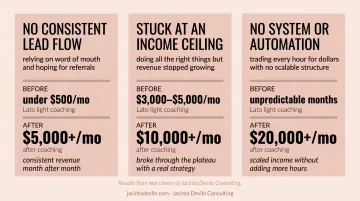
Across thousands of women entrepreneurs, the same three blockers show up repeatedly:
1. No clear niche or product/service. When the business tries to be everything, it resonates with no one. Client Jamie R. was running three separate businesses under one unfocused personal brand and described herself as "literally all over the place." A full rebrand that consolidated her identity into one cohesive presence changed everything — including measurable weekly follower growth from genuinely interested customers.
2. Inconsistent or absent marketing. Sporadic posting produces sporadic results. Client Joy W. was generating $500/month before working with Jacinta. With a structured strategy and consistent execution, she grew to $5K+ months — and surpassed her entire previous year's annual income in just six months.
3. Underpricing that caps income regardless of effort. This one is insidious because it masquerades as humility or competitiveness. Client Amanda O. came in with a goal of $2,500/month — a number that represented a significant underestimation of what her business could actually do. After Jacinta's coaching on strategy and positioning, she consistently hit $10,000+ months.
The Identity Shift That Changes Everything
Growing past these stall points requires one uncomfortable transition: moving from doing everything in the business to leading it strategically.
Here's what that difference looks like in practice:
- Working in the business: taking every client call, creating every piece of content, handling every admin task yourself
- Working on the business: building systems, evaluating what's actually producing revenue, making deliberate decisions about where your time goes
Most solo entrepreneurs never make that transition — not because the tactics are too hard, but because the mindset shift is. That's where real growth starts.
Build a Growth-Ready Foundation
Before layering on growth tactics, the foundation has to be solid. A business without a clear product/service, defined audience, and basic financial structure will leak revenue no matter how good the marketing is.
The Three Foundation Elements
1. Business structure: Most nonemployer businesses start as sole proprietorships — the simplest structure, but not always the right one as revenue grows. An LLC offers liability protection that becomes increasingly relevant once real income is coming in. Consult a business attorney or accountant to assess what fits your situation.
2. Separate business finances: If your business money and personal money live in the same account, you have no clear picture of what's profitable. Open a dedicated business checking account and run all income and expenses through it. Without that separation, you're guessing — and guessing makes it impossible to spot what's working.
3. A written plan with three clear answers: You don't need a 40-page business plan. You need to be able to answer three questions cleanly:
- Who exactly do you serve?
- What specific problem does your product/service solve for them?
- How does revenue get generated — and how much do you need?
Whether you're starting from zero or already generating revenue, these foundations determine how much of your growth effort actually sticks. Jacinta's Business Launch Program builds this infrastructure from scratch, while the Business Growth Program begins with a diagnostic of existing foundations before layering strategy on top.
Create a Marketing Engine That Works Without You
Inconsistent marketing is the single most common reason one-person businesses stop growing. The fix isn't posting more — it's building a system that attracts and nurtures customers even when you're focused on client work.
Social Media: The Most Accessible Growth Channel
For solo entrepreneurs, social media is one of the highest-ROI, lowest-barrier growth channels available. The key word is consistency. Showing up sporadically produces sporadic results; showing up with a clear strategy compounds over time.
Jacinta built her own business on this exact premise — growing from direct sales to consistent $10K+ months in e-commerce by using social platforms strategically. Her recommended approach for clients:
- Pick one or two platforms where your ideal customer actually spends time
- Create content that educates, builds trust, and positions you as the authority in your niche
- Make a clear, consistent call to action — not just content, but conversion
That strategy produces real results. Christina R. grew a Facebook group from zero to 36,000+ members and her Instagram from 13K to 95K+ followers. Within six months, she hit six-figure income, quit her full-time job, and landed five-figure brand deals with Walmart and QVC.
Email: Your Most Valuable Owned Asset
Unlike social media, where the algorithm decides who sees your content, your email list belongs to you. It doesn't disappear if a platform changes its rules.
Email marketing generates an average of $36 for every $1 spent, according to Litmus — making it one of the highest-ROI channels available. Start building your list early with a simple lead magnet: a checklist, resource guide, or short how-to that your ideal customer genuinely wants. Jacinta's working examples — "5 Ways to Make Sales Online" and "30+ Content Ideas That Work" — are short, specific, and immediately actionable. That's the formula: one clear promise, delivered fast.
Once subscribers join, nurture them with consistent value-driven emails. Promotional messages work when they're earned through trust built first.
Automation: How One Person Keeps the Engine Running
That email nurture sequence? It runs whether you're on a client call or offline for the weekend. A marketing engine only works without you if parts of it run automatically. The tools Jacinta builds for her clients include:
- Email sequences — welcome series (5–7 emails), nurture sequences, and launch campaigns running automatically via Flodesk or Klaviyo
- Social scheduling tools — content batched and scheduled in advance rather than created daily
- DM automation — tools like LinkDM automate Instagram message responses, turning passive reach into active conversations
- CRM systems — platforms like Dubsado or HoneyBook track leads and follow-ups without manual effort
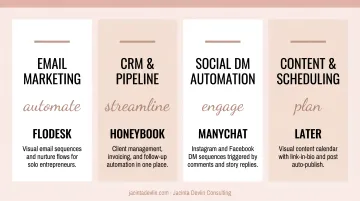
Each tool requires a one-time setup investment. After that, your marketing runs in the background while you focus on the work that actually needs you.
Master Your Money: Pricing, Profit, and Financial Systems
Why Underpricing Is a Growth Strategy Problem
HoneyBook research found that female freelancers earn 26% less per project than male counterparts, complete 22% more projects, and still earn 11% less annually. For service-based solo business owners, the math on underpricing is brutal: no amount of hustle compensates for a price that was never high enough to sustain the business.
Underpricing isn't just a financial problem. It's a positioning problem too. Low prices attract clients who push back on everything and rarely become your best customers or advocates.
Pricing for Real Growth
Start with two numbers: your actual costs, and the income you need the business to generate. Then consider the value your product/service delivers to the customer — not just the hours it takes you.
A tiered product/service structure gives you flexibility and increases average revenue per client:
- Entry-level product/service: lower price point, lower commitment, often a group format or digital product
- Core product/service: your primary service or program at your standard rate
- Premium product/service: highest-touch, highest-investment option for clients who want the most access
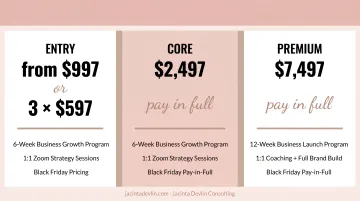
This structure lets clients self-select their entry point, so your core product/service never has to compete on price with itself.
Track Your Numbers Monthly
SCORE reports that 82% of small business closures are tied to cash flow issues — problems that are preventable when you're watching your numbers consistently. Three metrics every solo business owner should review monthly:
- Revenue — total income generated
- Profit margin — what's left after costs
- Monthly recurring income — predictable, repeatable revenue that isn't dependent on landing new clients
If you haven't separated personal and business finances yet, do it today. You cannot make strategic growth decisions with money you can't clearly see.
Build Multiple Income Streams
A single revenue stream is a single point of failure. Adding a complementary income stream stabilizes your business and creates growth without proportionally increasing your workload. Options worth considering:
- A digital product or course
- A group program or membership
- Affiliate income through Amazon, LTK, or brand partnerships
- Sponsored content or co-branded collaborations
Jennie S. started with direct sales, then added Amazon and LTK affiliate income, launched her own boutique store, and built an email list of 500+ subscribers — all within one year, reaching $5K+ months across multiple brands. She built each stream sequentially, layering onto a foundation that was already producing results before moving to the next.
Time, Systems, and Strategic Outsourcing
Protect Your High-Leverage Hours First
Time is the constraint every solo entrepreneur shares. The solution isn't a better to-do list — it's identifying your highest-leverage activities (the ones that directly generate revenue or attract customers) and protecting time for those before anything else gets scheduled.
A practical framework: set two to three clear priorities for the quarter, then build weekly tasks around those priorities instead of reacting to whatever demands attention that day. Without that structure, you stay busy — but rarely move forward.
How to Use Outsourcing to Buy Back Your Time
You don't need employees to get leverage. Strategic outsourcing to freelancers or contractors frees your time for the revenue-generating work only you can do. Common tasks worth delegating include:
- Graphic design and branding assets
- Bookkeeping and expense tracking
- Social media scheduling and posting
- Email list management or copywriting
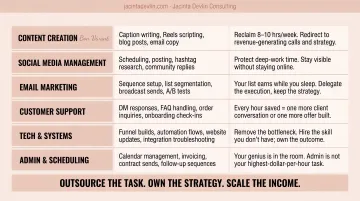
Research from Clutch found that 90% of small businesses planned to outsource in 2022, with 27% citing time savings and efficiency as the primary motivation. For solo operators, the math is straightforward: if a task can be delegated for less than your effective hourly rate, delegating it makes financial sense.
That principle shapes how Jacinta Devlin structures her services at Devlin Consulting. Her done-for-you marketing systems handle full execution (brand, website, funnels, content) through her team, while her done-with-you options pair coaching with hands-on implementation — both designed for women who want leverage without hiring in-house staff.
Mindset and Community: The Growth Factors No One Talks About Enough
Running a solo business is genuinely isolating. Without colleagues, a manager, or a team around you, it's easy to stay small — not because of capability, but because there's no one pushing back on your assumptions or holding you accountable to your goals.
Peer groups, mastermind communities, and entrepreneurial networks step in where a team would. They bring the outside perspective, honest feedback, and accountability that you simply can't manufacture on your own.
Jacinta's Dream+Create Online Coaching Community is built specifically for this: group coaching calls, live weekly trainings, peer networking, and direct access to Jacinta in a women-only environment. Client Sharon B. credits the community's networking opportunities with helping her form the partner relationships and collaborations that contributed to her growth from $4K in year one to $20,000+ per month on Amazon.
Mindset work belongs in your business plan alongside marketing and financial strategy — and it deserves the same attention. These are learnable skills that directly impact revenue:
- Believing your product/service is worth what you charge
- Holding sales conversations without shrinking or over-explaining
- Weathering a slow month without catastrophizing
Treat them accordingly.
Frequently Asked Questions
How much can a one-person business realistically make?
The Census Bureau reports that 29.8 million nonemployer businesses generated $1.7 trillion in receipts in 2023, and MBO Partners identified 5.6 million independent workers earning more than $100,000 annually. Six-figure and seven-figure solo businesses exist across every industry. Niche clarity, consistent marketing, and strategic pricing are the primary drivers of where you land in that range.
How do you grow a one-person business without hiring employees?
The key levers are strategic pricing, a consistent marketing system, email and social media automation, and selective use of freelancers for non-revenue tasks. Growth doesn't require payroll — it requires leverage. The right systems and outsourcing let one person operate at the output of a small team.
What is the biggest mistake solo business owners make when trying to grow?
Inconsistent marketing is the most common culprit: specifically the "post and pray" pattern of sporadic content with no real system behind it. The close second is underpricing, which caps income regardless of how much effort goes in. Both are strategy problems with fixable solutions.
How do you market a one-person business on a limited budget?
Organic social media, email marketing, and word-of-mouth referrals deliver the highest ROI per dollar spent. Pick one or two platforms where your audience actually lives, show up consistently with content that builds trust, and start collecting email addresses from day one. Consistency beats volume every time.
When should a solo entrepreneur invest in a business coach?
Coaching delivers the most value when growth has stalled despite real effort, when revenue exists but won't stay consistent, or when you're ready to scale and need a strategy built around your specific business rather than generic advice.
How do you build multiple income streams as a one-person business?
Start with one strong core product/service, get it generating consistent revenue, then layer in complementary streams — affiliate partnerships, a digital product, or a group program — that serve the same audience without doubling your workload. Jennie S. built affiliate income, a boutique store, and brand partnerships over one year by stacking streams sequentially, not simultaneously.