
Business development coaching for women isn't a course, a mastermind, or a motivational program. It's a working strategy built around your actual business — your customers, your model, your goals — with someone accountable to your results beside you.
This article covers what business development coaching actually does, why most women's businesses stall, what real measurable results look like, and what separates a coach worth hiring from one who isn't.
Key Takeaways
- Business development coaching is a personalized, strategy-first partnership built around your specific business
- Most women's businesses stall for the same predictable, fixable reasons — and they don't have to
- The right coach has actually built and scaled a business — not just studied how to coach about one
- Real results are measurable: consistent revenue months, a working sales system, a business that grows without burning you out
- Coaching works at any stage — whether you're launching or hitting a ceiling
What Business Development Coaching Actually Does for Women in Business
Business development coaching is a collaborative process where a coach works with you to build a strategy specific to your business. That means a real plan built around your actual goals, your customers, and your business model — not a generic blueprint designed for someone else's market.
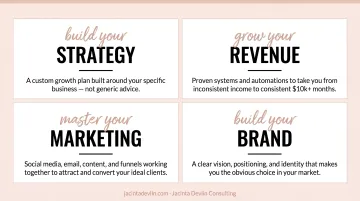
The core work covers four interconnected areas:
- Revenue clarity — identifying where income is actually coming from and where it should be
- Sales and marketing systems — building repeatable processes that generate consistent revenue
- Priority actions — identifying which activities move the needle vs. which just feel productive
- Execution mindset — developing the confidence and consistency to follow through
The Accountability Factor
A coach holds you to your strategy in a way a course, book, or peer group simply cannot. Research from Dominican University found that people who combined written goals with accountability and weekly progress reports achieved goal-completion rates far above those working alone — [add link when available]. That dynamic is built into every quality coaching engagement.
As Jacinta Devlin's client Carissa P. described it: "She knew how to hold me accountable and the strategies that would give me the most growth... I was given direct advice and when I followed through, my business increased." Her business grew 40% year-over-year.
The Mindset Element
Strong business development coaching for women addresses more than tactics. Self-doubt, fear of visibility, imposter syndrome, and underpricing are real obstacles — and they require direct work alongside your business strategy, not after it. Jacinta Devlin integrates mindset and execution work throughout every coaching engagement — because a plan you don't believe in won't get implemented, no matter how solid it is.
Coaching, Consulting, and Online Courses: What's Actually Different?
These three models are often used interchangeably. They shouldn't be.
| Model | What It Does | What It Lacks |
|---|---|---|
| Online Course | Delivers general frameworks you apply on your own | Personalization, accountability, real-time support |
| Consulting | Diagnoses your business and delivers solutions | Ongoing engagement; exits when the deliverable is done |
| Coaching | Builds strategy with you and holds you accountable to executing it | N/A — this is the combination |
Business development coaching combines the strategic depth of consulting with the personalization and accountability of an ongoing relationship. Unlike a consultant who hands over a deliverable and leaves, a coach stays in the work with you. Unlike a course, the strategy adapts to your business in real time.
Why Generic Content Fails Women Entrepreneurs
Many women arrive at coaching after spending money on courses or downloading templates that didn't translate to their business. That's not a personal failure. Generic content can't account for your specific niche, your customer base, your product/service structure, or where you're starting from.
Jacinta Devlin puts it directly: "You do not need another DIY course — you need a business coach who has actually built and scaled a six- and seven-figure online business and who will sit on weekly Zoom calls with you and tell you exactly what to do next for your specific business."
That combination of real strategy and ongoing accountability is what actually moves the revenue number. Mindset matters — but so does knowing exactly what to do on Monday morning.
Why Most Women's Businesses Stall — and What Coaching Breaks Through
Most women who feel stuck aren't lazy or directionless. They're doing a lot — posting content, networking, trying new platforms. The problem isn't effort. It's that the effort isn't connected to a clear, written revenue strategy — what the SBA calls "the foundation of your business."
Here are the stall points that show up most predictably:
"Post and Pray" Marketing
Women are visible on social media but have no conversion architecture behind it — no defined content pillars, no sales funnel, no email infrastructure. The result: activity without income. Research from the NWBC identifies strategic planning gaps as a key barrier to women-owned business growth.
Doing Everything Alone
Wearing every hat means no time for strategic thinking, no one to challenge assumptions, and no accountability outside yourself. Coaching interrupts this cycle directly.
Underpricing and Undervaluing
FreshBooks found that self-employed women earn 28% less than self-employed men — a gap often rooted in underpricing rather than underperforming. Coaching addresses this through both mindset work and concrete pricing strategy. Jacinta's client Sharon Bean initially thought a $100k annual goal was impossible. Her first $20,000 month proved otherwise.
The Revenue Ceiling
Women who are already making money but can't break past the next level have usually built a business that depends entirely on their own manual effort. The fix isn't working harder — it's building the systems and infrastructure that keep generating revenue whether they're working or not.
What Real Results Look Like: From First Dollar to Consistent Income
Measurable results from business development coaching aren't abstract. They look like:
- Consistent monthly revenue with no more starting from zero each month
- A working sales system that converts without constant manual effort
- Clarity on which activities drive income vs. which ones just feel busy
- A business model that's sustainable long-term
What's Possible: Documented Client Outcomes
Jacinta Devlin has helped women entrepreneurs across fashion, travel, e-commerce, social selling, and professional services achieve results across the full revenue spectrum:
- Lisa K. (Fleur de Lis Boutique) — $1,250 on launch day, $3,300 in her launch month, $20,000 in her first four months, and $100,000+ in year one
- Sharon B. — went from $4,000 in her entire first year on Amazon to $20,000+ per month consistently
- Amanda O. — scaled from a $2,500/month goal to consistent $10,000+ months within months
- Christina R. — quit her corporate job within six months, grew her Instagram to 95k+ followers, and now sells hundreds of thousands per month through Amazon and LTK
- Joy W. — grew from $500 months to $5,000+ per month consistently, surpassing her previous annual income in six months
- Carissa P. (Park Lane Jewelry) — achieved 40% year-over-year business growth
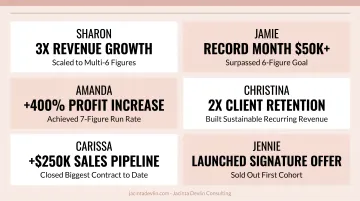
These results don't happen by showing up and listening. The women who see the biggest outcomes treat coaching as a true partnership — they show up, execute between sessions, and stay committed to the strategy. Most see early momentum within 30–60 days, with many hitting their first $5k–$10k month within 6–12 months.
What to Look for in a Business Development Coach for Women
Not all business coaches are equal — and the difference matters when you're investing real money and real time.
Here's what actually separates a coach worth hiring from one who will waste your time:
- Real operator experience: A coach who has navigated launch fear, revenue ceilings, pricing decisions, and team-building has insight that no certification can replicate. Jacinta Devlin built five revenue-generating businesses — including a 12-year Top 1% direct sales career, a six-figure Amazon storefront, and her own clothing boutique — before coaching her first client.
- Individualized strategy: If a coach's approach looks the same for every client, it isn't built for your business. Look for someone who builds around your specific stage, model, and goals — not a template someone else used.
- A verifiable track record: Skip the impressive-sounding names. Ask for results from women in similar industries at similar stages — what did they achieve, and how long did it take?
- Real chemistry: You'll be sharing actual numbers, real fears, and honest failures. That only works if you trust the person across from you. Find a coach who challenges you directly — not one who validates everything you're already doing.
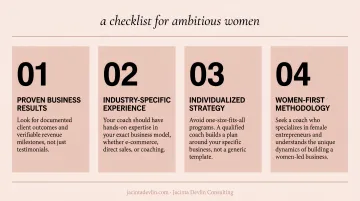
According to ICF research, 85% of coaching clients value working with a credentialed coach. Credentials matter — but for women in business specifically, lived entrepreneurial experience often matters more than certification alone.
Frequently Asked Questions
What does a business development coach do?
A business development coach helps entrepreneurs identify growth opportunities, build a clear revenue strategy, and stay accountable to executing it. The work combines strategic guidance with ongoing personalized support, built around your specific business and goals.
What is the 70/30 rule in coaching?
The 70/30 rule is a coaching guideline suggesting the client should be doing roughly 70% of the talking during sessions, with the coach listening and asking questions rather than lecturing. The intent is to draw out the client's own thinking and problem-solving, not to deliver a one-way stream of advice.
What are the 5 C's of coaching?
The 5 C's referenced in coaching frameworks typically include Clarity, Commitment, Confidence, Competence, and Connection — core elements a strong coaching relationship develops across both strategy and execution.
How is business development coaching different from taking an online course?
A course delivers general frameworks you apply on your own, with no accountability and no adaptation to your specific business. Coaching builds a custom strategy around your actual goals and holds you accountable to following through on it.
How long does it take to see real results from business development coaching?
Many clients see early clarity and momentum within the first 30–60 days. Meaningful revenue results typically build over 6–12 months of consistent work. The pace depends heavily on your starting point and how committed you are to implementing between sessions.
Can coaching help women who are just starting out, or is it only for established businesses?
Coaching is valuable at any stage. The work is always about building the right strategy for where you are right now — whether that's launching your first business or breaking through a revenue ceiling you've been stuck at for a year.