
The U.S. health coaching market has reached $7.6 billion, with an estimated 128,000 coaches and health educators competing for clients. Standing out in that market requires more than great coaching. It requires a clear niche, a professional brand, a scalable offer suite, and repeatable systems for bringing in clients.
This guide covers each of those pillars — practically, not theoretically.
Key Takeaways
- Niche clarity is the single highest-leverage move you can make early in your growth journey
- Build a strong brand and professional online presence — both are non-negotiable for attracting consistent clients
- Scale beyond one-on-one sessions through intentional offer design, not just more hours
- Combine email lists, consistent content, and referrals to create predictable client flow
- Track key metrics and install simple systems to avoid the burnout cycle that derails solo coaches
Define Your Niche and Ideal Client Profile
Many health coaches try to serve everyone and end up resonating with no one. This is what's sometimes called the expertise trap — the mistaken belief that casting a wider net catches more clients. In practice, it does the opposite.
A defined niche sharpens your marketing, tightens your messaging, and makes your programs land with the right people faster.
Consider the difference between these two positioning statements:
- Broad: "I help people get healthy."
- Specific: "I help women health coaches sign their first five clients and build a program that earns consistent income — without burning out."
The second immediately signals who it's for, what problem it solves, and what the outcome looks like. A prospective client reading that knows within seconds whether it applies to her.
There's also a real pricing argument for going specific. Hinge Research found that high-visibility specialists in professional services can command fees up to 13x higher than generalists with no visibility. Coaches who are seen as the go-to expert for a defined problem can charge accordingly — generalists rarely can.
How to Choose a Niche That Works for Your Business
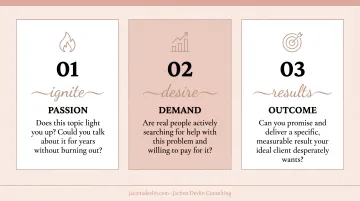
Use this three-part filter before committing to a direction:
- Passion and expertise overlap — Where does what you know best meet what genuinely energizes you?
- Demonstrated demand — Are people actively searching for solutions to this problem? Are communities, forums, and content creators already serving this audience?
- Specific problem, specific outcome — Can you name the problem clearly and describe the transformation the client achieves?
Once your niche is set, build a basic ideal client profile that captures:
- Demographics (age, life stage, profession)
- Core pain points and frustrations
- Goals and desired outcomes
- What they've already tried that hasn't worked
Keep this profile somewhere visible. It should be the reference point for every offer you build and every conversation you have with a prospective client.
Build a Brand and Online Presence That Attracts Clients
Your brand is the total impression a prospective client forms when they encounter your business: your website, your Instagram, a Google search result, a referral from a friend. It should communicate who you serve, what outcome you deliver, and why they should trust you over anyone else.
That trust has to be built deliberately. ICF's 2022 Global Consumer Awareness Study found that 78% of people considering coaching say certifications and credentials are important or very important — a number that rises to 85% among people who've already worked with a coach. Surface your credibility; don't assume clients will dig for it.
Your Website as a 24/7 Sales Tool
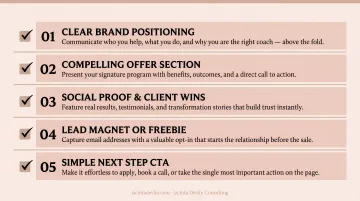
Your website works while you sleep. A health coaching website that converts visitors into leads needs these non-negotiables:
- Clear niche statement on the homepage: a visitor should know in five seconds who you help and what outcome you deliver
- Compelling "About" section: builds personal connection and establishes why you're credible
- Services or offers page: describes outcomes (not just deliverables) and provides a clear path to learn more or book
- Client testimonials and results: social proof is critical; BrightLocal data shows 50% of consumers trust online reviews as much as personal recommendations from friends and family
- Strong call to action: a free discovery call, a lead magnet, or both
SEO amplifies all of this. Using niche-specific keywords in your page titles, headers, and blog content builds organic visibility over time. A blog or resource section does double duty: it positions you as an expert and drives ongoing search traffic without paid ads.
Social Media Strategy That Builds Trust and Converts
Pick one or two platforms where your ideal client actually spends time, then commit. Trying to maintain a presence on five platforms simultaneously leads to average content everywhere.
For women's wellness niches, Pew Research confirms that 55% of women use Instagram, and women are more likely than men to use Facebook and TikTok. Instagram is the starting point for most health coaches targeting women.
A content mix that works:
- Educational posts that demonstrate your expertise on the problem you solve
- Transformation stories and testimonials (with client permission)
- "Day in the life" content that builds personal connection and relatability
- Direct calls to action for consultations or offers
Short-form video is worth prioritizing. Keep videos under 30 seconds — that's where health coaching audiences engage most. Consistency and authenticity matter more than production quality.
Create Scalable Coaching Offers and Revenue Streams
A business built entirely on one-on-one hourly sessions has a hard ceiling. There are only so many hours in a day, and that ceiling arrives faster than most coaches expect. The solution is an intentional offer suite — not just a flagship 1:1 package.
Building an Offer Suite That Grows With Your Business
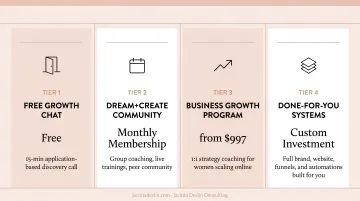
Think of your offer suite in three levels:
- Entry point (low or no cost): A free lead magnet (5-day challenge, checklist, mini-guide), discovery call, or low-priced workshop builds trust and fills your pipeline with the right people before they're ready to invest.
- Core 1:1 coaching program: Your primary revenue driver. Price it based on the outcome delivered, not hours spent. Packaging into 3-month or 6-month programs improves client commitment and creates steady, foreseeable income month to month — a client paying for a 6-month transformation is more invested than one buying sessions one at a time.
- Scalable group offer: A group coaching program, online course, or membership lets you serve more clients without proportionally more time. The online coaching industry is projected to exceed $11 billion by 2032 — the demand for group and digital formats is growing fast.
- Passive income layer: Self-paced courses, downloadable guides, and digital resources generate revenue between client engagements and serve those who aren't ready for full coaching yet — income that isn't tied hour-for-hour to your calendar.
Master Your Marketing and Client Acquisition Strategy
Consistent, targeted content is the primary organic growth engine for female entrepreneurs. Blog articles, social posts, short videos, and email newsletters that speak directly to your ideal client's pain points build authority over time and attract inbound leads. Consistency matters more than volume — one strong piece of content per week beats sporadic bursts of activity.
Every piece of content should connect back to your niche and ideal client profile. Generic content attracts a generic audience. Specific content attracts the exact client you want to work with.
Your email list is your most valuable owned asset. Social media platforms are rented land — the algorithm decides who sees your content. Your email list is yours. Litmus reports email marketing generates an average ROI of $36 for every $1 spent, making it the highest-return channel available to most coaches.
A lead magnet — a free resource that solves a specific problem for your ideal client — grows the list. A nurture email sequence builds trust and moves leads toward booking a discovery call. Together, a strong lead magnet and a well-built welcome sequence are among the most underused assets in women-owned coaching and service businesses.
Referrals and partnerships are your highest-conversion growth lever. Nielsen data shows 88% of consumers trust recommendations from people they know more than any other channel. Satisfied clients are your best source of new clients — but most coaches never ask directly. Build a deliberate process for requesting referrals and reviews.
Strategic partnerships with complementary women in business — virtual assistants, brand photographers, copywriters, web designers, or fellow coaches in adjacent niches — create a steady stream of warm referrals without paid advertising. Consider:
- Identifying 3-5 women whose services complement (not compete with) yours
- Establishing a mutual referral agreement with clear expectations
- Co-hosting a workshop, Instagram Live, or email feature to cross-introduce your audiences
- Following up quarterly to keep the relationship active
These partnerships take time to build. But a single strong referral partner can consistently send you pre-sold, high-trust leads month after month.
Build Systems, Track Metrics, and Scale Strategically
Most health coaches run their businesses reactively — responding to whatever's urgent rather than building toward what's important. The shift from reactive to intentional requires systems.
Four systems every health coaching business needs:
- A simple CRM to track leads, active clients, and follow-ups
- Automated scheduling and onboarding — use Calendly or Acuity to eliminate back-and-forth booking and automate your intake process
- A repeatable discovery call framework that consistently converts qualified leads into paying clients
- A content batching workflow — one focused block per week or month beats scrambling for ideas daily
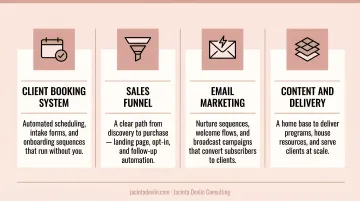
These systems save hours per week and directly enable scale by freeing you to focus on high-value activities.
Metrics to Track Monthly
Coaches who know their numbers can make strategic decisions. Coaches who don't are guessing. Track these each month:
- Discovery calls booked
- Discovery call conversion rate
- Active clients
- Monthly revenue
- Client retention and referral rate
- Email list growth
If any of these metrics is consistently flat or declining, you have a specific signal to work with — not a vague sense that something isn't working.
When to Bring in Outside Strategy
Once you're generating revenue but can't pinpoint why growth has stalled, a business strategist can often identify the gap faster than you can from inside it. The value is a strategy built around where you are now — your offers, your audience, your actual numbers — not a generic framework applied to everyone.
Jacinta Devlin at Devlin Consulting works this way with women coaches and service providers specifically. Clients have scaled from sub-$500 months to consistent $10K+ months, with some boutique owners clearing $100K in year one and direct sales leaders exceeding their prior annual income within six months. The work covers sales funnels, email marketing, content strategy, and offer design — built around each client's business, not a one-size playbook.
If you're generating revenue but hitting a ceiling you can't see past, the starting point is a free 15-minute discovery call to assess fit and map out the right path forward.
Frequently Asked Questions
How do I build a successful health coaching business?
Success comes from treating the business side with the same rigor as your coaching expertise. The foundational pillars are niche clarity, a strong brand and online presence, a defined offer suite, consistent marketing, and business systems. Most coaches who stall are skilled at coaching but haven't invested equally in building the business around it.
What are the 5 C's of health coaching?
No official "5 C's" framework exists from NBHWC or ICF, but coaches commonly reference Clarity, Connection, Commitment, Confidence, and Consistency as guiding principles. These apply as much to building your business as they do to your coaching practice. For a credentialed foundation, the ICF structures its Core Competencies across four domains: Foundation, Co-Creating the Relationship, Communicating Effectively, and Cultivating Learning and Growth.
What is the 80/20 rule in health coaching?
The 80/20 rule (Pareto Principle) holds that roughly 80% of outcomes come from 20% of inputs. In practice, this means identifying the handful of client behaviors that drive the most results — and the handful of marketing activities driving most of your inquiries — then prioritizing those above everything else.
What is the 70/30 rule in health coaching?
The 70/30 rule is a widely used session guideline: the client speaks 70% of the time, the coach speaks 30%. It keeps sessions client-led rather than directive, with the coach drawing out insights rather than delivering answers.
How do health coaches get more clients consistently?
The three most reliable client acquisition strategies are a targeted content strategy tied to a specific niche, an email list with a strong lead magnet driving consistent signups, and an active referral and partnership system. Consistency of effort across all three matters more than any single tactic.
How do you scale a health coaching business beyond 1-on-1 sessions?
Start by packaging your 1:1 work into outcome-based programs (3 or 6 months) rather than hourly sessions — this raises value and price. From there, introduce group coaching or an online course to serve multiple clients at once, then layer in passive income products like digital downloads or self-paced courses to generate revenue that doesn't require your direct time.