
Your brand is not your logo. It's the reason someone chooses you over the dozens of other women selling the exact same thing.
That distinction matters more now than ever. According to the U.S. Census Bureau, women own 14.2 million U.S. businesses. In crowded markets — coaching, direct sales, boutiques, affiliate marketing — the product is rarely the differentiator. The person behind it is.
There's also a layer most branding advice ignores: women face a specific social penalty around self-promotion that men simply don't. This post won't gloss over that. It will reframe personal branding as a strategic revenue tool — not self-aggrandizement.
Key Takeaways
- Authentic personal branding starts with your values, story, and who you serve — visual design comes later
- Women face a real "likability conundrum" around self-promotion — understanding it changes how you show up
- A strong personal brand builds trust faster than any paid ad campaign
- Consistency across platforms builds familiarity, and familiarity is what turns followers into buyers
- Your brand evolves as your business grows; your core values are the anchor
Why Personal Branding Hits Different for Women in Business
The Competitive Reality
Women now represent 39.2% of all U.S. companies and generate $3.3 trillion in annual revenue, according to the National Women's Business Council. That's a massive, growing market — and an increasingly crowded one.
In direct sales specifically, hundreds of reps sell identical products from the same catalog at the same price. The only variable any seller controls is herself — her story, her presence, her credibility. That's personal brand.
Jacinta Devlin saw this firsthand across 12 years in direct sales, eventually training 50,000+ women in the social selling space. The sellers who broke through to top results weren't always the ones with the best products or the biggest budgets. They were the ones who built a recognizable, trusted personal identity that made customers choose them.
The Likability Conundrum
Harvard Business Review research found that women face distinct social penalties for behaviors associated with success — including assertiveness and touting their own performance. Men don't carry the same social risk for the same behaviors.
That reality calls for strategy, not retreat. Authentic branding sidesteps the backlash by leading with story and values rather than ego-driven promotion. You're not announcing how great you are — you're letting people see who you are.
The distinction matters in practice:
- Story-led content builds connection without triggering the "too self-promotional" reaction
- Values-forward positioning attracts buyers who already align with what you stand for
- Consistent presence builds trust before a sale ever enters the conversation
Why It Connects to Revenue
Sprout Social research found that when consumers feel connected to a brand, 76% will buy from that brand over a competitor and 57% will increase their spending. Trust is the mechanism. And personal brands build trust faster than any corporate logo ever could.
What Authentic Personal Branding Actually Means
Brand vs. Visual Identity
The most common misconception: personal branding is your logo, your colors, your Instagram grid. Those are tools. Your brand is the reputation you build — the feeling people get when they interact with your content, your offers, and your presence.
Jacinta's brand development work makes this distinction explicit. Visual identity elements (logo, color palette, typography) express the brand strategy — they don't constitute it. A polished logo without the underlying strategy signals competence at the surface and nothing deeper.
Performative vs. Authentic
Performative branding copies what's trending, mimics successful competitors, and builds from the outside in — "what should I look like?" rather than "what do I actually stand for?"
Consider two women:
- Woman A studies what the top coaches in her niche post and replicates their aesthetic, captions, and offers. Her content looks polished but feels hollow. Followers don't buy.
- Woman B shows her real process — including the messy parts. She talks about why she does the work, who she does it for, and what she's learned. Her audience feels like they know her. They buy before she ever pitches.
The difference isn't polish — it's origin. Woman B's brand works because it started with something real.
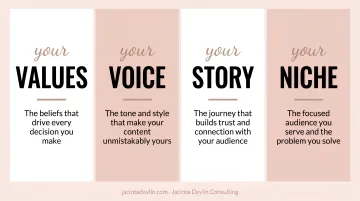
The Four Core Pillars
Every authentic personal brand rests on four foundations:
- Values: what you stand for — non-negotiable across every product/service and every piece of content
- Voice: the personality that comes through when you write, speak, or show up on camera
- Story: where you started, what changed, and why this work matters to you
- Who you serve and the specific problem you solve for them (your niche)
One warning: authenticity washing is real. Being open and relatable is valuable. But oversharing or performing vulnerability without substance erodes credibility. Authentic branding is honest and strategic — it's not the same as unfiltered.
Start Here: The Foundation of Your Authentic Brand
Step 1 — Clarify Your Values
Write down 3–5 core values that guide every business decision. These become the non-negotiable thread through every piece of content, every product/service, and every client relationship.
If one of your values is transparency, that shows up as sharing your real numbers, your process, and your setbacks alongside your wins. If it's real-world results, every piece of content connects back to tangible outcomes rather than theory. Values aren't a branding exercise — they're operating principles.
Step 2 — Craft Your Brand Story
Your story is your most powerful competitive advantage. No one else has lived it.
Map your journey:
- Where did you start?
- What pushed you forward when it was hard?
- What was the moment that changed everything?
- What do you want to help others achieve?
Jacinta's story is the model here. She started at 21 as a broke college student who walked into a direct sales jewelry party thinking it sounded like fun. That party became a 12-year direct sales career, then a national training role at Stella & Dot, then an influencer platform, then a boutique, then a coaching business. That lived journey — honest, specific, and earned — is exactly why clients say "she's walked in my shoes." A story that specific is impossible to copy.
Step 3 — Define Your Audience With Precision
A personal brand without a clear audience is just content. Get specific — not "women entrepreneurs" but "women in direct sales who are stuck at $2K/month and want consistent $10K months." The more specific the niche, the stronger the brand signal.
Audience clarity drives real results. Two examples from Jacinta's client roster show what that looks like in practice:
- Carissa P. (Park Lane Jewelry direct sales leader) — hit 40% year-over-year growth
- Ally G. (Dune Jewelry) — reached $10,000+ sales months consistently
Both achieved those results because the strategy was built around exact audience clarity — not a vague demographic.
Step 4 — Develop Your Brand Voice
Voice is how your values and personality come through in written and spoken content. Are you warm and encouraging, or direct and results-focused? Authoritative with humor, or conversational and personal?
Jacinta's voice is a good example of this in action: warm and conversational (she opens messages with "Hey friend!"), direct and results-focused, and genuinely multi-dimensional. That's why her audience recognizes her content immediately — even without a logo in the frame.
Identify your natural communication style and commit to it consistently. When your audience hears the same voice across every platform and every post, they start to feel like they already know you — and that's what turns followers into buyers.
None of this requires a professional brand shoot or a redesigned website. It requires self-awareness and the courage to show up honestly.
Show Up and Stand Out: Building Visibility That Drives Real Revenue
Platform Strategy That Doesn't Burn You Out
A great personal brand that no one sees is a missed opportunity. But the answer isn't to be everywhere.
Identify where your ideal clients actually spend time, then go deep on those platforms. For most women entrepreneurs:
- Direct sellers and social sellers → Facebook (groups + profile), Instagram
- Boutique owners and product brands → Instagram, TikTok Shop, Pinterest
- Coaches and service providers → Instagram, LinkedIn, email
- Affiliate marketers and influencers → Instagram, LTK, Amazon storefronts, Facebook groups
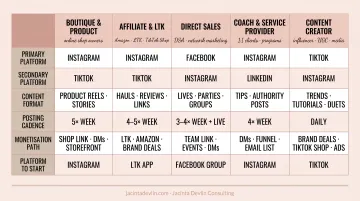
Consistency without burnout comes down to three habits: content batching, repurposing, and a simple weekly rhythm. Jacinta's team builds these systems for clients — content pillars, weekly calendars, hook templates, Stories sales sequences — so every post has a purpose behind it.
Content That Actually Converts
The 80/20 principle applies directly here: roughly 80% of your content should educate, inspire, or connect — and about 20% should sell. Constant offers without relationship-building create resistance. Story and trust-building come first.
Four content types that work for female entrepreneurs:
- Behind-the-scenes — your process, not just your outcome
- Client wins — real results (with permission) that show what's possible
- Personal story posts — specific moments from your journey, not generic inspiration
- Educational tips — practical, immediately useful content in your area of expertise
Visibility Beyond Your Own Platforms
Social media is rented land. Speaking engagements, podcast appearances, collaborations, and press features build authority in a way algorithm-dependent content cannot. Nielsen research found that 84% of consumers trust recommendations from people they know completely or somewhat — earned credibility carries weight social posts rarely match.
Jacinta has spoken at Pearl Time, Quotable Live, SWFL Women in Business, Stella & Dot International Hoopla, and Park Lane Jewelry International, among others. Her speaking isn't supplementary to her brand — it's foundational to it. Pursue at least one visibility opportunity outside your own platforms each quarter.
Overcoming the Self-Promotion Trap
The Real Cost of Staying Invisible
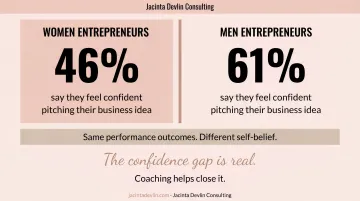
Research from NBER economists Exley and Kessler found a striking gap: equally performing men rated themselves 61 out of 100 while women rated themselves 46 out of 100. Same performance, dramatically different self-presentation.
In business, that gap has a direct cost. Opportunities go to the most visible — not always the most talented. If you're not talking about your work, someone less qualified is talking about theirs.
Self-Promotion as a Service, Not Bragging
Self-promotion done with authenticity is not bragging. It's service. When you share your expertise, your results, and your story, you are showing someone who needs exactly what you have where to find it.
Shift from "talking about myself" to "showing someone the way." That one mental switch makes it easier to show up consistently — because you're no longer promoting yourself, you're pointing people toward a solution they're already searching for.
Three Tactics to Get Comfortable
- Share client results (with permission) — outcomes are more persuasive than any pitch
- Walk through your process, not just the win — showing the work builds trust faster than announcing results
- Lead with story before the product/service — let your audience know, like, and trust you first
When Jacinta helped Christina R. rebrand to @mybalancedstyle, Christina didn't just gain a new logo. She gained the positioning and confidence to pitch 5-figure brand deals with Walmart and QVC. The brand clarity came first. The revenue followed.
How Your Personal Brand Evolves as Your Business Grows
Your personal brand is not static — and it shouldn't be. As your business grows, your audience may shift, your offers may change, and your story adds new chapters.
Think of it like updating a wardrobe while staying true to your personal style. The specific pieces evolve. The underlying aesthetic doesn't.
Jacinta's own trajectory makes this concrete: she went from broke college student to Top 1% direct sales seller, then National Sales Director, then fashion influencer, boutique owner, and eventually business coach. Each stage was a deliberate evolution. The core was always the same: building businesses on authentic expertise, not manufactured image.
If your brand doesn't feel fully figured out yet, that's normal. The brand becomes clearer through action — through showing up, getting feedback, noticing what resonates, and doubling down on what feels most true. Jacinta's Business Launch Program is built for exactly this: women take their brand from blank page to revenue-generating launch in 12 weeks, building identity and positioning in parallel with showing up — not as a prerequisite to it.
Action builds clarity faster than planning alone ever will.
Frequently Asked Questions
What is authentic personal branding for female entrepreneurs?
Authentic personal branding means building a public-facing identity rooted in your real values, story, and expertise — not a curated persona. When you show up as who you actually are, your audience connects with you, not a polished performance. That connection is what turns followers into buyers.
How do I build a personal brand without feeling like I'm bragging?
Reframe self-promotion as service: when you share your story and expertise, you're helping someone find exactly what they need. Share your journey, client wins, and hard-earned knowledge — that evidence speaks louder than any claim you could make about yourself.
What makes a personal brand authentic versus performative?
Authenticity means your brand reflects your actual values and voice consistently — on difficult days and good ones. Performative branding mimics trends or copies competitors without a real foundation in who you are. Audiences sense the difference quickly.
How does personal branding help female entrepreneurs make more money?
A strong personal brand builds trust faster and lowers sales resistance. People already feel like they know you before they buy, which means less convincing and more converting. According to Sprout Social, 76% of consumers will choose a brand they feel connected to over a competitor — trust outperforms any cold ad campaign.
How do I find my personal brand voice?
Notice how you naturally communicate in real conversations. Identify the tone that feels most like you — warm, direct, educational, humorous — and use it consistently across every platform. The more recognizable your voice becomes, the faster your audience learns to trust you.
How often should I post on social media to build my personal brand?
Consistency matters more than frequency. Showing up 3–4 times per week with intentional content outperforms daily posting that leads to burnout and disappearance. Choose a realistic rhythm and stick to it — an audience that can count on you trusts you faster.