Introduction
You're posting every day, saying yes to every opportunity, and working more hours than you ever did in your 9-to-5. But your revenue looks almost identical to what it was six months ago. The product is good. Your customers love you. So why isn't it growing?
This is where most women-owned businesses stall — not from lack of effort, but from lack of the right strategy.
The opportunity is real. According to the 2025 Wells Fargo/WIPP report, women now own 14.5 million businesses — 39.2% of all U.S. firms — generating $3.3 trillion in annual revenue.
But the scale gap tells a different story: women-owned businesses account for only 6.2% of total U.S. business revenue, and just 13.7% of women-owned employer firms ever reach $1M+ in revenue. The ownership numbers are there. The scale is not.
Closing that gap starts with strategy. This post covers the growth moves that actually shift the numbers for women entrepreneurs — not generic tips recycled from someone else's playbook, but the specific approaches that create consistent revenue and scalable businesses.
Key Takeaways
- Growth starts with an honest audit of where your business actually stands — not where you hope it is
- A revenue-first strategy built around your business model outperforms copying what worked for someone else
- Social selling, email marketing, and video content are the highest-leverage growth tools available to women entrepreneurs right now
- Systems and automation separate businesses that plateau from those that scale
- The right network, funding, and resources can accelerate your trajectory faster than any single tactic
Start With an Honest Assessment of Where Your Business Actually Stands
Most growth strategies fail before they start. Women entrepreneurs jump to tactics — new platforms, new products, new offers — without diagnosing what's actually holding the business back. Generic advice makes this worse by pushing one-size-fits-all solutions onto businesses with completely different problems.
Before choosing any growth strategy, answer these questions honestly:
- What is your current monthly revenue, and is it consistent?
- Where do your best customers actually come from?
- What is your conversion rate on your primary product/service?
- Where are leads dropping off in your sales process?
- What are you spending the most time on that isn't generating income?
The Ceiling Most Women Entrepreneurs Hit
There's a predictable stall point in women-owned businesses — often somewhere between $500 and $2,500 per month — where working harder stops producing results. Client Carissa P., a Park Lane Jewelry team leader, described it well: "I felt overwhelmed and was unsure of what parts of my business needed more focus." Jamie Ralliford put it even more directly: "Prior to working with Jacinta I was literally all over the place."
That stall is almost never a hustle problem. It's a strategy problem.
The Three-Area Business Audit
Before adding anything new, identify the weakest link across these three areas:
- Are you dependent on one unpredictable revenue channel, or do you have multiple consistent streams?
- Are you spending most of your working hours on activities that directly generate income?
- Do you have a repeatable system for bringing in new customers, or is every sale a manual effort?
Answering these questions honestly — before adding anything new — is what cuts months of guessing down to days. Jacinta Devlin has coached women from sub-$500 months to consistent $5k–$50k+ months, and every engagement at Jacinta Devlin Consulting starts with this exact audit before a single strategy is built.
Build a Revenue-First Strategy That's Custom to Your Business
A revenue-first strategy means every decision — content, offers, pricing, partnerships, time — gets evaluated against one question: does this move revenue forward? Not visibility. Not engagement. Revenue.
Identify and Double Down on What's Already Working
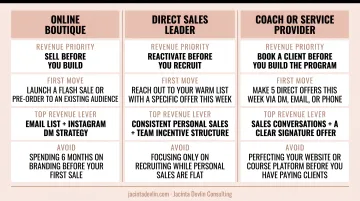
Before adding new channels or products, identify your highest-revenue activities and do more of those. Here's what this looks like across three business types:
- Social seller: Your Facebook Group is converting at a higher rate than your Instagram. Double down on group content and community growth before expanding to TikTok.
- E-commerce boutique owner: Your email list drives 60% of repeat purchases. Prioritize growing that list before running paid ads to cold traffic.
- Service-based business: Referrals from two specific clients account for most new business. Create a structured referral program before building out new lead generation channels.
Audit Your Offer Structure and Pricing
Many women entrepreneurs either undercharge or create too many offers — both of which dilute focus and confuse buyers. Ask yourself:
- Which single product/service generates the most revenue with the least friction?
- Are your prices reflective of the value you deliver, or are they what feels "safe"?
- Could a simpler product/service suite actually convert better?
Lead with your strongest product/service and get it working consistently — then you're ready to build on top of it.
When to Add Multiple Income Streams
Multiple income streams are smart — but timing matters. Adding streams too early, before your primary revenue is consistent and systematized, typically slows growth rather than accelerating it.
The right sequence: stabilize and systematize your primary revenue channel first, then layer in complementary streams. Jacinta Devlin followed exactly this path — building a Top 1% direct sales career before adding an Amazon storefront, then LTK affiliate income, then brand partnerships, then coaching and consulting.
Each stream was added on top of a working foundation, not instead of one.
Why a Template Won't Work for Your Business
Copying another business's strategy — even a successful one in the same industry — rarely works because every business has different strengths, audiences, and conversion points. A direct sales team leader scaling from $3k to $10k per month needs a completely different strategy than a boutique owner doing the same.
Personalized coaching delivers what templates can't: a strategy built around your specific business. When Amanda O. entered coaching targeting just $2,500 per month, the individualized strategy Jacinta built around her business got her to consistent $10,000+ months — a result that required knowing her business, not a blueprint from someone else's.
Master Social Selling and Digital Marketing
Social selling is not just posting on social media. It's the deliberate use of platforms to build relationships, create trust, and convert followers into buyers. For women entrepreneurs without large advertising budgets, it's one of the most accessible growth channels available.
What Actually Converts (vs. What Just Builds Followers)
Not all content is created equal. Here's the distinction between what drives revenue and what drives vanity metrics:
| Converts to Buyers | Builds Vanity Metrics Only |
|---|---|
| Story sales sequences with clear calls to action | Aesthetic posts with no purchase pathway |
| Facebook Group community content with buying intent | Follower growth challenges with no conversion strategy |
| DM automation flows (tools like LinkDM) | High-follower accounts with disengaged audiences |
| Email sequences triggered by behavior | Social-only strategies on rented platforms |
| Live shopping events with scripted product/services | Passive Reels with no product/service attached |
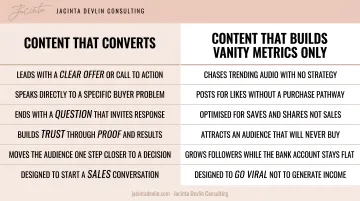
Client Sharon B. illustrated this gap clearly. She spent an entire year selling on Amazon and earned $4,000 total — then grew two Facebook Groups (one to 30,000+ members, another to 37,000+ in just four months) and reached $20,000+ per month consistently. The platform didn't change. The strategy did.
Email Marketing: Your Most Valuable Owned Asset
Social platforms change their algorithms constantly. Your email list doesn't. According to Litmus, email marketing generates an average ROI of $36 for every $1 spent — a return that compounds over time as your list grows.
The email sequences worth building first:
- Welcome sequence (5–7 emails) — establishes brand voice and begins the relationship-to-sale journey
- Abandoned cart sequence — critical for e-commerce businesses
- Launch campaign sequence — 8–16 emails spanning pre-launch, launch week, and post-launch
- Post-purchase loyalty sequence — converts one-time buyers into repeat customers
Short-Form Video Without a Production Budget
Email keeps your audience engaged once they're on your list — but video is often how they find you first. According to Wyzowl's 2026 Video Marketing Report, 91% of businesses now use video as a marketing tool, and HubSpot reports that 49% of marketers rank short-form video among their top ROI-driving content formats.
For women entrepreneurs without a production budget, skipping video isn't the answer. Pre-written hook templates, scripted Reels and TikTok content, and a structured posting calendar make consistent smartphone filming achievable without creative burnout.
For entrepreneurs ready to invest in professional assets, Jacinta Devlin Consulting's VIP Content Day provides an on-location shoot that produces months of high-quality video and photo content in a single day.
Michele and McKaylee of MckMich Collective credited the VIP Content Day as foundational to their successful launch and early brand partnerships.
Create Systems and Automation So Your Business Can Scale
Most women-owned businesses are founder-dependent. If the owner stops working, revenue stops too. This is the single biggest barrier to scaling past a certain revenue point — and it's not solved by working more hours.
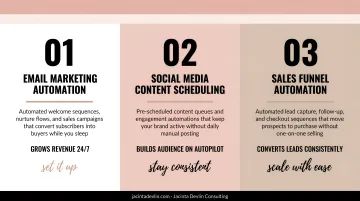
The Three Highest-Impact Areas for Systems
1. Automate your follow-up and lead nurturing. Manual DM follow-ups and one-off email campaigns don't scale. Setting up a welcome sequence and abandoned cart flow using Flodesk or Klaviyo can recover sales that would otherwise be lost — without any additional manual effort per sale.
2. Batch and systematize your content. Batching content creation into scheduled sessions, using a content calendar, and automating Instagram DM responses via tools like LinkDM converts sporadic posting into a consistent, converting system. Client Jamie Ralliford attributed her jump to 25–30 new engaged followers per week directly to streamlining and automating her social media.
3. Streamline booking, payments, and admin. Tools like Dubsado, HoneyBook, or Acuity for booking and contracts — paired with Stripe or Square for payments — eliminate the administrative back-and-forth that consumes hours each week.
Start by identifying the repetitive tasks eating your time without generating income. Replace those with tools or templates, and redirect that time toward the work that actually moves your business forward.
Build a Network That Opens Doors
The women who grow fastest rarely do it alone. They build intentional relationships with mentors, sponsors, peers, and collaborators — in person and online — and those relationships create compounding opportunities that no marketing strategy can replicate.
Two Relationships Worth Cultivating Intentionally
Mentors give you specific, experience-based guidance — not inspiration, but direction. Client Carissa P. chose to work with Jacinta because "she's walked in my shoes." That lived experience is what makes mentorship actionable.
Sponsors go a step further. They have influence and use it on your behalf — actively introducing you to opportunities rather than advising from the sidelines. For influencers and affiliate marketers, a sponsor might be a brand partner who connects you to their wider network. For service providers, it's often a client with a large following who advocates for you publicly.
SCORE data shows that mentored businesses are 12% more likely to remain in business after one year, and that consistent mentoring reduced the small business failure rate from 25% to 13%. That's not a small margin — it's the difference between a business that survives and one that doesn't.
The Power of Women-Specific Business Communities
Individual mentorship gives you a guide. A peer community gives you something different: the collective intelligence of women solving the same problems at the same time.
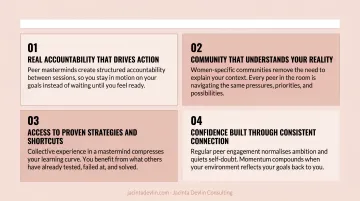
Peer groups, masterminds, and women-focused communities product/service:
- Real-time feedback from people who understand your exact challenges
- Collaboration and co-promotion opportunities that grow reach faster
- Accountability that keeps you moving when motivation stalls
- Connections that turn into referrals, partnerships, and clients
Jacinta Devlin's Dream+Create Online Coaching Community has produced documented results from exactly this dynamic. Sharon B. directly attributed her growth to "partner relationships, group collabs, and networking opportunities" she found through the community. Joy W. landed brand partnerships and surpassed her previous annual income within six months of joining.
Tap Into Capital and Resources Designed for Women Entrepreneurs
Funding programs and free resources built specifically for women-owned businesses exist — and knowing where to find them saves real time and money.
Funding Options Worth Exploring
- Amber Grant (WomensNet): Monthly $10,000 grants for women-owned businesses; monthly winners are eligible for an annual $50,000 grant. Active applications at ambergrantsforwomen.com
- IFundWomen: Corporate-partner grants including IFW Fund Forward Awards — 18 U.S. women entrepreneurs receiving $10,000 each. Active portal at ifundwomen.com
- Tory Burch Foundation Fellows Program: For for-profit, majority women-owned businesses with a minimum $75,000 in annual revenue. Applications open annually at toryburchfoundation.org
- SBA WOSB Federal Contract Program: The federal government targets at least 5% of federal contracting dollars for women-owned small businesses annually
- SBA loan programs + Lender Match: Accessible through the SBA's women-owned business guide
Free and Low-Cost Resources
- SCORE: Free expert mentoring, workshops, and resources for small business owners
- Women's Business Centers (WBCs): SBA-funded centers offering free or low-cost counseling and training for women starting or growing a business
- NAWBO: The National Association of Women Business Owners, a dues-based organization with local chapters and national advocacy
Frequently Asked Questions
What is the fastest business growth strategy?
The fastest path is the one that doubles down on what's already working in your specific business. For most women entrepreneurs, that means improving conversion on existing offers and focusing on customer retention before chasing new audiences. Retention is cheaper than acquisition — and it compounds faster.
What is the most profitable business for women?
There's no single answer. Service-based businesses (consulting, coaching, staffing), e-commerce, and social selling consistently show strong margins for women entrepreneurs. Profitability depends more on strategy, pricing, and systems than the business type itself.
What are the 5 C's of entrepreneurship?
One widely used framework identifies them as Creativity, Connectivity, Consistency, Clarity, and Credibility. Together, these five qualities describe what sustains entrepreneurial growth over the long term — not just what launches a business, but what keeps it moving.
What are the 7 M's of entrepreneurship?
Commonly cited as People (Manpower), Money, Materials, Machines, Methods, Markets, and Management. Used together, these seven areas give any business owner a clear framework for spotting where the gaps are — and where to focus next.
How can women entrepreneurs access funding for business growth?
The main avenues are grants (Amber Grant, IFundWomen), SBA loan programs and Lender Match, women-focused lenders, crowdfunding, and angel investor networks. A clear business plan and documented revenue history strengthen any application.
What is the biggest challenge for women-owned businesses trying to scale?
The most common challenge is the absence of a scalable strategy. Businesses grow to a point and then plateau because they're founder-dependent, operating without repeatable systems, clear revenue targets, or a defined customer acquisition process. Working harder doesn't solve a strategy problem.