For many women entrepreneurs, the missing piece isn't effort or talent. It's a marketing strategy built around how they actually sell — not a generic corporate playbook designed for someone else's business.
Women-owned businesses are growing fast. According to the National Women's Business Council, there are 14.5 million women-owned businesses in the U.S., representing 39.2% of all firms and generating $3.3 trillion in annual revenue. The momentum is real. But without a structured strategy, even the most talented entrepreneurs plateau.
This article covers practical, proven marketing strategies tailored to women entrepreneurs — from building a personal brand and social selling to email marketing, referral programs, and closing tactics that actually convert.
Key Takeaways
- A strong personal brand builds the kind of trust that converts — faster and cheaper than paid ads alone
- Social selling and community-building align naturally with relationship-first selling styles
- Email marketing returns measurable revenue when you pair smart list-building with the right automations
- Referrals and reviews tap into buyer trust that no ad budget can manufacture
- Tracking your results and dropping what isn't working is how you scale instead of stall
Why Marketing Looks Different for Women-Owned Businesses
Women entrepreneurs often bring genuine strengths to marketing: storytelling, community-building, and relationship-driven selling. The problem isn't the strengths. It's the absence of a system that turns those strengths into consistent revenue.
As Jacinta Devlin puts it: "You don't have a social media problem. You have a strategy problem dressed up as a social media problem."
The Real Constraints
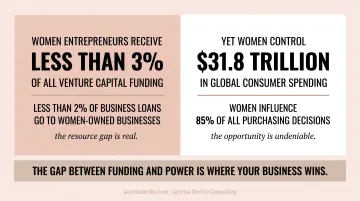
Women-owned businesses face a measurable resource gap. The NWBC reports that women start businesses with an average of $75,000 compared to $135,000 for men — and in high-growth firms, that gap widens to $150,000 vs. $320,000. Marketing strategies need to account for tighter budgets and higher efficiency requirements.
Add to that the reality that 70.5% of women business owners aged 35–44 cite balancing work and family as a primary reason for starting their business — which means most are running their marketing while also running everything else.
The Opportunity
Women control an estimated $31.8 trillion in global spending and influence 70–80% of all consumer purchasing decisions, according to consumer intelligence firm NIQ. Women-owned businesses that market authentically to their audience have a built-in advantage — they understand their buyer in a way that larger, generic brands don't.
The strategies below are built around that edge — pairing authentic connection with the systems and channels that turn it into predictable revenue.
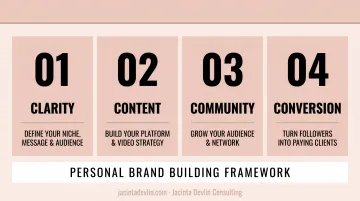
Build a Personal Brand That Sells for You
In service-based businesses, coaching, direct sales, and boutique retail — you are the brand. A recognizable, trusted personal brand reduces friction between discovery and purchase. People buy from people they know and trust.
What a Strong Personal Brand Actually Includes
A personal brand isn't just a logo or color palette. It's a combination of:
- A clear niche that tells potential buyers they're in the right place from the first scroll
- A consistent visual identity so your content is instantly recognizable across platforms
- An origin story that builds emotional connection faster than any product description
- A defined voice that makes you memorable across every post, email, and video
Where to Show Up
Pick one or two platforms where your ideal customer already spends time and commit to showing up there with intention, rather than posting sporadically across every channel.
For women entrepreneurs in direct sales, boutique retail, or coaching, Instagram and Facebook Groups are the most consistently high-impact platforms. Jacinta Devlin's clients have documented results building Instagram audiences from 500 to 6,000+ followers and Facebook Groups from zero to 36,000+ members — not through luck, but through platform-specific strategy.
Platform choice matters beyond Instagram and Facebook, too. Pew Research data shows 50% of U.S. women use Pinterest and 40% use TikTok — both higher than men — making them strong options for reaching female buyers depending on your niche.
Why Video Builds Trust Faster Than Anything Else
Short-form video — Reels, TikToks — lets potential customers get to know you before they ever visit your website or send a DM. That familiarity shortens the sales cycle.
HubSpot's 2024 Consumer Trends Report found that 63% of consumers prefer authentic marketing videos over polished ones. You don't need professional production. You need to show up as yourself, consistently.
Behind-the-scenes content, customer wins, educational posts, and your own journey all signal credibility and keep your audience engaged in between buying decisions.
Leverage Social Selling and Community Building
Social selling is the practice of using social platforms to build relationships, start conversations, and guide people toward a purchase. It's one of the most effective strategies for women entrepreneurs precisely because it plays to relational strengths — trust-building, authentic dialogue, and community.
How to Engage (Not Just Post)
The difference between a social media presence and a social selling strategy comes down to interaction:
- Respond to DMs promptly — every message is a relationship touchpoint
- Comment intentionally on your ideal customer's content
- Use polls, Q&As, and question stickers to invite dialogue
- Position every interaction as relationship-building, not transaction-processing
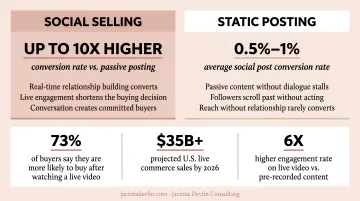
HubSpot's 2025 social selling playbook reports that social outreach generates a 42% response rate compared to 26% for email among sales professionals — a meaningful gap worth acting on.
That gap reflects what Jacinta Devlin saw firsthand across a 12-year direct sales career and her role as National Director of Sales & Field Training at Stella & Dot, where she trained 50,000+ women. Her core insight: the same principles that scale large teams apply to solo entrepreneurs. Conversion quality matters more than audience size.
Build a Community, Not Just a Following
Creating a Facebook Group or Instagram page takes ten minutes. Building one filled with engaged people who actually buy takes a real strategy.
Owning or participating in an online community (Facebook Groups, paid memberships, brand communities) creates ongoing touchpoints with potential buyers and positions you as a trusted leader rather than another vendor in their feed. Research from Higher Logic found that 60% of people are more loyal to a brand because of access to a community — a loyalty dividend that compounds over time.
Live Video: The Highest-Converting Format
Live selling — on Facebook, TikTok Shop, or Instagram — creates a "right now" buying environment that other content formats can't replicate. McKinsey reported live commerce conversion rates approaching 30% in retail settings. That's significantly higher than standard ecommerce averages.
Live Q&As, pop-up sales events, and behind-the-scenes launches all drive urgency and real-time connection. For women in direct sales or boutique retail, a single well-run live selling event can move more inventory in 30 minutes than a week of static posts.
Use Content Marketing and Email to Nurture and Convert
Most people who find you aren't ready to buy yet. Content marketing and email do the long-game work: they keep you visible, build trust, and make sure you're top of mind when your audience is ready to act.
Map Your Content to the Buyer Journey
Different stages require different messages:
| Buyer Stage | Content Focus | Examples |
|---|---|---|
| Awareness | Who you are, what you solve | Reels, introductory posts, podcast appearances |
| Consideration | How your product/service works, social proof | FAQs, testimonials, behind-the-scenes |
| Decision | Clear CTA, urgency, risk removal | Limited-time offers, testimonials, email sequences |
HubSpot data shows that businesses with an active blog average 55% more website visitors than those without one — and that content compounds over time in a way that paid ads don't.
Email Marketing: Your Highest-ROI Channel
Litmus reports email marketing delivers an average ROI of $36 for every $1 spent — one of the highest returns of any marketing channel. That's not a channel most entrepreneurs can afford to ignore.
Jacinta Devlin's philosophy is direct: "An Instagram account is rented land — the platform decides who sees your content. An email list is owned land." Her data shows email conversion rates run 10–40x higher than social media for the women she coaches.
Building your list starts with a lead magnet — a free resource your ideal customer actually wants. Examples include:
- A downloadable checklist or guide
- A free workshop or training replay
- Templates your audience can use immediately
- A quiz with personalized results
Jacinta's own lead magnets — including "5 Ways to Make Sales Online" and "30+ Content Ideas That Work" — give her clients a proven starting point when building their own.
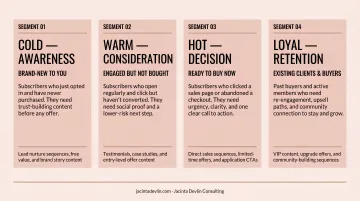
Segmentation Is Where Email Gets Powerful
Not everyone on your list is in the same place. Someone who bought from you three times needs a different message than someone who downloaded your freebie six months ago and never purchased.
Segmented email campaigns drive 30% more opens and 50% more click-throughs than unsegmented campaigns, according to HubSpot. Even a simple segmentation setup delivers a measurable lift. Start with these basic splits:
- Buyers vs. non-buyers — purchased customers get loyalty and upsell sequences; non-buyers get nurture and social proof
- Product or product/service interest — group subscribers by what they opted in for or clicked on
- Engagement level — re-engage cold subscribers separately from your active readers
- Stage of business — a woman just starting out needs different content than someone already scaling
Turn Happy Customers Into Your Sales Engine
Your most satisfied customers are your most underutilized marketing asset.
Nielsen reports that 88% of global consumers trust recommendations from people they know more than any other channel. And Wharton research found that referred customers have 16% higher lifetime value and 18% lower churn than non-referred customers. The numbers make it clear: referrals aren't just a nice bonus — they're one of the highest-ROI channels you have.
That means building a system to generate them isn't optional. It's one of the smartest moves you can make.
Build a Referral Program That Actually Gets Used
A referral program doesn't need to be complicated. It needs to be:
- A single link or code your customer can forward in two taps
- Backed by an incentive that genuinely motivates — discount, credit, exclusive access, or a gift
- Promoted at the right moment: your post-purchase thank-you email, packaging, and follow-up messages
The best time to ask for a referral is right after a customer has a win — when their satisfaction is highest and their enthusiasm is real.
Use Reviews and Testimonials Strategically
BrightLocal's 2023 Local Consumer Review Survey found that 98% of consumers read online reviews before making a decision, and 85% are more likely to use a business after reading positive reviews.
Collect testimonials at peak satisfaction moments — right after a purchase, after a client milestone, or when a customer shares positive feedback unprompted. Then use that social proof where potential buyers are making decisions:
- Sales pages and website homepage
- Social media content (especially Stories and Reels)
- Email campaigns and sequences
- DM conversations with warm leads
The more specific the testimonial — with real numbers and real outcomes — the more persuasive it is. Vague praise ("I loved working with her!") is far less effective than specifics ("I went from $500 to $5,000 per month in six months").
Practical Sales Tactics to Close More Deals
Strategy drives visibility. Tactics drive conversions. Here's where the sale actually happens.
Clarify Your Offer First
Many women entrepreneurs undercharge, bury their product/service in vague language, or simply don't make it easy for someone to say yes. A strong product/service has three components:
- A clear outcome — what specifically will the buyer experience or achieve?
- A clear price — no hunting around, no "message me for details"
- A clear call to action — one specific next step, not three options
Personalized calls-to-action convert 202% better than generic ones, according to HubSpot data from 330,000+ CTAs. Specificity isn't pushy — it's helpful.
Use the Sales Funnel to Diagnose Drop-Off
If people follow you but don't buy, the gap is usually in the consideration or decision stage. Ask:
- Do you have strong social proof at the point of purchase?
- Is your CTA clear, or is it buried?
- Are you nurturing leads between their first discovery and their purchase decision?
The median landing page conversion rate across industries is 6.6% — a useful benchmark for evaluating opt-in and sales page performance.
Where Generic Tactics Fall Short
Diagnosing drop-off is step one. Step two is building a strategy around how your customers actually buy — not a template borrowed from someone else's business.
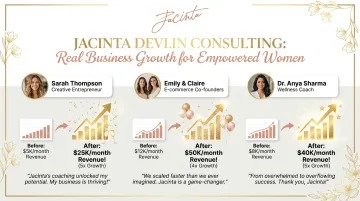
Jacinta Devlin Consulting works with women entrepreneurs to build custom sales strategies tailored to their specific business model, whether they're launching for the first time or scaling past a revenue ceiling.
Real client results show what's possible with the right strategy in place:
- Lisa K. (Fleur de Lis Boutique) generated $100,000+ in year one
- Amanda O. went from a $2,500/month goal to consistent $10,000+ months
- Joy W. surpassed her previous annual income within six months
Frequently Asked Questions
What is the best marketing strategy to increase sales?
There's no single best strategy — the most effective approach combines personal branding, social engagement, email marketing, and strong product/service clarity, all tailored to where your ideal customers spend time. Pick the combination that fits your business and work it consistently.
What are the top 5 marketing strategies to increase sales?
The five highest-impact strategies for women entrepreneurs are: (1) personal brand building, (2) social selling and community engagement, (3) email marketing with segmentation, (4) referral programs, and (5) content marketing.
What is the 3-3-3 rule in sales?
The 3-3-3 rule is often referenced as a follow-up cadence: reaching out three times, across three different channels, over three time intervals. It helps salespeople stay persistent without feeling intrusive. The value isn't in the specific numbers — it's in having a consistent follow-up structure rather than giving up after one touchpoint.
What are the 4 C's in sales?
The 4 C's — Customer, Cost, Convenience, and Communication — are a customer-centric alternative to the traditional 4 P's of marketing. Instead of leading with product and price, they ask: what does the customer need, what are they willing to pay, how easily can they buy, and how do they want to be reached?
How can women-owned businesses use social media to increase sales?
Show up consistently on one or two platforms, use short-form video to build trust and visibility, and engage in conversations rather than just broadcasting. Include a direct call-to-action in every post and Story so your audience knows exactly what to do next. Consistency and conversation convert better than volume.
How do I know if my marketing strategy is actually working?
Track key metrics monthly: email open rates, social engagement, website traffic, lead inquiries, and actual sales conversions. If followers are growing but sales aren't, look at your product/service clarity and CTA strength. If traffic is solid but conversions are low, examine your social proof and landing page.