
Introduction
Women now own 14.5 million U.S. businesses — 39.2% of all firms — generating $3.3 trillion in annual revenue, according to the 2024 NWBC Annual Report. Yet a persistent revenue gap remains: the NWBC estimates women-owned businesses would add $10.2 trillion to the U.S. economy if average revenues matched men-owned firms.
The gap isn't a hustle problem. Women are working hard. What's missing is strategic support built specifically for how they operate, what they're building, and the real barriers they face.
Generic business courses, DIY templates, and one-size-fits-all advice weren't designed for the specific realities women face — the industry niches, the income goals, the marketing channels that actually convert. Coaching built for women closes that gap by delivering strategy tailored to the actual business in front of them.
This guide breaks down what small business coaching packages for women actually look like in 2026 — the formats available, realistic pricing across tiers, and how to identify which type fits where you are right now.
Key Takeaways
- Coaching packages range from single-session intensives to ongoing 6-month+ 1:1 programs, each suited to a different growth stage.
- The ICF reports an average session fee of $234 for a one-hour coaching session; full program investments scale significantly from there.
- Women-specific coaching addresses scattered strategy, low revenue expectations, visibility blocks, and tech overwhelm.
- Package-based coaching outperforms hourly — transformation builds in sequence, not isolated sessions.
- The right package depends on your revenue stage, growth timeline, and whether you need strategy, accountability, or both.
What Makes Small Business Coaching Packages Different for Women
It Goes Beyond Standard Business Advice
Women entrepreneurs face specific, documented structural barriers — not just confidence issues. The NWBC's revenue parity data is stark: closing the gap between women-owned and men-owned firm revenues would add over $10 trillion to the U.S. economy. That gap reflects pricing patterns, capital access, and strategic infrastructure — all areas women-specific coaching is designed to address directly.
Jacinta Devlin, founder of Jacinta Devlin Consulting, sees consistent patterns across her client base: women arriving with artificially low revenue goals, scattered strategy, and tech overwhelm that stalls growth entirely. Her clients aren't lacking effort. They're lacking a specific, prioritized plan built around their actual business.
Coaching vs. Mentoring vs. Consulting
Before choosing a package, understand what you're actually buying:
- Coaching — A coach asks questions, challenges your thinking, and holds you accountable. You bring the drive; they bring the structure and the tough calls.
- Mentoring — A mentor shares their own experience and guides your growth. It's more relationship-based than structured, and less focused on specific business outcomes.
- Consulting — A consultant diagnoses and prescribes — often doing the work for you. Done-for-you services, brand builds, and funnel architecture fall here.
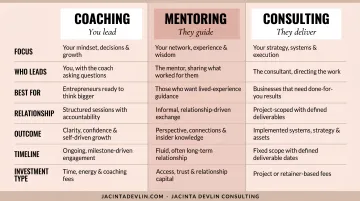
Many premium programs blend all three. Knowing which you need right now — strategy, accountability, execution support, or all of them — determines which package is worth your investment.
Why Packages Beat Hourly
Package-based coaching works because business transformation is sequential. You can't build an effective sales funnel before your brand positioning is clear. You can't fix inconsistent revenue with one call.
Packages create commitment on both sides. They focus the coach and client on a defined outcome — not reactive problem-solving. For women who thrive with a clear roadmap, the structure itself accelerates results.
The 2026 Landscape
That structure also works regardless of where you're located. Online coaching has removed geography as a barrier entirely. According to ICF's 2023 Global Coaching Study, audio-video coaching rose from 48% in 2019 to 83% in 2022 — and that shift has only deepened. In 2026, the coaching format you need is accessible anywhere, with hybrid programs combining live Zoom sessions, async support, and peer community now the standard format.
Types of Small Business Coaching Packages for Women in 2026
Not every package is right for every woman. The best fit depends on your current revenue stage, how much hands-on support you need, and whether you're launching or scaling. Here's how the main formats break down.
Starter: Single Strategy or Intensive Session
A 60–90 minute intensive session is designed to diagnose one specific problem or unlock a clear next step. It's best suited for women who are:
- Just starting out and testing an idea
- Stuck on a specific decision (pricing, product/service, platform)
- Not yet ready to commit to a longer engagement
The ICF's 2025 data puts the average one-hour coaching session at $234, though specialized business coaching sessions typically run higher than the global average across all coaching types.
A strong single session delivers clarity on your biggest bottleneck, a prioritized action plan, and an honest assessment of whether ongoing coaching makes sense for where you are.
Growth Package: 8–12 Week Coaching Program
This is the most common entry point for women who are already generating some revenue but feel stuck or inconsistent. A well-structured 8–12 week program typically includes:
- Biweekly or weekly coaching calls
- Email or messaging support between sessions
- Defined milestones reviewed at regular intervals
- Deliverables that support implementation, not just conversation
The difference between a strong program and a weak one comes down to accountability. Look for a specific stated outcome upfront — not "general business coaching" — plus check-ins between sessions and a coach who assigns real implementation work, not just conversation topics.
Forbes contributor data from 2023 puts monthly business coaching fees at $1,000–$5,000, though program-level pricing varies significantly by coach experience and what's included.
Premium 1-on-1 Coaching: 6-Month Engagements
The highest-touch option. Built for women who are done guessing and ready to build with a real strategy behind them. What's included at this level:
- Weekly 1:1 calls directly with the coach (not an associate)
- A custom growth plan built around your business model, offers, and revenue targets
- Direct access between sessions for time-sensitive questions
- Accountability structures that keep implementation moving
This is where Jacinta Devlin Consulting operates. Jacinta's Business Growth Program is fully individualized — no cohort, no recorded curriculum dump, no recycled playbook. Every strategy is built around the specific client: her business model, audience, platform mix, and revenue goals.
Her documented client outcomes include boutique owners hitting $100k+ in year one, Amazon sellers scaling from $4k annually to $20k+ per month, and influencers reaching six-figure income within six months of consistent work.
Programs at this level typically range from $3,500 to $15,000+, with pricing confirmed after a discovery call.
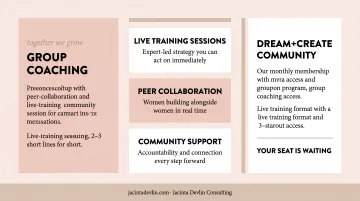
Group Coaching Program
Group coaching delivers strong results at a lower price point, particularly for women who learn well from peer examples and benefit from community accountability.
A solid group program includes:
- Weekly group coaching calls
- A shared curriculum with defined topics
- Peer accountability structures
- Access to a private community
The Dream+Create Online Coaching Community — Jacinta's group membership — is built around exactly this model. Members access live group trainings, a private peer network, and done-for-you content resources. Clients like Sharon B. and Joy W. have credited the community directly with accelerating their results, not just the 1:1 coaching alongside it.
Hearing how other women solve the same problems you're facing shortens your learning curve fast. It also breaks the isolation that keeps so many solo operators stuck longer than they need to be.
How Much Do Small Business Coaching Packages Cost in 2026
Pricing Overview by Tier
| Package Type | Typical Investment Range |
|---|---|
| Single strategy session (60–90 min) | ~$234 avg (ICF 2025 global data); specialized coaching higher |
| 8–12 week growth program | Varies; $1,000–$5,000/month cited in business coaching market |
| Premium 1:1 (6-month ongoing) | $3,500–$15,000+ (Jacinta Devlin Consulting documented range) |
| Group coaching membership | Program-dependent; varies by coach and format |
What drives price? Primarily the coach's track record, how customized the strategy is, and how much direct access you get. A program with weekly 1:1 calls and between-session support will cost more than a group cohort with recorded modules — and for good reason.
The Most Expensive Mistake Women Make
The most expensive mistake women make is choosing the lowest-cost option because it feels "safer."
An under-resourced program produces slow progress, wasted months, and eventual reinvestment in something better. The real cost of the wrong package is measured in time lost — not dollars spent. If coaching helps you add $3,000–$5,000 in monthly revenue, a $5,000 program pays for itself within two months.
Payment Structures and ROI
Most serious coaching programs product/service both pay-in-full and installment options. Pay-in-full typically comes at a discount — at Jacinta Devlin Consulting, for example, the Black Friday Business Growth Program is $2,497 pay-in-full versus $2,788 total on a payment plan.
Before you sign, run a simple revenue ROI: if this coaching helps you hit a specific monthly revenue target, how many months until the investment pays for itself? For most women in the $5k–$10k/month range, that math closes faster than expected.
Tax Deductibility Note
Business coaching expenses may be deductible as a professional development or business expense under IRS guidelines. IRS Topic No. 513 notes that work-related education expenses may be deductible if they maintain or improve skills needed in your current work. Confirm the specifics with your own tax professional — this is not tax advice.
What to Look for When Choosing a Small Business Coaching Package
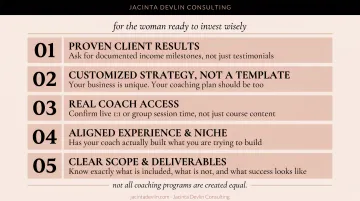
5 Criteria Worth Evaluating
Track record with women at your business stage — Not just testimonials, but outcomes at your current revenue level. A coach who has helped boutique owners scale from $0 to $100k+ is a different credential than one with generic "business success" claims.
Clarity of the promised outcome — Vague is bad. "We'll grow your business" tells you nothing. Look for a coach who can state what a client typically achieves within the program timeframe.
Built-in accountability structures — What happens between sessions? Accountability check-ins, community access, and direct messaging access are signals of a serious program.
Who actually delivers the coaching — Will you be working directly with the named coach, or handed off to an associate? Jacinta Devlin Consulting guarantees weekly 1:1 calls directly with Jacinta — not a junior team member.
Coaching style match — Do you want to be challenged and pushed, or primarily supported and guided? Both are valid. Neither works if the style doesn't match how you operate.
Red Flags That Signal a Bad Investment
- Guaranteed income claims with no written substantiation
- Pressure to sign immediately or lose the product/service
- No real testimonials or case studies — only vague praise
- The coach's only business is coaching (no prior operating experience)
- Packages structured around the coach's convenience, not client outcomes
The FTC has made deceptive earnings claims in coaching a specific regulatory target, with updated guidance issued in 2025. If a program promises you'll make $X by date Y, that's a warning sign — not a selling point.
What the Right Relationship Feels Like
Once you've ruled out the red flags, the right fit has a different feel entirely. You should be challenged, supported, and confident that your coach has actually built a business before coaching others to build one.
Jacinta Devlin holds that standard directly. She built and scaled multiple revenue-generating businesses — a $10k+/month ecommerce brand, a $1M+ consulting firm, an Amazon storefront, and a clothing boutique — before coaching became her primary focus. That history is what makes the strategy she builds for clients executable from day one, not generic advice borrowed from someone else's playbook.
Conclusion
In 2026, the right small business coaching package can be the difference between staying stuck at your current revenue and actually breaking through it. For women who've hit a ceiling they can't crack alone, structured coaching with someone who's built the business you're building is the most direct route forward.
Match the right package type and investment level to where you are now — then commit fully to where you're going.
If you're done with generic advice and ready for a real strategy built around your specific business, Jacinta Devlin Consulting is where to start. Jacinta works exclusively with women entrepreneurs and brings 15+ years of real operating experience to every client engagement. Book a free 15-minute Growth Chat directly with Jacinta at calendly.com/devlinconsulting/15-minute-consultation to explore what working together looks like.
Frequently Asked Questions
What is the average cost of a business coach?
The ICF's 2025 data puts the average one-hour coaching session at $234 globally across all coaching types. Full coaching packages scale significantly from there — from a few hundred dollars for group programs to $3,500–$15,000+ for premium 1:1 engagements. Cost reflects coach experience, program depth, and level of access.
What are the 5 C's of coaching?
The 5 C's are an informal coaching framework — commonly listed as Clarity, Compassion, Curiosity, Commitment, and Confirmation. They describe the conditions a strong coaching conversation creates: the coach stays curious rather than prescriptive, helps clients gain clarity, and builds real commitment to follow-through.
What is the 80/20 rule in coaching?
The 80/20 rule suggests the client speaks roughly 80% of the time while the coach speaks 20%. The coach's role is to ask powerful questions and guide thinking — not lecture. For women entrepreneurs, working through their own solutions out loud is often where the real breakthroughs happen.
What is the 70/30 rule in coaching?
The 70/30 principle describes a session where the coach listens 70% of the time and speaks 30% — slightly more active than the 80/20 model, often used when the coach is providing structured feedback or reviewing specific deliverables. Either way, the client drives the conversation.
Is one-on-one coaching better than group coaching for women entrepreneurs?
Neither is universally better. 1:1 coaching delivers personalized strategy and faster iteration for specific business challenges. Group coaching provides community, affordability, and peer learning that 1:1 alone can't replicate. The right choice depends on your current stage, budget, and whether you need custom strategy or structured community support — or both.
How long does it take to see results from a small business coaching package?
Most clients feel initial clarity and momentum within the first 30–60 days. Measurable revenue growth — consistent $5k–$10k+ months — typically emerges within 6–12 months for those who implement consistently between sessions, not just show up for the calls.