
Introduction
Most small business owners hear the same advice on repeat: post more, get a logo, run some ads. So they do — and still wonder why their business feels invisible.
Here's the problem: surface-level tactics without a real brand strategy don't build businesses. They burn time.
The fix isn't more tactics — it's understanding what branding actually means. Branding isn't your logo or your color palette. It's the full experience someone has every time they encounter your business — your words, your visuals, your values, and the feeling you leave behind.
For women building boutiques, direct sales teams, affiliate brands, and coaching practices, a strong brand is the entire reason a customer chooses you over someone offering the same thing.
Research from Constant Contact's 2024 SMB survey found that 73% of small business owners lack confidence in their marketing strategies — not because they aren't working hard, but because they're executing without a clear brand foundation underneath.
This article breaks down five branding strategies built for real small businesses — the kind that create recognition, build trust, and turn browsers into buyers.
Key Takeaways
- Branding is the full customer experience — your voice, visuals, values, and story — not just your logo
- A clear brand identity built around your mission and audience is the non-negotiable foundation
- Consistency across every platform builds the trust that converts browsers into buyers
- Your story is the one differentiator no large corporation can copy or outspend
- Customer advocacy drives the highest conversions at the lowest cost — and it starts with delivering on your brand promise
What Is a Branding Strategy (and Why Small Businesses Can't Skip It)
A branding strategy is a long-term, intentional plan that shapes how your target audience perceives, remembers, and trusts your business. It covers your identity, voice, messaging, and visual presence across every customer touchpoint — your website, social media, emails, packaging, and even how you reply to a DM.
Small businesses don't compete on budget. They compete on trust, personality, and connection. That's exactly why branding matters more for a boutique owner or direct seller than it does for a big corporation with a $10M ad budget.
Consider this: Edelman's 2024 Trust Barometer found that 84% of consumers need to share values with a brand before they'll buy from it. For small businesses built on relationships, that number isn't surprising — it's the whole game.
When your brand is clear, consistent, and emotionally resonant, the results compound:
- Customers come back without needing a discount to pull them in
- Word-of-mouth referrals start doing work your ad budget can't
- Your content finally lands because people already know what you stand for
Without that clarity, consistent posting still won't build an audience — because effort without identity doesn't compound.
The Top 5 Proven Branding Strategies for Small Businesses
Strategy 1: Build an Authentic Brand Identity Around Your "Why"
Your brand identity starts with your mission — the reason your business exists, not your product list or service menu.
Customers don't just buy what you sell. They buy into what you stand for. According to Ipsos research shared by the World Economic Forum, an average of 70% of consumers across 25 countries prefer to buy from brands they believe reflect their own principles. In the U.S., that preference for values-aligned brands rose from 50% in 2013 to 66% by 2021.
Before you build anything else, answer these three questions honestly:
- What is your mission? Why does this business exist beyond making money?
- What values guide your decisions? What would you refuse to compromise on?
- Who is your exact customer, and what do they care about? Not "women aged 25–45" — go specific.
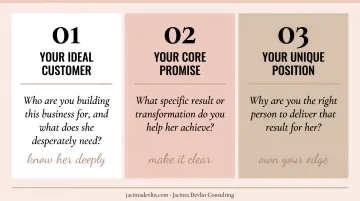
The answers to these questions should filter into every brand decision you make. A boutique owner who believes in accessible style at fair prices makes different decisions than one chasing luxury positioning — from the fonts on her website to the tone in her captions.
Jacinta Devlin built her consulting business around a specific belief: that financial independence isn't reserved for someone else — it's available to any woman willing to build the right strategy. That belief, grounded in her own story of starting as a broke college student at a jewelry sales party at 21, shapes everything from her women-only client roster to her conference keynote titled "Success Is Not for Someone Else, It's Also for You."
That's a mission functioning as a brand asset, not just a tagline.
Inconsistency here is what makes most small businesses feel "invisible" despite hard work. If your website sounds formal, your Instagram sounds casual, and your emails sound like someone else entirely, customers can't form a coherent picture of who you are. Clarity comes first.
Strategy 2: Create a Consistent Visual Identity
Your visual identity is your brand's first impression. Research in peer-reviewed journals has found that users form judgments about visual appeal within 50 milliseconds — before they've read a single word.
A consistent visual identity includes:
- Logo — primary mark, secondary marks, and submarks
- Color palette — primary, secondary, and accent colors
- Typography — heading, body, and accent fonts
- Imagery style — the look and feel of photos you use
The goal isn't just to look good. It's to look recognizable. When someone scrolls past your Instagram post, sees your email in their inbox, and visits your website — they should feel like it's the same brand every time.
A boutique serving style-forward women will look entirely different from a B2B consultant, and both should look different from a direct sales team leader. That's not inconsistency — that's intentional design aligned to your audience.
Tools don't need to be expensive. Canva — which now serves over 260 million monthly active users and has a dedicated small business solution — makes professional visual brand management accessible without a design budget.
After creating your visual elements, document them in a simple brand style guide. List your exact hex codes, font names, and approved image styles in one place. This prevents the slow erosion of brand consistency that happens when you're tired, busy, or delegating content to a contractor.
Strategy 3: Develop a Distinct Brand Voice and Own It
Brand voice is the personality and tone your business uses to communicate. It shows up in every caption, email subject line, product description, and sales page you write.
The mistake most small businesses make is defaulting to what sounds "professional" — formal, stiff, and generic. But professional doesn't mean robotic. A social selling brand speaking to ambitious women sounds completely different from a corporate consulting firm, and that specificity is a competitive advantage, not a liability.
Your brand voice should stay consistent whether you're:
- Writing an Instagram caption
- Drafting a client proposal
- Sending a welcome email sequence
- Responding to a comment or DM
Inconsistency between platforms creates a fragmented experience. A customer who discovers you through a fun, personable social post and then lands on a cold, formal website feels like she found a different brand, and that friction erodes trust fast.
Build a short internal brand voice guide. It doesn't need to be elaborate:
- 3–5 tone descriptors (e.g., warm, direct, encouraging, never corporate)
- Words or phrases you use regularly
- Words or phrases you never use
- One example of on-brand copy vs. off-brand copy for the same situation
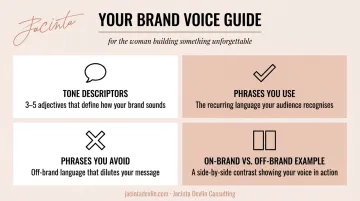
This single document pays dividends the moment you hire a VA, bring on a content creator, or outsource any writing. Consistency isn't just a brand problem — it's a systems problem, and this guide is the system.
Strategy 4: Use Storytelling to Build Emotional Connection
Storytelling is the most underused branding strategy available to small business owners. Large corporations spend millions trying to manufacture authenticity. You already have the real thing — and your specific story is something no competitor can replicate.
A 2020 study published in the Journal of Consumer Behaviour found that storytelling in advertising produced more favorable emotional responses and higher word-of-mouth intentions than purely informational content — and the effect was strongest when the story was told by the company founder rather than a customer.
Four story elements consistently resonate with audiences:
| Story Element | What to Share |
|---|---|
| Origin | Why did you start? What was the moment everything changed? |
| Values | What do you stand for? What would you never compromise on? |
| Struggles | What did you have to overcome? What did starting actually look like? |
| Customer wins | How have you transformed the people you serve? |
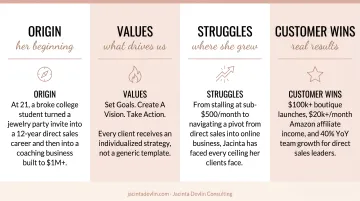
Jacinta Devlin's brand story hits all four. She started at 21 as a broke college student who accepted a jewelry party invite because "pairing accessories, drinking wine and making some extra cash sounded like fun." That one yes turned into a 12-year direct sales career where she became a Top 1% seller and million-dollar earner — not because she had a trust fund or connections, but because she built the right systems and refused to believe success belonged to someone else.
That story is why her clients say things like "I decided to work with Jacinta because she's walked in my shoes."
Where to use storytelling:
- Your About page (the most-read, most-skimmed page on most websites)
- Social media captions — especially when sharing milestones or behind-the-scenes content
- Email welcome sequences
- Sales pages
- Live speaking and video content
You don't need professional production. You need honesty and specificity. A vague story ("I always wanted to help people") lands nowhere. A specific one ("I was working two jobs and said yes to a jewelry party") lands everywhere.
Strategy 5: Turn Customers Into Brand Advocates
The most trusted branding doesn't come from what you say about yourself. It comes from what your customers say when you're not in the room.
Nielsen's 2021 Trust in Advertising Study — based on more than 40,000 global consumers — found that 88% trust recommendations from people they know more than any other channel. No ad budget competes with that.
Three specific tactics to activate customer advocacy:
1. Collect and showcase testimonials actively. Don't wait for customers to leave reviews. Ask directly, make it easy, and put what they say front and center — on your homepage, in your email sequences, and in your social content. BrightLocal's 2026 Local Consumer Review Survey found that 85% of consumers say positive reviews make them more likely to use a business.
2. Create shareable moments and prompt user-generated content. Give customers a reason to tag you. A packaging insert, a branded hashtag, a post-purchase prompt asking them to share their experience — these small gestures generate real, organic content that reaches audiences your ads never will.
3. Build a community where your most engaged customers deepen their connection. Jacinta Devlin's free Facebook Group for female entrepreneurs (facebook.com/groups/businessgrowthfemaleentrepreneurs) and her Dream+Create coaching membership aren't just client perks — they're advocacy engines. Clients who are part of a community talk about that community. Two clients, Sharon B. and Christina R., grew Facebook Groups to 30,000+ and 36,000+ members respectively under Jacinta's guidance, using the same community-building principles she teaches.
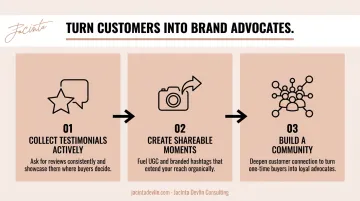
When your customers are telling your story, your brand reaches audiences paid advertising never will — and it arrives with a credibility no ad spend can buy. That's the compounding value of building advocacy into your brand from the start.
How to Know If Your Branding Strategy Is Working
Brand results compound over months, not weeks. But there are clear signals that traction is building:
Qualitative signals:
- New customers say they "feel like they already know you" before reaching out
- Inbound inquiries mention how they heard about you — through a friend, a shared post, a referral
- Customers use language from your brand voice to describe what you do
Quantitative signals:
- Engagement rate trends up on social content over 60–90 days
- Email open rates improve as your list becomes more targeted
- Referral traffic grows without additional ad spend
- Repeat purchase rate increases month over month
Start tracking both:
Ask every new client or customer how they found you and what made them decide to reach out. Do this manually if needed — the patterns you spot across 20 answers are more valuable than any dashboard.
Track engagement metrics, email open rates, and website referral traffic monthly. Don't compare week to week — compare quarter to quarter.
The most important audit question: Can a new visitor to your social profile or website clearly explain what you do, who you serve, and why they should trust you — in under 30 seconds? If the answer is no, sharpen your message before adding more content or spending on ads.
Common Branding Mistakes Small Businesses Make
Mistake 1: Inconsistency across platforms. Switching tones, visuals, or messaging based on trends — or simply because there's no brand guide to reference — signals instability to potential customers. Inconsistency isn't just an aesthetic problem; it actively undermines the trust you're trying to build. Every time someone encounters a different version of your brand, they have to re-evaluate whether they know who you are.
Mistake 2: Jumping to tactics before building the foundation. Running ads, posting daily, and redesigning a website before the brand identity, target audience, and voice are defined is the most common — and most expensive — marketing mistake small businesses make.
Jacinta's Business Launch Program builds in a deliberate sequence: brand foundation and market research first, then strategy, then execution. The website — often the first thing entrepreneurs rush to build — comes near the end of that sequence, not the beginning. Skipping the foundation doesn't save time; it guarantees rework.
Mistake 3: Treating branding as a one-time project. A logo refresh or a new bio is not a brand strategy. Brands evolve as businesses grow, and the ones that build lasting recognition stay consistent in their core identity while sharpening their execution over time.
The businesses that stall after early momentum are usually the ones that treated branding as a launch task rather than an ongoing commitment.
Here's a quick look at how these mistakes tend to show up in practice — and what to do instead:
| Mistake | What It Looks Like | The Fix |
|---|---|---|
| Inconsistency | Different tone on Instagram vs. email vs. website | Create a simple brand guide with voice, visuals, and messaging rules |
| Tactics before foundation | Running ads before defining your audience | Lock in brand identity and ICP before spending on promotion |
| One-time mindset | Rebranding every year without a core identity | Build a stable core, then refine execution as you grow |
Conclusion
Your brand is the accumulated experience customers have with your business — what they see, feel, and remember every time they encounter you. Small businesses that invest in a clear, consistent, emotionally resonant brand are the ones that stand out. The ones customers return to. The ones that grow.
The five strategies above aren't theory. They're the same foundation that boutique owners, direct sellers, affiliate marketers, and coaches have used to go from invisible to undeniable:
- $100k+ boutique launches in year one
- $20k/month Amazon affiliate income
- 95k+ Instagram followings built after a rebrand
- Direct sales teams scaling 40% year over year
If you're ready to build a brand people recognize, trust, and buy from consistently, Jacinta Devlin Consulting offers personalized strategy and coaching built around your specific business — not a one-size-fits-all template.
Book your free 15-minute Growth Chat to see if it's the right fit. Every program starts with a real conversation, and every strategy is built around you.
Frequently Asked Questions
What is the most important branding strategy for a small business?
Building a clear brand identity rooted in your mission and target audience is the foundation. Without it, every other strategy — social media, visual design, storytelling — lacks direction and produces inconsistent results. Start here before anything else.
What is the difference between branding and marketing?
Branding is who you are, what you stand for, and how you're perceived over time. Marketing is the tactics you use to promote and sell. Branding shapes long-term trust; marketing drives short-term awareness and conversions. Marketing works better when the brand underneath it is clear.
How do I create a brand identity for my small business?
Start with your mission, values, and target customer. Then translate those into your visual identity — logo, colors, fonts — and your brand voice. Document everything in a simple style guide and apply it consistently across every touchpoint, from your website to your social captions.
How long does it take to build a recognizable brand?
Businesses that commit to showing up with the same voice, visuals, and message typically see meaningful recognition within 6–12 months. The key is showing up on a regular cadence — not perfectly, but predictably.
How much does branding cost for a small business?
You can build a strong brand on a lean budget using tools like Canva for visuals and organic social media for presence. If you want professional brand development handled for you — logo, voice, style guide, and strategy — Jacinta Devlin Consulting's done-for-you brand programs start at $3,500.
How do I build a personal brand as a female entrepreneur?
Lead with your authentic story, be visible and consistent on the platforms where your ideal customers spend time, and let your values and personality shape your content. Your personal brand is often your business's most powerful differentiator — especially in crowded markets.