
For many women entrepreneurs, the problem isn't effort. It's that there's no clear strategy connecting any of it. Every tactic is its own island, and without a unifying plan, time and budget disappear with little to show for it.
The stakes are real. According to the 2024 State of Women's Small Business Report by Block Advisors, 45% of women entrepreneurs say their business would thrive if they had marketing and advertising support — and 22% list marketing as their least favorite task entirely. That's not a motivation problem. That's a support gap.
This guide covers what a marketing coach actually does, the clearest signs you need one, and exactly what to look for when choosing the right fit for your women-owned small business.
Key Takeaways
- A marketing coach builds a personalized strategy around your specific business — not a generic plan
- Scattered marketing, stalled growth, burnout, or revenue goals with no clear roadmap all signal it's time to get a coach
- The right coach brings real business experience — built-in-the-trenches results, not just theory or credentials
- Prioritize individualized strategy over templated courses that weren't built for your business
- Verify documented client outcomes — revenue growth, launches, and scaling wins — from women in businesses like yours
What Does a Marketing Coach Actually Do?
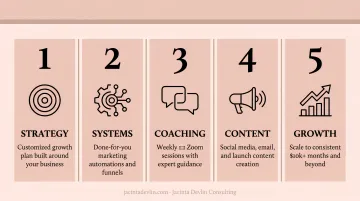
A marketing coach works with you, one-on-one, to clarify your goals, assess what's working, and build a strategy tailored to your specific business. Then they hold you accountable to actually executing it.
That's different from hiring an agency, buying a course, or bringing in a consultant who delivers a report and disappears.
What working with a coach actually looks like
Working with a coach typically includes:
- Regular 1:1 sessions (weekly is standard for serious coaching programs)
- A personalized growth plan built around your business model, offers, and revenue targets
- Direct feedback on your marketing as you implement it — not advice delivered in a vacuum
- Accountability between sessions so execution doesn't fall through the cracks
- Ongoing support that adapts as your business evolves
Coach vs. Agency: What's the Difference?
This is where a lot of women entrepreneurs get confused — and it matters.
An agency executes marketing for you. They run your ads, manage your social content, handle your email campaigns. You pay for output. The trade-off: it's typically expensive, and you don't necessarily build the strategic understanding to own your marketing long-term.
A coach builds your capability and strategy. You do the implementation, guided by someone who knows exactly what to prioritize and why. Over time, you develop real marketing muscle — not just a dependency on someone else doing the work.
For women entrepreneurs who want to understand and own their marketing, the coaching model is more sustainable. And when you're ready to hand off execution, a strong coach can help you know exactly what to delegate — and to whom.
Signs It's Time to Find a Marketing Coach
You're Doing "Post and Pray" Marketing with No Strategy
Posting on social media some days, skipping it others, sending an email when you remember — and hearing crickets in return. This pattern has a name: scattered marketing. And it's more common than most business owners admit.
Research from Constant Contact found that 73% of small businesses lack confidence that their marketing strategy is actually contributing to their business goals — and 42% procrastinate on or ignore marketing planning altogether.
A coach replaces the guesswork with a goal-aligned plan. Instead of doing a little of everything and hoping something lands, you know exactly what to prioritize and why.
Your Business Has Plateaued Despite Your Effort
Revenue is flat. New customers aren't coming in consistently. Or you're making money, but can't seem to push past a ceiling no matter how hard you work.
This is one of the most common triggers for women applying to coaching programs. The plateau isn't a sign you're doing something wrong — it's a sign you need a different strategy, not just more hustle.
A good coach diagnoses what's actually stalling growth and builds a targeted plan to push through it. Most of the time, the ceiling isn't about how hard you're working — it's about which strategy you're using.
You're Overwhelmed Wearing Every Hat
SCORE data shows small business owners average 45.5 hours per week, with nearly 30% working more than 50 hours — and 38% of female business owners struggle with work-life balance. When you're simultaneously the CEO, marketer, customer service team, and fulfillment department, marketing is almost always what gets deprioritized.
A coach helps you:
- Identify which marketing activities are actually worth your time
- Build systems that run without your constant involvement
- Stop doing everything and concentrate on the activities that drive real revenue
You're Too Close to See Your Own Blind Spots
Being deeply inside your business makes it nearly impossible to evaluate it objectively. You're too close to your own messaging to see where it's unclear. Too invested in your offer to notice where it's misaligned with what your audience actually wants.
An outside coach brings fresh perspective — catching gaps you can't see, like messaging that sounds clear to you but confuses potential buyers, or an offer positioned for the wrong audience entirely. That outside view corrects course faster than any amount of internal effort could.
You Have Big Revenue Goals but No Roadmap
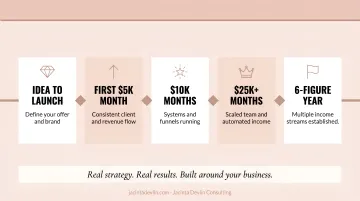
Consistent $10K months. Quitting your corporate job. Building a business that runs without you doing everything. The vision is clear. The path to get there isn't always.
A marketing coach bridges that gap — turning those ambitions into a clear plan with prioritized steps and milestones you can measure along the way. Instead of chasing every opportunity, you move with intention toward a specific target.
What to Look for When Choosing a Marketing Coach
Not every marketing coach is the right fit. For women entrepreneurs with specific business models and real revenue goals, these criteria separate the coaches worth investing in from the ones who aren't.
Proven Business Experience — Not Just Credentials
Ask whether this coach has actually built something. Not just studied it. Not just earned a certification. Have they generated revenue, grown a team, navigated their own plateaus?
A coach who has built something real understands what you're facing at a depth that theory can't replicate. When they give you advice, they're drawing from decisions they made with their own money, their own clients, and their own business on the line — not frameworks from someone else's case study.
Specialization That Matches Your Business Model
A coach who spent 20 years in corporate brand marketing may not understand the nuances of building an ecommerce boutique, scaling a direct sales team, or monetizing an Amazon storefront. The advice that works for a Fortune 500 marketing department rarely translates directly to a women-owned small business.
Look for a coach with direct, hands-on experience in your specific model — whether that's ecommerce, social selling, affiliate marketing, service-based, or brick-and-click retail. Their advice should be immediately applicable, not something you have to adapt from a completely different context.
Custom Strategy Built Around Your Business
There's a meaningful difference between a coach who builds custom strategy around your specific business and one who sells the same course, framework, or playbook to every client.
Generic frameworks rarely account for your audience, your offer, your platform mix, or where you actually are in your business. A personalized strategy does. Ask coaches directly: Will you build this around my business, or will I be following a system you use with everyone? The answer tells you a lot.
A Track Record with Women Entrepreneurs Specifically
Coaches who have worked extensively with women entrepreneurs understand dynamics that go beyond marketing tactics — imposter syndrome, undervaluing your work, doing everything solo, balancing business with life obligations. These dynamics show up directly in how strategies get implemented (or don't).
Ask for client testimonials, case studies, and real outcomes from business owners who look like you. Revenue numbers, growth percentages, timeline milestones — specifics matter here.
Coaching Structure, Accountability, and Access
Evaluate how a coach actually works with clients before you commit:
- Is it 1:1 or group format?
- How often do you meet?
- Is there support between sessions, or do you wait until the next call?
- How is accountability built into the engagement?
The difference between a transformative coaching relationship and an expensive conversation often comes down to structure. Consistent access and built-in accountability are what move the needle — and they're worth asking about before you sign anything.
How Jacinta Devlin Consulting Can Help
Jacinta Devlin built her coaching practice the same way she built everything else — by doing it herself first.
Her career started at 21 as a jewelry sales rep in direct sales. Over 12 years, she became a Top 1% seller and million-dollar earner at lia sophia and Park Lane Jewelry, then joined Stella & Dot as National Director of Sales & Field Training, where she trained over 50,000 women in the social selling space.
From there, she launched her own ecommerce brand to consistent $10K+ months, built her Amazon storefront to six figures, and grew Jacinta Devlin Consulting to over $1M in revenue.
Coaching is her fifth business, not her first. When Jacinta gives strategic advice to a boutique owner or a direct sales leader, she's drawing from her own experience in those exact models — not from a certification curriculum.
Her approach: every strategy is built around the client's specific business, goals, and gaps. No cohort, no recorded curriculum dump, no copy-paste playbook — just a real plan designed for their exact situation.
Documented client outcomes include:
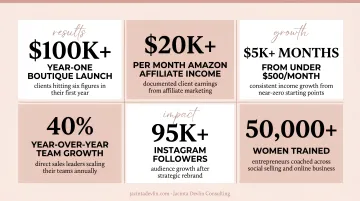
- Lisa K. (Fleur de Lis Boutique): $1,250 launch day → $100K+ in year one
- Sharon B. (Amazon seller): $4,000 in year one → $20K+ per month consistently
- Carissa P. (Park Lane Jewelry): 40% year-over-year growth through 1:1 coaching
- Christina R.: quit her corporate job in 6 months, now selling hundreds of thousands monthly on Amazon and LTK
What sets her apart from most coaches:
- 15+ years of hands-on experience across direct sales, ecommerce, and online business
- Coached clients across fashion, travel, ecommerce, retail, and service-based industries
- Delivers individualized strategic plans — not DIY courses or generic frameworks
- Keynote speaker at Pearl Time, SWFL Women in Business, and Stella & Dot International Hoopla
Programs start at $3,500 and are application-based. The first step is a free 15-minute Growth Chat at calendly.com/devlinconsulting/15-minute-consultation.
Conclusion
Finding the right marketing coach comes down to fit — not follower count, not fame. The best coach for a women-owned small business is the one who has built something real themselves, understands the specific business model in front of them, and builds strategy around the individual, not the template.
Real marketing progress comes from focused effort with the right strategy behind it — not more content, more platforms, or more hustle. If you're ready to move forward with clarity, Jacinta Devlin Consulting works exclusively with women entrepreneurs to build strategy around your specific business, not a generic playbook. Start with a free 15-minute Growth Chat to find out if it's the right fit.
Frequently Asked Questions
What does a marketing coach do?
A marketing coach works one-on-one with business owners to clarify goals, build a personalized marketing strategy, and provide ongoing accountability and expert direction. Unlike an agency (which executes marketing for you) or a one-time consultant (who advises without continued support), a coach builds your skills and holds you accountable over an extended engagement.
How much does a marketing coach for small business cost?
One-on-one coaching typically ranges from $2,500 to $15,000+, depending on the coach's experience and program length. Group or membership-based programs run lower. When comparing options, weekly calls, accountability, and between-session access matter as much as the base price.
What is the difference between a marketing coach and a marketing consultant?
A consultant typically delivers a strategy document or set of recommendations, often as a one-time project. A coach works alongside you over an extended engagement — building your skills, refining strategy in real time, and holding you accountable to execution. The ongoing relationship is what drives sustained growth.
How do I know if a marketing coach is right for my women-owned small business?
You're likely ready for a marketing coach if you're marketing inconsistently with no real strategy behind it, your growth has stalled despite consistent effort, you're overwhelmed doing everything yourself, or you have clear revenue goals but no concrete plan to reach them.
How long does it take to see results from working with a marketing coach?
Most entrepreneurs feel clarity and early momentum within the first one to two months. Significant revenue milestones — hitting a first $5K or $10K month, for example — typically emerge within six to twelve months of consistent execution with a well-matched coach.
Can a marketing coach help with social media and ecommerce?
Many coaches specialize in specific channels or business models, and those specializations matter. If you're a social seller, Amazon affiliate, boutique owner, or ecommerce brand, specifically seek out a coach with direct, hands-on experience in those spaces — not a generalist who will apply a one-size-fits-all framework to your business.