
For most women running service businesses — coaches, consultants, social sellers, boutique owners, direct sales leaders — the missing piece isn't skill or effort. It's structure. Specifically, it's a sales funnel: a system that takes someone from discovering you for the first time to becoming a paying client, without requiring you to manually sell every single transaction.
A service business funnel is different from a product funnel. There's no impulse buy, no checkout button at the end of a 30-second scroll. When you are the service, potential clients need to believe in your expertise and trust you before they'll commit. That requires more touchpoints, more relationship-building, and a nurture phase that most service business owners skip entirely.
This article walks through exactly what a service sales funnel is, what you need before building one, the five-step process for building it, the factors that determine results, and the mistakes that quietly kill conversions.
Key Takeaways
- A service funnel moves a stranger from discovery to paying client — earned through trust, not impulse.
- The five core stages are: attract, capture, nurture, convert, and retain.
- Most service businesses lose clients in the nurture phase — the culprit is almost always a missing follow-up system.
- A lead magnet disconnected from your paid offer attracts the wrong audience every time.
- One working funnel beats five half-built ones every time.
What Is a Sales Funnel for a Service Business?
A sales funnel is the structured path a potential client takes from first discovering you — through social media, referrals, a Google search, or a recommendation — to hiring you. For service businesses, that journey is built on trust, not convenience.
This is where product funnels and service funnels diverge. When someone buys a candle or a sweater online, the decision is low-stakes and fast. When someone hires a coach, consultant, or service provider, they're buying a result they can't fully see in advance.
That requires a different kind of selling — one built on credibility, relationship, and consistent presence before the offer ever lands.
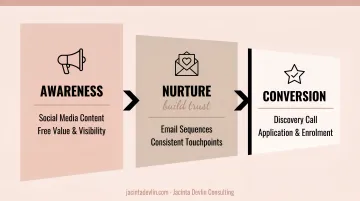
The Three Core Sections of a Service Funnel
| Funnel Stage | What Happens Here | How It Ends |
|---|---|---|
| Top (Awareness) | Potential clients discover you through content, referrals, or search | They find your lead magnet or opt-in |
| Middle (Nurture) | You build trust through email, content, and follow-up | They become warm, ready to buy |
| Bottom (Conversion) | You invite them to take the next step | A discovery call, application, or sales page |
Notice what's missing from the bottom row: a cart. Unlike product funnels, a service funnel ends with a conversation — a discovery call, a strategy session, a proposal. Every stage before that moment exists to make the person on the other end of that call already trust you before you say a word.
What You Need Before Building Your Sales Funnel
The biggest reason service funnels fail isn't a bad tool or the wrong platform. It's that owners start building before the foundation is clear — and every weak assumption at the start creates a leaky funnel downstream.
Clarity on Your Ideal Client
Before you write a single email or design a single landing page, you need to know exactly who you're building for. Not a vague demographic — the specific person. Ask yourself:
- What problem are they actively trying to solve?
- What language do they use to describe it?
- What outcome are they hoping for?
- What's keeping them from getting there?
Every piece of copy, every lead magnet topic, every email subject line depends on knowing this person precisely. Skipping this step means building a funnel for everyone — and a funnel built for everyone converts no one.
Your Core Service Offer
A funnel has to be built backward from a specific offer. What are you selling, at what price point, and how do clients actually engage with you — 1:1 coaching, a group program, a consulting package, a done-for-you service?
Vague offers create leaky funnels. If you haven't clearly defined what someone gets, what it costs, and what outcome they can expect, no amount of funnel architecture will fix that gap. Get the offer clear first.
Your Platform and Starting Point
Where do your ideal clients actually spend time? Instagram, Facebook Groups, LinkedIn, email, or somewhere else? Pick one primary channel to drive traffic from before your funnel is built and working.
Trying to maintain five platforms simultaneously before a single funnel is converting is one of the most common and costly mistakes service business owners make. Start with one platform, one funnel, and one offer. Expand once it's working.
How to Build a Sales Funnel for Your Service Business
These five steps aren't a universal template. They work when they're customized to your specific offer, audience, and voice. Results depend entirely on that fit.
Step 1: Create a Lead Magnet That Attracts Your Ideal Client
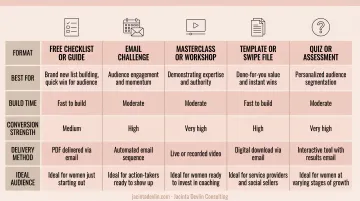
Your lead magnet is the entry point. It's a free, high-value resource that earns a potential client's contact information and earns their trust — before you've asked them to buy anything.
Effective lead magnets for service businesses include:
- A free guide, checklist, or resource list
- A short training or mini masterclass
- A free challenge (5 or 7 days)
- A strategy session or discovery call
- A content swipe file or template
Jacinta Devlin uses exactly this approach in her own business — lead magnets like "5 Ways to Make Sales Online," "30+ Content Ideas That Work," and "10 Affiliate Link Programs" serve as the entry point into her email funnel, and the same formats are replicated across client Done-For-You builds.
The non-negotiable rule: your lead magnet must connect directly to the problem your paid service solves. A misaligned lead magnet doesn't just underperform — it actively clogs the funnel with people who will never buy.
Step 2: Build an Awareness and Attraction Strategy
Before anyone enters your funnel, they have to find you. For service businesses — especially coaches and social sellers — that means consistent content on the platforms where your ideal clients already spend time.
Organic content works well for trust-based businesses because it lets potential clients get to know your expertise and approach before they raise their hand. By the time someone opts into your lead magnet, they already know who you are — which reduces friction at every stage that follows.
Effective organic attraction formats include:
- Instagram Reels and Stories (reach + relationship-building)
- Email marketing to your existing list
- Long-form YouTube or podcast content (authority-building)
- SEO blog content (organic search discovery)
- Facebook Group strategy (community and trust)
The goal isn't to be everywhere. It's to show up consistently in one or two places your ideal client actually looks.
Step 3: Capture Leads and Drive Them to Your Offer
A landing page — or opt-in page — converts a warm, interested follower into a lead in your database. This is where the exchange happens: they give you their email address in exchange for your lead magnet.
Essential elements of a high-converting opt-in page:
- A clear headline that names the specific outcome or resource
- A single, focused promise — no clutter
- A simple form (first name and email, nothing more)
- One clear call to action
According to Unbounce's 2024/2025 benchmark report, the median conversion rate for professional and commercial services landing pages is 6.1%, with top-quartile pages reaching 14.1%+. Email traffic converts at around 14% — nearly double the median.
That gap is one of the strongest arguments for building your email list before relying on paid social. The action you ask for should feel low-friction and immediately valuable — a download, a webinar registration, a free call booking. Minimal commitment, real instant value.
Step 4: Nurture with Email and Follow-Up Content
The nurture phase is where most service businesses lose clients they were this close to converting.
Once someone opts in, they need a sequence of emails that builds trust, demonstrates your expertise, and addresses doubts they haven't voiced yet. Without this sequence, leads go cold — not because they weren't interested, but because no one followed up.
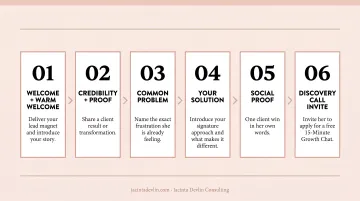
An effective nurture sequence for a service business looks like this:
- Email 1 — Deliver the lead magnet, introduce yourself briefly
- Email 2 — Share your story and why you do this work
- Email 3 — Demonstrate expertise with a specific tip or teaching
- Email 4 — Share a client result or transformation
- Email 5 — Address a common objection or doubt
- Email 6 — Transition into an invitation (discovery call, application, or sales page)
Research from Demand Gen Report found that lead nurturing programs produced an average 20% increase in sales opportunities compared to non-nurtured leads. And Campaign Monitor's email benchmarks show professional services emails average 19.3% open rates — roughly one in five people on your list will see each email.
Jacinta Devlin recommends Flodesk as the primary platform for coaches and service providers; she also works with Klaviyo, Kit, and MailerLite depending on the client's tech stack.
Step 5: Convert Through a Clear Sales Conversation or Offer
For most service businesses, conversion happens in a 1:1 conversation — a discovery call, strategy session, or consultation. That moment needs structure.
An effective conversion conversation:
- Starts with understanding the prospect's current situation and goals
- Surfaces the specific obstacle blocking their progress
- Connects your service to the transformation they're seeking
- Makes a clear, direct invitation to work together
At Jacinta Devlin Consulting, the Free 15-Minute Growth Chat follows exactly this framework — asking about the prospect's business model, current revenue, goals, and obstacles before recommending (or honestly declining to recommend) a specific program. That structure is what makes the call feel like a diagnosis, not a pitch.
For lower-ticket programs, conversion can also happen through a direct sales page or webinar pitch. But in every case, there must be one clear call to action, transparent pricing, and obvious next steps. Confusion at the conversion stage is where revenue disappears.
Key Factors That Determine Whether Your Funnel Actually Converts
Two service businesses can follow the exact same five steps and get completely different results. What separates a converting funnel from one that stalls comes down to these variables.
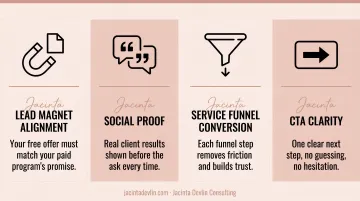
Lead Magnet-to-Offer Alignment
If your lead magnet doesn't directly connect to what you're selling, you attract browsers instead of buyers. The best lead magnets make a prospect think, "I need this — and I definitely need whatever comes next."
A free training on pricing your services aligns with a high-ticket business strategy program. A checklist on Instagram growth does not. Alignment at the top of the funnel determines the quality of every lead that follows.
Nurture Sequence Quality and Consistency
Service businesses sell trust as much as they sell outcomes. A nurture sequence that's generic, infrequent, or impersonal won't move a prospect forward — it will confirm she doesn't need you.
Content type and frequency both matter. Once a week is the minimum — going quiet for three weeks after someone opts in is the same as not nurturing at all. These content types consistently outperform promotional emails:
- Client stories and documented outcomes
- Behind-the-scenes transparency into your process
- Specific tips that demonstrate real expertise
- Direct responses to the objections you hear most often
Social Proof and Credibility Signals
Every potential client is deciding whether to bet on a result she can't yet see. Nielsen's 2021 research found 88% of consumers trust recommendations from people they know over any other form of advertising — which is why client testimonials, case studies, and real outcome stories are the most powerful credibility tools a service business owner has.
Include social proof at every stage of the funnel:
- Lead magnet copy and opt-in page
- Nurture email sequence
- Sales page
- Discovery call booking page
Documented results from real, named clients outperform credentials every time.
Clarity of the Next Step
Every single stage of your funnel must have one clear action for the reader to take. One. Not three options, not a vague "reach out," not "follow me for more."
- After your content: click to download the freebie
- After your opt-in page: check your inbox
- After your nurture email: book a call
HubSpot data shows personalized calls to action convert 202% better than generic defaults. The principle extends beyond landing pages — every funnel touchpoint performs better when the next step is specific, clear, and singular.
Common Sales Funnel Mistakes Service Business Owners Make
Most service businesses don't fail because of a bad offer. They fail because of avoidable funnel mistakes that compound quietly over time.
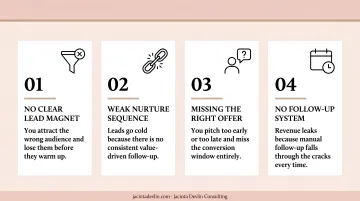
Building multiple funnels before one is working. A new lead magnet, a new landing page, a new nurture sequence — all started before the first one is tested. One funnel built well and run consistently will outperform five half-finished ones every time.
Skipping the nurture phase. Jumping from "download this freebie" directly to "buy my program" rarely works for a high-trust service purchase. The nurture phase is where the sale is actually made — weeks before the discovery call even happens.
Not following up after a discovery call. Silence after a call is not a "no." HubSpot reports that 80% of successful sales require five or more follow-up interactions, yet 48% of salespeople never attempt a single follow-up. Most service business owners are leaving money on the table simply by stopping too soon.
Using someone else's funnel template without customizing it. A funnel built for a $97 online course will not convert for a $5,000 coaching package. A funnel designed for a product-based business will not work for a relationship-dependent service.
As Jacinta Devlin puts it: "Every strategy is custom-built around your business, your offers, your audience, your platform mix, and your specific revenue goals" — anything less creates a system that looks complete but doesn't convert.
Frequently Asked Questions
What is a sales funnel for professional services?
A sales funnel for professional services is the structured path a potential client takes from first discovering your expertise to hiring you. Each stage is designed to build the trust required before someone commits to a high-touch, high-investment service purchase, which differs from product funnels that lean on convenience and impulse buying.
What is the 10-3-1 rule in sales?
The 10-3-1 rule, originally from the insurance and financial advisory space, states that for every 10 qualified prospects, roughly 3 will have a conversation and 1 will convert. Use it to work backward from your revenue goals and calculate how many people you need at the top of your funnel.
What is the best lead magnet for a service business?
The best lead magnet directly addresses the biggest pain point your paid service solves. High-performing formats include free guides, checklists, a short masterclass, a challenge, or a free strategy session. Format matters less than alignment: a simple checklist tied to your offer will outperform a polished video that isn't.
How many stages should a service business sales funnel have?
Five core stages — attract, capture, nurture, convert, and retain — work for most service businesses. Simplicity is an advantage, especially when starting out. A five-stage funnel you actually run consistently will always outperform a complex nine-stage funnel you never finish building.
How do I know if my sales funnel is working?
Track four numbers: opt-in rate (professional services median is 6.1%, top quartile 14.1%+ per Unbounce), email open rate (average 19.3% for professional services), discovery call booking rate, and close rate. A weak number in any one area tells you exactly which stage to fix first.
What is the difference between a marketing funnel and a sales funnel for service businesses?
A marketing funnel generates awareness and captures interest: it handles visibility, content, and lead capture. A sales funnel converts that interest into paying clients. Both are necessary, and the handoff between them requires the most attention: moving a warm lead into a sales conversation is the point where most service businesses either gain a client or lose one for good.