
This is the reality for so many women building direct-to-consumer (D2C) brands. The problem isn't your product; it's the lack of a system.
D2C is one of the most powerful business models for female entrepreneurs today. It gives you complete control over your pricing, customer relationships, and profit margins. But control without a strategy is just guessing. This article provides the strategic roadmap—the funnel and revenue system—that turns inconsistent sales into a predictable growth engine.
Key Takeaways
- D2C puts you in control of your brand story and profit, but a solid foundation is essential.
- A sales funnel isn’t optional; it’s the system that turns strangers into loyal customers.
- Knowing your Customer Acquisition Cost (CAC) and Lifetime Value (LTV) is non-negotiable for growth.
- Traffic is wasted without a conversion strategy; revenue comes from your offer, messaging, and follow-up.
- Retention and repeat purchases are the real secret to scaling to consistent $10k+ months.
Why the D2C Model Gives Women Entrepreneurs an Unfair Advantage
When you sell directly to your customer, you own the entire relationship. There's no retail middleman taking a cut, no marketplace dictating your brand's position. You control the experience, you own the data, and you keep more of the profit. For women-led brands built on authenticity, storytelling, and community, that kind of ownership is the whole point.
The D2C market is not a small niche; U.S. sales are forecasted to hit $239.75 billion in 2025. The opportunity is enormous, but it comes with challenges. Many founders we work with at Jacinta Devlin Consulting arrive feeling stuck, facing common hurdles:
- Rising ad costs that eat into already thin margins.
- An unclear funnel structure, leading to a "post and pray" marketing approach.
- Inconsistent revenue that makes it impossible to forecast or reinvest confidently.
None of that points to a bad business. It points to a missing system. The right strategic framework turns each of those challenges into a specific, fixable problem — and that's exactly where the work starts.
Start With the Numbers: The D2C Revenue Foundation
Before you spend another dollar on marketing, you must know two numbers: Customer Acquisition Cost (CAC) and Customer Lifetime Value (LTV). Strategy without numbers is just guessing, and women who know their numbers are the ones who scale.
CAC vs. LTV: The Only Math That Matters
- Customer Acquisition Cost (CAC): This is simply what you spend in marketing to get one new customer. If you spend $100 on ads and get 10 new customers, your CAC is $10.
- Customer Lifetime Value (LTV): This is the total profit a customer generates for your business over their entire time buying from you. It includes their first purchase and all subsequent repeat purchases.
If your LTV is higher than your CAC, your business model works. If it's not, no amount of traffic will fix a broken foundation.
To put a number on it: say you sell a skincare product and it costs $40 to acquire a new customer. That customer buys from you four times and generates $120 in total profit — that's a healthy 3:1 LTV-to-CAC ratio, and a business worth scaling.
Know Your "Allowable CAC"
Your "allowable CAC" is the maximum you can spend to acquire a customer while remaining profitable. This number should guide every marketing decision you make. If you know you can profitably spend up to $50 to get a new customer, you can confidently invest in paid ads, influencer partnerships, or affiliate programs that fall below that threshold.
The Fastest Lever: Average Order Value (AOV)
Average Order Value (AOV) is the average amount a customer spends per transaction. Raising it is one of the fastest ways to improve profitability without spending more on ads.
A few small shifts to your offer structure can add real dollars per transaction:
- Bundle a necklace with matching earrings instead of selling pieces individually
- Turn a single lipstick into a "starter kit" with a liner and gloss
- Add a low-cost complementary product at checkout as an upsell
Each of these moves raises your AOV — which lifts your LTV and gives you more budget to bring in new customers.
Building a D2C Sales Funnel That Converts
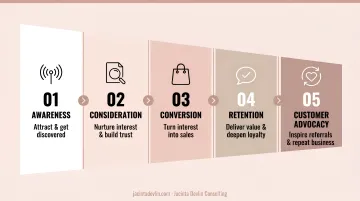
A sales funnel is the structured journey you guide a customer through, from their first interaction with your brand to becoming a loyal, repeat buyer. Most brands lose people in the gaps between stages. A high-performing funnel closes those gaps.
The five core stages are:
- Awareness: A potential customer discovers your brand for the first time.
- Interest: They engage with your content, follow you, or sign up for your email list.
- Desire: They connect with your brand story and want the solution your product provides.
- Action: They make a purchase.
- Retention: They love their experience, buy again, and tell their friends.
Top of Funnel: Earning Attention
This is where you stop the scroll. Your top-of-funnel content—whether it's an Instagram Reel, a TikTok video, or a blog post—needs to create curiosity. The goal isn't to sell immediately; it's to earn a click, a follow, or an email signup. Focus on content that educates, entertains, and tells your brand's unique story.
Middle of Funnel: Building Trust
Once you have their attention, you need to build trust. Email is where that trust gets built. A well-crafted welcome sequence introduces your brand story, shares social proof, and shows a new subscriber exactly why your product is different — moving them from curious to convinced before you ever ask for the sale.
Bottom of Funnel: Making the Sale
The final step is the purchase. Your offer needs to be clear and compelling — a strong value proposition, compelling product photography, customer reviews, and a frictionless checkout process. So many sales are lost to a confusing offer or a broken checkout page. For women building community-driven brands, authenticity at this stage is your competitive edge. Buyers want to feel connected to the founder behind the brand.
The difference between a funnel that converts and one that leaks revenue usually comes down to how well each stage is connected. At Jacinta Devlin Consulting, the Done-For-You Marketing Systems service builds these end-to-end systems — brand, website, funnels, email sequences, and automations — tailored to your specific business, not repurposed from someone else's playbook.
Driving Traffic to Your D2C Brand
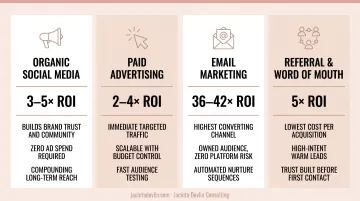
Once your funnel is built, you need to fill it with the right people. Focus your energy on these four traffic sources.
- Organic social (Instagram, TikTok, Facebook) builds community and converts warm traffic — prioritize behind-the-scenes content, video tutorials, and UGC over constant promotion.
- Email marketing is the audience you own. With an average ROI of $36 for every $1 spent, it's your most reliable channel for welcome sequences, promotions, and abandoned cart recovery.
- Paid advertising on Meta and Google scales what's already working — start small, test creative and messaging, and increase budget only once you have a proven return on ad spend.
- Influencer and affiliate marketing puts your brand in front of warm, engaged audiences. 71% of consumers trust influencer recommendations — partnering with creators who align with your brand is one of the fastest ways to build that trust at scale.
Converting Browsers into Buyers: Your D2C Revenue Engine
Traffic means nothing if it doesn't convert. Converting visitors into buyers is your actual revenue engine — and conversion rate optimization (CRO) is the most overlooked growth lever for D2C founders. A 1–2% improvement in your conversion rate can double your revenue without spending another dollar on ads.
Optimize Your Product Page
Your product page has one job: to convince a browser to click "Add to Cart." Every element should remove a reason not to buy.
- Lead with a headline that names the product and who it's for — no guessing required.
- Write descriptions around outcomes, not features: what changes for your customer after buying?
- Invest in professional photos and video that show the product in real use.
- Pull reviews, ratings, and user-generated content front and center where shoppers can't miss them.
- Make your "Add to Cart" button impossible to overlook — size, color, and placement all matter.
Recover Lost Sales with Email
Did you know that, on average, over 70% of online shopping carts are abandoned? That's a massive pool of near-buyers. An automated abandoned cart email sequence — a short series reminding shoppers what they left behind, with an optional small incentive — is one of the fastest ways to turn lost clicks into completed orders.
Frame Your Offer to Maximize Value
The online space gives you the freedom to tell your product's full story. Use psychological pricing and offer framing to increase both conversion rates and AOV.
- Bundles: Group related products together for a 10–15% discount.
- Limited-Time Offers: Create urgency to encourage immediate purchase.
- Subscription Options: Offer a "subscribe and save" model for consumable products.
Retention and Scaling: From One Sale to Consistent $10k+ Months
The real profitability in a D2C brand isn't in the first sale; it's in the second, third, and fourth. It can cost 5 to 25 times more to acquire a new customer than to retain an existing one. This is where you scale.
Build post-purchase email flows that deliver an exceptional customer experience.
- Thank You & Welcome: Confirm their order and welcome them to your brand community.
- Usage Tips: Help them get the most out of their new product.
- Repurchase Reminders: For consumable products, send a reminder when it's time to reorder.
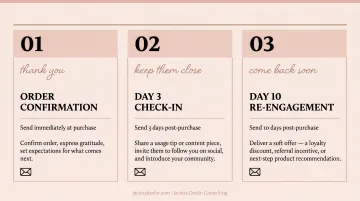
For replenishable products, a subscription model is worth building early. It stabilizes monthly income, increases LTV, and gives you the revenue predictability to invest more confidently in acquiring new customers.
That stability makes the next step easier: scaling with focus. Don't try to launch new products, expand to new channels, and enter new markets all at once. Master your hero product and your primary sales channel first — that's where most founders stall after early success.
Jacinta Devlin has guided women through exactly this phase, from their first sale to running $100k+ boutiques and consistent $10k+ months. If you're hitting a ceiling, that's often where outside strategy makes the biggest impact.
Frequently Asked Questions
Frequently Asked Questions
How to grow a D2C business?
Growth comes down to four pillars:
- Know your unit economics (CAC and LTV)
- Build a funnel that moves customers from awareness to purchase
- Treat retention as your primary revenue multiplier
- Scale one channel before diversifying
Which is better, D2C or B2C?
D2C gives you full control over pricing, customer data, and brand story, which makes it better suited for founders seeking direct relationships and higher margins. B2C through retail offers broader distribution but sacrifices margin and customer ownership.
What is a D2C sales funnel?
A D2C sales funnel is the structured path a customer takes from discovering your brand to making a purchase — and then coming back again. Each stage, from awareness through retention, is a deliberate step you design and control.
How do I get my first customers for my D2C brand?
Start with your existing network and social media presence to build initial awareness. Use organic content to provide value and focus on building an email list from day one to own your audience.
How do I increase revenue for my D2C brand without increasing my ad spend?
Three levers that cost nothing in ad spend:
- Optimize your product pages for conversion rate
- Increase average order value with bundles and upsells
- Build post-purchase email flows to bring existing customers back
What metrics should I track to grow my D2C brand?
Start with four: Customer Acquisition Cost (CAC), Customer Lifetime Value (LTV), Average Order Value (AOV), and conversion rate. These numbers reveal exactly where your brand is profitable — and where it's leaking revenue.