
Introduction
You love what you do. You're out there crafting unforgettable experiences, guiding travelers through places they've never seen, and working harder than you ever imagined. But the bookings are inconsistent. Some months are great; others are painfully slow. You're doing everything — posting on Instagram, updating your website, chasing inquiries — and somehow the business still isn't growing the way it should.
The problem usually isn't effort. It's strategy.
The global tours and experiences sector reached $271 billion in 2025 and is projected to hit $342 billion by 2029, growing at roughly 8% annually. Demand is there. The businesses that capture it share five things:
- Niche clarity — knowing exactly who you serve and why they choose you
- A strong brand — one that builds trust before a booking conversation starts
- Consistent digital marketing — showing up where travelers are actually searching
- Scalable systems — operations that grow without burning you out
- Strategic partnerships — relationships that send you qualified referrals
This guide breaks all five down: a practical growth roadmap for tourism entrepreneurs who are ready to stop spinning their wheels and start building a business that compounds.
Key Takeaways
- Niche first — without a defined ideal client, no marketing strategy will consistently work
- Brand = the first sale — your audience must trust you before they ever buy
- Consistency drives revenue, not viral moments or random posting
- Systems let your business grow beyond what you alone can manage
- Partnerships multiply reach far faster than solo effort ever will
Define Your Niche and Ideal Tourism Client
Define Your Niche and Ideal Client
The single most common reason women's businesses plateau isn't a lack of effort — it's trying to appeal to everyone. When your messaging speaks to all buyers, it resonates with none of them. Your content becomes generic, your ads waste money, and the right clients scroll past without recognizing you as the obvious choice. Getting specific about your niche is what changes that.
Finding Your Profitable Niche
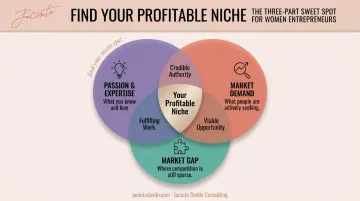
The sweet spot sits at the intersection of three things:
- Passion and expertise — what you know deeply and can deliver with real authority
- Market demand — what your ideal customer is actively searching for and spending on
- Market gaps — what competitors in your space aren't doing well
The data on niche markets is clear. Women-owned e-commerce businesses that lead with a defined niche consistently out-convert broad-appeal competitors. Direct sales leaders who position around a specific lifestyle or transformation — rather than leading with product — build larger teams faster. Coaches who specialize outbook generalists.
Strong niche categories with proven demand for female entrepreneurs right now:
- Online boutiques with a defined aesthetic or customer identity
- Direct sales and network marketing with a personal brand angle
- Amazon and LTK affiliate businesses built around a content niche
- Coaching and consulting for a specific outcome or audience
- Digital product and course businesses tied to a documented skill set
Choosing one doesn't shrink your opportunity. It makes your message specific enough to actually land.
Build Your Ideal Client Profile
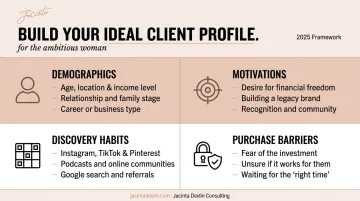
Once you've chosen a niche, get specific about who you're serving. A proper buyer persona covers:
- Demographics — age, location, income level, where she is in her business journey
- Motivations — why she's buying, what outcome or transformation she's after
- Discovery habits — where she finds businesses like yours (Instagram, Google, TikTok, email, referrals)
- Purchase barriers — what stops her from committing (price, trust, unclear ROI, too many options)
Every marketing decision — your captions, your ad targeting, your website copy — should flow from this profile.
Identify Your Unique Selling Proposition (USP)
Your USP is not "great service." Every operator claims great service. A real USP is the specific, compelling reason a customer picks you over every other option available to them.
Ask yourself two questions:
- What do I offer that no one else in my market does?
- What transformation or lasting result does my customer walk away with?
Your answers — specific, honest, experience-rooted — become the foundation of every marketing message you'll ever write.
Build a Tourism Brand That Commands Attention
Build a Business Brand That Commands Attention
Your brand makes the first sale. Before a customer buys, books a call, or clicks follow, they need to feel something — excitement, trust, curiosity. A weak or inconsistent brand signals risk. A strong one does the selling before you ever speak to anyone.
Branding isn't just a logo. It's your visual identity, your tone of voice, the stories you tell, and the emotional feeling someone carries after encountering your business.
The Power of Brand Storytelling
Customers aren't just buying a product or a program — they're buying an outcome, an identity, a story they can see themselves in. According to Edelman's Brand Trust research, 81% of consumers say they need to trust a brand before they'll buy. That trust starts with your story, not your sales pitch.
Your brand story should answer:
- What compelled you to build this business in the first place
- Who you are — your voice, your values, what makes your business distinctly yours
- The transformation your customer experiences — what changes for them after working with you or buying from you
This is the approach Jacinta Devlin coaches her clients through — building a "Pro Identity" that's rooted in a real story and a specific positioning, not generic aesthetics assembled from a template. Brand discovery comes first; logo and color palette come after.
Your Website Essentials
Over 75% of consumers judge a business's credibility based on its website design, according to Stanford research. Your website is not a brochure — it's your primary sales tool. It needs:
- Professional, mobile-first design (over 60% of web traffic now comes from mobile devices)
- Inspirational photography and video throughout
- Clear calls to action: Book Now, Check Availability, Contact Us
- Detailed, compelling product or service descriptions
- Genuine customer testimonials prominently placed
- Fast load times (53% of mobile users abandon a page that takes longer than 3 seconds to load, per Google)
Reviews and Visual Content
Your website builds credibility, but social proof closes the sale. On platforms like Google, Facebook, and Instagram, reviews and testimonials are often the deciding factor for new customers. Proactively ask every happy client for a review. Respond professionally to any negative feedback — your response is public, and it signals exactly how you operate.
For visuals, build a content library from three sources:
- Professional photography — invest in at least one shoot per season
- Customer-submitted content — ask buyers and clients to tag you and reshare with permission
- Short-form video — Reels and TikToks showing real moments from real results and behind-the-scenes work
Develop a Digital Marketing Strategy That Drives Bookings
Develop a Digital Marketing Strategy That Drives Sales
There's a difference between a digital marketing strategy and posting when you feel like it. A real strategy starts with clear goals, identifies where your ideal client spends time online, and maps specific content and campaigns to each channel. Consistency over months — not one viral post — is what builds real revenue momentum.
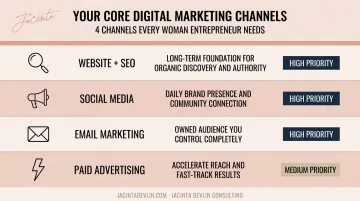
The Four Channels That Matter Most
| Channel | Primary Role | Priority |
|---|---|---|
| Website + SEO | Be found when buyers search for what you offer | High — long-term foundation |
| Social Media | Brand awareness and audience growth | High — daily presence |
| Email Marketing | Nurture leads, drive repeat purchases | Medium — owned audience |
| Paid Advertising | Accelerate reach while organic builds | High — especially early on |
No single channel is enough on its own. The strongest online businesses for women entrepreneurs combine a searchable website, an active social presence, and a growing email list — so no algorithm change or platform shift can wipe out their revenue overnight.
Social Media by Platform
Match your platform to where your ideal customer actually spends time:
- Instagram and TikTok — Millennials and Gen Z; Instagram drives purchase decisions for female consumers across fashion, beauty, lifestyle, and coaching categories
- Facebook — Gen X buyers, community-driven content, and group-based selling
- Pinterest — inspiration-driven shoppers planning future purchases across home, fashion, and lifestyle
Authentic content consistently outperforms promotional posts. Behind-the-scenes moments, real client results, product in use, and personal storytelling build the trust that converts followers into buyers.
SEO and Paid Advertising
SEO is a long-term investment that compounds and reduces reliance on paid ads. Prioritize:
- Niche-specific keywords in your page titles and product or service descriptions
- A Google Business Profile with updated photos and consistent review responses
- Blog content that answers questions your ideal client is already searching
For paid advertising, Google Ads and Meta ads can accelerate sales while organic reach builds. Start small. Track cost-per-sale. Test your creative before scaling spend.
Email marketing deserves more attention than most female entrepreneurs give it. It's an owned channel — no algorithm decides who sees your content. Businesses using email marketing consistently report $36–$42 return per $1 spent, making it one of the most efficient tools available for women building online businesses.
Put Systems in Place to Scale Without Burning Out
Here's the harsh truth: without systems, your business doesn't grow — it just gets busier. You become the bottleneck — every booking, every question, every experience funneling through you personally.
Michael Gerber captured this precisely in The E-Myth — a business built around the founder's personal involvement can't scale. Systems are what allow anyone to deliver a quality experience consistently, without the founder doing everything personally.
The Core Systems Every Growing Tourism Business Needs
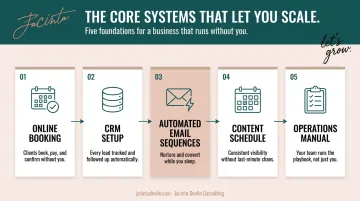
- Online booking that lets customers self-book 24/7 — 72% of travelers prefer booking online, and 80% want to complete the process entirely digitally
- A CRM to track who your guests are, when they traveled, and when to follow up
- An automated post-tour email sequence: thank-you, review request, referral ask, and future experience preview
- A content creation schedule so you're batching and planning — not scrambling daily
- An operations manual with documented tour delivery processes any team member can follow
If you've hit a revenue ceiling, a business strategist can help you build these systems faster than you'd manage alone — with a plan built around your specific business, not a generic framework someone else used.
Review and improve your systems regularly. What works at 10 bookings a month breaks at 100.
Grow Through Strategic Partnerships and Community
Solo growth has a ceiling. The tourism businesses that scale fastest tap into other people's audiences, relationships, and distribution channels rather than building every channel themselves.
Key Partnership Types
- Local hotels and accommodations — front desk and concierge staff can become your most consistent referral source
- Travel agencies — package your experiences into itineraries they sell to their clients
- DMOs and tourism boards — get listed, attend their events, build relationships with staff
- Non-competing tour operators — cross-refer clients for experiences you don't offer
These relationships don't form over email. Show up in person, attend industry events, and join your local visitor bureau — face-to-face connection moves partnerships forward faster than any digital outreach.
Influencer Marketing and User-Generated Content
Gen Z travelers are 34% more likely than average travelers to be influenced by posts from content creators and influencers. A well-chosen influencer partnership can generate months of content and direct bookings.
When vetting collaborators, check:
- Audience alignment — do their followers match your ideal traveler profile?
- Engagement rate — meaningful interaction matters more than follower count
- Authenticity — does the creator's style match your brand's feel?
Structure collaborations clearly: deliverables, timeline, usage rights, and whether the arrangement is paid, hosted, or affiliate-based.
Measure What Matters and Adjust Your Strategy
Growth requires data. Track these numbers consistently across your business:
- Website traffic and sales conversion rate
- Monthly revenue (trending toward your income goals)
- Which channels drive the most sales or clients (so you invest there more)
- Customer acquisition cost per sale
- Repeat purchase or client rate (your happiest customers are your cheapest marketing)
- Review and testimonial scores across all platforms
Set SMART goals quarterly — Specific, Measurable, Achievable, Relevant, and Time-bound. Then review your performance against them and adjust what isn't working. The businesses that grow consistently aren't the ones with the perfect plan — they're the ones willing to look at what the numbers say and actually act on it.
Frequently Asked Questions
How do you grow within the tourism industry?
Growing in tourism requires understanding current traveler trends, building a strong online presence, and forging partnerships with tourism boards, OTAs, and local businesses. Continuous improvement to the guest experience — and actively collecting reviews — is what sustains that growth over time.
What are the 7 P's of tourism?
The 7 P's are Product, Price, Place, Promotion, People, Process, and Physical Evidence. They form the core marketing and operations framework for tourism businesses — from how an experience is priced and delivered to how the physical environment shapes guest perception.
What are the 5 C's of tourism?
The 5 C's — Competence, Credibility, Communication, Creativity, and Customer Focus — serve as a framework for building a trustworthy, competitive tourism brand. Use them to audit whether your business earns a traveler's trust before they ever meet you.
What are the 4 C's of tourism?
The 4 C's — Customer, Cost, Convenience, and Communication — are a customer-centric counterpart to the traditional marketing mix. Applying them helps tourism operators align their offers with what travelers actually want, rather than what the business finds easiest to deliver.
What is the most effective marketing strategy for a tourism business?
The most effective strategy combines a strong organic presence — SEO, social media, and email — with targeted paid advertising and OTA distribution. Both only work when anchored by a clear niche and a brand story that resonates with your ideal traveler.
How do I attract more clients to my tour business?
Start with niche clarity and a professional online presence, then build through consistent social media content, positive reviews, OTA listings, and referral partnerships with local hotels and travel agencies.
Ready to stop guessing and start scaling? If you're a woman entrepreneur and your revenue has plateaued, Jacinta Devlin Consulting's Business Growth Program delivers weekly 1:1 strategy sessions, a personalized growth plan, and systems built around your specific business — not a generic template. Start with a free 15-minute discovery call at calendly.com/devlinconsulting/15-minute-consultation. Jacinta will tell you honestly whether it's the right fit.