For women entrepreneurs, a powerful personal brand isn't vanity — it's strategy. It determines who finds you, who trusts you, and who buys from you before you've even said a word.
This article covers the business case for personal branding, how to build a brand foundation rooted in story and positioning, how to show up strategically online, and how to turn brand visibility into actual revenue.
Key Takeaways
- Your personal brand works for you around the clock, even when you're not actively selling.
- Your story and lived experience aren't liabilities; they're the core of a brand that builds trust.
- Positioning — deciding what you want to be known for — matters more than posting frequency.
- Consistency over time compounds into recognition. Short bursts don't.
- A strong personal brand converts visibility into revenue — but only with a clear audience and deliberate message.
Why Personal Branding Is Non-Negotiable for Women Entrepreneurs
Personal branding is the intentional, strategic practice of shaping how others perceive you and your business — the intersection of your reputation, your expertise, and your story. For women entrepreneurs, it's not optional infrastructure. It's foundational.
According to the 2024 Wells Fargo Impact of Women-Owned Businesses report, there are 14 million women-owned businesses in the U.S., representing 39.1% of all firms — a 13.6% increase from 2019 to 2023. That's a competitive market.
Women operating within it also face documented structural barriers. A 2023 U.S. Senate Small Business Committee report found that 25% of women had loan applications denied in 2022, compared to 19% of men — a credibility and trust gap that doesn't stop at the bank.
A recognizable personal brand directly addresses this by doing what marketing materials can't: building trust before a sales conversation begins.
What a Personal Brand Actually Does for Your Business
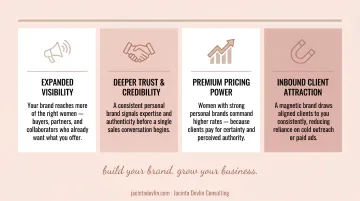
The business case is direct:
- Reduces customer acquisition costs — when people already know and trust you, the sales cycle shortens
- Creates pricing power — recognized experts command premium rates; unknown ones compete on price
- Attracts partnerships and collaborations — brands and collaborators reach out to people they can find and recognize
- Generates inbound interest — your reputation works even when you're not actively pitching
The 2024 Edelman-LinkedIn B2B Thought Leadership Impact Report found that 60% of buyers are willing to pay a premium to work with organizations that demonstrate expertise, and 90% of decision-makers are more receptive to sales outreach from those who produce high-quality thought leadership. That's the personal brand premium, documented.
The Cost of Having No Brand
Women entrepreneurs without a clear brand often find themselves:
- Competing on price instead of value
- Constantly hustling for visibility with no compounding return
- Building a business that depends entirely on their direct effort, not their reputation
If you don't define your brand, the market will define it for you — and usually gets it wrong.
Start With Your Story: The Foundation of an Authentic Brand
People don't connect with credentials. They connect with experiences, transformation, and authenticity. Your origin story — why you started, what you overcame, what you believe — is the raw material of a brand that builds lasting trust.
The Questions That Excavate Your Brand Story
Before you write a bio or post a piece of content, answer these:
- What problem were you trying to solve when you started?
- What did you learn the hard way that your ideal client is still figuring out?
- What makes your path to expertise different from everyone else in your space?
- What do you know now that you wish you'd known at the beginning?
Your answers to these questions are your brand. They're the raw material everything else is built on.
Why Lived Experience Builds Authority No Credential Can
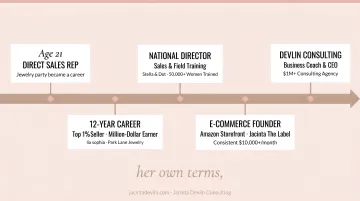
Jacinta Devlin's story is a precise illustration of this principle. She didn't start with a coaching certification or a business degree. At 21, as a broke college student working two jobs, she attended a direct sales jewelry party and signed up as a rep — mostly because pairing accessories and making extra cash sounded like fun.
What followed was a 12-year direct sales career in which she became a Top 1% seller and million-dollar earner at lia sophia and Park Lane Jewelry, building multi-million dollar teams along the way. That performance led to a corporate role as National Director of Sales & Field Training at Stella & Dot, where she designed and ran the field development curriculum, training 50,000+ women in the social selling space.
From there: influencer partnerships with Gucci, LTK, Amazon, and Nordstrom. A six-figure Amazon storefront. Her own clothing boutique, Jacinta The Label. And eventually, Devlin Consulting — built not because she set out to be a business coach, but because so many women saw her results and asked how she did it.
Every pivot in that journey is earned authority. The accidental start makes her relatable. A decade of execution makes her credible, and 50,000 women trained makes her proven. That's what a brand built on lived experience looks like, and no credential alone replicates it.
Define Your Brand Values
That kind of story clarity doesn't happen by accident — it's anchored in values. Beneath every strong brand story is a set of non-negotiable values. Values like ambition, freedom, authenticity, and community attract aligned clients and naturally repel misaligned ones. That's exactly what you want.
Identify 3–5 values that are genuinely yours, not aspirational ones you think you should have. They should show up consistently in your content, your client interactions, and your offers. Consistent values make your brand feel coherent. Without them, even a packed content calendar feels scattered to the people watching.
One caution: authenticity is non-negotiable. A manufactured persona might look polished, but your audience — especially women — will detect the gap between the curated version and the real one. That gap erodes the very trust you're trying to build.
Define Your Positioning: What You Want to Be Known For
Positioning is the single most skipped step in personal branding. It means choosing one specific territory — the intersection of your expertise, your audience, and a perspective that's distinctly yours — and committing to owning it.
Without clear positioning, even consistent content fails to build recognition. You can post every day for a year and still have people unsure what you actually do.
How to Write a Positioning Statement
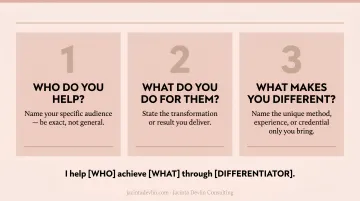
Your positioning statement answers three questions:
- Who do you help? (Be specific — not "women," but "women launching online boutiques" or "female direct sales leaders who want to build a personal brand beyond their company's brand")
- What do you help them do? (The specific transformation or outcome)
- What's the unique lens you bring? (The belief, method, or experience that separates your take from everyone else's)
A useful test: if someone who has never met you heard your name, could a follower describe what you do in one sentence — and would that description rule out your ten closest competitors? If not, your positioning isn't specific enough yet.
The Fear of Niching Down
This is one of the most common blockers for women entrepreneurs: the fear that narrowing your focus will shrink your audience.
It won't. Vague positioning gets scrolled past. Specific positioning gets remembered, shared, and sought out — because people can only refer you if they can describe you.
A Practical Exercise
Grab a notebook and answer these three questions:
- What are the 3 problems you solve best?
- What are the 3 types of women you most love working with?
- What is the 1 belief about your industry that most people get wrong?
Where those three answers overlap is your brand position. That's the ground worth owning — and the starting point for everything else in your brand.
Build Your Online Presence and Create Content That Converts
Choose Platforms Based on Audience, Not Trends
Platform selection should follow your audience, not what's trending — the right platform is wherever your specific buyers already spend time.
2024 DataReportal data on U.S. ad audiences gives a useful baseline for where women are reachable:
| Platform | Female Ad Audience Share | U.S. Adult Usage |
|---|---|---|
| 71.5% female | 50% of U.S. women | |
| 55.5% female | 47% of U.S. adults | |
| TikTok | 54.4% female | 40% of women use it |
| 53.7% female | 68% of U.S. adults | |
| 50.0% female | 40% of adults 30–49 |
A life coach's audience may live on Instagram. A B2B consultant's may be most active on LinkedIn. A social seller's community often gathers on Facebook and TikTok. Pick the platform where your specific audience shows up, not the one with the most general buzz.
Jacinta's own brand operates most actively across Instagram, Facebook groups, LTK, Amazon, and TikTok — because those are the platforms where her clients and their customers actually buy.
The Non-Negotiables of an Effective Online Presence
Regardless of platform, get these right before you post anything else:
- A clear bio that communicates exactly who you help and how — in two lines
- A profile photo that reads as professional and approachable
- Consistent visual identity (colors, fonts, style) so your content is recognizable in a feed
- A pinned or featured post that introduces your brand story to new visitors
The Three Content Pillars
Every woman entrepreneur's brand content should rotate across three types:
- Authority content — tips, frameworks, and insights that demonstrate your expertise (builds "know" and "trust")
- Story content — personal experience, behind-the-scenes, and transformation narratives (builds "like")
- Community content — questions, polls, responses, and spotlights that deepen relationship (builds "like" and loyalty)
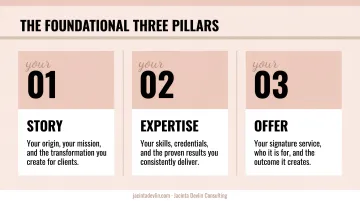
Brands that only post authority content feel cold. Brands that only post personal content lose credibility. Aim for a rotation: roughly two authority posts for every one story or community post, adjusted for what your audience actually engages with.
Consistency of message matters more than consistency of frequency. Showing up three times a week with a sharp, on-brand perspective builds more equity than posting daily with scattered, reactive content.
That consistency of message connects directly to your content's real goal — which is not virality. It's resonance. One post that speaks directly to a specific woman's exact problem is worth more than ten posts optimized for broad engagement. Write to one person, not an audience.
Turn Your Personal Brand Into a Revenue-Generating Asset
A strong personal brand generates inbound interest: fewer cold pitches, more qualified buyers already primed to purchase. When your brand clearly communicates who you help and what transformation you deliver, your sales conversations become confirmations rather than persuasion sessions.
The research backs this up: 75% of B2B decision-makers researched a product or service they hadn't previously considered after consuming thought leadership — and of those, 23% began buying from the organization that produced it. That's the inbound pipeline personal branding builds.
Practical Ways to Accelerate Brand-to-Revenue
- Build your email list from day one. Social platforms change algorithms; your list is yours and always will be.
- Share social proof as content — not just on a testimonials page. PowerReviews found that 99.75% of online shoppers read reviews and 45% won't buy if no ratings or reviews are available.
- Get on stages, podcasts, and summits where your ideal clients already gather. Expertise-led visibility builds trust faster than any ad.
- Create one clear offer entry point. Brand awareness needs somewhere to go — one visible first step converts curiosity into action.
What Devlin Consulting Clients Have Built
These results are documented. Clients who went through Devlin Consulting's programs built real, measurable outcomes:
- Lisa K. (Fleur de Lis Boutique): $1,250 on launch day, $100,000+ in year one — starting from zero business experience
- Christina R. (@mybalancedstyle): Grew from 13k to 95k+ Instagram followers after a rebrand, built a 36,000+ member Facebook group, and now generates hundreds of thousands monthly through Amazon and LTK
- Sharon B.: Went from $4,000 in her first full year on Amazon to $20,000+ per month consistently
- Joy W.: Went from $500/month to consistent $5k+ months across multiple businesses, surpassing her previous annual income in 6 months
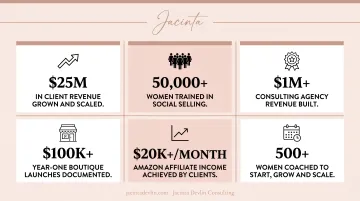
Every one of these results started in the same place: brand clarity. The right positioning, a defined identity, and a message that pulled in the right buyers.
If you're ready to build the strategy, systems, and positioning to turn your visibility into consistent, growing revenue, Jacinta's Business Growth Program was designed for this stage. Start with a free 15-minute Growth Chat to see if it's the right fit.
Frequently Asked Questions
What exactly is a personal brand for a woman entrepreneur?
Your personal brand is how you intentionally shape what others think of you — your reputation, expertise, and story working together. Unlike a company brand, it's built around you as the face of what you sell. That's what makes it so powerful: your clients are buying your trust as much as your offer.
How do I start building a personal brand when I'm just starting out?
Start with three things: clarify your story and values, define the one thing you want to be known for, and choose one platform to show up on consistently before expanding. Trying to do everything at once is the most common reason early-stage brands never gain traction.
Which social media platform is best for building a personal brand as a female entrepreneur?
The right platform is wherever your specific audience spends time — match platform to audience before worrying about format or trends. Instagram and Facebook groups are strong starting points for consumer-facing businesses; LinkedIn works better for B2B and service providers.
How long does it take to build a strong personal brand?
You don't have to wait years to see results. With clear positioning and consistent execution, meaningful momentum typically appears within the first few months, and significant income milestones are achievable within 6–12 months.
Can I have a personal brand and a separate business brand at the same time?
Yes — and the most effective structure is a personal brand that shares a lens with your business brand but occupies a broader territory. Your personal brand feeds credibility into your business, attracts partnerships, and builds an audience that follows you across whatever you create next.
What is the biggest mistake women entrepreneurs make with personal branding?
Trying to appeal to everyone. Broad positioning creates noise; specific positioning creates recognition. The more precisely you define who you serve and what you stand for, the stronger and more magnetic your brand becomes.