
According to the National Women's Business Council's 2024 data, women own 14.5 million U.S. businesses — 39.2% of all firms — yet those businesses generate just 6.2% of total U.S. firm revenue. That gap isn't a coincidence. It's the sum of every barrier covered in this post.
This isn't a pity post. It's a practical one. Women who know exactly what they're up against can build a strategy around it. Here are the six core challenges — and what actually helps.
Key Takeaways
- Women-owned businesses represent 39% of U.S. firms but capture a fraction of available capital and revenue
- The confidence double standard costs women real money through underpricing and missed opportunities
- Unpaid caregiving falls disproportionately on women, fracturing the focus business growth requires
- Most professional networks were built for men; women who build intentional communities close that gap faster
- Clarity, differentiation, and real strategy beat hustle and volume — every time
The Funding Gap: Why Women Still Fight Harder for Capital
The Numbers Behind the Disparity
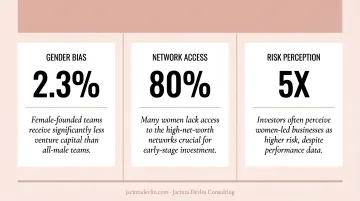
PitchBook's 2025 female founder report shows female-founded U.S. companies raised $73.6 billion — 27.7% of total VC deal value. Progress, yes. But all-female founding teams captured just 1.1% of U.S. venture capital that same year.
The bias shows up in the room. Harvard Business School researchers found investors preferred identical pitches 68% of the time when narrated by a man versus 32% when narrated by a woman.
Columbia researchers documented a related pattern: investors ask women prevention-focused questions (what could go wrong?) while asking men promotion-focused ones (how big can this get?). That framing gap is directly tied to lower funding outcomes.
The Structural Problem Behind the Numbers
The funding gap isn't just about investor bias. Three structural factors compound it:
- Own fewer assets on average, making traditional loan collateral requirements harder to meet
- Request smaller amounts: the Federal Reserve's Small Business Credit Survey found two-thirds of women-owned applicants asked for $100K or less, versus 49% of men-owned applicants — often leaving real needs underfunded
- Get approved less often: women-owned firms were approved for business loans 47% of the time versus 61% for men-owned firms, with 64% experiencing a funding shortfall
What Women Are Doing Instead
Most of Jacinta's clients are building businesses that don't need VC to get started — boutique owners, Amazon affiliates, direct sellers, and service providers who generate revenue first and fund growth from cash flow. Practical alternatives worth knowing:
- SBA Women-Owned Small Business federal contracting programs (5% federal contract goal)
- Grants specifically for women-owned businesses
- Crowdfunding and pre-sales to validate demand before investing
- Revenue-based financing once consistent income exists
The most common mistake: asking for less than the business actually needs. Women consistently underask, and underfunded businesses stall. Start with the real number.
The Confidence and Credibility Double Standard
The Double Bind
Too assertive, and she's aggressive. Not assertive enough, and she's dismissed. This isn't a perception problem unique to a few women — it's a documented pattern that creates constant internal negotiation male entrepreneurs simply don't face.
Research by Exley and Kessler found women rate their own performance 25% lower than men on average, even when their objective results are equal or better. A KPMG survey of 700 high-performing women found 75% had personally experienced imposter syndrome, with 56% fearing others wouldn't believe they were as capable as expected.
How It Shows Up in Business Decisions
Imposter syndrome in female entrepreneurs doesn't usually look like paralysis. It looks like:
- Pricing services below market rate because "I'm not ready to charge that yet"
- Over-delivering on every client without raising rates to match
- Hesitating to pitch larger clients or partnerships
- Holding back on visible content because it feels too self-promotional
- Waiting to feel fully ready before claiming authority
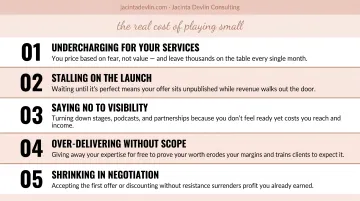
This isn't a personality flaw. It's a conditioned response to an environment that has historically penalized women for displaying the same confidence it rewards in men.
What Actually Builds Confidence
Confidence doesn't appear before action — it follows action. The practical path is to start showing up as the expert before you feel completely ready.
Jacinta's clients experience this directly. Christina R. grew her Instagram from 13,000 to 95,000+ followers and landed five-figure brand deals with Walmart and QVC. She didn't wait until she felt ready; she built visible credibility through consistent action, a clear brand identity, and a coach who laid out exactly what to do next.
Three things create that external confidence loop:
- Testimonials that prove your results to skeptical buyers
- Consistent content that builds familiarity and authority over time
- A clear market position that removes ambiguity about who you help and how
External proof becomes internal permission. The loop starts with showing up, not with feeling ready.
The Work-Life Juggle: When Everything Competes for Your Attention
The Data Is Clear
According to the Bureau of Labor Statistics' 2025 American Time Use Survey, women spend 2.8 hours per day on primary childcare versus 1.7 hours for men. Pew Research found that even in marriages where both spouses earn similar incomes, wives spend 6.9 hours per week on housework versus 4.4 hours for husbands.
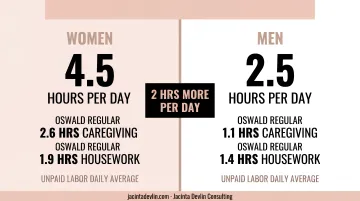
This isn't a complaint — it's a business reality. Building a business requires sustained focus, strategic thinking, and uninterrupted creative energy. All of those get consumed by constant context-switching between roles.
The Guilt Cycle
The hours lost are measurable. The guilt that follows is harder to quantify — but just as damaging. Women often feel guilty for working when they're at home, and guilty for not working when they're in business mode. That guilt erodes momentum faster than any scheduling conflict.
A 2024 poll found 35% of small business owners said lack of childcare prevents them from operating or expanding their business. That's a structural problem dressed up as a personal one.
What Successful Women Entrepreneurs Do Differently
They stop trying to do everything simultaneously. Practical shifts that protect business time:
- Set defined work hours and protect them, even when the schedule is unconventional
- Batch similar tasks together to cut down on constant context-switching
- Keep business time and home time separate — not every moment needs to serve two masters
- Let go of the belief that being constantly available equals being productive
The shift isn't about working more hours. It's about making the hours you do work actually count — and that starts with deciding they're worth protecting.
Lack of Networks and Mentors
Men built professional networks — and they built them for men. Women often enter industries without the informal relationships that quietly move opportunities, introductions, and capital. All Raise reports that when they started tracking in 2018, 91% of decision-makers at U.S. venture firms were men — a number that has shifted but still shows how much catching up is happening.
The scarcity of visible female mentors at the top creates a visibility problem. Research from a field study in Uganda found that female entrepreneurs with female mentors saw sales rise 34% and profits increase 29-30% compared to a control group — while those with male mentors saw no significant difference. Proximity to someone who has navigated the same specific terrain is what moves the needle.
That data points to something actionable: you don't wait for the right structure to show up — you build it deliberately.
- Seek out coaches and communities built specifically for women in your business category
- Online masterminds and membership communities provide peer access without geography constraints
- Jacinta Devlin's Dream+Create community is built for exactly this — member Sharon B. scaled from $4,000 her first year in Amazon selling to $20,000+ per month, crediting the network and partnerships she found there
The right community doesn't just product/service support — it creates the introductions, accountability, and momentum that would otherwise take years to find alone.
Market Saturation and Standing Out Online
If you're selling in a space dominated by women, you already know how crowded it feels. Etsy's U.S. seller base is 79% women, with 81% operating as solo businesses. The Direct Selling Association reports 5.4 million U.S. direct sellers — 73% of them women. ICF data puts women at 72% of global coaching practitioners.
Saturation itself isn't the problem. Lack of differentiation is.
Most businesses blend in because they lead with what they do instead of who they uniquely serve and why their approach is different. The instinct is to post more, be louder, stay more visible — but volume without clarity just creates noise.
The businesses that cut through in crowded markets share three things:
- They serve a clearly defined audience with a specific, named problem — not "women" or "entrepreneurs" broadly
- They show up with a recognizable point of view, not just products or service announcements
- They build real relationships with their audience over time, not just follower counts
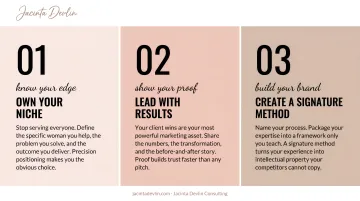
As Jacinta Devlin puts it: "You don't have a social media problem. You have a strategy problem dressed up as a social media problem." More content won't fix a positioning gap — but a sharper strategy will.
The Strategy Gap: Having a Business Idea vs. Building a Real Business
Busy vs. Building
There's a difference between women who are doing the work — posting, selling, showing up — and women who are building a business with systems, a scalable model, and a growth plan. Many women stall not from lack of effort, but because hustle replaced strategy somewhere along the way.
Common symptoms of the strategy gap:
- Inconsistent revenue with no clear reason why some months work and others don't
- No defined sales process — relying on sporadic posts and hoping someone buys
- Unclear ideal customer, which means messaging that resonates with no one specifically
- Pricing that can't scale because it's attached to time rather than value
- Feeling constantly busy without actual forward movement
Jacinta's platform describes it plainly: "You don't have a social media problem. You have a strategy problem dressed up as a social media problem." The same applies to revenue problems, visibility problems, and growth problems — most of them trace back to activity without architecture.
What the Shift to Strategy Actually Looks Like
The shift isn't about working more hours. It's about replacing scattered effort with a plan that compounds. Client Amanda O. came in generating $2,500 per month. Within months of working through the Business Growth Program, she was consistently hitting $10,000+ months — not because she tripled her effort, but because she redirected it.
This is where working with an experienced business coach changes the trajectory. Jacinta Devlin Consulting builds individualized strategy around each specific business: a custom growth plan built around your model, offers, audience, and revenue targets, with weekly 1:1 coaching to keep execution on track. Every client moves forward with a clear roadmap — not a guess.
Frequently Asked Questions
What are the major challenges faced by women entrepreneurs?
The core challenges include unequal access to funding, the confidence and credibility double standard, disproportionate work-life demands, limited professional networks, market saturation, and the absence of a real growth strategy. Most women face several of these at once.
Why do women entrepreneurs struggle to get funding?
Documented investor bias, collateral gaps from historical wealth inequality, and low approval rates for business loans all contribute. Women-owned firms were approved for loans 47% of the time versus 61% for men-owned firms, and two-thirds of women applicants request amounts below $100K — often underasking relative to actual need.
How can women entrepreneurs overcome imposter syndrome?
Imposter syndrome is a conditioned response, not a character flaw. It doesn't dissolve before action — it follows action. Showing up consistently, sharing expertise publicly, and collecting concrete proof of results builds confidence over time — waiting to feel ready first typically means waiting indefinitely.
What is the biggest barrier to growing a women-owned business beyond the startup stage?
The shift from activity-based hustle to strategy-based growth. Many women hit a ceiling because they're working in the business — posting, selling, fulfilling — rather than on a scalable plan. That requires stepping back and building the systems that create repeatable results.
How important is mentorship for women entrepreneurs?
Research shows female entrepreneurs with female mentors saw sales rise 34% and profits increase nearly 30% compared to those without. Beyond the numbers, the right mentor compresses years of trial and error into months of focused execution — especially when they've navigated the same specific business challenges firsthand.
Can women entrepreneurs succeed without a formal business background?
Absolutely. Jacinta started at 21 as a broke college student at a direct sales party and built to Top 1% seller, million-dollar earner, and a consulting business with over $1M in revenue. What matters is willingness to learn, take consistent action, and invest in the right guidance rather than trying to figure everything out alone.