
The gap between being a skilled photographer and running a profitable business is real — and it catches most photographers off guard. Suddenly you're not just a photographer. You're a marketer, a salesperson, a bookkeeper, a client manager, and a social media strategist, all rolled into one. According to the Bureau of Labor Statistics, 66% of photographers are self-employed — which means the majority are navigating every one of those roles without a team or a roadmap.
The result? Inconsistent bookings. Underpricing. Marketing that goes nowhere. Burnout from wearing every hat at once.
A business coach for photographers isn't a luxury add-on. It's the strategic investment that bridges the gap between creative skill and sustainable income — and this article breaks down exactly what that looks like in practice.
Key Takeaways
- A business coach addresses the business side of photography — pricing, marketing, client acquisition, and scalability — not technique.
- Most photographers plateau because of a strategy gap, not a talent gap.
- Coaching delivers the most impact in three areas: pricing confidence, revenue consistency, and accountable execution.
- Going without a coach often means slower growth, reactive decisions, and missed revenue that compounds over time.
- A great coach builds strategy around your specific market, niche, and goals — not a generic template someone else used.
What Is a Business Coach for Photographers?
A business coach for photographers is not a photography mentor — and the difference goes deeper than job title.
A photography mentor focuses on craft — composition, lighting, editing style, shooting technique. A business coach focuses on everything else: pricing strategy, marketing systems, client acquisition, revenue goals, and the operational decisions that determine whether your business grows or stalls.
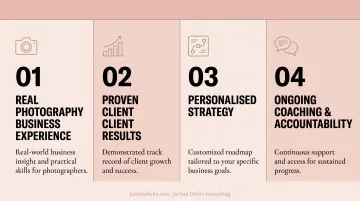
The best coaches don't just teach theory. They help you build and execute a plan specific to your business — your market, your niche, your client type, your capacity. That specificity is what separates advice you can act on from guidance that sounds good but goes nowhere.
Business coaching delivers specific outcomes:
- More consistent income month to month
- Higher-value clients who don't push back on your rates
- A business that doesn't depend entirely on you grinding harder every season
Those outcomes don't come from a generic playbook. They come from a coach who understands your specific situation and builds strategy around it.
Key Benefits of Hiring a Business Coach for Photographers
The benefits below aren't abstract — they show up in booking rates, average session revenue, and whether your business grows year over year or flatlines.
Faster Growth With a Clear, Personalized Strategy
Most photographers waste months, sometimes years, trying to reverse-engineer what's working for someone else. They follow generic advice from YouTube tutorials, courses, or Instagram posts built for a completely different market, niche, or business model. And then they wonder why it isn't working.
A coach builds a strategy specific to your situation: your pricing tier, your local market, your target client, your current capacity. Moving from guessing to executing is where the real time and money savings are.
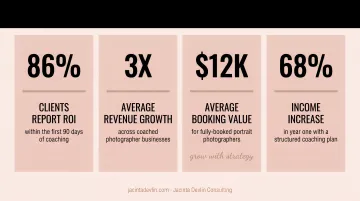
The data backs this up. An ICF Global Coaching Client Study found that 61% of coaching clients reported a positive change in business management, and among individuals who could quantify financial return, the median ROI was 344% — meaning most recouped more than three times their coaching investment. This is self-reported, cross-industry data rather than photographer-specific — but the directional reality holds: coaching produces measurable returns. For photographers, the metrics that move most are:
- Booking conversion rate
- Client inquiry volume
- Average package or session value
- Time to consistent $5K or $10K months
Pricing Confidence and Revenue Consistency
Underpricing is one of the most costly mistakes photographers make — and it's almost never about not being good enough. It's about fear of losing clients, not knowing your actual cost of doing business, or comparing your rates to competitors without understanding what those competitors' businesses actually cost to run.
The Professional Photographers of America notes that photographers on average keep roughly 20% of total income as personal pay, with the remaining 80% going to business expenses like equipment, software, insurance, and overhead. Price without accounting for that reality, and you're not building a business — you're running a very expensive hobby.
A coach helps you build a pricing structure that:
- Reflects your actual value and market position
- Covers your true cost of doing business
- Supports consistent monthly revenue targets rather than feast-or-famine swings
The downstream effect is significant. McKinsey research shows a 1% price increase can translate into an 8.7% increase in operating profits when volume holds. For photographers stuck at rates they set years ago, even a modest pricing correction compounds quickly.
The real outcome: higher average booking value, fewer clients needed to hit your income goals, and more time to do your best creative work — rather than overloading your calendar to compensate for undercharging.
Accountability, Direction, and the Clarity to Actually Execute
Most photographers already know what they should be doing: showing up consistently on social media, following up with leads, building a referral system, niching down. Knowing and doing are different things entirely without a structure that makes execution unavoidable.
Without accountability, everything feels urgent and nothing gets done consistently. The execution gap comes down to prioritization and structure, not motivation. A coach closes that gap through:
- Regular check-ins and real-time feedback on decisions
- A clear action plan with sequenced priorities (not a 47-item to-do list)
- An outside perspective that can see the whole business picture and redirect energy toward what actually moves the needle
Research from Dominican University found that people who sent weekly progress reports to an accountability partner achieved significantly more than those who only set goals, even those who wrote them down. The structure of regular reporting is what drives follow-through.
This matters most for photographers who are already earning but feel like they've hit a ceiling. Not sure if the answer is more marketing, different pricing, or new packages? A coach can see what you can't, precisely because you're too close to it.
Signs You're Ready for a Business Coach as a Photographer
Not every photographer needs a coach right now. But certain signals are worth paying attention to:
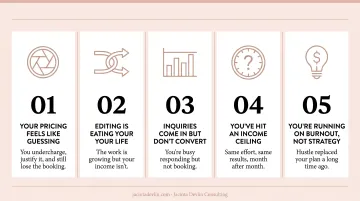
- Revenue inconsistency — strong months followed by slow months, with no clear explanation for either
- Pricing pushback — attracting clients who negotiate, compare you to cheaper competitors, or ask for discounts regularly
- Marketing without return — spending hours on Instagram or content creation and seeing no measurable impact on bookings
- The business is running you — you're reactive, always behind, never operating with a forward-looking plan
- The plateau signal — you know what you're doing technically, you're getting bookings, but growth has stalled and you can't identify why
That last one is where a coach pays for itself fastest. Photographers who are already doing well break through that ceiling faster with structured coaching — whether that means raising rates, scaling beyond solo shooting, or building toward consistent $10K+ months.
You don't need to be struggling to benefit. You need to be a woman who's serious about building something real — and done guessing at what's holding you back.
What Happens When Photographers Skip Business Coaching
Going it alone has a compounding cost that's easy to miss until years have passed.
Skills stay sharp. The business side stagnates. And photographers often stay at the same income level — and the same rates — for years, not because they lack talent but because no one ever helped them build a strategy for growth.
The pattern that emerges without structure is predictable:
- Chasing bookings last-minute instead of filling a calendar intentionally
- Saying yes to clients who aren't the right fit, at rates that don't serve the business
- Discounting to fill gaps rather than building demand that justifies higher prices
- Never having a forward-looking marketing plan — always reacting, never planning
Those operational patterns carry a mindset cost too. Without outside perspective, many photographers internalize the plateau as a personal failure — telling themselves "I'm not good enough" or "My market won't pay more."
That thinking is almost never accurate. The real problem is a missing strategy, not missing talent.
How to Choose the Right Business Coach for Your Photography Business
Not all coaching is created equal. A few criteria worth applying:
Look for a coach who has actually built something. Advice from someone who has personally scaled a business — navigated pricing decisions, built client acquisition systems, hit revenue targets — lands differently than advice from someone who has only taught the theory.
Prioritize individualized strategy over templated programs. A course gives you information. A coach gives you a plan built around your specific business, market, and goals. The best 1:1 programs — the kind built around no cohort, no copy-paste playbook, no generic frameworks — are where that difference actually shows up in revenue.
Match the format to your stage. Group programs and memberships work well for community and accountability. One-on-one coaching is where the most personalized strategy gets built. Someone just launching has different needs than a photographer hitting a revenue ceiling.
Watch for red flags. Avoid coaches who promise specific income results before understanding your business, or who lead primarily with lifestyle marketing rather than a repeatable business-building methodology. The best coaching relationship is grounded in honest assessment, clear accountability, and measurable milestones.
Frequently Asked Questions
How much should a business coach cost?
The 2025 ICF Global Coaching Study puts the average one-on-one coaching session at $234/hour, though costs vary significantly by format — group programs run lower, premium 1:1 packages run higher. The more useful frame is ROI: the right coach pays for themselves through improved pricing and booking outcomes, often within the first few months of engagement.
Is $100 an hour good for a photographer?
It depends on your market, niche, experience level, and actual cost of doing business — not just what others charge. The BLS reports a median photographer wage of $20.44/hour for employed photographers, but that figure excludes self-employed workers entirely. A $100 rate needs to hold up against overhead, unpaid admin time, equipment costs, and profit goals — which is exactly what a business coach helps you evaluate.
What does a business coach for photographers actually do?
A business coach handles the non-technical side of your photography business: pricing strategy, marketing systems, client acquisition, revenue goals, and operational structure. They don't touch camera technique or post-processing — that's a photography mentor's territory. A coach focuses on strategy and execution — building the plan that turns your photography into consistent, profitable income.
When is the right time to hire a business coach as a photographer?
Coaching is valuable at multiple stages — early on to build the right foundation and avoid costly mistakes, and later to break through a revenue ceiling. The best time is when you're serious about making photography a primary income source and ready to commit to a real strategy.
What's the difference between a photography mentor and a business coach?
A photography mentor focuses on craft — shooting style, technique, editing, and creative development. A business coach focuses on strategy, revenue, marketing, and operations. Both can be valuable, but they serve completely different needs. If your business isn't growing, a business coach is the gap you're missing.
Can a business coach help if I'm just starting out in photography?
Yes — starting with the right business foundations (pricing, positioning, marketing strategy) can dramatically accelerate early growth. The photographers who avoid years of underearning are almost always the ones who built a real business structure from the start, rather than figuring it out reactively.