Introduction
There are 14.5 million women-owned businesses in the U.S., representing nearly 40% of all firms. Yet those businesses account for only 6.2% of total national firm revenue — a gap that reveals exactly how wide the distance is between starting a business and actually scaling one.
Most women entrepreneurs aren't struggling because they lack drive. They're struggling because they don't know which strategies to prioritize, they're wearing every hat in the company, and they're following generic advice that wasn't built for an online or service-based business model.
This guide skips the generic playbook. Here are five concrete growth strategies built for 2026 — and for the realities of running a women-owned business right now:
- Personal branding — building authority that converts attention into revenue
- Social commerce — turning platforms into direct sales channels
- Scalable systems — removing yourself as the bottleneck
- Income diversification — creating multiple revenue streams from one business
- Community-driven growth — building an audience that sells for you
Key Takeaways
- A strong personal brand is your highest-ROI growth asset: it pulls buyers to you instead of chasing cold leads
- Social commerce and short-form video are core revenue channels in 2026, not optional extras
- Automation and scalable systems let you grow revenue without burning out
- Community, referrals, and strategic partnerships accelerate results faster than paid ads alone
Why 2026 Marks a New Era for Women Entrepreneurs
The numbers confirm what many women already sense: this moment is different.
According to the NWBC's 2024 data, 14.5 million women-owned businesses employ 12.9 million people and generate $3.3 trillion in annual revenue. That's not a niche segment — that's a major economic force.
The Playing Field Has Shifted
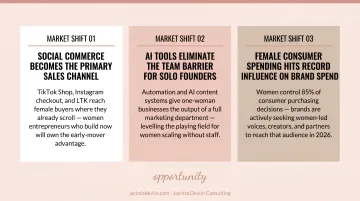
Three structural changes have made 2026 different from any previous era:
- Social commerce is exploding. U.S. social commerce sales are forecast to surpass $100 billion in 2026, up from $87 billion in 2025 — a 21.5% year-over-year increase
- The creator economy is mainstream. Creator economy ad spend reached $29.5 billion in 2024 and is projected to hit $37 billion in 2025, growing 4x faster than total media
- AI tools have lowered the cost of entry. Automation, content creation, and CRM tools that once required a full team are now accessible to a solo operator
The Gap That Still Exists
Despite this growth, the funding and revenue disparity remains stark. All-female-founded companies received just 1.9% of total U.S. venture capital in 2024, compared to 80%+ going to all-male-founded firms.
At the current rate of progress, closing the average revenue gap between women-owned and men-owned businesses would take 120 years. The five strategies below are designed to compress that timeline — starting with the decisions you make this year.
Build a Personal Brand That Attracts Customers Organically
Here's the core truth about selling online in 2026: people don't buy from businesses, they buy from people they trust. Edelman's 2024 Brand Trust research found that 84% of consumers must share values with a brand before purchasing. HubSpot's 2024 Consumer Trends Report found that 63% of consumers prefer authentic marketing videos over polished, produced ones.
A strong personal brand is the mechanism that creates that trust at scale — without requiring a massive ad budget.
What a Personal Brand Actually Means in Practice
For a small business owner, a personal brand is not a logo or a color palette. It's the consistent combination of:
- The story behind why you started and who you serve
- The specific problems you solve and results you create for clients
- How you communicate across every platform where your audience finds you
- The visual signals that make your content immediately recognizable
The Three Pillars for 2026
1. Niche clarity. The single most common brand mistake is trying to appeal to everyone. Specificity wins. Knowing exactly who you serve and what problem you solve makes your content more compelling, your product/service easier to buy, and your referrals more targeted.
2. Consistent visual identity. Your colors, fonts, and visual style should be immediately recognizable whether someone finds you on Instagram, in their inbox, or on your website. Inconsistency signals amateur. Consistency signals authority.
3. A signature content angle. What do you talk about that no one else talks about quite the way you do? This is what separates a forgettable feed from one that builds a real following.
Why Brand Authority Compresses the Sales Cycle
When your audience already trusts you as an expert before they need your product or service, the buying decision is faster and objection-handling is minimal. At that point, they're not comparing you to competitors. They're waiting to hear from you.
Client Christina R. saw this firsthand. After a complete rebrand to @mybalancedstyle, she grew from 13,000 to 95,000+ Instagram followers, hit six figures within six months, and went on to generate hundreds of thousands per month through Amazon and LTK. The rebrand repositioned her entire business, not just her visuals.
For women entrepreneurs who want to nail brand positioning without years of trial and error, working with a strategist who specializes in brand discovery and positioning architecture — like Jacinta Devlin — can shave years off that learning curve.
Master Social Commerce and Content-Driven Growth
Social commerce is no longer a trend worth watching. EMARKETER projects U.S. social commerce sales will surpass $100 billion in 2026, with TikTok Shop alone growing 407% in 2024 and projected to nearly double again in 2025. One-third of adults ages 18–34 have already made a purchase on social media.
The opportunity is real. The question is how to capture it.
The Three-Layer Content Framework
Effective social commerce requires three types of content working together:
- Short-form video (Reels, TikToks): drives reach and discovery. HubSpot reports short-form video delivers the highest ROI for 49% of marketers, with TikTok and YouTube Shorts both exceeding 5% engagement rates
- Longer storytelling content (captions, email, blog): builds trust and explains the "why" behind your product/service
- Direct calls to action: converts attention into purchases
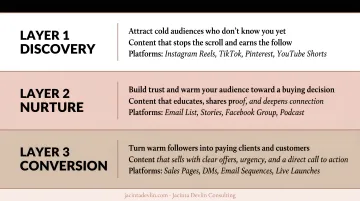
None of these works in isolation — skip one layer and the whole system stalls.
Which Platforms to Prioritize
| Business Type | Best Platforms |
|---|---|
| Personal brand, coaching, services | Instagram, TikTok |
| Boutique, fashion, lifestyle | Instagram, TikTok Shop, LTK |
| Home decor, beauty, lifestyle affiliates | Amazon Storefront, LTK |
| All business types | Email (owned audience) |
LTK is particularly powerful for product-based and lifestyle businesses — the platform drives more than $6 billion in annual sales across its creator and retail network.
Why Email Is Still Your Most Valuable Asset
Algorithm changes can cut your organic reach overnight. Platform bans are real. Your email list cannot be taken from you.
Litmus research shows email marketing ROI ranges from 10:1 to 36:1 for most companies — a figure that outperforms virtually every other channel. Jacinta Devlin frames it directly: Instagram is rented land; your email list is owned land. The women entrepreneurs who reach six figures consistently cite email automation as a core driver, not a nice-to-have.
Devlin Consulting builds full email systems for clients because the infrastructure behind the list matters as much as the list itself. That includes:
- Platform setup on Flodesk, Klaviyo, Kit, or MailerLite
- Welcome sequences that convert new subscribers into buyers
- Sales and launch campaign automation
- Abandoned cart sequences that recover lost revenue
Create Scalable Systems and Multiple Income Streams
Revenue growth without systems just creates more manual work — more hours, more bottlenecks, more burnout. The entrepreneurs hitting $10k, $20k, and $50k months aren't grinding harder than the ones who stay stuck. They've built systems that multiply their effort so the business grows without them being the engine.
The Automations That Matter Most
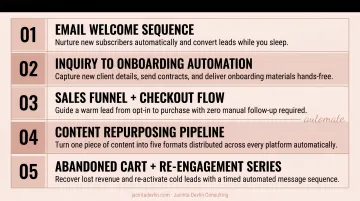
A well-built automation stack handles the repetitive work your business runs on:
- Email welcome sequence — converts new subscribers into buyers without manual follow-up
- Abandoned cart sequence — recovers lost sales from shoppers who didn't complete checkout
- Client onboarding workflow — removes the back-and-forth from new client intake
- Social media scheduling — maintains consistency without daily manual posting
- Payment and checkout systems — processes sales, sends receipts, and triggers post-purchase sequences automatically
Salesforce research found that 91% of SMBs using AI report revenue gains, and 90% say it helps them save time. Once the right automations are in place, those hours go back to revenue-generating work.
The Income-Stacking Model
Single-revenue-stream businesses are fragile. An algorithm shift, a slow season, or a platform policy change can wipe out a significant chunk of income with no backup plan.
Building multiple streams doesn't mean doing everything at once — it means layering strategically as each stream stabilizes. A practical model looks like this:
- Core product/service (service, coaching, product) — your primary revenue engine
- Affiliate income (Amazon, LTK, brand partnerships) — semi-passive, scales with audience
- Digital product or membership — lower-ticket, high-volume
- Brand partnerships — negotiated, project-based
U.S. affiliate marketing spend is projected to reach $13.2 billion in 2026 — a channel that rewards creators who already have an engaged audience.
Jacinta Devlin built this model personally — coaching/consulting, her Amazon storefront (StyledByJacinta), her LTK creator account, Jacinta The Label boutique, and brand partnerships with Gucci, Nordstrom, and Sephora. Coaching is her fifth business, not her first. She built each stream, stabilized it, then layered the next — sequence mattered more than speed.
Client Sharon B. mirrors this exactly — she went from $4,000 in her first full year on Amazon to consistently generating $20,000+ per month after implementing Jacinta's strategy. Client Joy W. went from $500 months to consistent $5k+ months across multiple businesses. The systems drove the results.
Grow Through Community, Referrals, and Strategic Partnerships
Paid advertising rents attention. Community builds the kind of trust that turns buyers into repeat customers and advocates.
Nielsen research found that 88% of global consumers trust recommendations from people they know more than any other channel — 50% more than online advertising. Foundational Wharton research on referral programs found that referred customers have 16% higher lifetime value, stay 18% longer, and generate measurably higher margins than non-referred customers.
A loyal community does your marketing for you. The goal is to build one.
Three Actionable Community Growth Strategies
1. Launch a referral program with a real incentive. Structure it with a specific reward for both the referrer and the new customer — a discount, credit, or gift. Even a simple setup creates a steady stream of warm leads that convert at higher rates than cold traffic.
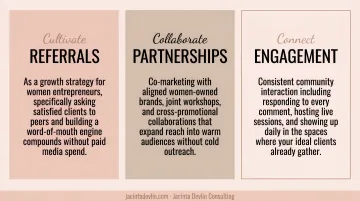
2. Pursue co-marketing partnerships with complementary businesses. Find women entrepreneurs who serve the same audience but product/service different products or services. Joint giveaways, co-hosted events, newsletter swaps, or Instagram Lives together immediately double your audience reach without ad spend. The women entrepreneur space is uniquely collaborative, and that goodwill is a real growth lever.
3. Show up consistently in the communities where your ideal clients already spend time. Whether that's a Facebook group, a Slack community, an industry forum, or an in-person event — contribution and consistency in one or two spaces builds relationships faster than posting to your own account.
Jacinta Devlin's Dream+Create Online Coaching Community is a working example of this approach. Client Sharon B. grew two Facebook Groups — one to 30,000+ members, another to 37,000+ members in just four months — and attributes direct partner relationships and group collaborations to her membership. That community-driven growth fed her Amazon revenue directly.
When you collaborate with another credible entrepreneur on a joint promotion, you borrow trust from both audiences at once. That borrowed trust converts faster than any cold campaign you could run.
Frequently Asked Questions
What are the most effective small business growth strategies?
The highest-impact strategies combine personal branding, social commerce, systems and automation, and community-driven marketing. Your current stage matters: a woman just launching has different priorities than one scaling past $10k/month.
How do women entrepreneurs grow their businesses online in 2026?
Short-form video drives discovery, email converts, and a clear personal brand builds trust across platforms. Social commerce on Instagram, TikTok, and LTK now makes it possible to sell directly through content without a large ad budget.
What is the fastest way to scale a small business to consistent revenue?
The fastest path combines a clear niche, a proven product/service, a content-driven marketing system, and scalable delivery. Skipping any of these creates a bottleneck : strong marketing can't fix an unclear product/service, and a great product/service without marketing stays invisible.
How can women entrepreneurs build multiple income streams?
Stack complementary streams: a core service or product, affiliate income (Amazon, LTK), a digital product or membership, and eventually brand partnerships. Build one to stability before adding the next — running all four at once splits focus and slows every one of them.
What role does social media play in growing a women-owned business?
Social media now functions as both a brand-building tool and a direct revenue channel. Instagram, TikTok Shop, and LTK let women entrepreneurs attract clients, build trust, and generate sales from the same piece of content, making it one of the most cost-efficient growth channels available.
How do I know when to hire a business coach?
The right time is when you're stuck at a plateau, unclear on your next move, or spending more time on trial and error than on execution. A good coach, like Jacinta Devlin at Jacinta Devlin Consulting, provides a personalized strategy built for your specific business rather than a one-size-fits-all curriculum.