

There are also patterns specific to women practitioners: discomfort with self-promotion, chronic underpricing, reluctance to call themselves experts, and the quiet belief that good clinical work should be enough to fill a caseload. These aren't character flaws. They're predictable responses to a training system that never taught business — and they're fixable.
This article covers six practical strategy areas: treating your practice like a real business, building an online presence, developing referral relationships, pricing with confidence, expanding revenue beyond individual sessions, and creating systems that support sustainable growth. The core premise is simple — growing a therapy practice isn't about working harder. It's about building smarter.
Key Takeaways
- Defining a clear niche attracts the right clients faster than broad, generalist messaging ever will
- A professional website, strong online presence, and strategic social media are non-negotiable growth foundations
- Referral relationships with aligned businesses and community partners remain one of the most reliable client pipelines available
- Pricing confidently is a business skill — undercharging leads to burnout, not humility
- Revenue beyond one-on-one client work reduces financial pressure and expands your impact without adding unsustainable hours
Treat Your Therapy Practice Like the Business It Is
The "I just want to help people" mindset is genuine and admirable. It's also the single most common reason women therapists avoid the business decisions that would allow their practice to actually survive. A practice that isn't financially sustainable cannot serve anyone.
Running a profitable practice isn't a compromise of your values — it's what makes your clinical work possible long-term.
Clarify Your Niche
Choosing a specialty is one of the highest-leverage decisions a therapist can make. A clearly defined niche sharpens your marketing, accelerates word-of-mouth referrals, and positions you as a go-to resource rather than a generalist competing against every other provider in your area.
Niching doesn't mean turning clients away — it means becoming the obvious choice for a specific population or problem.
A few examples of well-defined niches:
- Anxiety in high-achieving women, who present with specific concerns and a strong willingness to invest in support
- Postpartum mental health, a defined life stage with built-in referral partners (OB-GYNs, pediatricians, midwives)
- Couples navigating infertility, a specialized focus that commands premium rates and generates referrals from reproductive medicine providers
Each of these is specific enough to make marketing straightforward and referral relationships obvious.

Write a Real Business Plan
A business plan isn't just for bank loans. A simple, one-page plan covering your target client, service offerings, fee structure, marketing approach, and annual revenue goal gives every daily decision a frame of reference.
Without that frame, daily decisions become guesswork — and guesswork compounds into stalled growth.
According to SimplePractice's 2025 State of Private Practice report, the average self-pay therapy session rate is $139.75, compared to $99.75 for insurance reimbursements — a $40-per-session gap that compounds significantly across a full caseload. Knowing your numbers and structuring your practice accordingly isn't optional; it's how you build something sustainable.
Know Your Numbers
Every practice owner should have a working grasp of four core metrics:
- Caseload capacity — how many clients you can realistically see per week without compromising quality or your own wellbeing
- Average session revenue — weighted across self-pay, sliding scale, and insurance rates
- Monthly overhead — rent, EHR software, liability insurance, continuing education, marketing
- Income goal — what you actually need to take home, not just break even
TherapyDen's 2025 analysis of 1,200 private-practice Schedule C filings reported average gross billings of $147,000 with take-home pay of $96,500 after expenses. That benchmark is useful context — but your specific numbers, built around your fee structure, caseload, and overhead, are what actually drive decisions.
Use those benchmarks as a starting point, then build your own targets around your specific practice model and income goals.
Build an Online Presence That Attracts Your Ideal Clients
Your online presence is your storefront. If potential clients can't find you, research you, and feel confident in you before they reach out, they'll move on to someone they can. That's simply how most people make healthcare decisions today.
Build a Website That Works for You
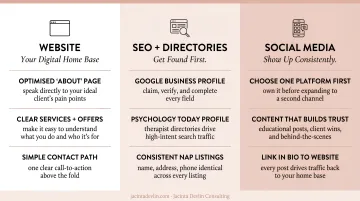
A strong therapist website isn't a credential display. It's a conversion tool. It should speak directly to your ideal client's pain point and make it easy for them to take the next step.
Every effective therapist website includes:
- A professional headshot (warm, approachable — not clinical)
- A bio written in plain language that connects with the client, not just lists degrees
- A clear description of specialties and who you work best with
- Location, telehealth availability, and current openings
- A straightforward way to book a consultation or send an inquiry — one click, no hoops
SEO matters here. Using location-based keywords ("therapist for anxiety in Austin"), writing blog content on topics your clients search for, and maintaining an updated Google Business Profile all help the right people find you without paid advertising.
Get Listed in Therapist Directories
Directories are often the first place therapy-seekers search. A complete, well-written profile dramatically increases inquiry rates.
| Directory | Cost | Key Features |
|---|---|---|
| Psychology Today | ~$29.95/month (verify current rate) | High traffic, HIPAA-compliant teletherapy platform, no contract |
| TherapyDen | Free basic profile | 140+ search filters, niche/values fields, no credit card required |
| GoodTherapy | Paid membership tiers | Profile with CE-related membership benefits (verify current pricing before listing) |
A profile with a photo, clear specialty description, insurance information, and a warm bio performs significantly better than a bare-bones listing.
Show Up on Social Media Strategically
Social media for therapists isn't about posting everywhere — it's about choosing one or two platforms where your ideal client actually spends time and showing up consistently. Instagram and Facebook work well for many therapy niches; TikTok is the stronger choice if you work primarily with younger adults or college-age clients.
Content ideas that work within ethical boundaries:
- Mental health tips and mental health education
- Myth-busting posts ("What therapy actually looks like")
- Normalized conversations about common struggles your niche faces
- Authentic personal perspective that builds trust — without disclosing client information
The goal is simple: a potential client finds your content and thinks "This person gets me." Post consistently, stay in your lane ethically, and that recognition compounds over time.
Grow Your Referral Network and Visibility
For most women in service-based businesses — especially in the early to mid-growth stage — referral relationships generate more consistent client volume than any single marketing channel. Warm referrals convert at higher rates because trust is already partially established before the first contact.
Build Local Referral Relationships
The strongest referral partners are people who regularly work with your ideal client:
- Complementary service providers (photographers, web designers, brand strategists)
- Local business associations and women's entrepreneur groups
- Networking communities in your niche (direct sales, e-commerce, coaching)
- Event organizers and conference coordinators
- Fellow coaches and consultants in adjacent specialties
Starting these relationships doesn't require a polished pitch. A brief introduction at a networking event, a direct message online, or a simple coffee chat is enough. The goal is to make it easy for them to refer — which means being specific about who you help and what you do.
Network with Other Service Providers
The mutual referral model among service providers is underused and highly effective. Building relationships with women in different but complementary specialties creates a two-way pipeline that benefits both businesses and their clients.
Practical ways to build this network:
- Join local chambers of commerce or women's business associations
- Attend industry-specific events and entrepreneur meetups
- Participate in online communities — Facebook groups and LinkedIn are strong starting points
Raise Your Visibility Through Speaking
Hosting free workshops, speaking at local business events, women's conferences, corporate panels, or online summits — these are some of the most effective ways to establish authority and generate referrals without paid advertising.
Many women hesitate to position themselves as speakers or experts. Push through it anyway. Early opportunities, even unpaid ones, build your portfolio, sharpen your delivery, and put you in front of people who become clients or send them your way.
Referral sources recommend women they trust — and visibility is what builds that trust.
Price Your Services with Confidence
Undercharging is one of the most consistent patterns among women practitioners — starting fees too low, keeping them there indefinitely, and feeling guilty about raising them. This isn't humility. It's a business problem that leads directly to burnout and forces a practice to operate at unsustainable margins.
A simple framework for setting fees:
- Research your local market — SimplePractice's 2025 therapy cost data shows average session fees ranging from $122 to $227 depending on state and region. Know where your market sits.
- Factor in your overhead — calculate monthly costs (space, software, insurance, CE) and divide across your intended caseload
- Anchor to your income goal — work backward from what you need to take home, not forward from what feels comfortable to charge
- Set your rate at the intersection of market data and the outcomes you consistently deliver

Offering reduced-fee slots is a legitimate access strategy — as long as the criteria, slot count, and boundaries are set before you're sitting across from a client who can't afford your full rate. Decide proactively: how many slots, at what rate, and under what circumstances. Reactive sliding scale management is how full-fee slots disappear.
Expand Your Revenue Beyond the Session
Trading one hour for one fee creates an income ceiling you cannot break without working unsustainable hours. For women therapists who want to grow both income and impact, adding revenue streams beyond individual sessions is a deliberate business decision.
APA's research confirms that group therapy is as effective as individual therapy for a wide range of conditions, yet makes up at most 5% of private practice treatment. That's a wide gap between what works clinically and what most therapists offer.
Four practical income expansion options:
- Group therapy — same time investment, multiple clients, no compromise in clinical effectiveness
- Themed workshops or psychoeducation series — one-time or recurring, can serve both current and prospective clients
- Digital products — workbooks, guided exercises, or e-books that clients access outside sessions
- Speaking and training — fees for presentations to organizations, companies, or professional groups
Each of these also functions as a marketing channel. A workshop attendee who isn't ready for therapy is a future client. A speaking engagement at a corporate wellness event generates both speaking income and referrals.
The core shift is recognizing that your expertise has value beyond the session hour. Start with one additional format — group therapy or a single workshop — before building out a full product suite. Adding too many streams at once fragments your focus; adding one strategically compounds your reach.
Use Systems to Scale Without Burning Out
Growth without systems creates chaos — and chaos is what causes most women entrepreneurs to plateau or walk away from businesses they worked hard to build. The solution isn't to slow down. It's to build infrastructure that keeps up with you.
Every growing service-based business needs these systems in place:
- Online scheduling with automated reminders — reduces no-shows and eliminates back-and-forth booking
- Client communication and documentation tools — non-negotiable for professionalism and client trust
- Consistent client intake process — intake forms, agreements, and onboarding communication that run automatically
- Financial tracking from day one — revenue, expenses, and outstanding invoices tracked consistently, even with a basic tool, so you always know where you stand
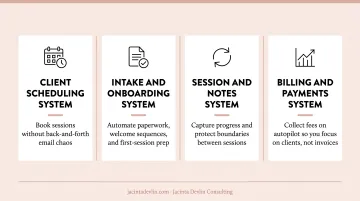
All-in-one platforms built for service providers — tools like Dubsado, HoneyBook, or a simple CRM paired with email automation — consolidate scheduling, contracts, invoicing, and follow-up in one place. The monthly cost is minimal compared to the hours they free up and the client experience they create.
Sustainable growth means your capacity doesn't become the ceiling. When systems handle the repetitive work, you protect your time, stay present for clients, and create room to take on more — without burning out in the process.
Frequently Asked Questions
How do you make $200,000 as a therapist?
Reaching $200K requires combining a full private-pay caseload at competitive rates with additional revenue streams — group sessions, workshops, speaking fees, or digital products. Getting there means running the practice like a real business, with intentional revenue strategy built around multiple income sources — not just adding more individual clients to your schedule.
How long should therapists commit before expecting a sustainable practice?
Most therapists find that two to three years of consistent effort — niche refinement, referral-building, and online presence development — is a realistic window for reaching a stable, profitable practice. Expecting sustainability sooner is possible with the right systems in place, but two years is a reasonable minimum commitment for most practitioners starting from scratch.
How long does it take to build a full therapy practice?
Most therapists reach a full caseload within one to three years, though that timeline shortens significantly with a well-defined niche, active referral relationships, and a strong online presence established early.
What is the best way to market a therapy practice?
The highest-impact combination for most therapists: an optimized directory profile (especially Psychology Today), a niche-specific website with local SEO, and active referral relationships with physicians and community providers. Consistency in these three areas outperforms trying to do everything at once.
Should therapists be on social media?
Yes — when used ethically and strategically. Choosing one or two platforms where your ideal client spends time and posting consistently is far more effective than maintaining a scattered presence across every platform.
How do I get more referrals for my therapy practice?
Build direct relationships with primary care physicians, school counselors, and community providers through brief introductory outreach and consistent follow-up. Also invest in peer referral relationships with therapists in complementary specialties — full caseloads flow both directions.