Introduction
Women-owned businesses now represent 40.6% of all U.S. firms — 15.7 million businesses and counting. Yet many of the women behind those businesses are running marketing completely solo, without dedicated teams or enterprise budgets.
The frustration is consistent: posting content regularly, sending the occasional email, showing up on social media — and still not seeing predictable growth. As Jacinta Devlin of Jacinta Devlin Consulting puts it, this is the "post and pray" trap: effort without strategy, and no tools to bridge the gap.
The right tools change that. This guide breaks down the best marketing tools for women-owned small businesses, specifically selected for social sellers, ecommerce founders, coaches, and boutique owners. Every tool on this list was chosen for ease of adoption, pricing accessibility, and proven ability to drive real revenue — not just brand awareness.
Key Takeaways
- The right tool stack depends on your business model and where your customers actually buy
- The five core functions to cover: visual branding, email marketing, social scheduling, automation, and analytics
- Most tools on this list product/service free tiers, but the wrong tool still costs you time you can't get back
- Tools amplify strategy, not substitute for it — define your goal first, then pick your software
Why Women-Owned Small Businesses Need the Right Marketing Tools
Women entrepreneurs — especially solopreneurs in social selling, ecommerce, and coaching — are typically handling marketing, fulfillment, customer service, and sales at the same time. The right tools are what allow one person to show up consistently without burning out.
The numbers back this up. According to Constant Contact's 2025 Small Business Now report, only 18% of small business owners feel very confident in their marketing effectiveness — down from 27% the year before. Effort is increasing, but confidence is declining. That gap is largely a tools and strategy problem, not a work ethic problem.
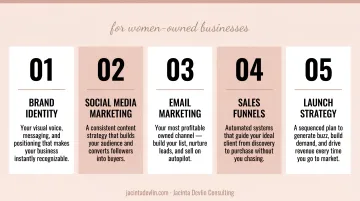
Closing that gap means having the right systems in place. For women running businesses across boutique retail, direct sales, influencer marketing, and coaching, that comes down to five functions:
- Design — creating branded content without a graphic designer
- Email marketing — building an owned audience that converts
- Scheduling — showing up consistently without being online all day
- Automation — capturing leads and responding to customers while you sleep
- Analytics — identifying what's working so you can scale it
The tools below cover each of those functions — chosen specifically for the business models most common among women entrepreneurs: boutique retail, direct sales, coaching, and affiliate and influencer marketing.
Best Marketing Tools for Women-Owned Small Businesses
Every tool here was chosen with the same filter in mind: will this actually work for a small or solo team running a real business? The list covers design, email, social media, automation, analytics, and client management — priced for entrepreneurs, not enterprise.
Canva
Canva is a drag-and-drop visual design platform used by 260 million people monthly — the go-to for entrepreneurs who need professional-looking branded content without hiring a designer.
Canva offers thousands of templates optimized for Instagram posts, email headers, pitch decks, and digital products. The Brand Kit feature keeps colors, fonts, and logos consistent across every piece of content you create. For boutique owners, coaches, and social sellers, that consistency is what turns a scattered feed into a recognizable brand.
Canva's own data shows SMBs using the platform report 90% faster content turnaround and 50% savings on design costs compared to external design work.
| Details | |
|---|---|
| Best for | Solopreneurs, boutique owners, coaches, and social sellers creating their own content |
| Pricing | Free plan (includes 1 Brand Kit); Canva Pro at $144/year for one person |
| Standout feature | Magic Switch — create one design and instantly reformat it for every platform |
Jacinta Devlin Consulting uses Canva templates directly within their Done-With-You client resources, including content planning and photo/video shoot planning tools shared with every client.
Flodesk
Flodesk is an email marketing platform built for design-forward, aesthetics-first brands. It's one of the most popular choices among women entrepreneurs who want beautiful, on-brand newsletters without a steep learning curve.
The drag-and-drop email builder produces visually polished results fast. Its workflow automation handles welcome sequences, lead magnet delivery, and sales funnels, so your email list generates revenue even when you're not actively selling.
Flodesk is Jacinta Devlin's personally recommended and used email platform. Her own lead magnets, free resources, and client builds all run through Flodesk. The Devlin Consulting team builds complete Flodesk systems for clients as part of both Done-For-You and Done-With-You marketing builds.
Common Flodesk automations built for women entrepreneur clients include:
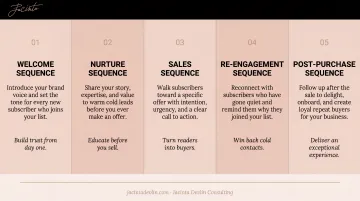
- Welcome sequence (typically 5–7 emails) triggered at opt-in
- Launch campaigns (8–16 email sequences for product drops or program launches)
- Abandoned cart sequences integrated with Shopify
- Post-purchase loyalty sequences to drive repeat buyers
- Evergreen sales sequences for always-available offers
| Details | |
|---|---|
| Best for | Coaches, boutique owners, content creators, and anyone building an email list to sell products or services |
| Pricing | Free plan ($0/month); Lite from $19/month (billed annually); Pro from $25/month (billed annually) |
| Standout feature | Workflow automation lets you build email sequences that sell on autopilot |
Later
Later is a social media scheduling and visual content planning platform with a strong focus on Instagram, built for businesses whose audience lives on visual platforms.
Later's visual content calendar lets you drag, drop, and preview exactly how your Instagram grid will look before anything goes live. Its best-time-to-post analytics show you when your audience is most active. The Link in Bio tool turns your Instagram profile into a shoppable mini storefront — a direct revenue driver for boutique owners and social sellers.
Later has analyzed 20M+ creators and tracked $2B+ in verified influencer-driven purchases through its platform.
| Details | |
|---|---|
| Best for | Social sellers, boutique owners, influencers, and anyone building an audience on Instagram, TikTok, or Pinterest |
| Pricing | 14-day free trial; Starter from $18.75/month (billed annually); free Link in Bio access available |
| Standout feature | Visual Instagram grid planner + Link in Bio page that functions as a shoppable landing page |
ManyChat
ManyChat is an automation tool that sets up interactive, automated conversations in Instagram DMs, Facebook Messenger, and SMS, without requiring the business owner to be online 24/7.
Many women-owned businesses sell directly through Instagram, where the sale happens in the DMs. ManyChat automates responses to comments and story interactions, collecting leads, delivering discount codes, and sending product links automatically.
The comment-to-DM feature is particularly powerful: when someone comments a keyword (like "PRICE" or "FREEBIE") on a post, ManyChat fires a personalized DM instantly. Real results on the platform include a creator generating $135,000 from two posts and another driving $65M+ in sales for ecommerce businesses.
| Details | |
|---|---|
| Best for | Social sellers, direct sellers, boutique owners, and coaches running Instagram-based promotions |
| Pricing | Free plan (25 active contacts); Pro from $29/month (2,500 contacts included) |
| Standout feature | Comment-to-DM automation converts Instagram engagement into direct sales conversations automatically |
Note: Jacinta Devlin Consulting uses LinkDM for Instagram message automation in their client builds. ManyChat is a widely used alternative serving the same core function.
Google Analytics
Google Analytics is a free website analytics platform that tracks who visits your site, where they come from, which pages hold their attention, and where they drop off.
For anyone investing time in content marketing, blogging, or organic traffic, it replaces assumption with data. The Traffic Acquisition report shows whether visitors arrive via organic search, social media, email, or paid ads. You'll see exactly which channels bring buyers — and which ones just bring traffic.
Three reports worth checking first:
- Traffic Acquisition — shows which channels drive the most visits
- Engagement Rate by Page — identifies which content actually holds attention
- Conversions — tracks goal completions tied to specific sources
| Details | |
|---|---|
| Best for | Any woman entrepreneur with a website, online store, or blog who wants data-informed decisions |
| Pricing | Completely free |
| Standout feature | Traffic source breakdown reveals your highest-converting channels, so you stop spending time on what isn't working |
HoneyBook
HoneyBook is an all-in-one client management platform for service-based small businesses, covering proposals, contracts, invoices, and client communication in a single workflow.
For coaches, consultants, and creative service businesses, client onboarding is often a chaotic mix of scattered emails, separate contract tools, and manual invoice follow-ups. HoneyBook consolidates all of it. Its Smart Files feature combines proposals, contracts, and payment collection into one client-facing document, cutting out the back-and-forth entirely.
HoneyBook is trusted by 100,000+ small businesses and has processed $12B+ in payments.
| Details | |
|---|---|
| Best for | Coaches, consultants, photographers, and service-based women entrepreneurs managing multiple client projects |
| Pricing | Starter at $29/month (billed annually); Essentials at $49/month; Premium at $109/month |
| Standout feature | Smart Files combine proposals, contracts, and payment into one client-facing document |
HoneyBook is one of several CRM and booking integrations supported within Jacinta Devlin Consulting's Done-For-You website builds, alongside Calendly, Acuity, and Dubsado.
How We Chose These Marketing Tools
These tools were selected based on how well they serve the business models most common among women entrepreneurs — social selling, ecommerce, coaching, and boutique retail — rather than defaulting to the most well-known enterprise platforms.
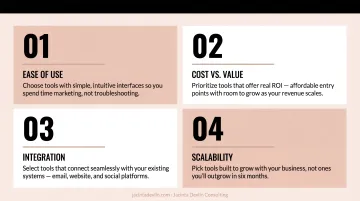
The four criteria that guided every selection:
- Ease of use for solo or small teams — no tool requires a tech background or dedicated IT support
- Free or accessible entry-level pricing — every tool on this list has a free tier or trial so you can test before committing
- Ability to drive revenue — not just brand awareness; each tool has a direct line to sales conversion
- Compatibility with where women entrepreneurs sell — Instagram, email, direct client relationships
The most common mistake to avoid: adopting too many tools at once and spending more time managing software than actually selling. The right approach is one tool per core function — design, email, scheduling, automation, analytics — used fully before adding anything else.
Choosing the right tool for your specific stage is just as important as choosing the right tool category. That's the kind of fit Jacinta Devlin works through with every client in her coaching programs — mapping tools to business model before any implementation starts, not after.
Conclusion
The right marketing tools only work when there's a strategy underneath them. When you're clear on who you're selling to and what you're offering, tools like these help you show up consistently, convert more efficiently, and stop trading every hour of your day for every dollar of revenue.
Start with one tool per core function: design, email, scheduling, and analytics. Once those four are running smoothly, adding the next layer gets a whole lot easier.
If you're ready to put a real marketing strategy behind the tools you're using, Jacinta Devlin Consulting offers personalized business coaching and strategy for women entrepreneurs at every stage — from first sale to seven figures. Book a free 15-minute Growth Chat to find out which program fits where you are right now.
Frequently Asked Questions
What is the most effective marketing tool for small businesses?
The most effective tool depends on your business model and where your audience buys. That said, email marketing consistently delivers the highest ROI across business types — Litmus reports an average return of $36 for every $1 spent. A social media scheduling tool is typically the next highest-impact addition for time-strapped solopreneurs.
What is the 3-3-3 rule in marketing?
The 3-3-3 rule has a few competing definitions in circulation, but one practical version frames it as: 3 seconds to capture attention, 3 minutes to hold interest, and 3 days to build enough trust for a purchase decision. For women entrepreneurs, it's a useful reminder that content needs a hook, a reason to keep reading, and enough consistent presence to convert.
What is the 70/30 rule in marketing?
The 70/30 rule refers to a content split where 70% of posts provide value, education, or entertainment and 30% are promotional. Closely related to the more widely cited 80/20 rule, this balance helps women entrepreneurs build trust before making the ask — which leads to higher conversion when promotional content does appear.
What marketing tools are free for small business owners?
Several tools on this list have genuinely useful free plans: Canva, Google Analytics, and ManyChat all product/service free tiers that are practical for early-stage businesses. Later offers a free Link in Bio tool. Free plans are a smart way to test a tool before committing to a paid subscription.
How do I market my small business on a tight budget?
Start with free tools that cover the basics: Canva for design, Flodesk's free tier for email, Later for scheduling, and Google Analytics for tracking. Prioritize organic social and community building before spending on ads. Only upgrade a tool when it has a clear, trackable connection to revenue.
What is the best social media platform for women entrepreneurs?
Instagram remains the strongest platform for both product-based and service-based women entrepreneurs due to its visual format and shopping integrations. TikTok is growing fast for discovery — 61% of TikTok users report discovering new brands on the platform, 1.5x more than on other platforms. The best platform is ultimately wherever your specific customer already spends her time.