
Introduction
You're skilled. You're passionate. You've put real work into what you do. And yet, someone with half your experience is getting the clients, the partnerships, and the opportunities you deserve.
That's not a talent gap. It's a positioning gap — and it's fixable.
Many women founders create content, show up on social media, and get no traction. The problem isn't effort. Without a clear brand position, you blend into a crowded market — potential clients can't distinguish you from ten other women doing something similar, so they default to whoever feels most familiar.
Personal brand positioning isn't about posting more or chasing followers. It's about owning a specific, recognizable place in your audience's mind — so that when your ideal client has the exact problem you solve, your name is the first one she thinks of.
This article covers what brand positioning actually means, why it matters more for solopreneurs than anyone else, and a practical step-by-step strategy to build yours.
Key Takeaways:
- Brand positioning is a deliberate claim you stake — not a byproduct of posting consistently
- A clearly positioned personal brand increases pricing power and attracts better-fit clients
- You need audience clarity, a positioning statement, and proof before broadcasting anything
- Depth on one or two platforms outperforms thin coverage across six
- Consistent visibility over time builds the trust that converts — not viral moments
What Personal Brand Positioning Actually Is (and Why It's Different from "Having a Brand")
A personal brand is the overall impression people have of you. Brand positioning is the specific, intentional claim you stake — the one thing you want to be known for, for a specific audience, that sets you apart from every alternative. Without positioning, even a polished brand stays invisible.
This distinction matters especially for women solopreneurs. When you are the business, your positioning is your marketing. There's no separate company brand carrying the weight. How you position yourself directly determines who finds you, what they're willing to pay, and whether they trust you before you've said a word.
Why Positioning Drives Revenue
According to the 2024 Edelman-LinkedIn B2B Thought Leadership Impact Report, 60% of decision-makers said they are more willing to pay a premium to work with someone who produces high-quality thought leadership — and 73% said expertise-based content is more trustworthy than any marketing material.
Positioning is what makes your expertise legible. Without it, even strong thought leadership disappears into the noise.
That's exactly what Jacinta Devlin sees in her client work: a brand that looks DIY signals "amateur" before you've said a word. It quietly reduces willingness-to-pay, conversion rates on premium offers, and brand-partner interest. The brand is the problem — and the problem shows up directly in revenue.
What "Positioned" Looks Like in Practice
A positioned woman founder can complete this sentence clearly and specifically:
"I help [specific person] achieve [specific result] through [specific approach]."
Her content, bio, website copy, and sales conversations all say the same thing. A stranger landing on her profile for the first time immediately understands who she is, who she helps, and why she's the right choice.
Positioning is not any of these things:
- Niching yourself into a box you hate
- Faking expertise you don't have
- One viral post that spikes and disappears
- A logo and color palette (that's branding, not positioning)
It's a repeatable, consistent signal that builds trust over time.
The Foundation: Define Your Position Before You Post Anything
Most women founders start with content before they've done the positioning work. That's backwards. Here's what to nail down first.
Step 1: Get Audience Clarity
You cannot position yourself until you know exactly who you're positioning yourself for. Not a demographic — a psychographic. What is she struggling with? What has she already tried? What does she ultimately want?
As Harvard Business Review's Jobs to Be Done framework explains, customers "hire" products and services to get a job done — and those jobs include functional, social, and emotional dimensions.
Content designed for everyone resonates with no one. Content designed for the woman who's tried every generic business course and is still stuck at $2k months? That lands every time.
Step 2: Answer the "Obvious Choice" Question
Ask yourself: When my ideal client is looking for someone like me, what would make me the obvious, no-brainer choice over everyone else?
Not a good option. The obvious one. The answer to that question is the seed of your positioning.
Step 3: Extract Your Credibility Moments
For women founders especially, your personal story is a differentiator no competitor can replicate. Pull out:
- The transformation you've lived through
- The specific results you've produced (for yourself or clients)
- The path you've walked that your ideal client wants to walk too
Jacinta Devlin built her consulting practice on exactly this. Her 12-year direct sales career, Top 1% seller status, and role training 50,000+ women gave her credibility moments no generalist coach could manufacture. Her story is her positioning.
Step 4: Gather Three Proof Points Before You Broadcast
Positioning without proof is just a claim. Before you start broadcasting your position publicly, gather three specific, outcome-based proof points:
- A client win with a real number attached
- A before-and-after transformation story (yours or a client's)
- A documented result that validates your expertise
Step 5: Address the Confidence Barrier
Many women founders downplay their expertise or wait until they feel "ready enough" to claim a strong position. One client who worked with Jacinta admitted: "When you suggested I could make a goal of $100k, I thought you were nuts and didn't believe I could ever achieve that."
Stake your position at the level your clients need you to operate — then build the certainty to match it. Confidence follows commitment, not the other way around.
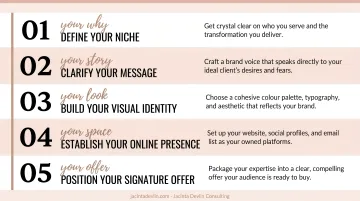
How to Build Your Personal Brand Positioning Strategy Step by Step
Once your foundation is set, here's how to build outward.
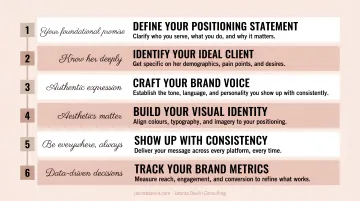
Step 1 — Write Your Positioning Statement
Craft a clear, specific one-to-two sentence statement that captures:
- Who you help
- What outcome you deliver
- What makes your approach distinct
This statement becomes the filter for every piece of content, every bio, and every sales conversation.
Step 2 — Audit Your Existing Online Presence
Google yourself. Review every social profile, bio, and piece of visible content. Ask: Would a stranger landing here immediately understand who I am, who I help, and why I'm the right choice?
If the answer is no — or "maybe" — that's your starting point. Common misalignments include:
- Bio that describes what you do but not who you help or what outcome you deliver
- Content that covers five different topics with no through-line
- Profile photos, tone, and messaging that contradict each other across platforms
Step 3 — Choose One or Two Platforms and Go Deep
Spreading across every platform dilutes positioning. Pick one to two channels where your ideal client actually spends time, optimize your profile to reflect your positioning statement, and commit to showing up there consistently before expanding.
Not sure which platforms fit your business model? That's exactly where a business growth consultant adds value. Jacinta Devlin's platform guidance is grounded in direct experience: she built a six-figure Amazon storefront, grew brand partnerships through Instagram, and scaled direct sales teams through Facebook communities. She teaches from results, not theory.
Step 4 — Build a Content Rhythm Rooted in Your Position
Content is the proof of your position. A simple weekly rhythm:
- One teaching post — something directly relevant to your ideal client's problem
- One proof post — a real result, client win, or before-and-after story
- One perspective post — your distinct point of view on your industry
Consistency matters more than volume. Three intentional posts per week beat seven scattered ones every time.
Step 5 — Engage Strategically
Positioning is reinforced through conversation, not just broadcasting. Show up meaningfully in spaces where your ideal clients gather — groups, comment sections, communities. Ask satisfied clients for testimonials. Position yourself as a peer and thought leader, not just a content publisher.
Step 6 — Measure What Actually Matters
Skip the vanity metrics. Track what actually signals your positioning is working:
- Inbound inquiries from ideal clients (not just anyone)
- Referrals from existing clients or peers
- Sales conversations that convert
- Whether your positioning statement is being reflected back to you by the people you're attracting
Choosing the Right Platforms to Amplify Your Position
Platform selection is a strategic decision, not a personal preference.
Match Platform to Audience and Content Style
The best platform is where your ideal client actually spends time — and where you'll show up consistently. A founder who loves writing will thrive on LinkedIn or long-form newsletters. One who's natural on camera will find more traction on Instagram Reels or video-first platforms.
Platform guidance by business type:
| Business Type | Primary Platforms |
|---|---|
| Boutique / Product brand | Instagram, TikTok, Facebook Groups, Pinterest |
| Amazon / LTK affiliate | Instagram, Facebook Groups, Pinterest |
| Direct sales / Network marketing | Facebook, Instagram |
| Coach / Service provider | LinkedIn, Instagram, YouTube, Email |
| Content creator / Influencer | Instagram, TikTok, LTK, YouTube |
According to Sprout Social's 2024 influencer research, 49% of consumers make purchases at least monthly because of influencer posts — and Instagram remains the primary hub for engagement and purchase decisions across most demographics.
That reach only materializes when you stay put long enough to build it.
Don't Platform-Hop
Changing platforms constantly resets momentum and signals inconsistency — to the algorithm and to your audience. Commit to one primary platform for at least 90 days before evaluating results. Among the founders Jacinta coaches, the ones who see the fastest audience and revenue growth are those who went deep on one or two channels, not wide across six.
Content That Reinforces Your Brand Position
Content is not decoration. Every piece should serve as evidence of the position you claim.
The Three Content Types That Build Positioning
- Story posts bring your personal journey into your marketing — your transformation, your failures, your specific path. This is what makes people feel seen instead of sold to.
- Proof posts document real client outcomes with specifics: numbers, timelines, before-and-after narratives. When Christina R. rebranded to @mybalancedstyle with Jacinta's coaching, she grew her Facebook Group from zero to 36,000+ members and reached six-figure income within six months. That's a proof post.
- Perspective posts share your distinct point of view — where you disagree with conventional advice, what you believe that others aren't saying. This is what makes a brand feel magnetic rather than just credible.
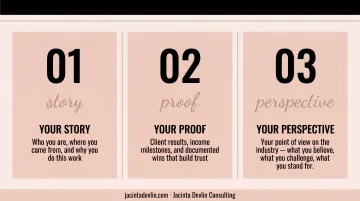
Used together, these three types cover the full range of what builds an audience: emotional connection, demonstrated results, and intellectual authority. The next question isn't what to post — it's how consistently.
Consistency Beats Virality
One viral post doesn't build a brand position. The predictable, week-after-week showing up — same message, same voice, same audience — is what creates the trust that moves someone from follower to buyer.
BrightLocal's 2025 Local Consumer Review Survey found that 42% of consumers trust online reviews as much as personal recommendations, and more than 75% watch video content when researching a business. Your consistent content is your social proof in motion.
Positioning Mistakes Women Founders Make (and How to Fix Them)
Trying to Appeal to Everyone
The most common positioning mistake is keeping the message broad to avoid alienating potential clients. A brand that speaks to everyone resonates with no one.
The fix: Get uncomfortably specific about who you serve and what exact problem you solve. The right people will self-select in. The wrong ones will self-select out. That's exactly the point.
Hiding the Personal in Personal Branding
Women founders often separate their personality and story from their "professional" presence out of fear of being judged. But for solopreneurs, the personal is the differentiator. People buy from people they trust, and trust is built through authentic visibility, not polished distance.
Jacinta's own brand is built entirely on the fusion of personal story and professional identity. Her path from broke college student at a jewelry party to Top 1% direct sales earner to business coach: that narrative isn't separate from her brand. It is her brand.
Positioning Without Proof
Claiming authority without demonstrating results is one of the fastest ways to lose credibility. The fix: Make proof a consistent practice, not a one-time checkbox:
- Lead with outcomes — frame every product/service around specific client results
- Share before-and-after stories with real numbers, not vague wins
- Collect testimonials and case studies on an ongoing basis
- Display social proof where buyers are already looking: your website, Instagram bio, sales pages
Frequently Asked Questions
What are the 3 C's of brand positioning?
The 3 C's are Customer, Company, and Competitors. Understanding your ideal customer's needs, your own unique strengths, and what competitors currently product/service helps you identify the unclaimed, valuable position that's distinctly yours: where your strengths meet a gap the market hasn't filled.
What are the 5 P's of personal branding?
The 5 P's typically include Purpose, Positioning, Presentation, Promotion, and Proof. For women solopreneurs, positioning and proof are the two most revenue-critical elements to nail first — everything else builds on those two foundations.
What are the 5 C's of personal branding?
The 5 C's are Clarity, Consistency, Content, Connection, and Credibility. The two that often get shortchanged are Connection and Credibility — Connection builds the audience that sees you, and Credibility gives them a reason to trust you enough to buy.
What are the 4 C's of personal branding?
The 4 C's are Clarity, Consistency, Content, and Community. The element most women underinvest in is Community — an engaged audience that refers you is worth more than any ad spend. But none of it works without Clarity as the foundation first.
How do I position myself as an expert when I'm just starting out?
You don't need years of experience to claim a position. You need a specific perspective, a clearly defined audience, and evidence — even early-stage results or your own transformation story — that demonstrates you understand the problem and have a real path to solve it.
How long does it take to build a personal brand as a solopreneur?
Most women see initial momentum within 30–60 days of showing up with a clear, consistent message. Significant results — better-fit inquiries, referrals, and consistent revenue months — typically build between the six and twelve-month mark. That compounding only works when the positioning is specific from day one — vague messaging stalls it every time.