
Women entrepreneurs are building businesses at a historic pace. According to the Wells Fargo 2025 Impact of Women-Owned Businesses report, there are 14.5 million women-owned businesses in the U.S., accounting for 39.2% of all firms and generating $3.3 trillion in annual revenue. Yet the average women-owned business still earns just $226,000 per year — and only 2.4% ever cross the $20 million revenue threshold.
That gap isn't about effort. It's about strategy, systems, and having the right guidance at the right time.
This article covers what a business advisor actually does, why specialized advisory matters for women entrepreneurs specifically, and what to look for when you're ready to find the right fit.
Key Takeaways
- A business advisor builds a specific, actionable strategy around your business — not generic templates or one-size-fits-all programs.
- Women-owned businesses face distinct challenges that specialized advisors are better equipped to address than generalist consultants.
- The right advisor brings lived experience, a track record with female founders, and a personalized approach.
- Common signs you're ready: revenue has plateaued, growth feels random, and you're stuck working in the business instead of on it.
- The right advisory relationship pays off in revenue, clarity, momentum, and the confidence to make decisions that move the needle.
What Is a Business Advisor for Women Entrepreneurs?
A business advisor is someone who evaluates where your business currently stands, helps you build a clear growth strategy, and works alongside you to implement it. That's different from a consultant who delivers a report and walks out the door, and different from a coach who focuses primarily on mindset and personal performance.
Here's how these roles break down in practice:
| Role | Primary Focus | Engagement Style |
|---|---|---|
| Business Advisor | Strategy + execution + accountability | Ongoing, implementation-driven |
| Business Coach | Mindset, confidence, performance | Ongoing, introspective |
| Business Consultant | Specialized expertise on a defined problem | Project-based, deliverable-focused |
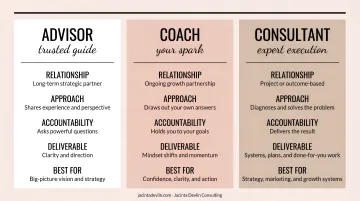
For women entrepreneurs, the most effective advisors blend all three — bringing strategic depth, hands-on execution support, and the kind of accountability that keeps you moving when the day-to-day gets overwhelming.
What Makes a Women-Focused Advisor Different
A specialized advisor understands that women building businesses aren't operating in a vacuum. They're often navigating:
- Building income around household and family responsibilities
- Launching or scaling in industries underrepresented in mainstream business advice (direct sales, boutique retail, affiliate marketing)
- Accessing less institutional support — SCORE data shows only 25% of women entrepreneurs seek financing compared to 33–34% of men, and just 39% receive the full amount requested
- Finding mentors who have actually built similar businesses, not just studied them
A general advisor hands you a framework built for someone else's business. A women-focused advisor — one who has actually operated in direct sales, run an e-commerce brand, or built income around real-life constraints — knows which parts of that framework to throw out and what to build instead.
Why Women-Owned Small Businesses Benefit from Specialized Advisory
Women-owned businesses have grown their revenue 53.8% from 2019 to 2024, which is not a marginal trend — that's a structural shift in how women are participating in the economy. Yet the average revenue figure of $226,000 tells a different story: most women-owned businesses are still constrained well below their potential.
The Growth Ceiling Problem
The ceiling isn't a talent problem. It typically comes from a combination of:
- Inconsistent sales systems — revenue that fluctuates unpredictably month to month instead of compounding
- Marketing that creates visibility but not conversions — posting, showing up, building an audience, and still not hitting revenue targets
- Operational bottlenecks — the owner is doing everything manually, which makes scaling impossible without burning out
- No clear revenue roadmap — knowing tactics isn't enough without a prioritized plan for which actions will actually compound into growth
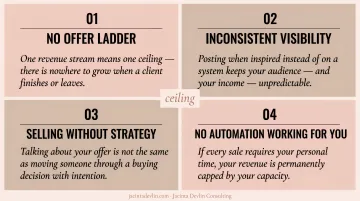
These aren't problems that more effort solves. They require a different kind of input.
The Case for Mentorship and Advisory
The data on mentored businesses is compelling. According to a 2019 SBA blog post, 70% of small businesses that received mentoring survived more than five years — double the rate of non-mentored businesses. SCORE's research reinforces this for the shorter term: 87% of mentored businesses were still operating after one year, compared to 75% of those without mentorship.
There's also a specific advantage to working with a female advisor. A randomized field experiment published in Marketing Science found that female entrepreneurs performed significantly better when guided by female mentors versus male mentors. The match matters because lived context changes the quality of the guidance.
Why Lived Experience Over Theory
Survival rates and match data tell you mentorship works. What they don't tell you is which advisors actually know the terrain.
There's a real difference between an advisor who has studied business scaling and one who has done it — in direct sales, e-commerce, affiliate marketing, or building a personal brand from scratch. The former can describe what the path looks like. The latter knows where the floor drops out.
That's the foundation behind Jacinta Devlin Consulting. Jacinta Devlin spent 12 years as a Top 1% seller and million-dollar earner in direct sales, served as National Director of Sales & Field Training at Stella & Dot, and built her own e-commerce brand to consistent $10,000+ months before coaching other women through the same transitions. The guidance comes from having operated in the same spaces her clients are navigating — not from theory about them.
What Does a Business Advisor for Women-Owned Businesses Do?
A strong advisory engagement covers five interconnected areas. Not all at once. The order is determined by what your specific business needs most.
Strategy Development
The starting point is an honest assessment of where the business actually is: revenue drivers, pricing, offers, gaps, and what's leaking time or money. From there, a real growth plan gets built — a roadmap designed around your specific business model, audience, and goals. That means digging into:
- What's actually driving (or blocking) revenue right now
- Where pricing and offers are leaving money on the table
- Which activities to prioritize so effort compounds instead of scatters
Most women entrepreneurs arrive without a prioritized strategy. They've been executing hard — just not in a sequence that builds on itself.
Sales and Revenue Growth
Inconsistent income is the single most common problem women entrepreneurs bring to advisory relationships. A good advisor helps you build:
- Repeatable sales systems (whether through social selling, e-commerce, email, or direct)
- Automation infrastructure that converts audience members into buyers without manual follow-up on every lead
- A revenue model where income is predictable rather than feast-or-famine
Marketing and Visibility
Most women entrepreneurs don't have a social media problem. They have a strategy problem that looks like a social media problem. An advisor identifies where your ideal customers actually are, which platforms to prioritize, and what messaging converts — then builds the systems to reach them consistently.
Accountability and Execution
Knowing what to do and actually doing it are different problems. Weekly check-ins, goal reviews, and between-session access to your advisor reduce the isolation and drift that solo business owners experience. Advisory relationships pay for themselves not in the strategy session, but in the execution that follows.
Operational Systems and Scaling
The owner doing everything eventually becomes the ceiling. Advisors help identify where the business is leaking time, introduce automations and delegation frameworks, and build the systems that let the owner step back from daily operations and focus on growth.
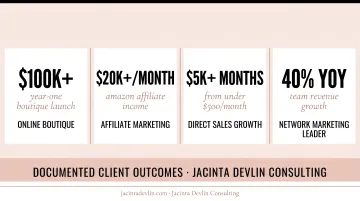
Jacinta Devlin Consulting structures its Business Growth Program around exactly this progression — weekly 1:1 strategy calls directly with Jacinta (no junior associates), a fully individualized growth plan, and done-for-you execution of the marketing infrastructure. Client results reflect what systematic advisory work produces:
- Joy W. went from $500/month to consistent $5,000+ months, surpassing her previous full-year income in just six months
- Sharon B. went from $4,000 in her first year on Amazon to consistently making $20,000+ per month after coaching
Signs You're Ready to Hire a Business Advisor
There's no single threshold, but these patterns appear repeatedly among women entrepreneurs before they seek advisory support:
- Revenue has plateaued for 3+ months and you've already tried changing what you're doing
- Growth feels reactive — some months are great, others aren't, and you're not sure why
- You're fully booked or maxed out but income hasn't grown — the ceiling is structural, not effort-based
- Time is consumed by tasks that don't move the needle — execution is constant but progress isn't
- You've tried DIY — courses, YouTube, free resources — and you're still stuck
That last pattern is particularly common. Many women arrive at advisory after years of trying to piece together strategy from free content. The cost of that delay — in time, missed revenue, and wasted energy — typically far exceeds the investment in coaching.
Hiring an advisor is what serious business owners do when they're ready to stop guessing and start building something that compounds. The value isn't in more information — it's in having someone in your corner who knows exactly where your business is stalling and how to fix it.
What to Look for in a Business Advisor for Women Entrepreneurs
Not every advisor who targets women entrepreneurs is equipped to work with them effectively. Here's what to screen for:
Lived experience, not just credentials. The most effective advisors have built businesses themselves — scaled revenue, managed teams, navigated the same problems their clients are currently facing. Jacinta Devlin built five revenue-generating businesses before coaching her first client. Consulting is what came after building, not instead of it.
A track record with women entrepreneurs specifically. Ask for concrete outcomes — clients who went from X to Y in a defined timeframe. Vague testimonials about feeling supported or gaining confidence are not enough. Look for revenue milestones, follower growth, business launches, and documented before-and-after results.
Personalized strategy, not packaged programs. The clearest signal of a one-size-fits-all approach is an advisor who recommends solutions before they understand your business. The right fit will want to know your specific model, audience, platform mix, and revenue targets before recommending anything. No cohort curriculum, no copy-paste playbook.
Direct access to the named expert. Many coaching programs sell access to a brand but deliver through junior associates. Confirm that you'll be working directly with the person whose experience you're paying for.
That last point shapes how Jacinta Devlin Consulting approaches every new client relationship. Every engagement starts with a free 15-minute discovery call with Jacinta directly — not a sales associate. Not every applicant is accepted, because the team only works with entrepreneurs they genuinely believe they can help.
Frequently Asked Questions
What does a small business advisor do?
A small business advisor evaluates the current state of your business, builds a strategic growth plan, and supports you in implementing it — covering sales, marketing, operations, and revenue systems. Unlike a consultant who delivers a report, an advisor stays involved through execution and course-correction.
Are small business advisors worth it?
The evidence says yes. Mentored and advised businesses survive at double the rate of non-mentored ones, according to SBA data. For women entrepreneurs, having an experienced advisor cuts through costly trial-and-error and compresses years of guesswork into a clear, executable strategy.
How much does a small business advisor cost?
Costs vary widely — from a few hundred dollars per month for group programs to $3,500 and above for one-on-one strategic advisory. The right investment depends on your business stage, the depth of engagement, and the advisor's experience level.
What is the difference between a business advisor and a business coach?
Coaches primarily focus on mindset, accountability, and personal performance. Advisors focus on business strategy and measurable outcomes. Many strong advisors blend both — and for women entrepreneurs, that combination of strategic clarity and accountability tends to drive the fastest results.
When should a woman entrepreneur hire a business advisor?
Key tipping points: when revenue has stalled, when growth feels reactive rather than strategic, or when you're maxed out but income isn't growing. Advisors add the most value once you have a proven product/service and are ready to scale — not when you're still figuring out what you're selling.
How do I find a business advisor who specializes in women-owned businesses?
Look for advisors with a demonstrated track record working with female founders, real business-building experience of their own, and a process that prioritizes personalized strategy over generic programs. Ask for specific client outcomes — not just testimonials — and verify that you'll work directly with the advisor, not handed off to a junior team member.