That's the gap most women-owned food businesses are dealing with. You're already wearing every hat: chef, owner, manager, and now, apparently, marketing director. Meanwhile, larger chains have entire teams dedicated to their digital presence.
Here's the thing: you don't need a big budget or a marketing degree to compete. What you need is the right strategy — one that works for your specific business, whether you run a brick-and-mortar restaurant, a catering company, a food truck, or a cottage food operation.
This guide gives you exactly that: a clear, actionable digital marketing framework built around the unique strengths of women-owned food businesses.
Key Takeaways
- 83% of diners research a restaurant online before visiting — your digital presence is your first impression
- A fully optimized Google Business Profile is free and one of the highest-ROI moves for any food business
- Your "women-owned" identity is a genuine competitive advantage, not just a label
- Consistency beats perfection on social media: one platform done well outperforms five done poorly
- Email marketing and loyalty programs turn one-time visitors into regulars who spend more
Why Digital Marketing Is a Game-Changer for Women-Owned Food Businesses
Why Digital Marketing Moves the Needle for Women-Owned Food Businesses
The numbers make the case quickly. According to Toast's 2024 research, 32% of diners always check a restaurant's website before visiting, and another 51% sometimes do. That's the majority of your potential customers making decisions before they ever see your sign.
And it's not just websites. Toast's 2024 social media data found that 62% of guests check a restaurant's social media before deciding to dine there. If your profiles are outdated, incomplete, or nonexistent, those customers are choosing someone else.
The Women-Owned Advantage Is Real
The "women-owned" label is a marketing asset — one that most food business owners underestimate. A peer-reviewed study in the Journal of Consumer Research found that a "woman-owned business" label enhanced perceived competence and service quality — especially where other credibility signals are limited. For a newer or smaller food business competing against established brands, that perception boost matters.
The National Restaurant Association reports that 41% of U.S. restaurant firms are majority-owned by women. You're not a niche player — you're part of a significant and growing force in the industry, and your marketing should reflect that.
No Big Budget Required
That credibility advantage costs nothing to claim — and neither do many of the strategies below. Digital marketing works for food businesses at every budget level:
- A food truck with 800 Instagram followers can outperform a chain with a $10,000 ad spend
- A cottage food business can build a loyal customer email list with zero paid tools
- A catering company can land on the first page of local Google results using a free Business Profile — no ad spend needed
The strategies below apply regardless of your format or budget.
Build Your Digital Foundation: Website and Google Business Profile
Start With a Website That Converts
Your website works for you around the clock. For a food business, the non-negotiables are:
- Mobile-first design: Most of your customers are searching from their phones
- Your menu, front and center: According to BentoBox, the menu is the most-visited page on any restaurant website and often the deciding factor for guests. Write it in plain text, not a PDF — PDFs frustrate mobile users and can't be indexed by search engines
- Clear calls to action: Online ordering, reservations, catering inquiry form — make these impossible to miss
- Consistent branding: Your website should feel like your food looks
For local SEO, weave location-based keywords into your content — phrases like "women-owned catering company in Denver" or "family recipe brunch spot in Austin." Write a meta title and description for your homepage that includes your city and what you do. It takes 30 minutes and makes a real difference.
Optimize Your Google Business Profile
If you only do one thing from this article, make it this: claim and fully optimize your Google Business Profile. It's free, and Google's own documentation confirms that complete, accurate business information improves how you rank in local search.
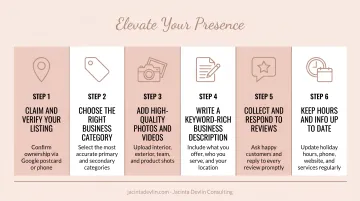
Steps that take an afternoon but pay off for years:
- Claim and verify your listing at business.google.com
- Ensure NAP consistency — your name, address, and phone number must match exactly across your website, Yelp, and everywhere else online
- Upload high-quality photos of your food, interior, and exterior — regularly
- Write a keyword-rich description that includes what you serve and where you are
- Keep your hours updated, especially for holidays
- Respond to every review, positive and negative
One step many women-owned businesses miss: add the "Identifies as women-owned" attribute to your profile. According to DigitalMaas, this attribute appears prominently during relevant keyword searches and displays a distinctive icon — making you discoverable to customers specifically looking to support women-owned businesses. It's a trust signal and a search filter in one.
Consistent activity on your profile — new photos, posts, review responses — tells Google your business is active and worth surfacing. Keep showing up, and your local rankings will reflect it.
Social Media Marketing Strategies That Actually Drive Sales
Choose Your Platform Strategically
Pick the right platform before you pick up your phone to post. Here's a quick breakdown:
| Platform | Best For | Format |
|---|---|---|
| Visual food content, brand storytelling, local discovery | Photos, Reels, Stories | |
| TikTok | Organic reach, behind-the-scenes, millennial/Gen Z discovery | Short-form video |
| Community groups, event promotion, older demographics | Posts, Groups, Events |
Start with one or two platforms and build consistency before adding more. An Instagram account with three posts per week consistently will outperform five accounts updated sporadically.
Platform data worth knowing: among weekly social media users, Toast found that 59% use Facebook most to discover new restaurants, followed by Instagram at 19% and TikTok at 17%. For TikTok specifically, a survey by MGH found 38% of all TikTok users had visited a restaurant after seeing it on the platform — rising to 53% among millennials.
Create Content That Builds Community and Drives Action
The content types that consistently perform for food businesses:
- High-quality food photography — natural light, real food, real plates
- Behind-the-scenes prep and kitchen content — people want to see the work
- Founder story posts — who made this food matters to your customers
- Customer spotlights and user-generated content — repost and tag customers who share your food
- Time-sensitive promotions — "Tuesday-only special" creates urgency
According to Popmenu research, 45% of U.S. diners have tried a restaurant for the first time because of a social media post by that restaurant. That means every post is a real acquisition opportunity.
The algorithm rewards consistency, but what actually converts followers into paying customers is authenticity. Real stories, real people, real food — that's what builds loyalty that lasts beyond a single visit.
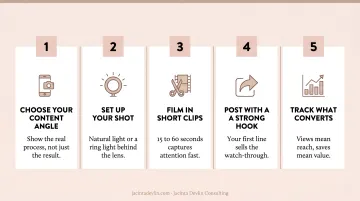
Use Local Creators and Micro-Influencers
Local food bloggers and community creators often deliver higher engagement than national influencers, and they're far more accessible for independent food businesses. A local micro-influencer with 8,000 engaged followers in your city is worth more than a national account with 500,000 passive ones.
There's also a discoverability benefit that goes beyond the platform itself. Instagram's official help documentation confirms that public posts from professional accounts can be indexed by third-party search engines, including Google, for content uploaded after January 2020. Keyword-rich captions and location tags don't just serve the algorithm — they extend your reach to people searching on Google too.
Use Your Women-Owned Story as a Marketing Superpower
The origin story behind your food is something no large chain can replicate. Consumers want to know who made their meal — the grandmother's recipe, the decade-long dream, the career pivot that led to the best empanadas in town. That story is your competitive edge.
This isn't just feel-good framing. The Journal of Consumer Research study cited earlier found that the "woman-owned" label directly enhances perceived competence and service quality. Your identity shapes how customers experience your food before they taste it.
Bring Your Story to Market Across Every Channel
- "About" page on your website: Write it in first person. Be specific. Customers want the real story, not corporate language
- Pinned founder post on Instagram: Your origin story deserves a permanent place at the top of your profile
- A short video or Reel: 60–90 seconds about why you started this business — no production required, just honesty
- Consistent language across all platforms: "Women-owned," "family recipe," "built from scratch" — these phrases should appear naturally across your website, social bios, and Google profile
Leverage the Women-Owned Badge Beyond Just Listing It
Your certification can open doors that no ad spend can buy:
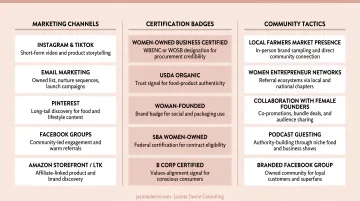
- WBENC Certification validates that your business is at least 51% owned and operated by women, and opens access to a national network of corporate buyers and PR opportunities
- Local women's chambers of commerce often feature members in newsletters, events, and media — free visibility among your target audience
- Women's business networks create co-marketing and referral opportunities with complementary businesses
Activate Your Built-In Community
Women-owned food businesses often have something large chains spend millions trying to manufacture: a community that genuinely wants them to succeed. Don't leave that energy passive.
Specific ways to activate it:
- Ask for reviews directly — in person, via email, with a QR code at the register
- Create a loyalty program (more on this below)
- Encourage customers to tag you when they share food photos
- Host events that give your community a reason to gather
Building that community is one thing — sustaining it requires a real strategy behind every touchpoint. That's where expert guidance pays off.
Jacinta Devlin has helped thousands of women entrepreneurs build the digital systems that drive consistent growth: brand identity, website, social media strategy, email marketing, and beyond. Her clients have scaled from pre-launch to six figures in year one. If you want a strategy built around your specific business rather than a generic template, start with a free 15-minute discovery call at calendly.com/devlinconsulting/15-minute-consultation.
Email Marketing and Loyalty Programs to Keep Customers Coming Back
Social media reach is controlled by an algorithm. Your email list is owned land.
According to Litmus, email marketing generates an average of $36 for every $1 spent — among the highest ROI of any marketing channel. For food businesses, it's also one of the most underused.
Building Your List
You don't need thousands of subscribers to see results. Start collecting emails through:
- A website pop-up offering a discount on first order
- In-store sign-up at the register
- Online ordering opt-in
- Loyalty program enrollment
Your welcome sequence (3–5 automated emails) should introduce your story, share your menu, and give new subscribers a reason to visit soon.
Emails That Drive Action
The highest-performing email types for food businesses:
- Seasonal menu announcements
- Subscriber-exclusive discounts ("15% off this weekend, for subscribers only")
- Event invitations
- Birthday offers
- "We miss you" re-engagement emails after 60 days of inactivity
Set these up once, and they run automatically — freeing you to focus on the parts of your business that actually need you.
The Business Case for a Simple Loyalty Program
According to Olo, analyzing over 100 million guest records, 60% of restaurant revenue comes from repeat guests. Keeping existing customers is far less expensive than acquiring new ones.
Simple tools to start:
- Square Loyalty: Points earned by visits, spend, or items purchased — fully customizable
- Toast Loyalty: Points redeemable in-store, online, or via mobile, with birthday rewards built in
A loyalty program also doubles as a list-building tool — every enrollment is a customer who's opted into your marketing.
How to Know If Your Digital Marketing Is Actually Working
You don't need to spend hours in analytics dashboards. Set aside 30 minutes at the end of each month and check these five things:
- Website traffic — Is organic search traffic growing month over month?
- Social media reach and profile visits — Are more people landing on your page from Reels, Stories, or shared posts?
- Social media engagement — Are your posts generating saves, shares, and comments (not just likes)?
- Email open rates — Industry average is around 20–30%; below that, test your subject lines
- Sales or inquiry trends — Are DMs, contact form submissions, or checkout completions increasing after promotional pushes?
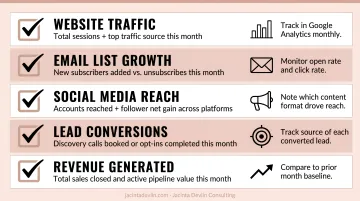
The most valuable data often comes from the simplest question: ask new clients or customers, "how did you find me?" A spike in DMs after a Reel goes semi-viral is data. A jump in email sign-ups the week you ran a limited-time offer is data. These patterns tell you where your audience is actually paying attention.
Track what changed after each marketing action. When something moves the needle — a specific subject line, a content format, a posting time — that's your signal to do more of it. When something consistently underperforms, cut it and redirect that time elsewhere.
Frequently Asked Questions
What are the 4 P's of marketing for restaurants?
The 4 P's are Product (your food, menu, and dining experience), Price (your pricing strategy and value positioning), Place (your physical location and online presence), and Promotion (how you market and communicate). According to OpenTable, these four elements form the core marketing framework for any restaurant decision.
What is the 30/30/30/10 rule for restaurants?
This describes a common budget split: 30% food costs, 30% labor, 30% overhead, and 10% profit margin. Actual numbers vary — the National Restaurant Association found 2024 labor costs at 30% for limited-service and 34.1% for full-service operators, with profit margins typically running 3%–5%.
What social media platforms work best for food businesses?
Instagram is best for visual brand-building and local discovery, TikTok for organic reach and behind-the-scenes content (particularly effective with millennial audiences), and Facebook for community groups and event promotion. Start with one platform and build consistency before expanding.
How do I market my women-owned food business on a small budget?
Start with free, high-impact tactics:
- Optimize your Google Business Profile
- Post consistently on one social platform
- Collect and respond to online reviews
- Use your women-owned identity to access PR and partnerships through networks like WBENC
How do I get more online reviews for my food business?
Ask directly — in person, via a follow-up email, or with a QR code at the register linking straight to your Google review page. Respond to every existing review to signal engagement. The more friction you remove, the more reviews you'll receive.
What is the most important digital marketing strategy for a new food business?
Claim and fully optimize your Google Business Profile first — it's free and directly impacts local search visibility. Then establish a consistent presence on one social platform with authentic content. Master those two before adding any other channels.