

Here's the hard truth: traffic isn't your problem. Most women-owned stores lose revenue not because too few people find them, but because the path from "discovered your brand" to "completed a purchase" is full of leaks. According to Baymard Institute, the average ecommerce cart abandonment rate sits at 70.22% — meaning roughly 7 out of 10 shoppers who add something to their cart walk away without buying.
That's a funnel problem, not a traffic problem.
This guide covers what an ecommerce funnel actually is, the four stages that matter most for women-owned stores, where sales most commonly slip away, and what to do about it — including the metrics worth tracking.
Key Takeaways
- An ecommerce funnel tracks every step a shopper takes — from first discovery to repeat purchase
- Most women-owned stores lose revenue at the middle and bottom of the funnel — not the top
- Fixing a leaky funnel means targeted improvements at specific stages, not just driving more traffic
- Trust signals, social proof, email capture, and frictionless checkout deliver the highest ROI for small stores
What Is an Ecommerce Funnel and Why It Matters
An ecommerce funnel is the complete journey a shopper takes from first hearing about your store to making a purchase — and ideally, coming back again. The "funnel" shape reflects a simple reality: many people enter at the top, fewer reach the bottom. That drop-off is natural. The goal isn't to eliminate it — it's to manage it intentionally.
For women-owned stores operating with lean teams and limited ad budgets, understanding your funnel is what separates guessing from growing. Without it, you can't tell whether you need more traffic or better conversion — and those require completely different solutions.
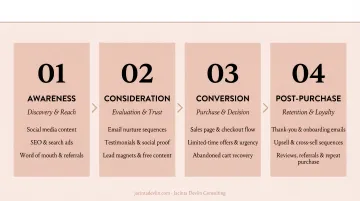
A basic funnel moves through four stages:
- Awareness — shoppers discover your store via social, search, or referral
- Interest — they browse products and engage with your content
- Decision — they evaluate, add to cart, and weigh the purchase
- Action — they buy (and ideally return)
Jacinta Devlin, who has coached hundreds of women-owned boutiques and product brands, calls this a strategy problem disguised as a social media problem: "You almost certainly do not have a social media problem. You have a strategy problem dressed up as a social media problem."
Posting more doesn't fix a broken funnel. Knowing where yours breaks — and fixing it — does. The sections below walk through each stage so you know exactly where to focus first.
The 4 Stages of an Ecommerce Funnel for Women-Owned Stores
Each stage of your funnel requires a different approach — awareness, consideration, conversion, and retention. What works at the top won't work at checkout, and what closes a sale won't build loyalty on its own.
Awareness (Top of Funnel)
This is where shoppers discover your brand for the first time — through an Instagram Reel, a Facebook group recommendation, a Pinterest search, or an LTK storefront. Your job at this stage is simple: make a strong first impression.
For women-owned stores, personal brand and community visibility are particularly powerful awareness drivers. Shoppers aren't just discovering a product; they're discovering a person behind the brand.
Consideration (Middle of Funnel)
Shoppers here are evaluating whether your store is right for them. They're reading product descriptions, studying photos, checking reviews, and forming an opinion about whether they trust you enough to buy.
Trust signals carry this stage. A polished product page, visible customer reviews, and authentic brand storytelling all move shoppers from "maybe" to "yes."
Conversion (Bottom of Funnel)
The shopper is ready to buy — but can still abandon. Unexpected shipping costs, a clunky checkout, or a missing return policy create last-second doubt. A streamlined, confidence-inspiring checkout is the primary lever here.
Retention (Post-Purchase)
Retention is where profitable ecommerce businesses are actually built. Repeat customers spend 67% more than new customers, according to Shopify — and they cost significantly less to sell to.
Post-purchase touchpoints make that repeat business happen:
- Thank-you emails that reinforce the purchase decision
- Review requests sent 5–7 days after delivery
- Replenishment reminders for consumable or seasonal products
- Loyalty offers that reward buyers for coming back
Where Women-Owned Stores Lose the Most Sales
Most revenue leaks happen in predictable places — and they compound. Fix one and your numbers move. Fix all five and your store starts to feel like it actually works. Here are the five most common:
Weak Top-of-Funnel Targeting
Posting broadly without a clear customer avatar fills the funnel with people who were never going to buy. When your content doesn't speak directly to your ideal buyer's needs, your metrics look active but your revenue doesn't reflect it. Niching down your social content — and any paid traffic — to match your specific buyer improves every downstream metric.
Product Pages That Don't Convert
Shoppers who land on a product page and leave without buying are usually missing information or confidence. A high-converting product page includes:
- High-quality lifestyle photography showing the product in real use
- Clear sizing, dimensions, or specs
- A benefit-focused description (not just feature lists)
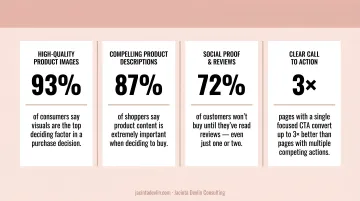
- Visible customer reviews — displaying reviews can increase conversion by up to 270%, per research from the Spiegel Research Center
No Email Capture Strategy
Social media reach is borrowed. An algorithm change can cut your visibility overnight. Many women-owned stores skip building an email list entirely — which means every mid-funnel shopper who isn't ready to buy on their first visit is lost forever.
Jacinta Devlin is direct on this point: "An Instagram account is rented land. An email list is owned land." Email converts at rates 10–40x higher than social media, yet most boutique owners have sub-1,000 subscribers and zero automation.
Cart Abandonment Left Unaddressed
With a 70.22% average abandonment rate, nearly three-quarters of shoppers who add items to a cart never complete checkout. The top reasons, per Baymard: unexpected costs like shipping and fees (39%), slow delivery (21%), and trust concerns about entering payment information (19%).
Most small stores never set up an automated abandoned cart email sequence. That means a significant share of near-buyers walks away permanently — for a problem that's entirely fixable.
No Post-Purchase System
After a sale, many women-owned stores go completely silent. No review request, no product recommendation, no loyalty incentive. Repeat purchase rates stay flat, and the store runs on a treadmill — spending constantly on new customer acquisition instead of earning more from buyers it already has.
How to Optimize Your Ecommerce Funnel at Every Stage
Top of Funnel: Drive the Right Traffic
Effective top-of-funnel strategy means showing up consistently where your ideal customer already spends time — Instagram Reels, Pinterest, Facebook groups, LTK — with content that speaks directly to her, not just your products.
For women-owned stores, authenticity outperforms polish. Personal brand storytelling and genuine behind-the-scenes content tend to outperform highly produced ad creative with this audience.
SEO-driven content pays off consistently over time. Blog posts and optimized product descriptions generate organic traffic without requiring daily posting volume — a real efficiency advantage for solo or small-team store owners.
Jennie Stehli, one of Jacinta's boutique clients, grew her blog to 3,000+ monthly visitors within a year while simultaneously building her social following and email list.
Middle of Funnel: Build Trust and Capture Leads
Two things move the needle most at this stage:
Optimize your product pages with lifestyle photography, detailed descriptions, prominent reviews, and UGC. Buyers often want to know who is behind the brand — a compelling founder story builds trust faster than any badge or certification.
Add an email opt-in with a compelling product/service — a discount, a style guide, a curated resource. Give first-time visitors a reason to share their email before they're ready to buy, so you can continue the conversation through automated sequences instead of losing them forever.
Jacinta's own lead magnets — short, specific, outcome-focused guides like "30+ Content Ideas That Work" — reflect the format that performs: concise, immediately useful, and relevant to the buyer you actually want to attract.
Bottom of Funnel: Remove Friction and Recover Lost Carts
Checkout optimization checklist:
- Fast page load on mobile (most shoppers are on their phones)
- Mobile-optimized checkout flow
- Multiple payment options (Shop Pay, Afterpay, Klarna, PayPal)
- Visible shipping costs before the checkout page
- Clear return policy displayed at checkout
Unexpected costs are the single biggest reason shoppers abandon — show them upfront and you eliminate the most common objection before it forms.
Abandoned cart email sequence timing (based on Omnisend best-practice guidance):
- Email 1 — 30–60 minutes after abandonment: Friendly reminder, show the cart items
- Email 2 — 24 hours later: Address common objections, highlight your return policy or reviews
- Email 3 — 72 hours later: Create urgency; consider a small discount for hesitant buyers
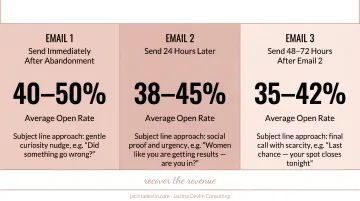
Klaviyo's abandoned cart benchmark data, based on 143,000+ flows, shows an average 50.5% open rate and $3.65 revenue per recipient — making this one of the highest-ROI automations a small store can set up.
Setting up these systems is exactly where Jacinta Devlin's Done-For-You Marketing Systems and Business Launch Program come in — built specifically for women ecommerce owners who want it done right without doing it alone.
Retention: Turn Buyers into Loyal Customers
Once you've converted a shopper, keeping her is where long-term revenue lives. A simple post-purchase flow does most of the work:
- Day 1: Thank-you email — warm, personal, reinforces their decision
- Day 3–5: Review request — make it easy, direct, and low-pressure
- Day 7–10: Product recommendation or loyalty product/service — introduce a complementary product or invite them to a VIP group
Private Facebook communities and VIP customer groups work especially well as retention tools for women-owned brands where personal connection drives loyalty. Jacinta's client Christina Roach (My Balanced Style) grew a Facebook community from zero to 36,000+ members under Jacinta's coaching — and that community became a central driver of her six-figure affiliate income, not just a brand touchpoint.
Key Metrics to Track in Your Ecommerce Funnel
| Metric | What It Tells You | Current Benchmark |
|---|---|---|
| Conversion Rate | % of site visitors who purchase | 1.6%–2.95% (global average) |
| Cart Abandonment Rate | % of shoppers who leave before buying | 70.22% industry average |
| Average Order Value (AOV) | Revenue per transaction | Varies by category |
| Email Open Rate | % of subscribers opening emails | 25.1% (ecommerce promotional) |
AOV formula: Total Revenue ÷ Number of Orders
Even small AOV increases compound quickly. If 200 orders per month average $45, raising AOV to $55 adds $2,000 in monthly revenue without a single new customer.
AOV tells you how much each transaction is worth — email tells you how well you're converting the audience you've already built. Track these three metrics to know if your list is actually working for you:
- Opt-in rate — are people signing up for your list?
- Open rate — are your subject lines working?
- Click-through rate — is your content driving action?
Pair these alongside your on-site conversion data and you'll know exactly which stage of your funnel needs attention. One automation worth setting up first: abandoned cart emails average a 50.5% open rate — double the standard promotional benchmark — making them one of the fastest wins available to any store owner.
Frequently Asked Questions
What is an ecommerce funnel?
An ecommerce funnel is a framework mapping the stages a potential customer moves through — from discovering a brand to making a purchase to becoming a repeat buyer. Understanding it helps store owners identify exactly where they're losing sales instead of guessing.
What is the 80/20 rule in ecommerce?
The 80/20 rule (Pareto Principle) in ecommerce suggests roughly 80% of revenue comes from 20% of customers. For women-owned stores, this makes the case for investing in retention and loyalty strategies for your best buyers rather than constantly chasing new ones — especially since repeat customers spend 67% more on average.
What are the 5 C's of ecommerce?
The 5 C's — Content, Context, Community, Customization, and Convenience — each connect to a different funnel stage. Community and content drive awareness; context and customization support consideration; convenience drives conversion. Use them as a quick checklist to spot which stage of your funnel needs attention first.
How do I know which stage of my funnel needs the most work?
Look at where the largest drop-offs occur. Plenty of traffic but few sales signals a mid- or bottom-funnel problem; very few visitors points to the top of the funnel. Your ecommerce platform's analytics dashboard — or Google Analytics — shows exactly where shoppers are exiting.
What role does social media play in my ecommerce funnel?
For women-owned stores, social media primarily functions as a top-of-funnel awareness and trust-building tool — but it can support every stage when used strategically. Product demos and customer DMs support consideration; community content and loyalty posts support retention. Pair it with email marketing so you own the relationship — social reach fluctuates, but your list doesn't.