
Many users struggle with exactly this: working hard but not seeing consistent growth, copying what other businesses do without knowing if it fits their own model, and feeling overwhelmed by every tool and channel competing for their attention.
According to the Federal Reserve's 2025 Small Business Report, 57% of small employer firms cited reaching customers and growing sales as an active operational challenge in 2024. That's not a motivation problem — it's a strategy problem.
This guide covers what online business coaching for retail actually is, why it works specifically for online retailers, what a coach does for your business, and how to find the right one.
Key Takeaways:
- Retail-specific coaching differs from general business advice — it's built around product-based businesses and online selling channels
- The most common plateau causes aren't what most owners think they are
- A personalized strategy consistently outperforms courses, templates, and DIY guesswork
- Real-world operator experience in a coach matters more than credentials alone
- Results can appear within the first 30–90 days when implementation is consistent
What Is Online Business Coaching for Retail?
Online business coaching is a professional partnership delivered virtually (via video calls, messaging, and digital tools) where a coach provides personalized strategy, accountability, and expert guidance toward specific growth goals. Unlike a course or template, it's an individualized plan built around your actual business.
How Retail Coaching Differs From General Business Coaching
A retail-focused coach understands the nuances that a generalist simply doesn't encounter. General business coaches might help with productivity systems or mindset — but they've never had to think about:
- Seasonal sales cycles and Q4 concentration
- Inventory and product-drop strategies
- The shift from in-person selling to digital platforms
- Platform-specific conversion mechanics on Amazon, LTK, or TikTok Shop
- Abandoned cart sequences for Shopify boutiques
- Content-to-commerce workflows on Instagram and Facebook Groups
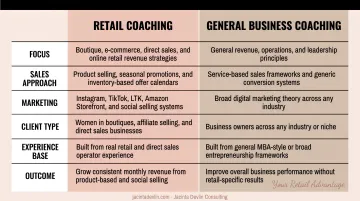
What works for scaling a SaaS company doesn't apply to a boutique owner working toward her first $10K month — and a retail-specialized coach knows exactly where that gap shows up.
Coaching Formats Available
Online retail coaching typically takes three forms:
- 1:1 coaching: weekly private sessions where a coach builds your strategy from scratch based on your specific business
- Group coaching communities: shared training, peer accountability, and live support at a lower price point
- Hybrid programs: strategy calls paired with done-with-you implementation for hands-on momentum
The right format depends entirely on your stage. A boutique owner pre-launch needs a build-from-scratch foundation; a direct sales leader pushing past $25K/month needs a growth and systems overhaul. The best coaches recognize that difference immediately and structure accordingly.
Why Online Retail Businesses Hit a Plateau — and How Coaching Breaks Through It
Most plateaus aren't caused by what the owner thinks they are. That gap between the perceived problem and the actual problem is exactly where coaching earns its value.
The Most Common Stall Points
Online retail entrepreneurs tend to hit the same walls, regardless of business model:
- Inconsistent monthly revenue — strong months followed by unpredictable dips, with no clear reason why
- Over-reliance on one channel — building everything on Instagram or one sales platform, then feeling the consequences when reach drops
- No repeatable customer acquisition system — relying on word-of-mouth or sporadic posts rather than a process that works every month
- Scattered effort — doing too many things across too many platforms without knowing which activities actually drive revenue
Jacinta Devlin, founder of Jacinta Devlin Consulting, describes a pattern she sees repeatedly: clients whose entire marketing strategy is "post and pray" — posting sporadically, sending an email once a month, and getting one or two sales before feeling defeated. The effort is real. The strategy isn't.
The Social Selling Trap
Entrepreneurs who are great at building relationships online often hit a specific wall: the activity doesn't reliably convert. They post consistently, grow followers, get engagement — and still have unpredictable revenue.
The reason is structural. Three gaps show up almost every time:
- No conversion funnel connecting content to a sale
- No email sequence capturing the audience they're building
- No automated system turning followers into repeat buyers
As Jacinta puts it directly: "You almost certainly do not have a social media problem. You have a strategy problem dressed up as a social media problem."
How a Coach Interrupts the Pattern
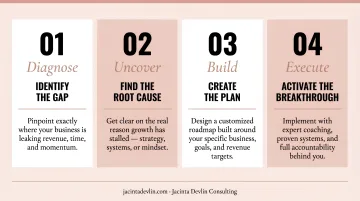
A good retail business coach starts with diagnosis, not advice. The real bottleneck is rarely what the owner identifies on the surface. Before any strategy is built, a coach reviews:
- Current revenue and channels
- What's been tried and what hasn't worked
- Where the actual conversion breakdown is happening
- Which activities drive revenue versus which just create busyness
Then comes accountability. Research cited by the SBA found that 70% of mentored small businesses survived more than five years — double the survival rate of non-mentored businesses. For most owners, that external structure is what finally converts clarity into consistent action.
The Key Benefits of Online Business Coaching for Retail Entrepreneurs
Personalized Strategy Over Generic Advice
Courses teach concepts to everyone. Coaching builds a plan for one specific business. What works for a $500K fashion brand won't translate to a boutique just crossing $5K/month. The platforms differ, the audience differs, the product/service structure differs — and a strategy built for someone else's business is just a template wearing your name.
Amanda O., a boutique store owner, entered Jacinta's Business Growth Program with a goal of $2,500/month. Within months, her business was consistently generating $10,000+ months — a result she credits directly to the individualized strategy, not to a generic framework.
Faster Progress With Fewer Costly Mistakes
A coach who has actually built what you're trying to build has already made the expensive errors — and can help you skip them.
Lisa K., owner of Fleur de Lis Boutique Florida, had never run a business before. Rather than spending months piecing together a strategy independently, she worked with Jacinta's Business Launch Program and generated:
- $1,250 on launch day
- $3,300 in her launch month
- $20,000 in her first four months
- Over $100,000 in year one
Speed matters in the early stages. Having a guide who has already navigated that terrain is what separates a six-figure year-one from a year of costly trial and error.
Objective Outside Perspective
As a business owner, you can't see your own blind spots. Friends and family soften their feedback. Team members often tell you what you want to hear.
A coach's job is to say "this isn't working" or "you're spending time on the wrong things" — and to mean it. That honest outside perspective is one of the most underrated benefits of the coaching relationship.
Carissa P., a Park Lane Jewelry direct sales leader, described her pre-coaching state this way: "Before working with Jacinta I felt overwhelmed and was unsure of what parts of my business needed more focus." That's a prioritization problem — exactly the kind an objective outside observer can identify and fix fast.
Scalability Through Systems and Automation
A retail business coach doesn't just help you hit next month's revenue number — they help you build infrastructure that keeps generating revenue without you doing everything manually.
This means email automations, sales funnels, content workflows, and social media systems that work between sessions. Sharon B., an Amazon affiliate seller, grew from $4,000 in her first year to $20,000+ per month consistently — by building email automations, a content workflow, and a sales funnel system with Jacinta's guidance — infrastructure that ran even when she wasn't.
What an Online Retail Business Coach Actually Does for You
Strategy Development and Business Assessment
Coaching starts with a real audit — not assumptions. Before any plan is built, a coach reviews:
- Current revenue and which channels are producing it
- Platform presence and what's actually converting
- Offer structure and pricing
- Email and funnel infrastructure (or the absence of it)
- Brand clarity and positioning
Only after that diagnostic does a real roadmap take shape. That's what separates coaching from a one-size-fits-all program: the strategy reflects where your business actually is, not where a generic curriculum assumes you are.
Sales and Marketing Guidance for Online Retail
One of the most practical things a retail coach does is help you stop spreading yourself across every platform at once. The specific guidance covers:
- Which platforms are most aligned with your products and audience
- Content strategy designed to convert, not just attract
- Email marketing systems that own your audience regardless of algorithm changes
- Social selling mechanics that translate in-person relationship dynamics to digital formats
- Launch campaigns for product drops, new collections, or boutique openings
The ICF reports that organizations using coaching see an average ROI of 7x the initial investment, with reported improvements in work performance and decision-making. For retail entrepreneurs, those gains show up most directly in how efficiently marketing spend is allocated and how quickly new strategies take hold.
Accountability and Ongoing Check-Ins
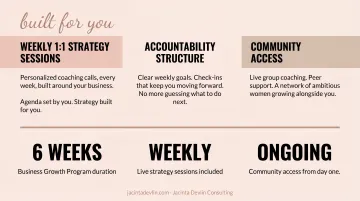
The coaching rhythm is what separates ongoing programs from one-time consultations. In Jacinta Devlin Consulting's Business Growth Program, this looks like:
- Weekly 1:1 Zoom strategy calls directly with Jacinta
- Accountability check-ins between sessions so momentum doesn't stall mid-week
- Direct access for situational questions when a decision needs to be made before the next call
- Access to the Dream+Create community for peer networking, group trainings, and shared resources between sessions
Lisa H., an online retail client, described the end of each session this way: "Each one of our coaching sessions wraps up with my enthusiasm at its max and a list of actionable steps to reach my next goal and beyond."
That structured support — consistent strategy plus between-session access — is what keeps clients moving toward revenue goals rather than stalling between calls.
How to Find and Choose the Right Online Business Coach for Your Retail Business
Identify What You Actually Need Before You Search
Before evaluating any coach, get specific about your situation:
- Are you pre-launch and need to build from scratch?
- Are you already selling but stuck at the same revenue month after month?
- Do you need to diversify from one channel to multiple?
- Are you trying to move from in-person selling to a digital model?
The answer shapes everything. A coach who specializes in early-stage boutique launches is a different fit than one who helps established sellers break through a $25K/month ceiling. Matching the coach to your specific challenge matters more than finding the most credentialed or well-known name.
Evaluate Real-World Retail and Ecommerce Experience
This is the most important filter. Has the coach actually built what you're trying to build — not just coached others, but done it themselves?
Look for documented evidence of:
- Running a product-based business (boutique, ecommerce store, physical brand)
- Operating on the specific platforms relevant to your business (Amazon, LTK, Shopify, TikTok Shop, direct sales)
- Building and growing online audiences that convert to sales
- Achieving revenue milestones comparable to your own goals
Forbes advises selecting a business coach with expertise in the client's specific niche — not just general coaching credentials. Retail expertise and coaching competence are both necessary. A credential without operating experience is theory. Operating experience without coaching skill is just a success story.
Jacinta Devlin's background is a concrete example of this standard. Before coaching a single client, she had already:
- Become a Top 1% seller and million-dollar earner in direct sales
- Served as National Director of Sales & Field Training at Stella & Dot
- Launched and run her own clothing boutique, Jacinta The Label
- Built a six-figure Amazon storefront
- Grown an LTK creator account with brand partnerships at Gucci, Nordstrom, Walmart, and Sephora
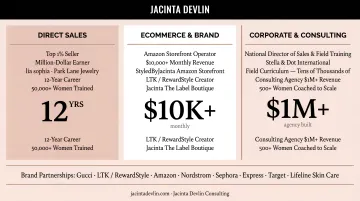
Coaching is her fifth business. She built all of this before she coached anyone.
Assess Communication Style, Format, and Fit
Experience tells you what a coach knows. Format and fit tell you whether working with them will actually move your business forward. Evaluate:
- Does the format (1:1, group, hybrid) match your learning style and current stage?
- Does the coach take every applicant, or are they selective about who they work with?
- Do testimonials come from businesses similar to yours?
- Is there a discovery call so you can assess fit before committing?
A coach who worked with a $50M brand may not be the right fit for someone building their first $100K. Use a discovery call to find out — not just to ask questions, but to assess whether their experience, approach, and communication style match where you are right now. Jacinta Devlin Consulting offers a free 15-minute Growth Chat at calendly.com/devlinconsulting/15-minute-consultation to do exactly that.
Frequently Asked Questions
What is the average cost of online business coaching services for retail?
Costs vary based on coaching format, program length, and the coach's experience. According to a Forbes contributor article, one-on-one business coaching typically runs $1,000 to $5,000 per month in the U.S., though program-based pricing structures vary widely. Group coaching memberships are generally more accessible. When evaluating cost, look at documented client outcomes — a program with a clear track record of $10K–$20K months pays for itself quickly.
What are the 70/30 and 80/20 rules in coaching?
The 70/30 rule is a conversation guideline: the client talks 70% of the time, the coach 30% — coaches listen more than they lecture. The 80/20 rule (Pareto Principle) holds that 80% of outcomes come from 20% of causes — in coaching, this means identifying the 20% of activities actually driving revenue and doubling down there.
How do you coach retail employees?
This guide focuses on coaching for retail business owners, not employee training. That said, working with a business coach helps owners build the leadership systems, team culture, and operational clarity needed to develop their staff more effectively.
How long does it take to see results from online business coaching?
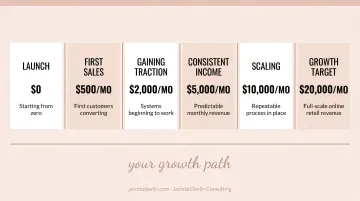
Results vary based on starting point and how consistently the owner implements. That said, Jacinta Devlin Consulting's Business Growth Program documents that most clients see measurable momentum within the first 30–60 days, with many hitting their first $5K–$10K month within 6–12 months. Lisa K. generated $1,250 on her boutique's launch day and $20,000 in her first four months — results driven by starting with the right infrastructure in place.
What's the difference between online business coaching and buying an online course?
A course delivers information. Coaching delivers a personalized strategy, accountability, and real-time feedback built around your specific business. A coach adapts everything to your business model, revenue stage, and goals — and holds you accountable to executing between sessions.
Can online business coaching help with social selling and ecommerce?
Yes — online retail coaching is particularly well-suited for entrepreneurs selling through Instagram, TikTok Shop, Amazon, LTK, or direct sales. Coaches with hands-on experience in these channels can build the digital sales strategies, content systems, and conversion processes these platforms require — channel-specific tactics drawn from actually operating those businesses.