Marketing automation breaks that cycle. Instead of chasing every sale manually, you build systems that work whether you're shipping orders, picking up your kids, or simply stepping away from your phone.
According to Constant Contact's 2024 research, 56% of small business owners have one hour or less per day to spend on marketing. That's the reality for most women running ecommerce stores — and it's exactly why automation isn't optional anymore.
This article covers the five automation workflows that move the needle most for women-owned ecommerce businesses, a step-by-step setup process, the best budget-friendly tools, and how to keep everything feeling like you — not a corporate email blast.
Key Takeaways
- Automation replaces manual, repetitive marketing tasks with trigger-based workflows so you can focus on growth
- The five highest-impact automations are welcome sequences, abandoned cart recovery, post-purchase nurture, re-engagement campaigns, and loyalty programs
- Most tools product/service free plans — you can start with zero budget
- Done right, automation makes every message feel more personal and relevant to each subscriber
- Start with one workflow and do it well before building the rest
Why Women-Owned Ecommerce Businesses Need Marketing And Sales Programs Now
Women-owned businesses are growing fast — NAWBO reports more than 1,800 new women-owned companies are created daily in the U.S., with female-owned businesses growing 21% over five years. Most of those founders are doing it without a team.
The problem isn't effort. It's that manual follow-up doesn't scale. You can't personally send a cart reminder to every shopper who got distracted at checkout, or individually welcome every new subscriber at 2 AM when they opt in. Automation handles all of that — triggered by what customers actually do, sent at exactly the right moment.
For women-owned stores chasing consistent $10K+ months, the math is clear: predictable revenue requires predictable systems. One well-built abandoned cart sequence running quietly in the background can recover thousands of dollars monthly with zero additional effort after setup.
That revenue case is only half the picture. Boutique owners, LTK creators, Amazon sellers, and social sellers build loyal audiences through genuine relationships — and automation doesn't replace that. It extends it.
When a customer buys from your shop and receives a personal-feeling post-purchase email that same week, that's relationship-building at scale. You wrote it once; your customers experience it as timely and thoughtful every single time.
The 5 Must-Have Ecommerce Marketing And Sales Programs Workflows
Welcome Sequence
The welcome sequence is the most important automation you'll build — and it should be the first one you set up.
It triggers the moment someone subscribes to your list, creates an account, or makes their first purchase. Klaviyo data shows automated welcome flows achieve a 1.97% conversion rate on average, with top brands hitting nearly 10%. That's new subscribers converting to buyers without you lifting a finger.
An effective welcome sequence includes:
- A warm introduction to your brand and what makes your store different
- Your founder story (briefly — people buy from people they like)
- A first-purchase incentive (discount code, free shipping, or exclusive product/service)
- A clear next step: shop the new arrivals, follow on Instagram, etc.
Devlin Consulting builds welcome sequences as 5–7 emails for boutique clients, with the copy written to match the store's specific brand voice — not a generic template.
Abandoned Cart Recovery
The average ecommerce cart abandonment rate sits at 70.19%, according to Baymard Institute's research across 50 studies. That means roughly 7 out of every 10 shoppers who add something to their cart leave without buying.
Abandoned cart automation is non-negotiable for any product-based business. The recommended sequence:
- Email 1 (1–2 hours after abandonment): A friendly reminder showing the items left behind
- Email 2 (24 hours later): Social proof, a customer review, or a gentle urgency nudge
- Email 3 (48–72 hours later): An optional incentive — a small discount or free shipping product/service
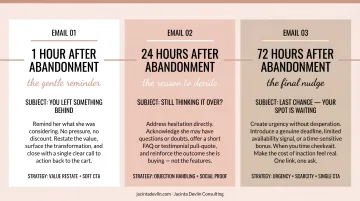
Klaviyo reports the average abandoned cart flow generates $3.65 revenue per recipient, with top performers reaching $28.89 per recipient. For Shopify boutiques, the trigger fires directly from store activity — no manual setup required per customer.
Post-Purchase Nurture and Upsell
The sale isn't the finish line — it's the starting point of the customer relationship.
Shopify research shows repeat customers account for 44% of revenue while representing only 21% of customers. Building an automated post-purchase flow is how you turn one-time buyers into loyal regulars.
A post-purchase sequence for a boutique or lifestyle brand typically looks like this:
- Day 1: Order confirmation with a personal note from the founder
- Days 4–5 (after estimated delivery): A check-in with care tips, styling ideas, or usage content relevant to what they bought
- Day 7–10: A review request — social proof that feeds future sales
- Day 14–21: A product recommendation for a complementary item based on their purchase
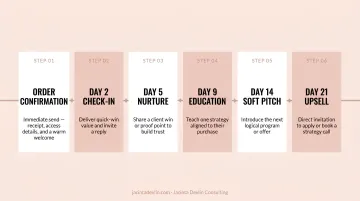
Post-purchase emails have some of the highest open rates in ecommerce — Klaviyo and Omnisend both report rates in the 47–63% range for these flows. Customers are actively engaged with your brand right after a purchase; that's exactly when a well-timed follow-up lands best.
Re-Engagement Campaign for Dormant Customers
Every email list has customers who went quiet. Re-engagement campaigns — also called win-back sequences — target buyers who haven't purchased in 60–90 days and bring them back into your world.
Omnisend reports win-back campaigns average a 33% open rate in ecommerce. They work because these customers already know your brand. They just need a reason to return.
What a strong win-back sequence includes:
- A reminder of their past purchase and why they loved your brand
- New arrivals or what's changed since they last shopped
- A meaningful incentive: exclusive discount, early access, or free shipping
- A final "last chance" email if they don't re-engage
For boutique owners and social sellers, your customer list is your most valuable asset. Reactivating a lapsed buyer costs far less than acquiring a new one — and win-back sequences do it on autopilot.
Loyalty and VIP Automation
Shopify data shows customers who redeem rewards make 2.5x more repeat purchases and have a 23% higher average order value than non-members. Loyalty automation captures that lift — and it fits naturally with the community-driven way women-owned brands already operate.
Even a simple two-tier system (regular customers vs. VIP) produces a measurable increase in customer lifetime value.
What loyalty automation can include:
- Automated points updates or milestone notifications
- Early access emails for new drops (VIPs get 24-hour advance notice)
- Birthday messages with a small exclusive product/service
- Purchase milestone triggers ("You've spent $X — here's a thank you from us")
Set these flows up once, and your best customers feel seen every time — without you manually tracking who bought what or when.
How to Start Automating Your Ecommerce Business Step by Step
Step 1: Pick One Problem to Solve First
Before touching any platform, choose a single goal: recovering abandoned carts, nurturing new subscribers, or reactivating lapsed buyers.
Starting with one focused workflow and executing it well beats trying to build five at once. Most business owners who attempt everything simultaneously end up with nothing fully functional.
The welcome sequence or abandoned cart flow is the right first choice for most stores — high ROI, universally applicable, and straightforward to build.
Step 2: Choose a Platform That Fits Your Tech Stack
Your automation platform needs to connect to where customers already shop — Shopify, WooCommerce, Etsy — and where you communicate with them — email, SMS, social.
Prioritize platforms that product/service:
- Pre-built ecommerce automation templates (saves hours of setup)
- Native integration with your existing store platform
- Pricing that scales with contact count, not feature tier
- A beginner-friendly interface you'll actually use
Jacinta Devlin personally uses and recommends Flodesk as her primary email platform, with Klaviyo a strong fit for Shopify boutiques that need more advanced ecommerce segmentation. If you're unsure which fits your store, a single strategy session before setup is worth it — building on the wrong platform wastes weeks.
Step 3: Segment Your Audience from Day One
Basic segmentation dramatically improves every automation. Even three simple segments work better than one undivided list:
- New subscribers who haven't purchased yet
- Past buyers segmented by purchase category
- VIP customers who've purchased multiple times
For boutique owners, this might mean tagging customers by style preference. For LTK or Amazon sellers, it might mean separating affiliate traffic from direct buyers. The tighter your segments, the higher your conversion rate — even a basic three-way split consistently outperforms a single broadcast list.
Step 4: Build the Trigger, Condition, and Action
Every automation follows the same simple structure:
- Trigger — Something happens (customer adds to cart, subscribes, makes a purchase)
- Condition — A rule is checked (did they complete checkout? Are they a new subscriber?)
- Action — An email or text fires automatically
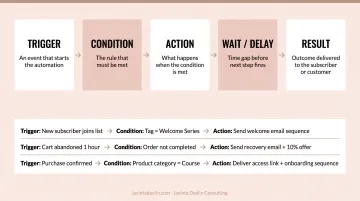
For example: a customer buys a dress from your boutique (trigger), three days after estimated delivery (condition), they receive an email with styling tips and a recommended matching accessory (action). Most platforms walk you through this visually — no coding required.
Step 5: Monitor, Test, and Improve
Once automations are live, the work shifts to reviewing:
- Open rates — Is the subject line working?
- Click rates — Is the content compelling?
- Cart recovery rate — How many abandoned carts convert?
- Revenue per recipient — What's each automation actually generating?
A/B testing subject lines, send timing, and product/service types improves results without rebuilding from scratch. Test one variable at a time — if open rates fall below 20%, that's your signal to rewrite the subject line before touching anything else.
The Best Budget-Friendly Marketing And Sales Programs Tools for Women-Owned Stores
Cost matters for growing businesses. The good news: you don't need to spend much to start.
| Tool | Best For | Free Plan |
|---|---|---|
| Klaviyo | Shopify boutiques needing advanced segmentation; Shopify's recommended email partner | Up to 250 profiles, 500 emails/month |
| Omnisend | Multi-channel sellers (email + SMS + push); ecommerce-specific templates | 250 contacts, 500 emails/month; Standard from $16/month |
| MailerLite | Beginners who want clean, simple automation without a tech team | 250 subscribers, 2,500 emails/month |
| Flodesk | Women-owned businesses wanting beautiful, brand-consistent emails with simple setup | Free trial available; flat-rate paid plan regardless of list size |
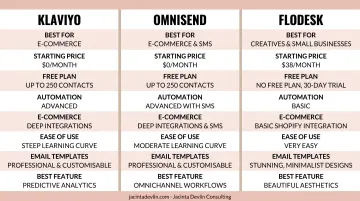
Once you've reviewed the options, here's what to weigh before committing:
What to prioritize when choosing:
- Pre-built ecommerce templates (so you're not starting from a blank screen)
- Native integration with your current platform
- Ease of use without a tech background
- Pricing that stays affordable as your subscriber list grows
A simpler platform you actually set up beats a powerful one you never launch.
Practical tip: Start with a free account, build your first automation, and confirm it's working before committing to a paid tier. Testing before paying removes the financial risk and shows you exactly what the tool can do for your business.
How to Keep Your Automation Feeling Personal and On-Brand
The most common objection: "I don't want my emails to feel like a corporate chain."
Automation done right makes communication feel more personal. A message that arrives three days after delivery, referencing the specific item a customer just received, is far more timely and relevant than a weekly blast to your entire list. McKinsey research shows that 71% of consumers expect personalized interactions — and 76% get frustrated when they don't get them. Automation is how you deliver that at scale.
The key principle: automation handles the timing and delivery. You still write the voice, the warmth, and the story.
Here's how to keep automated emails sounding like you:
- Write automated emails in the same conversational tone you use in your Instagram captions or with customers in person
- Use first names and dynamic product references — tools insert these automatically
- Don't over-automate; leave space for personal replies when customers respond to your emails
- Avoid clustering too many automated messages in a short window
Those tactical choices matter, but your biggest differentiator is your story. A boutique owner who includes a personal note about why she loves a particular product — or a behind-the-scenes detail about where it was sourced — creates the kind of brand loyalty that generic automation never achieves. That's something no big-box retailer can replicate, and it's exactly what your automation should carry forward.
Jacinta Devlin built her clothing boutique Jacinta The Label to consistent $10K+ months using this exact philosophy — automated systems that carry a genuinely personal voice, not corporate copy. That same approach — strategy paired with authentic voice — is what she builds for Done-For-You clients: the full automation stack, written to sound like them.
Frequently Asked Questions
What is ecommerce marketing automation and how does it work?
Ecommerce marketing automation uses software to send pre-written, trigger-based messages to customers based on their actions — subscribing, abandoning a cart, completing a purchase — without requiring manual sending each time. The platform handles timing and delivery; you write the messages once and they run automatically.
What is the best marketing automation tool for a small women-owned ecommerce business?
It depends on your platform and budget. Klaviyo is strongest for Shopify boutiques needing advanced segmentation; Omnisend covers email and SMS with a generous free plan. MailerLite is the most beginner-friendly option, while Flodesk suits women who prioritize brand aesthetics and want flat-rate pricing regardless of list size.
What automations should I set up first for my online store?
Start with the welcome sequence and abandoned cart recovery. Both deliver the highest ROI at every stage of growth, work for any ecommerce model, and most platforms include pre-built templates so setup is faster than you'd expect.
Can marketing automation still feel personal and authentic?
Yes — when done correctly, it feels more personal than manual blasts because messages are triggered by what a customer just did, not sent to everyone at once. Write in your own voice, use customer names and purchase references, and avoid sending too many messages in a short window.
How much does ecommerce marketing automation cost to set up?
Most platforms product/service free plans that cover the basics, with paid tiers scaling by contact count. A newer store can start at no cost, validate results, and increase investment as the list and revenue grow. Getting expert guidance upfront on platform selection saves significant time and avoids costly switching later.
How long does it take to see results from ecommerce marketing automation?
Abandoned cart recovery can generate measurable revenue within the first week, and welcome sequences start converting as soon as traffic reaches your opt-in. Re-engagement campaigns and loyalty programs build over 30–90 days as your audience grows and behavioral data accumulates.
Ready to get the right automation system built for your specific business — not a template someone else used? Book a free 15-minute consultation with Jacinta Devlin to talk through your current setup and what to build first.