
This is the pattern Jacinta Devlin sees most often when she starts working with a new client. As she puts it directly: "You don't have a social media problem. You have a strategy problem dressed up as a social media problem."
Posting more isn't the answer. Neither is copying what other creators do. What's missing is a digital-first brand strategy — the foundation that makes everything else actually convert.
This guide covers exactly what that strategy is, why it matters for women building income-generating businesses online, and the specific steps to build one that works for your business — not a generic template, but a real framework.
Key Takeaways
- A digital-first brand strategy unifies every touchpoint — social, website, email, and content — into one cohesive system
- Today's buyers take 6+ actions before purchasing a new brand, making multi-channel presence non-negotiable
- Five pillars power every digital brand: clarity, visual identity, voice, audience, and platform presence
- Social media drives discovery — but owned channels like email convert at 10–40x higher rates
- Consistent strategy, not more posting, is what produces compounding revenue results
What Is a Digital-First Brand Strategy?
A digital-first brand strategy isn't just having a website or an Instagram account. It means intentionally designing your brand around the digital channels where your audience already lives — so every touchpoint works together to build trust and drive sales.
Your brand is your identity — what you believe, who you serve, and why someone should choose you. Your digital strategy is how that identity reaches people. One without the other leaves money on the table. Combined, they create a recognizable, revenue-generating online presence.
What It Looks Like in Practice
Going digital-first is not about being everywhere. That's the trap most entrepreneurs fall into — spreading across six platforms, posting reactively, and burning out with nothing to show for it.
A digital-first brand strategy means:
- Being intentional about which platforms you show up on
- Ensuring every piece of content reinforces the same brand position
- Creating a connected experience that moves your audience from discovery to purchase
When those elements don't connect, you're producing content that doesn't compound. When they do, each post, email, and website visit works together — pulling the same audience closer to buying from you.
Why Every Woman Entrepreneur Needs a Digital-First Brand Strategy Right Now
The Way Buyers Shop Has Changed
Today's customers don't stumble into a purchase. According to a 2024 Google/Ipsos study, 60% of consumers take 6+ actions before buying from a new brand — price comparisons, reviews, social media research, and more.
That same study found 70% of weekly social media users turn to Google Search to evaluate products they discovered on social.
Buyers move across multiple channels before they decide. If your brand isn't showing up consistently at each of those touchpoints, you're losing sales you never even knew were in play.
The Real Cost of Operating Without a Strategy
Jacinta describes the pattern she consistently sees in new clients: women who are busy posting but not building. The symptoms are predictable:
- Inconsistent revenue — strong months followed by flat ones, with no predictable floor
- Scattered messaging — different tones, visuals, and offers across platforms
- Low conversion rates — content gets views, but followers aren't buying
- Burnout — enormous time investment with no compounding results
Client Jamie R. described it as being "literally all over the place" before working with Jacinta. Client Carissa P. said she felt "overwhelmed and unsure of what parts of my business needed more focus." Both are describing the same problem: tactics without a strategy underneath them.
The Opportunity
The flip side of that cost is real opportunity. Research from Lucidpress found that over 60% of brands reported consistent branding contributed to revenue growth of 10–20% or more. For boutique owners, coaches, direct sellers, and affiliate marketers, a digital-first strategy is what converts social media activity into predictable income.
The 5 Core Pillars of a Digital-First Brand
Pillar 1 — Brand Clarity
Before a single post goes live, you need clear answers to four questions:
- Who are you?
- Who do you serve?
- What specific problem do you solve?
- What makes you different?
Without this foundation, content has no direction. Consider the difference between "I sell women's clothing online" and "Fleur de Lis Boutique is the go-to destination for Florida women who want effortlessly stylish, everyday fashion — curated by a woman who lives the lifestyle." The second version tells a potential customer exactly whether she belongs. The first tells her nothing.
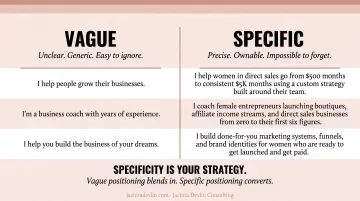
This is brand clarity. Get it right, and every content decision, platform choice, and product/service you create has a clear filter to run through.
Pillar 2 — Visual Identity and Consistency
A consistent visual identity (colors, fonts, imagery style) makes your brand recognizable across every platform a customer encounters you on. Recognition builds trust, and trust drives purchasing decisions.
This doesn't require a big budget. It requires intention: a defined color palette, consistent typography, and templates you actually use. Jacinta is direct about the cost of skipping this: a brand that looks DIY at the logo level "signals 'amateur' to your audience and directly hurts willingness-to-pay, conversion rate on premium offers, and brand-partner interest."
Pillar 3 — Brand Voice and Tone
How you communicate online is as important as how you look. Your voice (your personality, language, storytelling style) should be instantly recognizable whether someone reads your email, your caption, or lands on your website.
A practical way to define yours:
- Choose 3 adjectives that describe your brand's personality (warm, direct, aspirational)
- Complete a "sounds like / doesn't sound like" exercise: list phrases your brand would use versus phrases it would never use
- Apply it consistently across every platform
Pillar 4 — Audience Clarity
Jacinta's teaching here is direct: "Everyone isn't your potential customer." Trying to speak to everyone means you reach no one.
Audience clarity means knowing your specific customer's pain points, desires, daily habits, and where she spends time online. That specificity determines every content decision : what topics you cover, what language you use, which platforms you prioritize. Without it, you're guessing.
Pillar 5 — Platform Presence
A digital-first brand doesn't mean being on every platform. It means dominating the one or two platforms where your ideal customer already spends time.
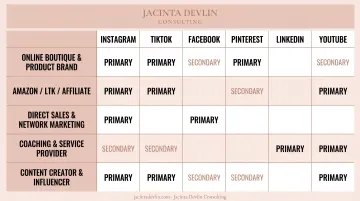
Platform choice should follow audience demographics and content type:
| Business Type | Primary Platforms |
|---|---|
| Boutique / Product Sellers | Instagram, TikTok Shop, Pinterest, Email |
| Direct Sellers | Instagram, Facebook Groups, Email |
| Coaches / Service Providers | Instagram, LinkedIn, YouTube, Email |
| Affiliate / Influencer Marketers | Instagram, Amazon, LTK, Pinterest, TikTok |
Women are significantly more likely than men to use Pinterest (50% vs. 19%) and TikTok (40% vs. 25%) according to Pew Research — making both platforms particularly relevant for women-led product and lifestyle brands.
How to Build Your Digital-First Brand Strategy Step by Step
Step 1 — Define Your Brand Foundation
Start here, even if you've been in business for years. Answer these questions before you touch your content calendar:
- What is my brand's purpose? — Why does this business exist beyond making money?
- Who am I speaking to? — Get specific. Not "women who like fashion" but "busy moms in the South who want affordable everyday style."
- What specific problem do I solve? — The clearer this is, the easier selling becomes.
- What is my unique value? — Why you, over anyone else offering something similar?
Many women skip this step entirely and wonder why their content doesn't convert. This is the strategy work that makes everything else click. As Jacinta builds with every client — from vision and mission to positioning and messaging architecture — the brand foundation is built before content creation begins, not after.
Step 2 — Map Your Customer's Digital Journey
A potential customer rarely buys on first encounter. She discovers you on Instagram, visits your website, maybe joins your email list, sees a few more posts, and eventually buys. A digital-first brand creates intentional touchpoints at every stage rather than hoping one channel carries all the weight.
For Jacinta's clients — boutique owners, social sellers, coaches, affiliate marketers — the journey typically looks like this:
- Discovery: Social media (Instagram Reels, TikTok, Pinterest)
- Consideration: Website visit, email opt-in, Facebook Group
- Conversion: Email sequence, sales page, checkout
- Retention: Post-purchase automation, loyalty content, community
The critical insight Jacinta emphasizes: social media is rented land. The algorithm controls who sees your content. An email list is owned land — you control who receives what, when.
As she tells clients directly: "An Instagram account is rented land. An email list is owned land — and your conversion rates are typically 10–40x higher than social."
A boutique owner's journey architecture looks nothing like a coach's. Getting this right for your specific business is what separates consistent $10K months from constantly starting over. That path starts with knowing what you're creating — and why.
Step 3 — Build Your Content Plan Around Your Brand Pillars
Once your journey map is in place, every piece of content has a job. Each post should reinforce your brand position and move your audience closer to a purchase or a deeper relationship.
A content plan built on your brand pillars includes:
- Content topics — what subjects align with your pillars and speak to your audience's pain points
- Content formats — Reels, Stories, carousels, email, blog, live video (choose formats that match how your audience consumes content)
- Posting cadence — consistency beats frequency. A realistic schedule you maintain outperforms an ambitious one you abandon
- Repurposing strategy — one piece of content, adapted for multiple platforms
For solo entrepreneurs managing every aspect of their business, batching content is what makes consistency sustainable. Block time weekly or bi-weekly to create in bulk, then schedule in advance using tools like Canva and your preferred scheduler — so your brand stays visible without consuming your day.
Showing Up Consistently and Building a Community That Buys
Posting for views and building a community that buys aren't the same activity. The difference shows up in the work: responding to comments, asking questions, celebrating customer wins, and sharing what actually happens behind the scenes of your business.
Social Proof Does the Selling For You
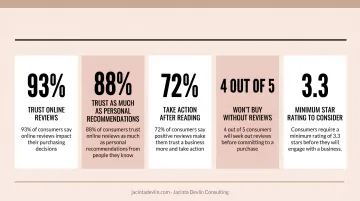
PowerReviews surveyed 8,153 U.S. consumers and found 91% trust ratings and reviews when making purchase decisions, with 82% trusting them as much as a personal recommendation. Testimonials, customer photos, and reposts aren't optional extras — they're core brand assets.
Actively gather them. Share them consistently. Client Christina R.'s Instagram rebrand, combined with strategic social proof and community building, took her from 13K to 95K+ followers and landed her five-figure brand deals with Walmart and QVC.
Own Your Community
Social media reach is shrinking. Organic Instagram reach has dropped to approximately 3–4% of followers. An email list or owned community (Facebook Group, membership) isn't algorithm-dependent — it's yours permanently.
Jacinta grew her own Dream+Create Online Coaching Community by showing up consistently and sharing real results publicly. Client Sharon B. built two Facebook Groups — one to 30K+ members and one to 37K+ members in four months — which drove her from $4K in her first year on Amazon to $20K+ per month. When you own the community, you control the conversation.
Authenticity Is Not Optional
For coaches, consultants, and social sellers, being the visible face of your brand is a competitive advantage, not a vulnerability. Jacinta's own story proves it: she didn't pitch coaching. She showed up, built publicly, and people started asking how she was doing it.
Her most requested speaking topic — "How I Made Multiple 6-Figures Online with Less Than 10K Followers" — points to the real lesson:
- Follower count doesn't drive revenue. Strategy and consistent visibility do.
- Showing up without a pitch builds trust faster than any promotional campaign.
- People buy from people they can see — which means your face, your process, your results.
How to Track What's Working and Adjust Your Strategy
Tracking the right numbers tells you exactly what's driving growth — and what to cut. Monitor these four metric categories to measure your digital brand's health:
| Metric Category | What It Measures | Key Numbers to Watch |
|---|---|---|
| Reach & Impressions | Awareness — are new people finding you? | Follower growth, post reach |
| Engagement Rate | Connection — is your content resonating? | TikTok: 2.63% median; Instagram: 0.43% median |
| Website Traffic & Email Opens | Interest — are they exploring further? | Email open rate benchmark: ~29.81% for e-commerce |
| Conversion Rate | Revenue — are they buying? | E-commerce global average: ~2.66% |
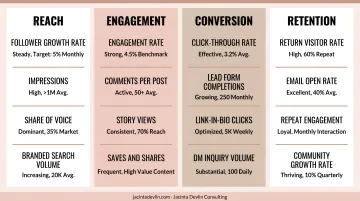
Once you know which metrics matter, reviewing them consistently is what turns data into decisions. Build in a regular strategy review — monthly at minimum, quarterly for deeper analysis. Ask:
- What content performed best?
- Which platform drove the most traffic or sales?
- Where are potential customers dropping off in the journey?
A digital-first brand requires ongoing refinement, not a one-time setup. The businesses that grow consistently are the ones that look at their numbers honestly, make small adjustments often, and stay committed to the process long enough to see compounding results.
Frequently Asked Questions
What is a digital-first brand strategy?
A digital-first brand strategy means intentionally designing your brand's identity, messaging, and presence around the digital channels where your audience lives — so every touchpoint (social, website, email, content) works together to build trust and drive sales. The goal is strategic presence, not maximum presence.
What are the 4 C's of brand strategy?
The 4 C's are Content (what you create and share), Consistency (how reliably you show up), Community (the audience relationships you build), and Conversion (turning followers into buyers). They map the path a stranger takes from first discovering your brand to making a purchase.
What are the most important elements of a digital-first brand strategy?
The five core elements are brand clarity (mission, values, positioning), visual identity, brand voice, audience understanding, and intentional platform presence. Gaps in any one of these areas will slow down what the others can deliver.
How do I choose the right social media platforms for my digital brand?
Choose platforms based on where your specific target audience spends the most time and what content formats match your strengths. Focus deeply on 1–2 platforms rather than spreading thin across all of them. For product-led women entrepreneurs, Pinterest and TikTok have the strongest female-audience evidence.
How long does it take to see results from a digital-first brand strategy?
Most of Jacinta's clients begin seeing momentum within 30–60 days of implementing a clear strategy. Consistent $5K–$10K months typically build over 6–12 months, depending on your product/service, consistency, and starting point.
Can I build a digital-first brand without a big budget?
Clarity, consistency, and strategy are the real requirements — not a large budget. The revenue-generating platforms (Amazon, LTK, Instagram, Facebook Groups) are free to join. Multiple Jacinta clients have built $10K+ months using only these free platforms and a clear strategy.