
Introduction
You're the CEO, the marketer, the customer service rep, and the content creator — and according to a 2023 Guidant Financial survey, nearly 40% of women business owners cite "wearing too many hats" as their top growth barrier. If you're a woman entrepreneur, this isn't a complaint. It's just Tuesday.
But here's the problem: no amount of hustle can break through a bandwidth ceiling. When your time is the bottleneck, growth has a hard cap.
Marketing automation protects your time so you can show up fully where it actually counts — in client relationships, product decisions, and the work only you can do. The personal touch that makes your business worth following stays yours. The repetitive middle work doesn't have to.
This post covers why automation matters specifically for women-owned businesses, the four workflows that deliver results fastest, a step-by-step strategy framework, and how to choose tools without overspending. No borrowed playbooks. No one-size-fits-all templates.
Key Takeaways
- Automated emails generate $3.41 per email versus $0.15 for standard campaigns
- Start with one workflow (a welcome series) before building a complex system
- Define your goal before choosing any platform — strategy always precedes software
- Automation amplifies human connection; it doesn't replace it
- Most platforms offer free tiers sufficient to launch your first workflow today
Why Women-Owned Small Businesses Have the Most to Gain
Women own more than 12 million U.S. businesses and generate $3.3 trillion in annual revenue. Yet women-owned businesses represent just 9.6% of total employment — meaning most are running lean. Very lean.
According to the National Women's Business Council, 70.5% of women entrepreneurs ages 35–44 rate balancing work and family as very important. Most are building businesses in the margins of an already full life. That statistic isn't about preference — it's about real, daily bandwidth constraints.
The Bandwidth Ceiling Is Real
Hustle gets you started. At some point, though, the only way to grow is to stop doing everything manually — and that's precisely where automation changes the equation.
Research from Constant Contact found that 60% of small businesses using marketing automation say they saved time or worked more efficiently, with 33% saving more than 40 minutes per week. That's 40 minutes returned to client work, product development, or simply being present.
Automation Doesn't Make You Less Human
This is the most common concern Jacinta Devlin hears from her coaching clients — coaches, direct sellers, boutique owners, and social sellers who have built their businesses on personal connection. The worry makes sense.
But consider what actually makes marketing feel cold: forgetting to follow up, leaving a new subscriber without a welcome, letting a warm lead go quiet for two weeks. Automation prevents all of that. Done right, it ensures every lead, customer, and follower gets a response — which is more personal, not less.
The Leveling Effect
A solo woman entrepreneur with the right automation stack can show up with the consistency and professionalism of a full marketing team — without the payroll. A boutique owner running Shopify + Klaviyo can recover abandoned carts, send post-purchase sequences, and welcome new subscribers automatically — the same infrastructure a major retailer uses.
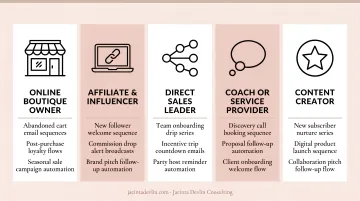
Here's how this plays out by business type:
- Boutique owners — abandoned cart automation recovers sales already nearly made
- Coaches and service providers — nurture sequences move leads through longer decision cycles hands-free
- Direct sellers — email lists create owned audience infrastructure independent of any company platform
- Social sellers and influencers — DM automation and evergreen email funnels convert followers without manual outreach
- Ecommerce entrepreneurs — post-purchase and loyalty sequences turn one-time buyers into repeat customers
The Automations Every Woman-Owned Small Business Should Build First
Don't try to build the whole system at once. Start with high-impact, low-complexity workflows that prove the model and build momentum. These four are the right place to start.
The Welcome Series
A welcome sequence is the single highest-return automation most small businesses can build. According to Omnisend, welcome automations average a 35.53% open rate, 3.94% click rate, and $6.16 revenue per email — dramatically outperforming standard broadcast campaigns.
A simple 3-email structure that works:
- Immediate welcome — deliver on your promise (freebie, discount, or content) and set expectations for what's coming
- Day 2: Value delivery — share your brand story, a helpful resource, or something genuinely useful to your new subscriber
- Day 4: Soft offer introduction — introduce what you do and invite them to take a next step, without pressure
This sequence builds the relationship from day one — and runs without any input from you. Jacinta's team builds welcome sequences (typically 5–7 emails) as a core deliverable in both her Done-For-You and Done-With-You marketing programs, primarily on Flodesk — her personally recommended platform.
The Lead Nurture Sequence
When someone downloads a guide, registers for a workshop, or clicks a specific link, they've told you exactly what they care about. A generic follow-up wastes that signal entirely.
A short behavioral email sequence — triggered by that specific action — moves leads through the decision process automatically. This matters especially for coaches and service providers with longer sales cycles, where a prospect might need 5–7 touchpoints before booking.
Segmenting by lead source and engagement level ensures the right message reaches the right person at the right time.
The Abandoned Cart or Inquiry Recovery Sequence
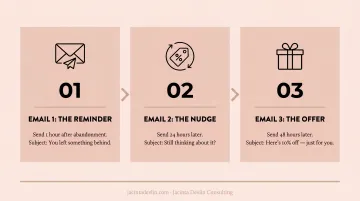
For product sellers: 70.22% of online shopping carts are abandoned before purchase, according to Baymard Institute's analysis of 50 studies. Abandoned cart emails average a 50.5% open rate and 3.33% placed order rate — meaning this automation recaptures sales that were already nearly made.
For service-based businesses, the equivalent is following up on incomplete inquiries, unbooked consultations, or abandoned sign-up flows. Someone showed interest and stopped short — an automated sequence follows up so you don't have to.
The Re-Engagement Campaign
Email lists decay. ZeroBounce reports 23% list decay in 2025 — nearly one in four subscribers goes cold every year. Inactive contacts hurt your deliverability metrics and inflate your subscriber count without adding value.
A simple re-engagement sequence:
- Send a compelling reason to reconnect (a new offer, a resource, a personal note)
- Follow with an easy opt-down or unsubscribe option for those who don't engage
The contacts who re-engage are often your warmest leads — they just needed the right prompt at the right moment. Customer reactivation emails average a 33.11% open rate — modest, but real revenue from contacts you'd otherwise lose.
How to Build Your Marketing And Sales Programs Strategy Step by Step
The most common mistake: buying a tool before defining a goal. Platform features don't determine your strategy. Your business goals do.
Step 1: Define One Clear Goal
Pick one specific, measurable outcome : improve lead-to-client conversion rate, increase repeat purchases, or shorten the time from first contact to first sale.
Trying to solve everything at once produces a bloated system nobody uses. Every strategy should be built around your specific business and revenue goals — not a generic template someone else used.
If you're not sure which goal will move the needle most, that's exactly the kind of clarity Jacinta Devlin helps clients find before a single automation is built.
Step 2: Map Your Customer Journey
With your goal defined, map every touchpoint from first awareness to repeat purchase. Then ask:
- Where do I lose people?
- What questions do they always ask before buying?
- What would happen if I followed up every single time?
This map reveals exactly where automation adds the most value — usually where follow-ups are missed or leads go cold between touchpoints.
Step 3: Choose What to Automate First
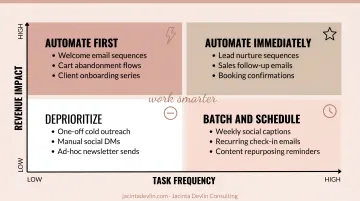
Prioritize based on two factors: frequency (how often does this task happen?) and impact (does it directly affect revenue?).
Welcome sequences, lead nurture, and abandoned cart or inquiry recovery come first. One important rule: automate what already works manually. Automation amplifies what's working — it doesn't fix what's broken.
Step 4: Select Your Tools and Set Up Integrations
Match the platform to your current business size and technical comfort level , not where you hope to be in two years. Your email platform needs to connect to your website, CRM, and ideally your social media or ecommerce store.
Start with a free tier before committing to paid. Most platforms offer enough functionality to launch your first workflow at no cost. (Platform recommendations are in the next section.)
Step 5: Launch, Monitor, and Optimize
Launch imperfect. An 80% automation running is worth more than a perfect one still in draft.
A simple review rhythm for the first two weeks:
- Pull open rates, click rates, and conversion outcomes
- Make one change at a time based on what you find
- Note what improved, then apply the same logic to the next sequence
Most women who stick to this rhythm see measurable improvement within 30 days — not because the automation is perfect, but because they keep refining it.
Choosing the Right Tools Without Blowing Your Budget
Three things matter most when evaluating platforms:
- Ease of use — can you build a workflow without a tech background?
- Key integrations — does it connect to your website, social platforms, or ecommerce store?
- Pricing structure — does it scale based on contacts so you're not overpaying early on?
Here are four beginner-friendly options well-suited to women-owned small businesses:
| Platform | Best For | Starting Price |
|---|---|---|
| Flodesk | Coaches, personal brands, boutiques — design-focused with flat-rate pricing | ~$25/month ~$25/month |
| Mailchimp | General small business use, broad integrations | Free up to 250 contacts; paid from ~$13/month |
| Klaviyo | Ecommerce and Shopify-based boutiques | Free up to 250 profiles; paid tiers scale by contacts |
| Kit (ConvertKit) | Creators, coaches, digital product sellers | Free up to 10,000 subscribers; paid from ~$33/month |
If you want a practitioner's take: Jacinta uses and recommends Flodesk across her Done-For-You and Done-With-You programs — it's the platform she builds on most often for coaches and personal brands. For boutique owners running on Shopify, Klaviyo is her team's go-to for abandoned cart sequences and post-purchase automation.
The platform itself is rarely the expensive part. The real cost is the hours spent doing manually what automation handles in minutes — and the revenue that slips through while you're still figuring it out.
How to Know If Your Automation Is Actually Working
Open rates and follower counts feel satisfying. They don't pay the bills.
The metrics that actually matter are the ones tied to revenue and relationship progression. Start here:
The Three Metrics Worth Tracking
- Lead-to-customer conversion rate — are the right people becoming paying clients?
- Customer lifetime value — are automated sequences increasing repeat purchases or upsells?
- Time-to-first-sale — is automation shortening the path from discovery to decision?
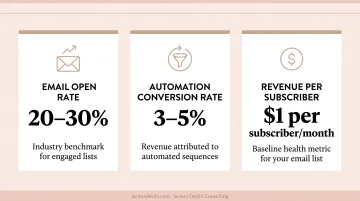
Before launching any automation, set a baseline. Pull your current numbers and record them. Without a before/after comparison, you can't know if anything improved.
The Monthly Review Habit
Once per month:
- Pull your three core numbers
- Compare to last month
- Identify one thing to test or improve
Keep it simple. The point is consistent action on real data, not a perfect analytics dashboard.
When a Workflow Underperforms
Don't scrap it. Diagnose it:
- Check the trigger logic — is it firing correctly?
- Review the email copy — is it relevant to where that person is in their journey?
- Test a different subject line
- Confirm the right segment is receiving the message
Most underperforming workflows have one fixable problem. Find it, adjust one variable at a time, and give it 30 days before drawing conclusions.
Frequently Asked Questions
What is a marketing automation strategy?
A marketing automation strategy is a deliberate plan for using technology and workflows to handle repetitive marketing tasks — covering what to automate, in what order, and toward which business goals. It's the architecture behind how leads are nurtured and customers are retained without manual effort — not just buying a tool or scheduling posts.
Is marketing automation suitable for small businesses?
Small businesses — especially solo founders and small teams — often benefit most from automation because it lets them deliver consistent, personalized marketing without a full team. Most platforms offer free tiers designed specifically for early-stage operators, so cost isn't a barrier to getting started.
What is the 80/20 rule for marketing automation?
The 80/20 rule holds that roughly 80% of your results come from 20% of your automations — typically welcome sequences, lead nurturing, and abandoned cart recovery. Starting with those core workflows delivers the fastest ROI before you build out anything more complex.
What is the 3-3-3 rule in marketing automation?
The 3-3-3 rule isn't a standard framework in email marketing automation — it's actually a sales prospecting concept. For email sequences, what matters is the logic: deliver value, build trust, then introduce an offer. The number of emails matters far less than the purpose behind each one.
How do I start marketing automation as a solo woman entrepreneur?
Start with one goal, one workflow, and one tool. A welcome series is almost always the right first choice — it's high-impact, straightforward to build, and begins generating results immediately. Master the basics before adding complexity. Most women who get stuck do so because they tried to automate everything at once before any single workflow was actually working.
Can marketing automation help me build more consistent income?
Yes. Nurture sequences keep leads warm, re-engagement campaigns revive dormant contacts, and post-purchase flows drive repeat sales — all without additional manual effort. When your marketing runs in the background, consistent $5k–$10k+ months stop depending on whether you showed up online that day.