
The challenge isn't a lack of marketing channels. It's too many of them, with too little clarity on what actually moves revenue for smaller brands with limited time and budget. Most women-owned ecommerce brands are still guessing — posting more, trying every platform, chasing trends — without a strategy underneath any of it.
This post cuts through that noise. What follows are the specific digital marketing strategies that drive real revenue for women-owned ecommerce brands — not enterprise playbooks, but practical tactics built for ambitious women working toward consistent $10K+ months.
Key Takeaways
- A focused multichannel strategy consistently outperforms trying every platform at once
- Your personal brand is one of your most powerful marketing assets — build it intentionally
- The 80/20 rule means focusing on the 20% of channels driving 80% of your revenue — and cutting the rest
- 2026's highest ROI comes from owned channels (email + SEO) layered with social commerce
Why Digital Marketing Is Non-Negotiable for Women-Owned Ecommerce Brands
Without digital marketing, even great products sit unseen. Google reports that 48% of consumers get purchase inspiration online, making visibility a prerequisite to any sale happening at all.
Here's what makes this particularly relevant for women entrepreneurs: a 2025 Journal of Consumer Research study — across five preregistered studies with 2,585 participants — found that "woman-owned business" labels directly enhance perceived competence. That trust signal is a genuine marketing asset, not a soft differentiator.
That trust advantage compounds when paired with digital marketing's greatest perk: it levels the playing field. A boutique owner with the right targeting, community strategy, and email automation can compete directly with larger brands — because authentic connection and personalization outperform raw ad spend at scale.
Women entrepreneurs are often natural community builders and storytellers, and those skills have measurable business value:
- Community-driven email lists convert at higher rates than cold paid traffic
- Consistent brand storytelling drives repeat purchases and word-of-mouth referrals
- Authentic content builds the kind of trust that paid ads can't manufacture
The Core Ecommerce Digital Marketing Channels That Drive Real Sales
Effective ecommerce marketing uses a layered channel approach. Start with what builds long-term visibility, then layer in what accelerates discovery. Trying every channel at once produces mediocre results across all of them.
Owned Channels: SEO and Email Marketing
SEO is the foundation. Optimizing product pages, category pages, and blog content for buyer-intent keywords means your store gets found organically — without paying per click. Start small: write 3–5 product descriptions targeting specific search phrases your buyer actually uses (think "black midi dress for wedding guest" rather than just "black dress").
Email marketing is where the revenue compounds. Litmus reports email ROI at $45 for every $1 spent in retail and ecommerce — and automated flows outperform broadcast campaigns significantly.
Three automations every women-owned ecommerce brand should build first:
- Welcome sequence — introduce your brand, build trust, and drive that first purchase while a new subscriber's interest is at its peak
- Abandoned cart recovery — with average cart abandonment at 70.22%, a well-timed recovery sequence recaptures revenue that's already close to converting
- Post-purchase follow-up — turns one-time buyers into repeat customers without any manual effort
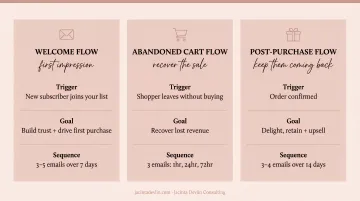
Klaviyo benchmarks show automated flows average a 2.11% placed order rate versus just 0.16% for standard campaigns. These three automations alone can meaningfully lift revenue before you touch any paid advertising.
For platform selection, Flodesk works well for women-owned ecommerce brands starting out — it's what Jacinta uses in her own business and builds on for clients. Klaviyo and Kit are solid options for brands already operating on those platforms.
Social Commerce and Paid Advertising
Social commerce is now where discovery and purchase happen in the same breath. US social commerce sales hit $71.6 billion in 2024 and are expected to exceed $100 billion in 2026. The friction between "I want this" and "I bought this" has nearly disappeared.
For women-owned brands, the organic social tactics that build both reach and revenue:
- Short-form video showing products in use (founder-led, low-production)
- Behind-the-scenes content that humanizes the brand
- Authentic storytelling that connects product to lifestyle
- TikTok Shop and Instagram Shopping integration so viewers can purchase without leaving the app
Paid advertising is the accelerant, not the starting point. Use it to amplify what's already working organically, retarget visitors who didn't convert, and reach lookalike audiences of your best customers. One focused platform with a small budget outperforms thin spend spread across three.
Content Marketing
Blog posts, how-to guides, videos, and buyer-focused editorial content build trust while driving organic search traffic at the same time. This is especially powerful for niche product brands where education and lifestyle storytelling do the selling.
A boutique owner, for example, could write "How to Style a Linen Midi Dress for a Summer Wedding" — a post that speaks directly to her buyer's identity and intent, pulls in organic search traffic, and positions her as the authority on exactly what she sells. The content serves discovery, trust, and conversion all at once.
The Personal Brand and Social Selling Advantage for Women Entrepreneurs
For women-owned ecommerce brands, the founder is often the brand's most compelling asset. Buyers connect with the person behind the business in ways they never will with a faceless storefront. That connection is a competitive moat large brands cannot replicate.
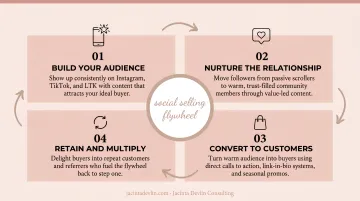
The Social Selling Flywheel
Social selling works through compounding trust, not interruptive advertising:
- Organic content builds an audience around your products and personality
- Consistent engagement converts followers into a community that trusts your recommendations
- Trust converts to sales — your audience buys because they believe in you, not because they saw an ad
- Happy customers become advocates who extend your reach organically
Jacinta Devlin built her clothing boutique, Jacinta The Label, and her StyledByJacinta Amazon storefront to consistent $10K+ months using exactly this model. She layered Instagram, TikTok, LTK, and Facebook content on top of a strong email marketing system, then scaled into brand partnerships with Gucci, Nordstrom, and Sephora.
Micro-Influencers and UGC
Micro-influencers (10K–100K followers) drive higher engagement than mega-influencers because their audiences are more targeted and their recommendations feel personal. Sprout Social reports that Instagram micro-influencers average the highest engagement rates among all influencer tiers, including celebrities.
User-generated content extends this trust strategy to your existing customer base. Bazaarvoice reports that apparel and accessories shoppers who engage with UGC on product pages convert at 2x the rate of those who don't. A simple post-purchase email asking customers to share a photo wearing their purchase, or a social giveaway that incentivizes tagging, generates authentic social proof that converts better than polished brand advertising.
Practical UGC prompt: Include a line in your post-purchase email sequence: "We'd love to see how you're wearing it — tag us on Instagram for a chance to be featured." Low effort, high payoff.
For women ready to move beyond organic reach alone, working with someone who has built this exact growth path shortens the time from strategy to results. Jacinta Devlin Consulting works with women-owned ecommerce brands to build custom strategies tailored to their specific business and goals.
The 80/20 Rule Applied: Which Strategies Actually Move Revenue
Roughly 80% of your ecommerce revenue comes from 20% of your marketing activities. For a brand with limited time and budget, identifying that 20% and going all-in is the most important strategic decision you'll make. Most brands scatter effort across every channel instead, and end up building nothing to a high standard.
Finding Your Top 20%
Start with three accessible tools:
- Google Analytics — which channels drive revenue (not just traffic)
- Meta Business Suite — which content and ad creative actually converts
- Your email platform analytics — which automations and campaigns produce orders
Look for where buyers come from, not just where visitors come from. A channel that drives 40% of your traffic but 5% of your revenue is not your 20%.
Once you know which channels bring actual buyers, the next question is what happens after they purchase. That's where most brands leave serious money on the table.
Retention Is Your Highest-ROI Marketing Activity
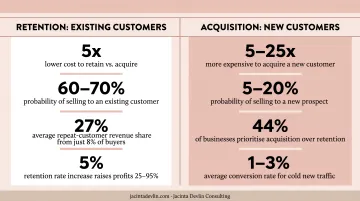
Shopify reports that loyal ecommerce customers are just 21% of your customer base but generate 44% of revenue and 46% of orders. HBR's foundational research shows acquiring a new customer costs 5–25x more than retaining an existing one.
This means retention marketing often delivers better ROI than new customer acquisition:
- VIP email sequences for past buyers
- Exclusive early access to new products
- Loyalty rewards for repeat purchases
- Segmented emails based on purchase history
Amanda Olson, a boutique owner coached by Jacinta Devlin, scaled from a $2,500/month goal to consistently hitting $10,000+ months. That result came from systems built to convert one-time buyers into repeat customers — not from chasing new acquisition every month.
Budget Allocation Sequence
- Email automation first — you own the list, there's no per-click cost, and returns compound over time
- SEO second — organic traffic that builds without ongoing spend once it ranks
- Organic social third — use it to build audience and trust before you put a dollar behind ads
- Paid advertising last, once your funnel already converts — ads should amplify results, not create them from scratch
2026 Ecommerce Marketing Trends Women-Owned Brands Must Know
AI Is a Content Production Equalizer
Nearly 60% of small businesses now use AI for business operations, according to the US Chamber of Commerce. For solo and small-team ecommerce operators, AI tools allow production of product descriptions, email sequences, SEO blog posts, and social captions at a pace that previously required a full marketing team.
The brands winning with AI are those using it to amplify their authentic voice — not replace it. AI output that matches your brand voice converts. Generic, template-sounding content doesn't.
Short-Form Video Is the Primary Discovery Channel
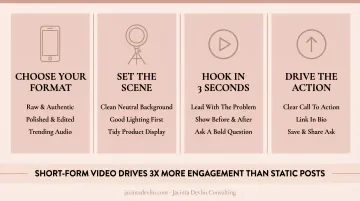
TikTok, Instagram Reels, and YouTube Shorts are where consumers discover products in fashion, beauty, lifestyle, and home goods — categories where women-owned brands are heavily represented. Authentic, lo-fi video consistently outperforms polished ads because it aligns with how platform algorithms actually reward engagement.
High-performing content formats in these categories include:
- Founder showing and explaining products on camera
- Behind-the-scenes footage of packing orders or sourcing
- Styling tutorials and "how to wear/use" walkthroughs
- Honest reviews and unboxings from real customers
TikTok Shop is one channel to watch closely — US GMV reached $15.1 billion in 2025, up 68% year over year. The purchase journey on TikTok — discover, trust, buy — maps directly to the social selling flywheel women entrepreneurs already do well.
Mobile-First Is Non-Negotiable
Shopify reports mobile ecommerce conversion now averages 2.41% versus 2.05% on desktop — and the majority of ecommerce traffic comes from mobile. A slow checkout, non-mobile-friendly product page, or complicated payment process kills conversion before it happens.
Quick audit: Purchase something from your own store on your phone right now. Count every tap, every load delay, every point of friction. That friction is lost revenue.
How to Build Your Ecommerce Marketing Strategy From Scratch
Step 1 — Define Goals and Audience Before Choosing Channels
Strategy starts with knowing exactly who you're selling to and what revenue milestone you're building toward. Vague goals produce scattered effort. "Grow my brand" sends you in twelve directions at once. "Reach $10K/month in 90 days" forces you to prioritize.
Use a SMART goal framework: Specific, Measurable, Achievable, Relevant, Time-bound. Once you know the goal, the channel choice follows logically — you're not guessing, you're engineering.
Step 2 — Build the Foundation Before Scaling
The sequence that works:
- Optimize product pages and your website for conversion.
- Build an email list with a compelling lead magnet.
- Establish one primary social channel with consistent content.
- Use paid advertising only after these fundamentals are in place.
The most common ecommerce marketing mistake is running paid ads before the foundation is ready to convert that traffic. You're paying to send people to a leaky bucket.
Step 3 — Measure, Learn, and Adjust
The brands that grow fastest aren't the ones who spend the most. They measure consistently — email open and click rates, website conversion rate, social engagement, revenue by channel — and make decisions from data rather than assumptions.
Real-time analytics eliminate guesswork. They also make the 80/20 rule actionable: once you can see which 20% of your activity drives 80% of your results, you know exactly where to reinvest.
For women ready to accelerate this process with expert guidance, Jacinta Devlin Consulting builds custom strategy plans around your specific business — not a course or template designed for someone else. Book your free 15-minute discovery call to see how a custom strategy can accelerate your growth.
Frequently Asked Questions
What is a digital marketing strategy for ecommerce?
A digital marketing strategy for ecommerce maps out which channels — SEO, email, social media, paid ads — you'll use to reach buyers and turn them into customers. The key word is "your": it should be built around your specific audience and revenue goals, not copied from a brand with a different model or budget.
What is the 80/20 rule in ecommerce?
Roughly 80% of your ecommerce revenue comes from 20% of your efforts — your most loyal customers, best-performing products, and highest-converting channels. Smart brands use analytics to find that 20% and double down on it instead of spreading effort thin across everything.
What is the 3-3-3 rule in ecommerce marketing?
The 3-3-3 rule is a focus framework: craft 3 key messages, target 3 audience segments, and track 3 metrics per campaign. For small brands especially, that constraint prevents the trap of trying to measure everything and acting on nothing.
What social media platforms work best for women-owned ecommerce brands in 2026?
Instagram and TikTok lead for product discovery in lifestyle, fashion, and beauty — the categories where women-owned brands are most concentrated. Facebook still performs well for community building and reaching buyers over 40. Picking one or two platforms and showing up consistently beats a scattered presence across five.
How do I market my women-owned ecommerce brand with a limited budget?
Start with owned channels: build an email list with a lead magnet and optimize your site and product pages for search. Both compound over time with no per-click cost. Once organic channels are producing results, use paid advertising to scale what's already working — not to compensate for a foundation that isn't converting yet.