

Introduction
You have a great product. You're posting consistently. But sales are inconsistent, and you can't figure out why.
Here's what's usually happening: the traffic exists, but there's no systematic path moving a browser into a buyer. In working with hundreds of women selling physical products online, the same problem shows up repeatedly — traffic going to pages that weren't built to convert, and no clear answer for why the numbers don't add up.
A physical product sales funnel isn't just a product page with a "Buy Now" button. It's a structured sequence that addresses the specific objections, trust gaps, and decision triggers unique to someone purchasing something they can't touch, try on, or instantly download.
Copying a digital product funnel template — or any generic funnel — is one of the most expensive mistakes physical product sellers make.
This guide covers exactly how to build a funnel that works for physical products: the right funnel model for your price point, the five-step build process, the variables that actually drive conversions, and the mistakes that kill results before they show up.
Key Takeaways
- Physical product funnels must handle shipping costs, quality uncertainty, and brand trust — friction points digital funnels rarely face
- The Tripwire funnel works best for products under $100; the Lead Magnet funnel is better for higher-ticket or considered purchases
- 70.22% of online shopping carts are abandoned — most of that loss is recoverable with the right funnel structure
- Post-purchase sequences are where most physical product sellers leave the most revenue uncaptured
- Optimizing an existing funnel outperforms launching new ones — test one variable at a time
How a Physical Product Sales Funnel Differs from a Digital Product Funnel
Digital products offer instant gratification. Someone buys, downloads, and starts using within minutes — the trust barrier is lower because the risk of waiting, receiving something damaged, or getting the wrong size simply doesn't exist.
With physical products, your buyer has to trust that an item they cannot hold will match the photos, arrive on time, and be worth the total cost — including whatever shipping fee shows up at checkout. That's a much bigger ask.
The Unique Objections Physical Product Buyers Face
At every stage of a physical product funnel, buyers are running silent calculations:
- Shipping costs — 39% of shoppers abandon carts specifically because extra costs like shipping and fees are too high, and another 21% abandon because delivery was too slow
- Product quality uncertainty — without the ability to touch or try the product, buyers rely entirely on photos, reviews, and descriptions
- Return policy concerns — 15% abandon carts because they find the return policy unsatisfactory
- Brand unfamiliarity — a buyer who's never heard of you needs more than a good product photo to hand over their credit card
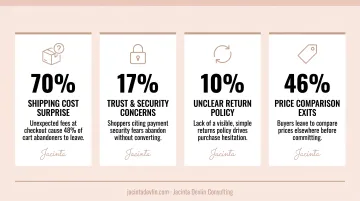
These objections don't disappear if you ignore them. They show up as abandoned carts, low conversion rates, and buyers who visit your page multiple times but never purchase. The goal of your funnel is to answer each objection before your buyer even has to ask.
The Logistics Dimension
Physical product funnels have to account for real-world constraints that digital sellers never face. These logistics directly shape what your funnel can promise:
- Inventory availability — scarcity urgency only works if it's real; false "only 2 left" claims erode trust fast
- Fulfillment timelines — your checkout messaging needs to reflect actual ship times, not aspirational ones
- Return handling — a clear, easy return policy reduces pre-purchase hesitation and post-purchase disputes
A funnel that promises two-day shipping when your fulfillment takes a week is a trust-killer that no email sequence can fully repair.
Types of Sales Funnels for Physical Products
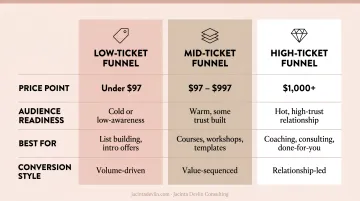
No single funnel model works for every product. The right choice depends on your price point, how familiar buyers are with your brand, and how much consideration your product typically requires.
Tripwire Funnel
The Tripwire funnel starts with a low-cost, high-value offer — typically between $5 and $50 — to convert a cold buyer into a paying customer with minimal risk. Once that first transaction is complete, upsells and order bumps increase the total order value.
This model works well for:
- Consumable products (candles, beauty, food)
- Multi-product stores where a gateway item introduces buyers to a broader catalog
- Brands working to break through first-purchase hesitation with cold audiences
BigCommerce research found that upselling and cross-selling can generate 42% more income from existing buyers, which is why the Tripwire model performs well even when the initial margin on the front-end offer is thin.
Lead Magnet Funnel
This model leads with a free, genuinely useful resource — a style guide, a lookbook, a product sample, or a discount code — in exchange for an email address. A nurture sequence then builds trust and introduces the product over several touchpoints before asking for the sale.
Best suited for:
- Products priced at $100 or more
- Items with a longer consideration window (premium fashion, specialty home goods, skincare)
- New brands where buyers need to understand the story before they buy
E-Commerce Direct Funnel
The Direct Funnel skips the nurture phase entirely — traffic goes straight to an optimized product or sales page built around strong social proof and a streamlined checkout. There are fewer steps between click and purchase, which is exactly the point.
This works best when:
- Your brand already has name recognition or strong reviews
- Buyers are actively searching for what you sell
- You're running retargeting ads to warm audiences who've already seen your brand
Without those conditions in place, a Direct Funnel sends cold traffic to a page that isn't ready to convert.
How to Create a Sales Funnel for Physical Products
Step 1: Define Your Audience and Funnel Strategy
Before you build a single page, get specific about who you're selling to. Not "women who love fashion" — but "busy moms who want to feel put-together without spending an hour getting dressed." The more precisely you can describe the specific person and the specific problem your product solves, the more every page of the funnel will resonate.
Do the research before you build anything:
- Interview existing customers about what triggered their purchase
- Read your social media comments and DMs for unfiltered buyer language
- Dig into competitor reviews to see what customers say they needed and got
- Identify the exact moment that sends someone searching for your product
Set measurable goals before you launch:
- Target landing page conversion rate
- Average order value
- Number of new customers per month needed to hit your revenue goal
Without these numbers, you can't diagnose what's working or what needs to change. This pre-build clarity is where Jacinta Devlin's 12-Week Business Launch Program starts with every physical product client. Strategy and messaging have to be solid before a single page gets built.
Step 2: Build Your Lead Capture or Awareness Entry Point
Your top-of-funnel entry point is either a lead magnet landing page or a direct social ad that routes to a product page. Either way, the page has to earn attention fast.
A high-converting landing page for physical products includes:
- A pain-point-driven headline (not a product description)
- A clear, compelling offer with minimal friction to opt in or buy
- Social proof from real customers — photos, not just text
- One obvious next action (not three competing buttons)
Social media is where most physical product buyers first discover brands. HubSpot's 2024 Consumer Trends Report found that social media was the #1 product discovery channel, with 33% of consumers discovering a new product on social within the previous three months. On Instagram, TikTok, and Facebook specifically, content that shows the product solving a real, relatable problem consistently outperforms straightforward product pitches at this stage.
Short-form video drives this. Bazaarvoice reports that short-form video content influences buying choices for over 46% of shoppers — which is why Reels and TikToks showing your product in a real-life context are more effective top-of-funnel assets than polished ad creative.
Step 3: Set Up Your Offer, Checkout Flow, and Order Maximizers
This is where most physical product funnels quietly bleed revenue — and most sellers never notice.
Your product or checkout page needs:
- High-quality photos from multiple angles
- Customer photo and video testimonials (not just text reviews)
- Shipping timelines displayed clearly — not hidden until checkout
- A visible money-back guarantee or return policy
- Pricing without surprise fees
On shipping specifically: showing a slightly higher product price with free shipping often outperforms a lower price with a shipping fee added at checkout. Research shows 14% of shoppers abandon carts simply because they can't calculate the total order cost upfront. Address shipping costs on the product page — not at the checkout screen.
Order maximizers that work for physical product funnels:
- Add an order bump at checkout: a low-cost, relevant add-on the customer can grab with one click (a boutique selling a dress adds a matching belt for $18)
- Trigger a one-click upsell after purchase: a complementary or higher-value item that requires no new payment entry
Devlin Consulting builds both order bump pages and post-purchase upsell flows as part of its Done-For-You funnel builds — typically on Shopify for boutique and product brand clients, with ThriveCart or ClickFunnels for more complex checkout setups.
Step 4: Build an Email Nurture and Post-Purchase Sequence
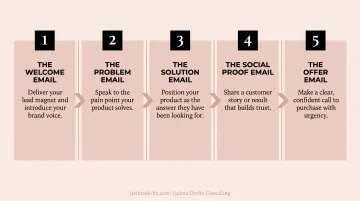
For prospects who opted in but haven't purchased, the sequence looks like this:
- Welcome email — brand story, values, what to expect
- Education emails — tips tied to the product's benefits
- Social proof emails — customer results, photos, and reviews
- Objection-handling email — addressing price, shipping, or quality concerns directly
- Urgency email — a genuine deadline or offer (not a fake countdown)
Email outperforms social as a conversion channel. Mailchimp's ecommerce email benchmarks show an average open rate of 29.81% and click rate of 1.74% — and when the sequence is built and segmented correctly, conversion rates run significantly higher than anything organic social can deliver.
For post-purchase, the sequence is where the real relationship gets built — and where most sellers skip the easy revenue:
- Order confirmation with clear shipping timeline
- Proactive delivery updates
- Usage tips or styling ideas
- Review or UGC request
- Cross-sell or loyalty offer for a related product
Jacinta's team builds and installs complete email sequences — welcome, nurture, sales, abandoned cart, post-purchase, and loyalty — primarily on Flodesk (her recommended platform) with Klaviyo fully supported for Shopify boutique integrations. Lisa K. of Fleur de Lis Boutique Florida went from launch day to $100,000+ in year one using this exact system.
Step 5: Track, Test, and Optimize
Four metrics every physical product seller needs to track:
| Metric | Industry Benchmark |
|---|---|
| Landing page conversion rate | 4.2% median; 11.4%+ top quartile (Unbounce) |
| Email open rate | ~29.81% for ecommerce (Mailchimp) |
| Cart abandonment rate | ~70% average (Baymard) |
| LTV:CAC ratio | 3:1 minimum; 4:1+ is a healthy target |
A/B test one element at a time — the headline, the email subject line, the product page layout, or the checkout button. Run one variable per test and let the data tell you what to keep. The most profitable move at this stage is almost always optimizing what you already have, not starting over with something new.
Key Variables That Determine Whether Your Funnel Converts
Two sellers can follow the same funnel structure and see completely different results. The gap comes down to four variables most sellers underestimate — and all four are within your control.
Shipping and Fulfillment Transparency
Shipping is one of the most predictable conversion killers in physical product funnels. Baymard's research found that 64% of users looked for shipping costs on the product page before adding to cart , yet 43% of sites don't display them until checkout. Put shipping costs and timelines on the product page. Don't make buyers discover them at the last step.
Trust Signals and Social Proof
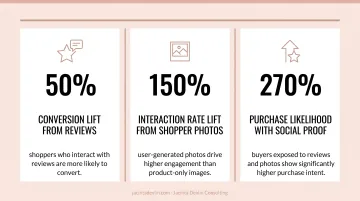
Physical product buyers can't try before they buy, so social proof does the job that a fitting room or product sample would otherwise do. The highest-converting trust signals for physical products:
- Customer photos wearing or using the product
- Video testimonials showing real results
- Visible return policy (not buried in the footer)
- Security badges at checkout
PowerReviews found that visitors who interact with ratings and reviews convert at a rate 108.6% higher than average, and visitors who interact with customer-submitted photos convert at 103.9% higher. Even 10 reviews can lift conversion by 45%.
Audience-Message Match
Broad targeting kills conversion. Compare these two audiences:
- ❌ "Women aged 25–45 who love fashion"
- ✅ "Busy moms who want to feel put-together in under 10 minutes"
The second one converts. Specificity in your headlines, product descriptions, and email copy is the single most controllable conversion lever you have.
Mobile Experience
Mobile drove 77% of global retail ecommerce visits and 56% of total retail revenue in 2024, and mobile cart abandonment sits at 80.45% , higher than any other device. A Deloitte study found that a 0.1-second improvement in mobile page speed produced an 8.4% increase in retail conversion rates.
Test every page of your funnel on your phone before it goes live. Not a preview : your actual phone, on a cellular connection.
Common Mistakes to Avoid When Building a Physical Product Sales Funnel
Build around the buyer, not the product — Messaging what the product is instead of what problem it solves for a specific person is the #1 reason funnels underperform. Skip the audience research and every stage falls flat.
The sale is not the finish line — Repeat buyers and referrals generate the highest-margin revenue in any product business. A weak post-purchase sequence leaves all of that on the table.
Overcomplicating before the funnel is proven — Layering upsell sequences, automations, and multiple product variations onto an untested funnel makes it nearly impossible to spot what's not working. Build one clean funnel, get it converting profitably, then add complexity.
Copying competitor funnels without understanding the context — A funnel built for a supplements brand won't work the same way for a boutique clothing seller. Audience psychology, price sensitivity, and trust barriers are entirely different. Use competitor research for inspiration, not a blueprint.
Frequently Asked Questions
How is a sales funnel for physical products different from one for digital products?
Physical product buyers face trust barriers that digital buyers rarely encounter — shipping costs, quality uncertainty, and return policy concerns. This requires more trust-building touchpoints, longer nurture sequences, and explicit objection-handling at every funnel stage rather than a simple opt-in-to-offer sequence.
What type of sales funnel works best for low-cost physical products?
The Tripwire funnel is typically the most effective for products priced under $100. It converts cold buyers with a low-risk initial offer and uses order bumps and one-click upsells to increase total order value without a lengthy nurture sequence.
How do I drive traffic to my physical product sales funnel?
The most effective sources for physical product sellers are organic social media (Instagram Reels, TikTok, Facebook groups), paid social ads targeting a specific buyer persona, and email marketing to an existing list.
Do I need expensive software to build a physical product sales funnel?
No. A Shopify store paired with an email marketing platform like Flodesk covers the core infrastructure most physical product sellers need to start. Strategy and offer quality matter far more than platform choice. Don't stall your launch searching for the perfect tool.
How long does it take to see results from a physical product sales funnel?
Enough data to begin optimizing typically comes within 30–60 days of consistent traffic. A profitable, stable funnel usually takes 3–6 months of testing and iteration.
How do I handle returns and fulfillment within my sales funnel?
Address return policies and fulfillment timelines transparently on the product page, at checkout, and in the post-purchase email sequence. A clear, low-friction return policy reduces perceived risk upfront, which increases initial conversion rates — not just post-purchase complaints.