
Many women founders respond to stalled growth by doing more: more posting, more content, more ads. Without a strategic foundation underneath that activity, the result is high effort with low return. According to a Lucidpress study, consistent branding can increase revenue by up to 33% — but consistency requires a strategy to be consistent with.
This article covers what brand strategy consulting actually means for women-owned startups, why it matters at every stage of growth, what the process looks like in practice, and how to find the right consultant to build it.
Key Takeaways
- Brand strategy is your positioning, messaging, and customer clarity — not your logo or color palette
- Unclear brand strategy causes wrong-fit clients, low conversions, and pricing confidence problems
- 14.2 million women-owned businesses compete in the U.S. — no distinct position means competing on price alone
- Brand strategy gaps hit hardest at the $500–$5,000/month stage, but create a ceiling at every level
- Women who replace templates with a strategy built for their business break through — clients have scaled from sub-$500 to consistent $5k+ months
What Brand Strategy Consulting Actually Means
The most common misconception about brand strategy: it's a logo, a color palette, or an Instagram aesthetic. Those are brand identity — the visual expression of strategy. Strategy is what comes first.
Brand strategy is the foundational framework that defines:
- How your business is positioned in the market
- Why a customer should choose you over every alternative
- Who your most likely buyer actually is
- How your message is communicated consistently across every platform and sales conversation
Strategy vs. Tactics: The Distinction That Matters
Marketing tactics — content, ads, email campaigns — drive traffic. Brand strategy determines whether that traffic converts. You can run a perfect Facebook ad campaign and still see dismal results if the message it drives people toward is unclear, generic, or aimed at the wrong customer.
Strategy shapes everything downstream. Pricing communication, offer framing, content approach, sales conversations — all of it flows from a clear strategic foundation. Skip it, and you'll keep generating traffic that doesn't buy.
What Brand Strategy Consulting Actually Delivers
So what does a brand strategy engagement actually produce? Concrete deliverables your business can act on immediately:
- Defines where your brand sits in the market — and why that position is ownable
- Documents your target customer with enough specificity to write copy that stops them mid-scroll
- Builds a value proposition around the transformation you create, not just the features of your offer
- Creates a messaging framework that works across your website, bio, sales calls, and DMs
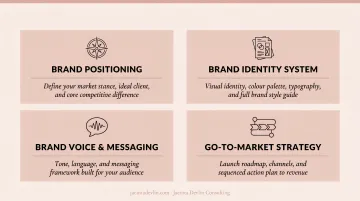
At Jacinta Devlin Consulting, this work is embedded directly into the Business Launch Program and available as a standalone rebrand engagement for established businesses — built specifically around each client's business model and market, not adapted from a one-size-fits-all framework.
Why Women-Owned Startups Need Brand Strategy From Day One
The scale of the market makes differentiation urgent. The U.S. Census Bureau reports 14.2 million women-owned businesses in the U.S., generating $2.8 trillion in total receipts. Women-owned businesses account for 22.9% of all employer firms. That's not a niche — it's a highly competitive landscape where looking and sounding like everyone else is fatal.
The Saturation Problem
Social selling and ecommerce make this especially clear. The Direct Selling Association reports 5.4 million U.S. direct sellers, 73% of them female, operating in a market generating $34.7 billion in annual retail sales. Add to that the fact that U.S. social commerce sales are projected to hit $87 billion in 2025 — and you have an enormous number of women selling similar products through similar channels.
Without a clear and distinct brand position, the default competition becomes price. That's a race no founder wins.
The Growth Ceiling Pattern
At a certain revenue level — often between $2,500 and $5,000 per month — a business stops growing not because the founder isn't working hard enough, but because the brand underneath can't support the next stage.
At Jacinta Devlin Consulting, this pattern shows up consistently. Joy W. arrived earning $500 a month across her businesses. After brand and strategy work, she scaled to consistent $5,000+ months and surpassed her previous full annual income in just six months. Amanda O. entered with a goal of $2,500/month and reached $10,000+ months.
The bottleneck in both cases wasn't effort — it was the absence of a strategic brand foundation.
The "Trying to Appeal to Everyone" Trap
This is especially common for relationship-driven businesses — coaches, direct sellers, boutique owners, service providers. When your offer could theoretically help anyone, the instinct is to write messaging that speaks to everyone. The result is messaging that converts no one.
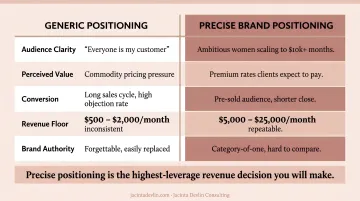
Brand strategy forces a level of specificity that broad messaging never can. When you know exactly who you're talking to, your content stops blending in — and your ideal buyer starts paying attention. That shift, from generic to precise, is often what separates founders who plateau at $3k months from those who break through to $10k and beyond.
The Core Components of a Brand Strategy That Drives Revenue
Brand Positioning
Positioning is the specific space your brand occupies in your customer's mind relative to every alternative. A well-defined position answers three questions:
- Why you?
- Why now?
- Why not the competitor?
Weak positioning sounds like: "I help women feel confident and empowered." Hundreds of brands say this.
Strong positioning sounds like: "I help women in direct sales build the team infrastructure and online presence that takes them from part-time income to full-time freedom in 12 months." Specific. Ownable. Differentiating.
Target Audience Clarity
"Women aged 25–45 who want to grow their business" is not an Ideal Customer Profile. That describes roughly half the adult female population.
A genuinely specific customer profile includes what she struggles with right now, what she's already tried, what success looks like to her, and where she spends her time online. When you know exactly who you're talking to, your content, offers, and sales conversations become relevant by design — not by accident.
Brand Messaging Framework
Messaging is how positioning becomes language. It's the words on your website homepage, in your Instagram bio, during a discovery call, and in a DM response. Inconsistency across those touchpoints is one of the fastest ways to lose credibility with potential buyers.
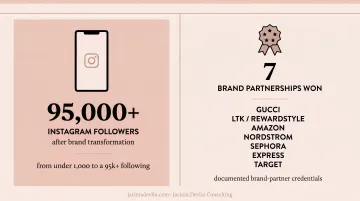
When Christina R. rebranded to @mybalancedstyle, she didn't just update her logo. She rebuilt her entire messaging foundation from the ground up. The result: growth from 13,000 to 95,000+ Instagram followers and five-figure brand deals with Walmart and QVC — outcomes that weren't possible when her brand position couldn't support them.
Value Proposition
Clear messaging sets the stage — but the value proposition is what closes the sale. For service-based and product-based founders alike, it must communicate the specific transformation a customer experiences, not a list of features. This matters most for coaches, consultants, and direct sellers whose offers are relationship-based.
A professional brand identity isn't just aesthetically satisfying. It directly influences willingness to pay, conversion rates on premium offers, and eligibility for brand partnerships. That's what separates a brand that attracts opportunities from one that has to chase them.
What the Brand Strategy Consulting Process Looks Like
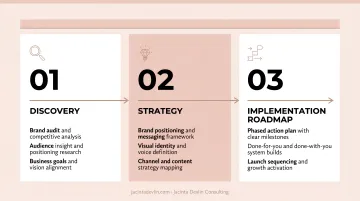
Discovery and Brand Audit
Every engagement begins with an honest assessment of where the business currently stands. This includes:
- What messaging exists and how the founder is currently perceived
- Where the gaps are between current perception and intended positioning
- What the competitive landscape looks like
- Which platform and channel mix makes sense for this specific business
At Jacinta Devlin Consulting, the discovery process starts with a free 15-minute call with Jacinta directly — not a junior associate. This shapes the entire strategic brief before any execution begins.
Strategy Development and Positioning Work
This is where the core brand strategy takes shape: positioning, messaging architecture, audience definition, and value proposition. The deliverables produced include:
- Brand vision and mission statements
- Brand positioning and messaging architecture
- Brand voice and tone guide
- Tagline development
- Market research and competitive audit
- A full brand style guide PDF for contractor handoff
The key distinction at Jacinta Devlin Consulting: every strategy is individualized to the specific business, not adapted from a course or template. As the program documentation states, there is "no cohort, no recorded curriculum dump, no copy-paste playbook."
Implementation Roadmap and Ongoing Iteration
Once strategy is defined, it translates into a prioritized action plan covering what content to create, which platforms to focus on, how to talk about offers, and how to show up consistently. Each coaching session closes with concrete next steps specific to that client's business.
That plan isn't static. As offers evolve and markets shift, it's worth revisiting and refining the strategy. Watch for these signals:
- Is the right customer responding?
- Are conversion rates improving?
- Does the brand still reflect where the business is heading?
Common Brand Strategy Mistakes Women Founders Make
Skipping Strategy and Going Straight to Tactics
Building a website, posting daily, and running ads without clear positioning means high activity with low return. "Your strategy for marketing right now is post and pray." Posting more is not the answer when the problem is strategic.
Copying a Competitor Instead of Building a Distinct Position
Modeling a brand after someone successful in your space means you end up looking like a lesser version of someone else — not the obvious choice. The goal isn't to replicate what already exists. It's to identify the white space: what actually sets your offer apart.
Signs you're in copy-cat territory:
- Your bio and messaging sound like everyone else in your niche
- You picked your brand colors because a competitor's palette "felt right"
- You struggle to explain why a buyer should choose you over the person you admire
A competitive audit — done before any positioning decisions — is what separates a distinct brand from a forgettable one.
Treating Brand-Building as a Design Project
Handing brand-building entirely to a graphic designer or social media manager produces beautiful assets with no strategy underneath. Design executes strategy. It can't replace it.
Logo, color palette, and typography should be built from a positioning framework — not created before one exists. At Jacinta Devlin Consulting, visual identity development always follows brand strategy work, not the other way around.
How to Choose a Brand Strategy Consultant Who Gets Your Vision
Look for Someone Who Has Built Businesses, Not Just Advised Them
There's a real difference between a consultant who has scaled her own business and one who has only worked in an advisory capacity. Jacinta Devlin, for example, built businesses across direct sales, ecommerce, and consulting before shifting to coaching — which means she can identify the real problem faster because she's lived it, not just studied it.
Demand Individualized Strategy, Not a Recycled Framework
Ask any potential consultant directly: is your process built around my business, or does every client go through the same curriculum? The answer matters. The right brand strategy consultant builds a plan around your specific audience, offers, and growth stage. If the answer involves a workbook designed for someone else, that's worth knowing before you sign anything.
Questions worth asking upfront:
- How do you customize your approach for different business models?
- Can you show me positioning work you've done for a client in my industry?
- What does your process look like in the first 30 days?
Verify a Track Record With Businesses Like Yours
Look for a consultant who has worked with founders in your industry or at your revenue stage. Ask for client results and examples of positioning work — not just testimonials about the experience. A consultant who specializes in women-owned startups will have context that a generalist won't. That familiarity with your market, your audience, and your specific growth challenges is what separates useful strategy from generic advice.
Frequently Asked Questions
What is the difference between brand strategy and brand identity?
Brand strategy is the foundational plan — positioning, messaging, audience definition, and value proposition. Brand identity is the visual and verbal expression of that strategy — logo, colors, typography, and tone of voice. Identity without strategy produces inconsistent, ineffective branding that looks polished but doesn't convert.
How early in my startup should I invest in brand strategy consulting?
Ideally before major marketing spend, a website build, or a product launch. That said, brand strategy consulting is equally valuable for businesses already generating revenue that have hit a growth ceiling — stalled growth is often the clearest signal that the underlying strategy needs attention.
Can brand strategy consulting actually help me make more money?
Yes — directly. When messaging is specific, positioning is distinct, and the right customer is clearly targeted, conversion rates improve, pricing confidence increases, and referrals become more consistent. Brand clarity is what turns marketing spend into actual sales.
How is brand strategy consulting different from hiring a marketing agency?
A marketing agency executes campaigns and tactics. Brand strategy consulting builds the strategic foundation those campaigns need to work. Strategy comes first; execution follows. Running campaigns without a strategic foundation wastes budget.
How do I know if my current brand strategy isn't working?
A few signals point directly to a weak brand foundation:
- Inconsistent month-to-month sales with no clear cause
- Constantly explaining what you do when you meet someone new
- Attracting customers who aren't a good fit
- Spending on marketing with little to show for it